A hotel bed isn’t just someplace to rest your head at night. A hotel room isn’t just a place to store luggage and a toothbrush. After touchdown, your hotel becomes the first point of contact to shape your journey. The first impression that sets the tone. One step into the lobby can make you giddy with anticipation—or send you into a spiral of regret.
Vacations are escapes from our daily lives. Taking us to places we’ve dreamed about, read about, coveted, and saved up for. That heart-pounding thump of wow, whoa, OMG, I can’t believe I’m in (insert: Morocco, Thailand, Japan, New York). The flip side? Oh no, ugh, gulp, ick, this is definitely not what I expected.
Harness the wow, whoa, and OMG, and carry them with you—along with your sunscreen and sunglasses. Tuck them into your backpack for that hike, bike ride, or camel ride. At the end of the day, your reward will be a cushy bed to sink into, a hot soak for tight muscles, a view to set your spirit free, and a trendy bar to craft your favorite cocktail.
Let’s explore some of the world’s most remarkable hotels. After all, it’s the gateway to your adventure.
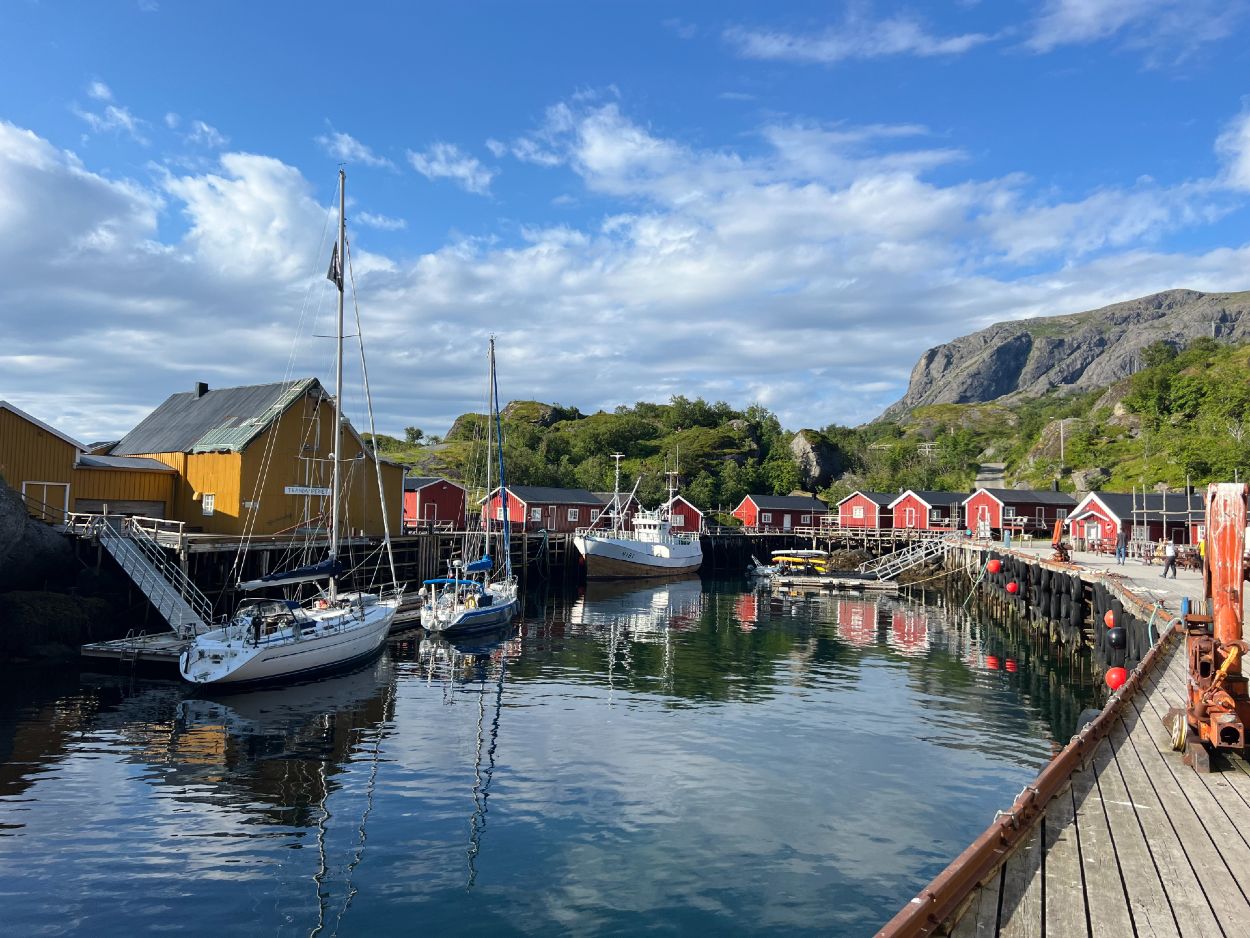
Nusfjord Village & Resort, Lofoten Islands, Norway
The Lofoten Islands, located just inside the Arctic Circle, are an archipelago of seven main islands bisected by glacial fjords. Travelers are rushing to this previously little-known Arctic destination because of its dramatic mountainscape, towering cliff walls, and deep, rocky fjords. Nusfjord Village & Resort sits at the end of a remote valley on one of these remote islands in the remote Arctic Circle. It doesn’t get more off the beaten path than Nusfjord.
Nusfjord was once a traditional fishing village, where fishermen spent the winter tackling the world’s toughest profession. (No, it isn’t travel writing.) That the soul of the village remains, along with nesting (endangered and protected) kittiwakes, the smithy, the General Store, the cod liver refinery, art gallery, and rorbus (traditional fishing cabins), is Nusfjord’s charm. And while tourists are free to roam this restored village by day, guests have it all to themselves come 5 pm. It’s then that I don my fluffy robe and slippers and slip into the sauna.
Their website states,“The earliest settlements in Nusfjord date from 425 BC. Our unique cultural heritage makes this fishing village one of Norway’s oldest and best-preserved. In Nusfjord’s golden age, over 1,500 fishermen lived in the rorbu cabins. Today, there are only 16 people who can call Nusfjord their permanent home.”
Why Go to Nusfjord Village?
Adventure, adventure, adventure. Views to knock the socks off even the most intrepid traveler. Hike, bike, kayak, RIB, SUP, surf, repeat. Nusjord Resort has it all (with Northern Lights streaking the winter skies). A spa and sauna with a window overlooking Arctic Circle views means never sacrificing a view for the sake of self-care.
What About The Rooms?
Ranging from one-bedroom rorbus to ones with several rooms, a living room, a kitchenette, and a roaring fireplace, Nusfjord has added all the creature comforts those frozen fishermen had to live without. Original timber-clad walls, soft woolen blankets, Nespresso makers, tea kettles, and high-end amenities abound.
For those who want to splurge, reserve Dahlgården, the home of the original landowner, Hans Dahl, and the most exclusive accommodation at Nusfjord. The House of Dahl is a private retreat in the village, offering views of the mountains and the sea and beautiful historic furnishings befitting a wealthy landowner.
And The Food?
Nusfjord Village & Resort has three dining options. Restaurant Karoline is the signature spot, with dark wooden walls, windows overlooking the harbor, and an ambience that has guests relaxed and cozy before they’re even seated. Karoline serves traditional Arctic fare like cod with smoked beurre blanc,Jerusalem artichoke with bleak roe, and pickled green apple, and crisp pork belly with beets, orange, and a touch of aquavit.
Oriana Taverna is a firelit pizza and wine bar located in what was once a whisky cellar. Serving everything from Margherita and Parma pies to more decadent options topped with champignons, chanterelles, and truffle oil, it’s a nice contrast to the more refined dishes at Karoline.
Lastly, find Landhandleriet Café tucked away in the whimsical old General Store, dating back to 1907. Grab a table with a view and choose from a limited menu featuring simmering fish soup, homemade waffles, and various baked goods—a great option for lunch or breakfast.
Nusfjord’s Best Photo Op
There are no bad shots of Nusfjord Village & Resort, just one picture-postcard after another. But for the best overview of the property, head to the upper parking lot. An unlikely and easily overlooked spot, it’s here where Nusfjord Village visually reigns.
The Lofoten Islands Are Waiting
Until not long ago, the Lofoten Islands were virtually unknown to the average traveler. But with the help of Instagram and TikTok, tourism is growing at a fast and furious pace. Lodgings here are finite. Book a year out if you want your first-choice accommodation.
Nusfjord’s prime and central location in the Lofoten Islands makes it a fantastic base for exploring the entire archipelago. It’s an authentic, historic gem reimagined for the modern-day traveler. For those seeking a bit of hygge (Scandi-comfort realized through candlelight, coziness, and sheer ambience) on their adventure, there’s no place better positioned to deliver it.
Intimate fishing cabins with plush down comforters, topped with piles of oversized pillows, make Nusfjord so much more than a place to rest your head.
Don’t forget to ask for a late check-out. You’ve earned it.
Our guide’s voice breaks the silence, even-toned, but with a noticeable sense of urgency. “We need to get back to the Zodiacs—there’s been a polar bear sighting.” Twenty-five SLRs freeze mid-click. We file back along the rocky shoreline towards the boats, an energy in our steps equal parts thrill and fear.
It’s one thing to read about polar bears in National Geographic. It’s quite another to come face-to-face with one on his home turf.
My eyes scan the shore, the sea, and past the huddle of walruses we haven’t had nearly enough time with. I don’t see a bear, and quietly wonder if the guides are being overly cautious. Later, I’ll learn that a polar bear can catch the scent of a seal from miles away.
I don’t doubt them again.
I slide onto the black neoprene hull and glance back at the heap of blubbering, grunting, and burrowing walruses I’ve come so far to see. I pray to the wildlife gods this isn’t our only encounter with them. But in the Arctic, nothing is guaranteed. Each day reveals something different, whether it’s a sleek minke whale swimming alongside the ship, an Arctic fox playing with her newborn cubs, or a too-close-for-comfort call with a tumbling iceberg.
Back on the ship, I grab my binoculars and head to the bow, ready to spot the elusive bear who so rudely interrupted our first polar landing.
The Poles are Magnetic
“Didn’t you just go to Antarctica?” my friend asks over coffee. Slightly embarrassed, I say, “Yes… Two years ago. But this time I’m going to the Arctic. You know, the land of polar bears and Santa Claus?” She laughs, “Of course you are.”
What’s funny is that someone who loathes cold weather, cold water, even iced coffee, chooses to spend so much time in the chilliest places on Earth. The irony isn’t lost on me. I’m obsessed with all things glacial. I binge-watch Frozen Planet.I dream about whales.
There’s something magnetic about the poles—the barren and remote landscapes, the improbable wildlife, and the lack of infrastructure. There’s the added element of danger; this is the home of the world’s largest land-dwelling carnivore, mind you. The underlying thrill is addictive.
So back to the tundra I go. This time, to Svalbard, an archipelago located deep within the Arctic Circle, accompanied by my 21-year-old daughter and 80-year-old stepfather. Spanning three generations, each of us is keen to experience the Arctic in our own way.
This trip will not only change me, it will teach me. I’ll learn the differences between auks and murres. I’ll hike to historical trapper huts whose rickety wooden shelves are still lined with empty bottles of whiskey. I’ll linger in the glow of the Midnight Sun. Stepping out of my ordinary life, even if briefly, I’ll see the world—and myself—a little differently.
Who Goes To The Arctic Circle?
According to The Washington Post, approximately 100,000 tourists explored the Arctic via cruise ships and expeditions last year. The rise in popularity is attributed to several factors, including retreating sea ice, which has opened up more navigable routes, as well as an increased interest in traveling to extreme destinations. Melting glaciers are surely significant drivers—the desire to see this remote part of the world before the ice is gone.
Nearly two-thirds of these visitors arrive in Svalbard, which was officially recognized as a Norwegian territory in 1920. Svalbard comprises over 100 islands, but the majority of the archipelago’s land is on its four largest islands: Spitsbergen, Nordaustlandet, Edgeøya, and Barentsøya.
The town of Longyearbyen is on Spitsbergen, the largest island. It’s not only the northernmost settlement on the planet but also one of the most isolated. Having arrived here on a flight from Helsinki via London, via Washington DC, it’s our gateway to the Arctic.
Have you read this book?
No? Then stop right here and place your order. I’ll wait. It’s a must-read, whether or not you’re interested obsessed with the Arctic. Every character is memorable and lovable, especially the dog.
It’s mid-June, and our expedition aligns with the Midnight Sun, a phenomenon that occurs between May and August, when daylight is experienced around the clock. Our trip also coincides with the summer solstice, the longest day of the year. This seems entirely redundant in the Arctic, where the longest day of the year lasts four months.
The perks of never-ending days need little explanation. Never-ending days mean there’s no time we can’t spot wildlife or admire snow-streaked mountains. Continuous daylight allows for longer excursions and more hours to photograph scenery.
The downsides of endless days are few—and are easily overcome with blackout shades and a silk eye mask.
Don’t Call it a Cruise
Maybe unfairly, the term cruise conjures up images of uninspired breakfast buffets, cringey late-night shows, and rounds of bingo. Every time someone asks, “When’s your cruise to the Arctic?” I say, “It’s not a cruise, it’s an expedition!” The differences between Quark’s Ultramarine and a Princess Cruise are as wide as the Barents Sea.
For one, our ship is purpose-built for polar travel, not a boat that was once used to ferry senior citizens from Miami to the Bahamas circa 1982. A purpose-built ship means the motorized Zodiac boats, which take us on our twice-daily excursions, are located at sea level so that no time is wasted getting out on the water. And because our ship is fully equipped with the latest technology for polar travel, it can reach destinations that other ships can’t.
Additionally, Ultramarine prioritizes sustainability and conservation. The ship is paperless, is equipped with high-tech machines that clean our muck boots after each polar landing, and is committed to eliminating single-use plastic.
Guests are provided with reusable water bottles, and filling stations are located on every deck. They support polar conservation, donate hundreds of thousands of dollars towards polar research, and partner with local communities and organizations.
The Ultramarine is badass.
Meeting Our Arctic Team
My stepfather and I are familiar with the ship, having taken the Ultramarine to Antarctica. We know what to expect: amazing tales of adventure, knowledgeable guides, freshly cooked meals in two panoramic-windowed restaurants, the best sauna on the sea, and modern rooms with heated bathroom floors, oversized flatscreen TVs, and windows overlooking the beauty of the High Arctic.
But this is Ella’s first time on board. Beyond the wildlife, I want her to meet the expedition team. I’m secretly relying on them to inspire her to a career beyond a cubicle on Lexington Avenue. To realize that not every college graduate is required to beeline to (New York, Chicago, Boston) within nanoseconds of receiving a degree. The world is wider than ever. A traditional office can wait.
Quark’s team includes experts in every field, spanning all ages and representing all parts of the world, from the islands of Washington State to the islands of New Zealand. They’ve circumnavigated Svalbard by sea kayak, photographed polar bears cuddling their cubs, and collectively covered thousands of nautical miles.
I’ve never seen a group of people so passionate about (pack ice, puffins, paddling, pinnipeds, polar history, polar bears, photography) as our expedition team. I don’t toss the word ‘passion’ around casually, but the Quark team embodies it. I want Ella to realize there is more than one way to work. More than one way to live.
The Wildlife Capital of the Arctic
Our journey begins in Longyearbyen and takes us clockwise around the island of Spitsbergen, ‘the wildlife capital of the Arctic.’ We tuck into bays and cruise along fjords, navigating our way north. Our voyage is dictated, first and foremost, by weather, which can change on a moment’s notice.
Sarah, our expedition leader, works in tandem with the captain, constantly making decisions, pivoting, and rerouting our course based on factors the passengers are blissfully unaware of. They want us to cross the bays and hike the mountains in the best conditions the Arctic can offer.
Spitsbergen lives up to its name, and our earlier evacuation leads to hours of polar bear viewing from the safety of the bow. Through scopes, binoculars, and zoom lenses, every passenger is on deck watching. Only two guests have brought zoom lenses powerful enough to capture the bear in any detail. I’m not one of them. My jealousy of their lenses borders on criminal.
In the Footsteps of the Polar Bear
The male bear we encounter lumbers along the base of the mountains. Twice, he rolls down the powdery slope like a six-year-old on a snow day. Eventually, he slips into the sea and swims miles across the channel. Once on the other side, he continues his journey over the mountain. I follow until he is fully out of sight, cursing my fuzzy polar bear photos. Yet, I’m enamoured nonetheless with this incredible moment.
Kayaking one morning, we see the massive footprints of a bear leading away from the water’s edge. I try to sound light and airy when I ask our guide, “How fresh are these tracks, do you think?” She shrugs.
I think back to our first sighting, when I learned these bears can swim for days without a break. This tidbit of knowledge brings a new intensity to the excursion. Who in the world thinks it’s a good idea to venture into polar bear country on a non-motorized plastic boat?
For the polar bear curious, there are rules governing how to observe them. This is for the safety of the polar bears, but I imagine we humans benefit, too. When sighted, a distance of at least 300 meters is strictly enforced.
However, this rule doesn’t apply when traveling through international waters, where ships will sometimes unknowingly pass a bear navigating drifting sea ice. No expensive zoom lenses are necessary for those lucky travelers who get a front row seat to the best show in the Arctic Circle.
Other Arctic Sightings
Ask most guests on board, and they’ll tell you they’re here first and foremost for the polar bears. While they are undoubtedly the biggest draw of the Arctic, there are many other amazing experiences to be had.
We see arctic foxes shedding their white winter coats to blend in with the gravel-gray mountains of summer. We see another walrus haul-out (yes, there is a wildlife god) blissfully sunbathing.
One hike, we spook a few Arctic reindeer, who, with their short legs and small, round heads, look cartoonish as they run circles around us. A circus of puffins flies past, their bulbous bodies an homage to their nickname, ‘flying potatoes.’
In Alkefjellet, living walls of birds dominate the landscape. The pungent smell of guano fills the air. Towering hundreds of feet above the sea, these bird cliffs are composed of massive columns formed by Jurassic-era geology. Every inch of the cliffs is alive with thousands of breeding pairs of kittiwakes, guillemots, and auks.
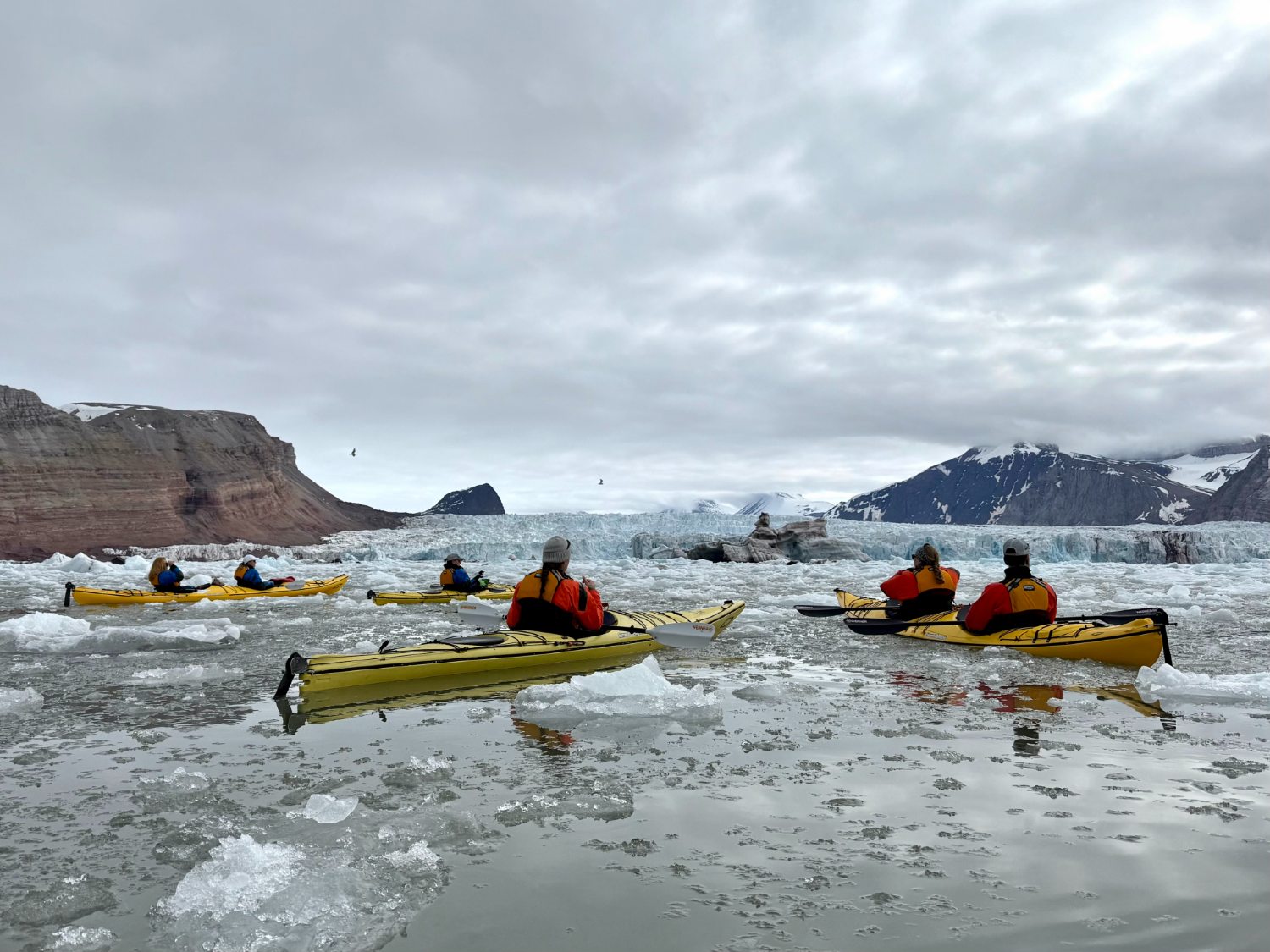
Our sea kayaking group drifts along the cliff walls. The cacaphony becomes ever more deafening the farther along the cliffs we paddle. The auks swoop so close that I instinctively duck, feeling the pressure of their powerful wings flapping against my head. A vicious fight breaks out between two territorial black guillemots. A ring seal plays hide-and-seek with our kayaking group. The Arctic teems with activity.
Snapshot: Life on the Ultramarine
Though our days are shaped by routine, our experiences are anything but. Around 7am, Sarah’s voice sings out over the PA system announcing breakfast—a highlight. All the meals are highlights, and that’s not only because I’m always hungry. There are omelettes made to order and an (inspired!) buffet with oodles of hearty delights that set me up for the day. By the second morning, the waiters already know my coffee order by heart.
During breakfast, Sarah tells us where we are. Why we don’t know our whereabouts is because the boat moves to a new location each night. It’s hard to explain what fun it is going to bed enveloped by one extraordinary landscape and waking up in another extraordinary one.
Sarah informs us which of the four excursion groups is heading out first. She lets the sea kayakers know their ready room meeting time and the departure times of the hiking groups. The schedule is a finely tuned machine—until it isn’t. This is the Arctic; anything can happen. But Sarah is on it.
Rick, Ella, and I are in the Kittywakes group. Sometimes we choose to sea kayak (a program limited to a select few who book early enough to get a coveted spot). Sometimes we choose to hike. Sea kayaking is a standout activity, an opportunity to be even closer to the sea and ice—a chance to work off buttermilk pancakes and brioche French toast.
By the time our morning excursion is over, it’s time for lunch, where, in addition to the buffet, there’s always a surprise waiting to satiate our hunger. That surprise can take the form of a taco bar, an Indian feast, or a colorful tower of sushi. No one goes hungry on the Ultramarine.
New Day, New Adventure
Before we can blink (or digest), it’s time for our second excursion. This time, the Reindeer group is first in the rotation, followed by the Kittywakes, Walruses, and Arctic Foxes. The inherent thrill of the unknown is what this trip is all about. I’m as giddy as a kid on Christmas morning.
What will I see today? A calving glacier? A bearded seal? Will I take a hike to one of the northernmost trappers’ lodges in the entire Arctic? The excursions last for 2-3 hours but pass by in the blink of an eye, kind of like Christmas morning.
Sleep comes hard and fast, despite the Midnight Sun. The Arctic is exhausting.
The Arctic is Transforming
They say transformative travel is trending. I’d argue that anyone who travels will change. Some destinations may be more extreme than others, but all travel encourages us to see the world (and our lives) from the outside in.
In the Arctic, the change feels urgent.
Travel fosters resilience, perspective, and connection. It connected my daughter and her grandfather when they shared a tandem kayak along the Lillihook Fjorden. It created bonds between me and Rick when we hiked a steep, snowy mountain towards a trio of grazing reindeer.
The connections continued both on and off the ship—between strangers who became friends due to shared wildlife sightings and a mutual love of adventure. Ella connected with the guides, many of whom were closer in age to her than me.
One fearless guide named Tara described her 72-day, unsupported sea kayaking expedition around the islands of Svalbard, during which she encountered 60 polar bears. Her story of endurance silenced every passenger, even the annoyingly chatty ones.
On the flip side, we heard from Gordo, our head of client services. He spoke about his experiences living in Longyearbyen for a year, during which he spent four months in complete darkness fending off polar bears and insanity. Gordo’s story had us roaring with laughter, and I wondered if his side hustle is stand-up comedy. It should be.
Polar Takeaways
We disembark. And even though the expedition has exceeded my expectations, I feel sad at the realization that this may be my only time here. It’s a greedy sadness. With eight hours to kill before boarding our first of three flights home, we spend them roaming Longyearbyen, visiting the Svalbard Museum, and getting an extended caffeine fix at the Husky Café, where reindeer meander among the tourists.
The museum’s glacier exhibits are made all the more compelling after having seen them up close. The receding ice is documented in a way that can’t be ignored. Like many things in life these days, I’m paralyzed by fear of not knowing how to help. If anything, these photographic reminders of climate change will encourage me to reconsider some aspects of my lifestyle.
Once home, I ask Ella her thoughts on the trip. I don’t smirk when she says she realized there were so many opportunities to work in unexpected places. She added, “And, visually, there was so much to see, both big and small, a place of contrasts.”
Each of us on board was given a window of opportunity to step outside of our regular lives and reset. To observe the effects of climate change in real time. I wonder if Ella’s generation will be the last to see the Arctic ice before it’s gone.
The Sound of Silence
I’m on the bow, my favorite place on the ship. Sarah’s voice breaks the silence, “Welcome to the furthest point the Ultramarine has ever ventured, 81° 23′ North. We’re approximately 500 miles from the North Pole.” I lean over the edge. The pack ice shatters as if in slow motion, creating mesmerizing patterns of white and blue. I stand still, listening to it crash and groan, watching it crack, humbled by the bleak landscape.
Out there, polar bears prowl the shifting ice searching for prey. Out there, icebergs tip, tumble, melt, and reshape. Out there, the Arctic transforms.
Up here, I do, too.
Planning your next adventure, but either don’t have the time or don’t know where to begin? Let me do the research for you. Click here to learn more with a complimentary discovery call.
Jamie Edwards Travel Coaching. My Research. Your Adventure.
Our RIB slices through Trollfjorden towards Svolvær, the scenic capital of the Lofoten Islands. Twelve of us instinctively lean left—as if we have some control over the heeling boat. The narrow fjord’s steep-sided, jagged mountains rise dramatically from the sea. The water swirling beneath me is a shade of blue I’ve never seen. Overhead, the sea eagles we met earlier turn back towards Raftsundet strait, realizing their midday snack is officially over. The trolls remain hidden.
As we get closer to the harbor, a stench hits me like a rogue wave. I look around. My face isn’t the only one scrunching in disgust. Our guide is watching. Is he smirking? The Brit behind me is the first to bite. “What’s that awful smell?” he asks. “Ahhhh,” Emil smiles and exhales slowly, deliberately. “That, my friend, is the smell… of money.”
Twelve heads turn in unison, baffled.
Where Are The Lofoten Islands?
I found the Lofoten Islands through my usual source of inspiration—Instagram. Those algorithms are eerily spot on, drawing me into little tiles of mesmerizing mountainscapes and fjords. I needed to know exactly where this magical place was and how soon I could get there.
The Lofoten Islands are in Northern Norway, I discovered, just inside the Arctic Circle.
Of course they are.
Factually speaking, the Lofoten Islands are an archipelago of seven main islands bisected by glacial fjords. By the numbers, they are about 100 miles long, over 3 billion years old, and have roughly 25,000 residents. The Midnight Sun reigns from late May to mid-July. Intriguing facts, Wikipedia, but I don’t need them to inspire my trip—Instagram beat you to it.
The Scandinavia Travel Boom
Scandinavia is on the cusp of a travel boom, partially as a reaction to the wildfires and raging heat from which the rest of Europe suffers. Some travelers are looking for more temperate climes. Others are seeking roads, or in this case, fjords less traveled—a response to overtourism plaguing countries like Italy, Spain, and Greece.
Nordic countries saw a surge in tourism last year, with Finland, Denmark, Sweden, and Norway reporting a record-breaking number of visitors. In Norway alone, nearly 17 million hotel nights were booked—a 3% increase from the previous year. Those numbers are expected to rise as more intrepid travelers view Scandinavia as the antidote to mainland Europe’s woes. But, the Lofoten Islands are remote even by Scandinavian standards.
It’s worth noting the emphasis on destinations yet to grace the covers of Travel+Leisure and Condé Nast Traveler. Travelers want bragging rights, to get to destinations first. If Scandinavia is the next travel hot spot, I want to get there first, too. I book my flights and ferries. Thank you, Meta. I’m on my way.
The Fish That Put Lofoten On The Map
“That smell is stockfish,” Emil continues. “Stockfish is Norway’s most important export—and has been for centuries. To us, the smell of drying cod is considered the smell of money.”
The Tørrfisk industry dates back to the Viking era. Tørrfisk (aka stockfish, or dried cod) was so lucrative that it lured over 30,000 fishermen to northern Norway each winter. Fishermen who endured the Arctic’s extreme and harrowing conditions to provide for their families back home.
PC: Ruramos
Once caught, the codfish, with their wiry whiskers and mouths agape, are placed on large pyramid-shaped wooden racks called fiskjehell. Norwegian winters are windy and well below freezing, thus creating a natural preservation system for the fish to dry without rotting.
Fiskjehells are still used in the Lofoten Islands and can be seen (and detected sight unseen) in many seaside villages—a monument to the dedicated fishermen who endured Lofoten’s long, dark winters.
Stockfish’s Place on the Global Table
The smell of stockfish also reminds us of Lofoten’s importance in commercial fishing. Of all the European nations that import dried cod from Norway, Italy is the largest. Stockfish is the central ingredient in their famous dish, Stoccafisso Accomodato (stockfish stew). It’s also a staple of Nigerian cuisine, often used for stews and soups.
Stockfish adorns the menus of Lofoten restaurants, from fine dining at the Kitchen at the End of the World to Svinøya Rorbuer’s humble restaurant, Børsen. Travelers can experience the fish that built Lofoten with dishes like Tørrfisk Royal, cod stew with carrots, egg, butter, and bacon, and stockfish filleted with baked leeks, wild mushrooms, and kale.
The curious Brit quips, “I don’t see any fish, only empty racks.” Emil is ready. “The fish hang for three to four months,” he explains. “By May, about six million tons of cod hang in hjells, ready to be shipped. But, even when the racks are empty, the smell lingers.” Satisfied, the Brit settles.
The Fisherman’s Wife
Emil cuts the motor, and the silence is welcome. We’ve been careening around the fjord, feeding sea eagles and troll-hunting for hours. That’s when I see her. Standing poised and strong against the wind on a rocky promontory, she clutches a shawl around her neck with one hand and waves longingly with the other.
“That’s Fiskerkona,”Emil says, reading my mind. “The Fisherman’s Wife. She represents the resilience of the women left behind to raise families during their husband’s long absences. Many would never see their spouses again.” This poignant statue quiets the group—even the inquisitive Brit.
Turning Tradition into Luxury
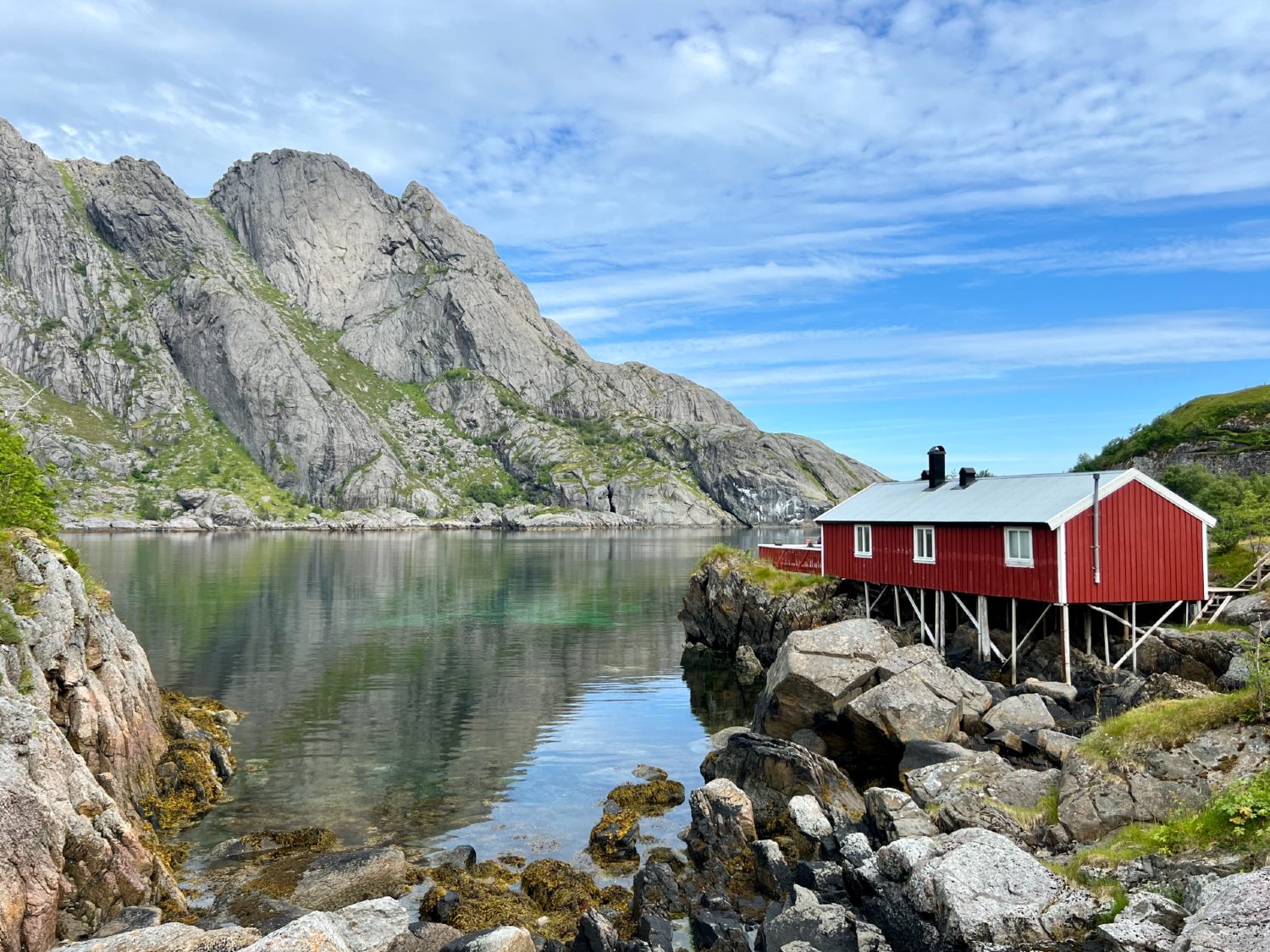
Thousands of fishermen traveled north each winter to hunt for Norway’s prized fish. They lived in rorbuer, traditional stilted, wooden huts. In Norwegian, ‘ror’ means row, and ‘bu’ means small house. Up to 12 fishermen shared each rorbu. Rorbuer were sheltered from the elements and divided into two parts, one for sleeping and one for gear. The ceilings were low, and the windows were small and inefficient. They had basic kitchenettes and uncomfortable beds. But, they provided what mattered most—direct and immediate access to their fishing boats.
These seaside cabins, many restored to their original red and yellow colors, have been retrofitted as tourist accommodations. Some, however, are retrofitted better than others. Rorbuer are an integral part of Lofoten’s history, giving visitors a chance to imagine life within the same four walls as Nordic fishermen, albeit in some cases, on 600-thread-count sheets, with rain showers and Nespresso machines.
Turning tradition into luxury is hard work. Not as hard as fishing for cod in the Arctic, but hard nonetheless. Although updated with modern conveniences and creature comforts, some rorbuer lack the sophisticated amenities often associated with high-end luxury. Others have found an idyllic balance, elevating the rorbu by adding soft, plush duvets, Bluetooth speakers, and bespoke toiletries while keeping the cabins’ historical integrity intact.
That said, rorbuer accommodations are in such high demand that some were fully booked as early as February for this coming summer. These rorbuer create a source of income beyond stockfish—attracting the kind of money that looks, feels, and smells like actual money.
The End Of The Road in the Lofoten Islands
The Nusfjord Arctic Resort is tucked away at the end of a road in a secluded valley that hovers over the sea. A Small Luxury Hotel of the World, Nusfjord has managed to preserve the look and feel of a typical fishing village so vividly that I could swear I traveled through time.
Many of Nusfjord’s rorbuer are several hundred years old. During the day, tourists come from near and far to explore the grounds, the general store, the bakery, the smithy, the boatshed, and the cod liver refinery.
They dine at the property’s on-site restaurant, Karoline, and gaze at the mountain views. They order pizza from a small wooden shack, grab a cold beer, and sit among the protected Black-Legged Kittiwakes (Krykka) that nest on the cliffs and windowsills. From 9am-5pm, Nusfjord swells with tourism.
But come 5:01pm, the property is reserved for guests only. Cue a mass exodus akin to heading west on Montauk Highway after Labor Day Weekend. It’s then that lucky Nusfjord guests peek out from their rorbu windows, making sure the coast is clear. They shuffle out in fuzzy slippers and fluffy robes one by one en route to the sauna.
Lofoten Island’s Endless Days
We’re getting closer to Svolvær’s docks. Our sea eagle safari will soon end. This high-speed RIB excursion has been a highlight of my trip. Not only because I saw so many of the promised eagles but also because of Emil’s insights into Lofoten’s history.
I look back at the scenery Instagram inspired me to come so far to admire. Hiking peaks like Reinebringen and Djevelporten provide an eagle-eye view of the islands that change with the sun, mist, and fog—each stunning in its own way. The mountains appear hand-painted and are set against layered clouds in a sky that never gets dark. Summer in Lofoten is an ongoing study in beauty. I could spend a lifetime of summers here and never tire of it.
The Set-Jetting Travel Trend
The Lofoten Islands aren’t the only Norwegian destination benefiting from a boost in tourism. Anyone who followed the black comedy Succession will recall the episode in which Shiv and Roman Roy visit Mattson’s homeland. The Roys stay at Juvet Landscape Hotel, a property entirely immersed in nature.
Juvet is located on the west coast of mainland Norway. It’s a great example of ‘set-jetting,’ the travel trend best described as wealthy Americans spending gobs of money in places like Thailand and Dubrovnik courtesy of TV shows like The White Lotus and Game of Thrones. These days, Juvet is as hard to get into as the Vatican on Easter Sunday. Damn you, Roman.
Achingly cinematic and designed with the environment as the star, Juvet’s seven minimalistic rooms include airy Birdhouses, glass-walled Landscape rooms, and the writer’s aerie, Scrivener’s Room. At Juvet, luxury is at its most understated, and the only tension lies in the ever-changing scenery.
Past, Meet Present
“Come back to Lofoten,” Emil calls out as we disembark. My heart sinks. The possibility of coming back seems unlikely. Who goes to the Arctic Circle twice? Hmmm. Maybe I do.
The sun is high in the sky. Since it won’t fully set, we have endless hours ahead of us to explore and relax. I peel off my dry suit and take off my goggles and hat. It’s 36 degrees, and I’m freezing. I think of the fishermen. I wouldn’t have made it past Fiskerkona.
Although Lofoten’s fishing industry remains deeply rooted in history, some things have changed. The boats have been modernized with GPS and sonar radar for tracking schools of fish. Safety has improved with the addition of anti-slip surfaces and hydraulic winches. The fishermen sleep in heated cabins and have cell phones to call their wives (whether they consider that an improvement is unclear.)
I turn towards Trollfjorden—contemplating those elusive trolls. I no longer detect the intrusive fishy smell. How quickly humans adapt—even to an unpleasant odor like dehydrated fish. Though surely not unpleasant to the residents of the Lofoten Islands—where the scent of dried cod symbolizes history, prosperity, and a tourist industry’s moment in the sun.
The Lofoten Islands are home to some of Earth’s most majestic and dramatic scenery. An adventure-lover’s playground, there‘s no one way to explore this dreamy archipelago in the Arctic Circle. Read on to discover how best to plan a trip to Norway’s most unique islands, including transportation methods, accommodation options, activities, and itinerary ideas.
‘Let’s go to the Lofoten Islands next summer,’ I say to my husband over dinner. He lifts his gaze and looks at me like I’ve just asked him to bungee jump into an active volcano.
‘We got back from Ibiza yesterday!’ he says in exasperation. ‘Next summer is a long way off.’
‘Except it isn’t,’ I argue. ‘Especially for remote places like the Lofoten Islands. Just wait. The rest of Europe has wildfires, crowds, and raging heat. Scandinavia will be the next travel hot spot. Not temperature hot—cool hot. Get it? We’ll be able to say we went first!’
Daniel sighs. I win.
The Lofoten Islands: Where to Start
Yikes, I win! Now what?
The DC heat is melting the soles off my shoes. But there’s no better time to plan for (next) summer. I start by tapping into my trusted travel sources. Google helps me map distances between islands, villages, and sights. Norwegian bloggers recommend lodging whose websites I comb through in granular detail. Adventure bloggers highlight must-do activities that I’m not convinced I’m adventurous enough to do. I cross-reference this information with Condé Nast Traveler, Travel + Leisure, and Outside Magazine to gauge credibility.
Then, I call my travel advisor to put the pieces of this Norwegian travel puzzle together. And although they’re still placing the finishing touches on their clients’ current summer trips, they listen as if they have all the time in the world. If they’re rolling their eyes about my fear of not getting a cabin in Nusfjord twelve months from now, I can’t tell.
I’m up for an Arctic adventure. The first question is, are you?
The Lofoten Islands are in Northern Norway, just inside the Arctic Circle—an archipelago of seven main islands bisected by glacial fjords. I discover the Lofoten Islands through Instagram. Those algorithms are scarily spot on. I’m immediately drawn to the dramatic mountainscape and steep walls of the deep, rocky fjords.
I’m intrigued by the Midnight Sun—keen to find out how I’ll stay asleep in the absence of darkness. (Spoiler alert: I don’t—pack an eye mask). I imagine feeling the fresh, cool Arctic air while searching for sea eagles and whales. I’m more excited to sleep in an authentic fisherman’s cabin than an oceanfront suite at The Four Seasons.
Lofoten Facts:
• The Lofoten Island mountains are about 100 miles long and over 3 billion years old. • The total population of the Lofoten Islands is approximately 24,500. • In Svolvær, the Midnight Sun prevails from May 25 to July 18. • During the summer, the Lofoten Islands have a mild, if changeable, climate.
Q. How do we get there?
The key to getting to the Lofoten Islands is the willingness to enjoy the journey and the destination. This is unpopular wisdom in my family, who treat an airport terminal like an Olympic sports arena. It isn’t hard to reach the Lofoten Islands—it just takes time and patience.
The best way to reach the Lofoten Islands is via ferry from the mainland port of Bodø. (Bodø is a 1.5-hour flight from Oslo.) Approaching Lofoten by boat can’t be underestimated. The distant islands are layered in rich gemstone hues of green and blue. The jagged, rugged-edged mountains look prehistoric and cut sharply against the cloudless blue sky. Passengers may even spot a pod of pilot whales if they are lucky. Keep your eyes open.
Travel Notes:
• Oslo is the most convenient gateway to the Lofoten Islands. • Many visitors fly from Oslo to Bodø then take a passenger ferry or prop plane to Svolvær or Leknes. • The ferry is a scenic and cost-effective way to get to the Lofoten Islands. Be sure to buy ferry tickets in advance using this link. • Widerøe offers direct flights from Oslo to Lofoten, but they are seasonal. Check availability. • Consider adding a few days in Oslo on the way to Lofoten and a few days in Bergen on the way home. Two days are ample time to explore these two cities and have the added benefit of breaking up the travel.
Q. Is Manshaussen Island Worth a Detour?
Manshaussen is an island retreat 850 miles north of Oslo and 31 miles south of the Lofoten Islands. It’s a big detour for a small resort, but I’m not visiting the Arctic Circle without at least one night in their award-winning glass sea cabins. Manshaussen was an insta-discovery circa 2018. Now, via a 1.5-hour flight to Bodø, a 2.5-hour passenger ferry to Nordskot, and a 5-minute speed boat, it becomes an insta-reality.
After three blissful day-filled nights on Manshaussen, we take a ferry across the Vestfjorden to Svolvær, the unofficial capital of the Lofoten Islands.
Q. How many days will we need?
Like many visitors to the Lofoten Islands, we travel mainly between the towns of Svolvær and Å. This scenic north-to-south driving route takes approximately 2 ½ hours. But having 4-6 days to explore this seemingly short route is necessary, as there are endless villages to wander, mountains to hike, pastries to devour, and wide sandy beaches to divert our attention.
The benefit of having a few extra days allows for flexibility. For example, if it rains the day a big hike is planned, you can adjust as needed.
Q. What’s the best way to get around?
A rental car is a must in the Lofoten Islands. We pick up ours in Svolvær, a natural starting point due to its convenient ferry terminal and airport. Svolvær’s roots as a fishing town are evident everywhere, from the traditional rorbus (fisherman cabins) to classic fishing boats and the ubiquitous stockfish drying racks.
As a side note, stockfish (Arctic Cod) is Lofoten’s claim to fame—Norway’s oldest and most important export. They say the smell of the drying cod is the smell of money, but I think that’s just a clever way to reframe an unpleasant odor.
The main road that connects the islands is the E10. It’s a staggeringly scenic and easy-to-navigate route, with low-arching, serpentine bridges, tunnels, and off-shoots to seaside villages and beaches. Camping and camper vans are especially popular ways to explore, but I’d rather eat stockfish for a year than roam Lofoten by van. My holiday, my choice.
Know before you go:
• Rent a car in advance as availability is limited. • Public transportation is not an ideal way to get around. • Go old school and take a paper map just in case WI-FI is an issue. • The journey is the destination! Enjoy the drive. To use a technical term, it’s crazy beautiful.
Q. What’s a rorbuer?
Rorbuer are the seaside stilted, wooden huts where traveling fishermen lived during the harsh cod fishing season. Up to four fishermen lived in each rorbu, which had kitchenettes and, most importantly, direct access to their boats. Today, these iconic cabins, most painted bright red with white trim, have been retrofitted as tourist accommodations. Some, however, are better retrofitted than others.
Q. Where will we stay?
I dive deep into rorbu websites, knowing we will sacrifice some traditional luxury for a more authentic accommodation experience. Belmond, Aman, and Auberge have yet to break ground in the Arctic. Long may that last.
For our five nights in Lofoten, we decide on two lodgings along our route—two nights in Svolvær and three in Nusfjord. These two bases allow us to easily wander the north and south regions and experience multiple rorbus with multiple views.
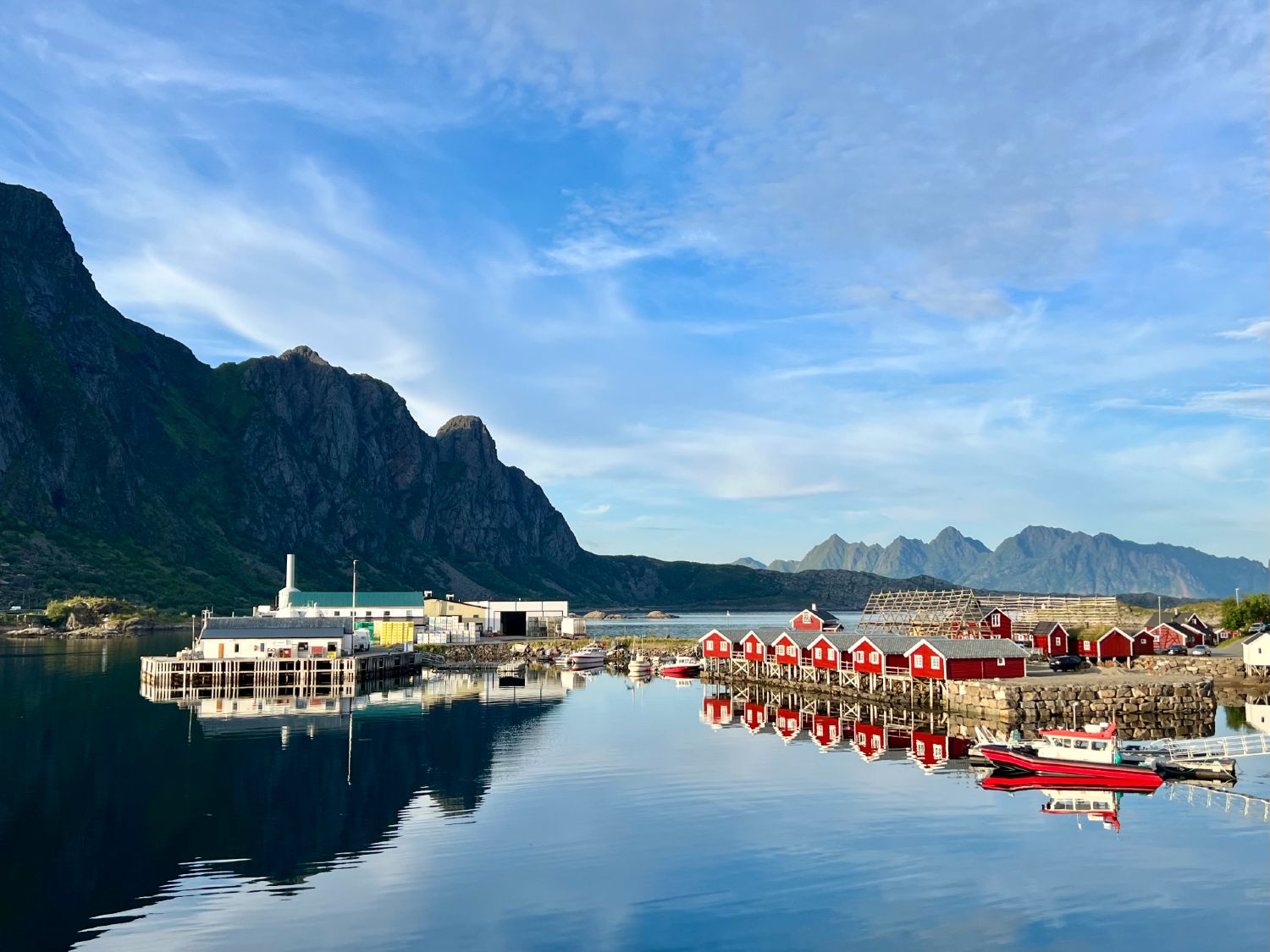
In Svolvær, we stay at Svinøya Rorbuer, whose below-average amenities and modest, underwhelming decor are compensated by its fantastic location, lively outdoor pub/restaurant, and harbor views. I can’t stop photographing the rorbuers and could often be found well past my usual bedtime waiting for the dipping sun to fire up its red exterior.
In contrast, Nusfjord Arctic Resort tips as far toward luxury as one can hope for in Lofoten. A Small Luxury Hotel of the World, this resort preserves the look and feel of a traditional fishing village.
Nusfjord’s rorbus are mustard yellow; many are several hundred years old. Tourists are welcome to explore the grounds, the general store, the bakery, the smithy, the boatshed, and the cod liver refinery throughout the day. But come 5pm, the property is reserved for guests only.
Nusfjord’s rooms are beautifully restored and appointed. Our rorbu has an ample yet cozy living space and two small bedrooms. The low ceilings were designed to warm the fishermen in the harsh winter. With soft bathrobes, slippers, and a Nespresso machine, Nusfjord’s cabins would be unrecognizable to the fisherman who slept there decades ago.
The Lofoten Islands are an adventure-seeker’s playground. And the Midnight Sun means no barriers exist to enjoying all they offer. Hiking, fishing, kayaking, SUP’ing, and fjord-exploring are just a few adrenaline-filled activities we participate in. We plan geographically, using our two bases wisely.
RIB’ing in Trollsfjord
In Svolvær, we take a high-speed RIB boat across Trollfjord—one of Lofoten’s most breathtaking fjords. RIB stands for ‘rigid inflatable boat.’ They’re an ideal way to crisscross the fjords and soak up the landscape’s natural beauty.
Trollfjord is defined by its narrow entrance, steep-sided mountains, and convocations of sea eagles. The eagles, also known as white-tailed eagles, are majestic. Their piercing eyes have two centers of focus. This binocular vision means they can see forward and sidewards at the same time, which is a pretty amazing, yet nerdy, bird fact.
Hiking in Svolvær and Reine
Daniel organizes two family hikes. He’s militant about getting to the summits in record time, so to an outside observer, our hikes look like four angry solo hikers muttering silently to themselves. But all our rage dissipates at the summit, even our daughter’s— the views are that good.
The hike to Devil’s Gate (Djevelporten) is accessed via Devil’s Staircase (Djeveltrappa), an ungodly number of stone stairs 1.8 miles straight up the mountain. It’s hell. But unveils a heavenly 360-degree panorama of Svolvær.
Further south, Reinbringen may be the most famous hike in Lofoten. This is due to its pinnacle views over the archipelago’s most picturesque villages—Reine, Sakrisøy, and Hamnøy. At 2 km total in and out, don’t be fooled by the seemingly short distance. This treacherous hike is a one-kilometer staircase to the sky.
Other activities worth mentioning:
• Kayaking (Reine Adventure) • The Blacksmith Museum and live blacksmith demonstration at Sund • Artscape Nordland: 35 works of art placed in the landscape across Nordland; five are in Lofoten, including ‘Untitled’ by American artist Dan Graham • The scenic, seaside Nusfjord to Nesland hike—accessed from Nusfjord Arctic Resort
Packing for Lofoten requires anticipating nearly every type of weather. The sky could be misty, foggy, and rainy at breakfast, then bright blue and cloudless by lunch. I wear layers most days, peeling them off as the temperatures rise. Thankfully, nothing is fancy in Lofoten. Hiking shoes and rain gear are a must. But, the inherent hygge culture of Norway means a hot sauna is always just a few white-slippered steps away.
Forgoing fancy doesn’t mean I can’t look good, so I rely on neutral colors and wrinkle-free fabrics I can wear multiple times. All are packed in my Eagle Creek carry-on bag, essential for a trip with so many moving parts.
My packing essentials:
• Lightweight puffer jacket • Raincoat • 2 x sweater/fleece • 2 x short-sleeved shirts and tank tops • 2 x long, lightweight pants • 2 x summer dresses • 1 pair each of birks or sandals and hiking shoes • Bathing suit • Sunglasses, sunscreen, hat • Eyemask
Q. What if I Don’t Want to Go Home?
While most articles and blog posts (including this one) agree that 4-6 days is plenty of time to visit the Lofoten Islands, I would have happily spent another night or two. These breathtaking islands are far less accessible than the Caribbean, and my chances of returning are slim.
I don’t want to go home. Yet I do—via flights to Bergen, Reykjavik, and finally, Washington DC, where we touch down to the same thermometer-shattering heat we left ten days ago. I miss the Arctic air. I miss the Eagles.
Over dinner a few nights later, I say, ‘So Daniel, I’ve been thinking about next summer…’
Anyone can Google a destination, but finding the right sources, the hidden gems, the places worth your time—well, that’s an art that takes time. I’ll cut through the noise, saving you from hours of searching in the wrong places. Each of my recommendations is researched with your specific trip in mind.
After visiting 70 countries on 7 continents, I know how overwhelming travel planning can be.
But I also know how to make it easy. And exciting. And stress-free.
A tiny square on Instagram stops me mid-scroll—a photo of a glass cabin perched above a stone jetty cantilevered over the sea. Through plate glass windows, a seated woman with a book on her lap gazes towards the horizon. The caption reads, “Can you see yourself in this chair?”
That was six years ago. If I’d seen it today, I would’ve been convinced the image was computer-generated. But in 2018, Instagram still depicted reality. Well, sort of.
“Yes!” I think to myself as that familiar swell of travel lust washes over me. “Yes, I can see myself there!” I look at the geo-tag, eager to learn the location of this enchanting chair.
Manshausen Island: 67°50.163’N, 14°46.462’E
I click on the map. Then zoom out. And out. And out. Finally, I recognize the shape of the country—Norway. I sigh. Not just Norway but a remote island off of a mainland village called Nordskot. Nordskot, population 56. The Arctic Circle. Manshausen Island is about as accessible as the moon. I swipe out of Instagram and put my phone away. I sigh again, this time in defeat.
Six years later, when planning our summer vacation, I remember that tiny square. Then, I build an itinerary around it.
Instagram vs. Reality
Who doesn’t love Instagram? Instagram is a portal to an alternate reality. Its mesmerizing photos pull us into a world of swoon-worthy vistas, avant-garde fashion, and food as art.
In 2018, the same year I covet that tiny square, Merriam-Webster declared ‘Instagram’ a verb. Hotels start dedicating Instagrammable spots to encourage social media posts, like Moet Chandon vending machines or waterfall swings. On Instagram, all the world’s a show, and everyone wants to be in it—or at least photograph it.
How would real-life Manshausen compare to its Instagram feed? I recognized the geographic hurdles and inherent risks. Getting there will take three planes, a ferry, and a speedboat. The weather could be hot and sunny or cold and rainy. The food could be inedible. The activities underwhelming. What if the island doesn’t even exist? I was acting on a gut feeling—hoping my family would trust it.
“Ummmm, I found this cool place on Instagram,” I tell them. “Ok, boomer,” my son shoots back, even though I’m not. My daughter raises an eyebrow. My husband says, “What could possibly go wrong?” Exactly.
So begins our journey to the Arctic Circle. We fly to Oslo, where we spend two nights at the architectural beauty, The Sommerro Hotel. From Norway’s capital city, we fly to the port town of Bodø to await the 7pm ferry. With hours to spare, we find an outdoor restaurant. I order a Pimms Cup in honor of Wimbledon just as Djokovic and Alcaraz amble onto the court. The sun is shining. We settle in for the match.
The ferry is the first of many surprises in Norway—a glorious introduction to the Arctic landscape and the power of the midnight sun. Passengers disembark at ports called Moskenes and Helnessund. Their spouses, dogs, and kids welcome them eagerly at the dock. I wonder what their stories are. What happens here in Helnessund? Do they know their village is all the rage on Instagram?
When we glide into Nordskot at 9pm, the sun is still high in the sky and casts a golden glow over the towering mountainscape. I imagine few places on Earth evoke a sense of utter breathlessness. The Norwegian islands in the Arctic Circle are some of them.
Angus Staples, one of Manshausen’s two hosts, meets us at the dock and lowers our bags into the boat. He looks like a mountain climber—rugged, compact, and deeply tanned. He whisks us to the island, the final leg of the journey that began with a tiny square on Instagram.
Instagram vs. Reality—the Moment of Truth
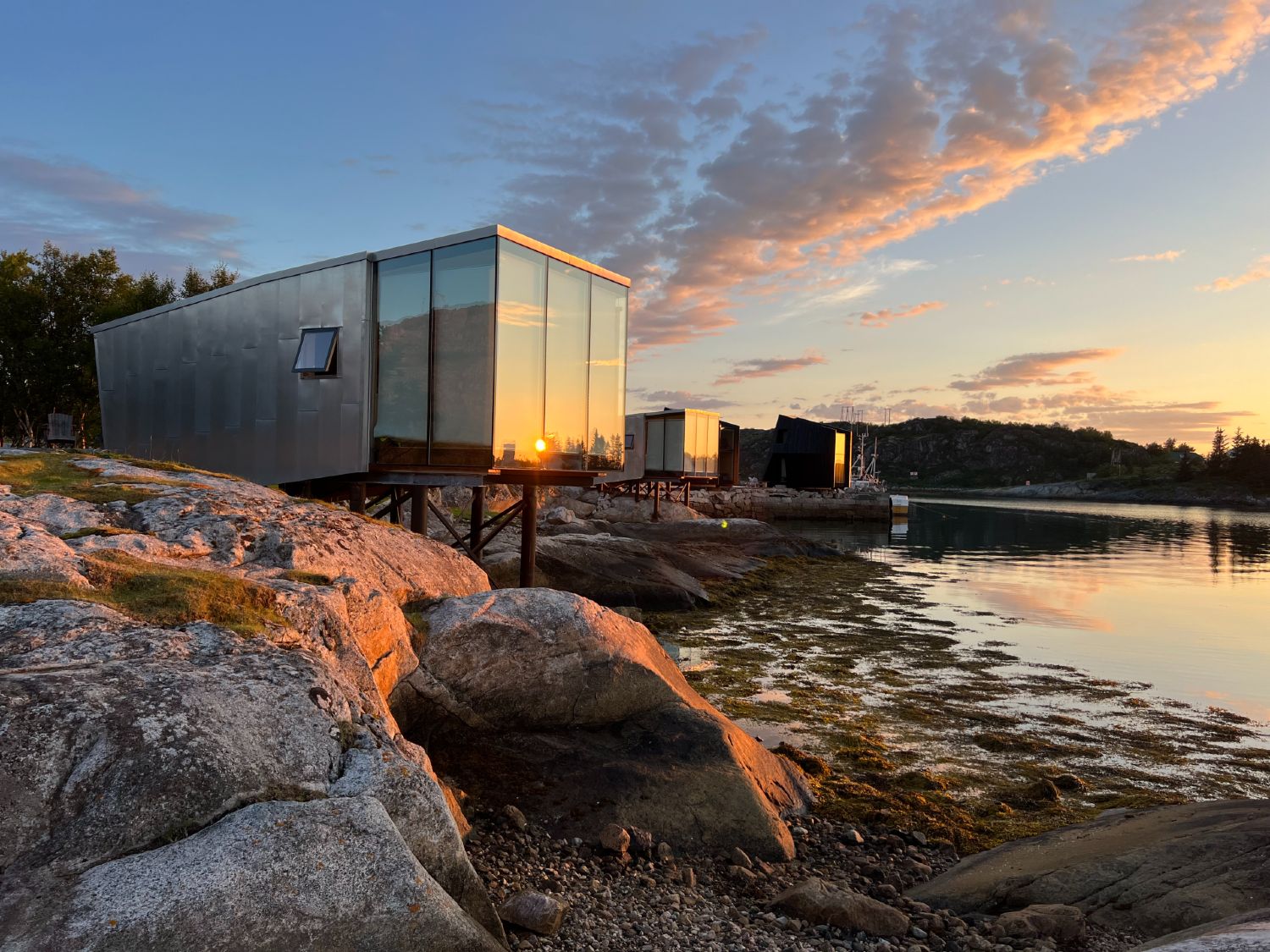
Any anxieties I have dissipate once Manshausen comes into view. I breathe a sigh of relief—thankful it exists. The glass cabins act like beacons, welcoming us to the island. The sun radiates off their metal exteriors, and the floor-to-ceiling windows mirror the placid, tranquil water. I see a wide dock stacked with yellow and red kayaks. A wooden sauna and a dozen bleating sheep are not far beyond it. We hear the low-piercingcalls of seagulls above.
I hop off the boat to find my chair.
The Manshausen Story Started in 1698
Manshausen is a small, flat, rocky island. A mere 14 acres in all, its roots date back to 1698 when it was a part of the Grøtøya trading post. Its sheltered location made it ideal for the area’s thriving fishing industry. Until the 1800s, Manshausen was used as a fish export storage location. But by the 1900s, ships were just too large to reach the island, and the trading post went bankrupt. After that, the island went through several iterations (none Insta-worthy) until a man named Børge came along.
Børge Ousland bought Manshausen in 2010. And, along with award-winning architect Snorre Stinessen, built a destination for intrepid travelers. Børge is a real-life polar explorer, having spent over 30 years traversing the Arctic and Antarctic regions, often in the bleakest and darkest months.
I imagine when he visits Manshausen between treks, it’s a true respite, with its intimate sauna, simple and flavorful food, and majestic sea eagles soaring overhead.
Norwegian-born Ousland was the first to complete an unsupported solo crossing of Antarctica. He was a deep-sea diver in the North Sea, a Navy Special Forces Officer, and was married at the North Pole. Børge Ousland is an all-around badass. I want to meet him. Sadly, he isn’t at Manshausen when we visit. He’s probably taming orcas, wrestling polar bears, or swimming the Drake Passage.
I overcome my disappointment and focus on more important matters—the sea cabins.
Manshausen’s Award-Winning Cabins
The nine sea cabins and two towers at Manshausen have won over 40 design and architectural awards, hence their inherent stopping power on Instagram. To me, the cabins artfully honor the traditional rorbu (fishing cabins) of the early 1900s. Communities of brightly painted rorbus were positioned in protected harbors with the harbor-facing side of the cabin on poles. This design meant fisherman could easily access their boats each morning.
Today, most rorbus have been retrofitted as picturesque accommodations for travelers. Their fiery red exteriors pop against the green and blue landscape—the kind of imagery that, if you catch the light right, can go viral. Although not mine, unfortunately.
Set on stilts above rocks and the ebbing tide, Manshausen’s nine modern cabins are made of wood, glass, and metal. Their angles and stark edges contrast the natural elements yet meld harmoniously within the scenery. The warm wooden interiors are simple and highly functional, with cubbies, hooks, and storage nooks in all the right places—except for the bathroom. Angus, a few more towel hooks would be helpful, please.
Each sea cabin on the island is named for one of Børge’s expeditions. The towers, Nansen and Amundsen, pay homage to his idols in polar exploration. It won’t surprise anyone who knows me that I heavily researched the ‘best cabin on Manshausen’ before booking. Phone calls were made. Aerial maps were navigated. Leaving this very important decision to fate was not an option.
Franz Josef sits just above the water and has uninterrupted mountain views. Its location at the far edge of the island means no one walks past our cabin, which is fairly important since they’re made almost entirely of glass.
The sea cabins advertise to sleep four people. In hindsight, we should have booked two cabins. During our stay, Norway experienced warmer-than-usual temperatures, and the second bedroom became an unwanted in-room sauna. I’m guessing this isn’t typical—unless you believe in global warming—otherwise, Manshausen should consider central air. Next time, we’ll book Patagonia, too.
Beach Mustard, Bread Ice Cream, and Other Culinary Surprises
Our three days on Manshausen are filled with round-the-clock sunshine, blue skies, and temperatures in the mid-70s. The weather is a gift in this part of the world known for highly changeable microclimates. I sit in my chair, but not as much as I thought I would. There’s too much to see and do.
Mornings on Manshausen are leisurely. Angus visits each guest at breakfast in the main house to confirm plans for the day. Ondrej, Manshausen’s chef and island co-host, creates magic in the open kitchen with a friendly and seasoned staff.
Ondrej tells us nearly all the ingredients he uses are foraged and sourced from the island and local area. On our first night, we have halibut topped with a plant I’d never seen. “It’s beach mustard,” Ondrej says, then mentions he’d found it earlier while walking. I later learn beach mustard is an aquatic herb with a salty, juicy flavor. It’s a spicy contrast to his light, flaky fish and poached tomatoes.
Overall, the food quality, presentation, and variety is another surprise. I’d been anticipating small, oily fishy fish like sardines and anchovies. Instead, we dine on freshly caught halibut and cod. Ondrej pairs unusual ingredients with familiar ones. We enjoy root vegetables like beets, cabbage, and parsnips in multiple ways. Truffle seaweed, pine shoots, and pine cones adorn our plates. Ondrej makes ice cream from leftover bread that he roasts and infuses with milk. Bread ice cream. Brilliant.
A Typical Day on Manshausen is Never Typical
One of the perks of never-ending sunlight is that activities are pretty much available 24/7. One night, our kids take the rowboat to Nordskot at 10pm in search of gummy bears. My husband and I watch from the cabin. Though we can’t hear them, it’s pretty clear from how the boat is rocking that they’re arguing. We look the other way.
Layers of mountains provide endless viewing entertainment. Norway’s mountainous mainland changes from green to blue to deep purple, and far beyond it, the Lofoten Island archipelago’s jagged peaks look like they were cut with a razor’s edge.
Manshausen offers adventures for every type of traveler. One morning we kayak, spotting our first sea eagles of the trip. Another day we fish, and my son catches four large halibut Ondrej will likely serve for dinner.
There’s hardcore mountain climbing along the Nordskot Traverse and more moderate hikes like the one we take to Resshola Cave. Otherwise known as ‘Troll’s Cave,’ it’s 140 meters deep and blankets us in complete darkness for the first time since arriving in Norway. Those trolls really know how to hide. I didn’t see a single one.
Each day, I walk the island, searching for treasures and following the sheep. All they do is eat and bleat. Bessie is my favorite, as she’s the hungriest and always lets me feed her.
Another woolly ewe wears a bell around her neck. I ask Ondrej if it’s so the staff knows where the sheep are at all times. “Actually, no.” He says, “It’s for the sheep. They get distressed when they can’t find each other, so the bell keeps them from getting lost.” At 2am, that very bell tells me the flock is grazing outside Franz Josef’s cabin. Such is life on Manshausen Island.
Sauna Culture
Sauna has been an integral part of Scandinavian culture since, well, forever. Many consider the sauna a sacred space, ‘Nature’s Church,’ a place to cleanse the mind, body, and spirit. It’s easy to see the allure. The mystical and traditional characteristics of the island permeate everything.
The wooden sauna sits beside a natural pool of water. Although the air temperature is warm, the water is anything but. Yet, it’s the best way to prepare, so we jump in and brave the chill. I cleanse my mind, body, and spirit multiple times a day. It’s so restorative my husband now wants one at home. Sauna—the ultimate Scandinavian souvenir.
Manshausen is Unreal/Real
After three days on Manshausen, we gather our things and get ready to meet the ferry. From Nordskot, we will head north to tackle the luminous Lofoten Islands, whose peaks we’ve been admiring in the far distance.
When the ferry floats in, it unloads a few new travelers destined for Manshausen. I wonder how they found it. Did they see it on Instagram? Which cabin did they get? I want to tell them to feed Bessie because she’s always hungry. And I want to prepare them for the ethereal colors of the sky at one o’clock in the morning. I want to hear what they think about bread ice cream.
I want to stay.
Manshausen blurs the lines between illusion and reality. Its location at the edge of the world furthers its dreamlike qualities. Once it’s entirely out of view, I turn around and face north. The Lofoten Islands are waiting. ‘But where will we go next?’ I can’t help but wonder.
Author’s Note: For those who wonder how we packed for this trip, it was carry-on only all the way to the Arctic. My go-to brand is Eagle Creek. Their Gear Warrior Backpack was ideal for my 18-year-old son, pictured below.