Category: Uganda

  • How To Pack for an African Safari (Carry-On Only)

    How To Pack for an African Safari (Carry-On Only)

    Are you heading on safari for the first time? An African safari is an adventurer’s travel trifecta—a combination of breathtaking wildlife, stunning terrain, and unparalleled lodging and hospitality. With over 20+ game drives across four countries, I’ve learned a thing or two about how to simplify the preparation for this exciting experience. My packing lists follow—organized into four simple categories. You can also download my ‘Ultimate Safari Packing List’ to have them all in one easy-to-access place.

    And while it’s not necessary to travel with only a carry-on—if you can manage it, you won’t regret it.


    Coach bag

    The first time I went on an African safari was in 2002. It was my honeymoon. My soon-to-be husband had kept it a surprise until check-in at JFK—a gesture that felt romantic then, but would feel utterly controlling now. That’s twenty years of marriage for you.

    A few weeks before departure, Daniel gave me a gift—an overnight bag from Coach. I loved its cherry red canvas exterior, wide shoulder strap, and soft leather details. But as I’d come to expect from many of Daniel’s gifts, it came with a catch. 

    “It’s for our honeymoon!” Daniel chirped excitedly. “Oh, how cool! You mean it’s my carry-on bag?” I questioned, although I already knew the answer.

    tracking in Africa

    Being Prepared Is Isn’t Everything

    How I packed for a three-week trip to an unknown destination in a bag designed for a weekend getaway is baffling. As my faded disposable camera photos show, I packed the wrong clothes, the wrong gear, and way too many shoes. Yet, I can’t recall needing a single thing as we journeyed across Tanzania that June. That’s young love for you. 

    Despite my anecdotal story of unpreparedness, I vowed to be ready when we took our kids on safari years later. I googled safari clothing, what to wear on safari, safari must-haves, and safari packing lists. This time, I’d be prepared. This ain’t no honeymoon.  

    If a similar Google search got you here, congratulations—you have a safari on the horizon. It’s one of the world’s most intense, immersive, engaging, and magical experiences. I’ve been on safari in Tanzania, Botswana, South Africa, and Uganda. With each trip, I fine-tuned my packing skills, filing away tips for my future safari-bound self and my safari-bound friends and relatives. I figured out how to consolidate. And found my safari style without entirely forgoing fashion. I made peace with layers and colorless clothes.

    on safari

    Safari Style 101

    Safaris are considered once-in-a-lifetime experiences due to their high costs and far-flung locations. It’s painful to shell out even more money for clothing you may never wear again.

    Thankfully, safari clothing need not be expensive. The best way to dress for a safari is modestly and with a neutral color palette. Take advantage of a high/low buying strategy. This means spending more on certain pieces (like a good fleece or puffer) to balance items (like underlayers) where you can safely compromise fashion and durability.

    Bush plane

    In Africa, It’s All About Layers

    Safari game drives typically occur around sunrise and sundown. You don’t need David Attenborough to tell you these are the times of day when wildlife is most active. Unfortunately, these coincide with the times of day I am least active. But safari is well worth going outside of your comfort zone! Be suspicious of an outfitter that advertises a noon game drive. The leopards and lions will be enjoying a midday siesta. You should consider one, too. Game drives are tiring.

    As for safari clothing, it’s all about layering. Think about a tank top base layer, a lightweight, long-sleeved mid-layer, and a fleece and puffer outer layer. The thin mid-layer will be your new BFF, as it will protect your skin from the sun and pesky tsetse flies. Lightweight, long pants are better than shorts despite the temperature for the same reason. Invest in a good fleece and puffer, as you will wear them daily and likely beyond Africa.

    sunset

    And it’s all about the Sun

    Mornings in Africa are typically cool. You’ll be awake before the sun. Sunrises and sunsets are another reason why we go to Africa. The muted layers of the terrain will morph and change as the day breaks, adding another level of awe to an already awe-inspired morning. Sunsets are equally mesmerizing—with no air pollution or city lights to spoil them.

    As the temperatures rise, slowly peel off your layers. Settle into the sounds of the savannah. Get your camera ready and listen to your all-knowing guides. The fun is about to begin.

    Author and husband on safari

    Safari Clothing Packing List:

    2 x base layers (tank or short-sleeved shirts)
    2 x mid-layers (lightweight and long-sleeved, neutral colors)
    * 1 x fleece (neutral color)
    * 1 x lightweight puffer (I like this one from Patagonia because it folds down to the size of a paperback)
    1-2 linen shirts and/or shorts or, for women, a wrinkle-free dress (for evenings around the firepit comparing wildlife sightings, also doubles as a nice outfit for layover city days)
    2 x lightweight pants (zip-off ones are popular; I don’t know why)
    Buff (for dust, flies, and keeping hair off your face—the uses of a good buff are endless)
    2 x sports bras 
    7 x underwear (many lodges have complimentary laundry)
    7 x socks (at least two thicker and longer pairs to go over pants if on a walking safari or a trek in Uganda. Otherwise, prepare to meet the local fire ant community.)
    Hat (wide-brimmed to protect your neck and, yes, neutral)
    * Hiking shoes (broken in, in advance)
    Closed-toe shoes or sneakers 
    Flip flops (for hanging around the pool)
    1 x bathing suit (it’s tempting to take more—don’t. This isn’t Cabo.)

    * Splurge-worthy item


    Click here for my free ‘Ultimate Africa Safari Packing Lists’


    lion on Canon camera

    Gearing Up

    The right gear is integral to a safari experience, especially for wannabe wildlife photographers, bird nerds, and travel bloggers. But gear is cumbersome. Choose what to pack with care. Unless you’re applying for a job at Nat Geo, an iPhone may suffice—they take beautiful photos. My go-to is a combo—an iPhone (hanging from a lanyard around my neck at all times) and a Canon Rebel SL2, which is lightweight, user-friendly, and has WI-FI capabilities so I can post to Instagram in real-time. 

    Safari Gear Packing List:

    * Luggage (Eagle Creek is my go-to choice; this is my pick)
    Packing cubes (Eagle Creek packing cubes have endless uses: toiletries for plastic-free countries, dirty laundry, souvenirs)
    iPhone and charger
    iPhone lanyard (Somewhat dorky, yes—but you’ll thank me when baboons don’t steal your phone)
    * Camera and lenses (one good zoom will do—they’re expensive, consider renting one)
    Extra battery and/or SD card
    * Binoculars (sometimes provided, but having your own is worthwhile—these are the ones I use)
    Sunglasses
    Day pack (for your gear)
    Universal Travel Adapter (this is the one I have)

    * Splurge-worthy item

    White rhinos in Africa

    Little Things Count

    Don’t let the length of the following list scare you. In total, these self-care items take up less space than that extra pair of shoes you won’t wear. But little things count—especially things that protect our bodies and minds in one of the most unforgiving places on Earth.

    Safari Self-Care Packing List:

    Sunscreen (transferred into CVS travel-sized containers you can dispose of as you go)
    Lip balm with SPF
    Insect repellent (The National Capital Poison Center recommends a concentration of DEET no higher than 30%)
    Eye mask (this one is my go-to)
    Ear plugs (although the nightly chorus of wildlife is a highlight of safari) 
    Prescription meds (cute pillboxes are all the rage)
    Small medical kit (a nod to my paramedic husband, who doesn’t go to Safeway without one)
    Feminine products (because there’s no CVS in the Okavango Delta)

    Landscape

    Less is Less

    It’s human nature to be overprepared, especially in a place as foreign and remote as Africa. If you’ve chosen a reputable safari outfitter with your travel advisor, then you need not worry. Anything critical you may have forgotten will be taken care of. Strive to pack less. Make a carry-on bag a goal. Feeling unencumbered on a trip with so many moving pieces is liberating. 

    But no matter what you pack in, some things don’t belong on a safari in Africa. 

    What Not to Pack Packing List:

    Perfume (or creams/moisturizers with a strong scent that will attract or repel wildlife)
    Fine jewelry (the rhinos don’t care how many David Yurman bangles you have)
    Plastic bags (some countries, like Rwanda, are polythene-free)
    Dressy clothes and shoes (safari is decidedly casual)
    Drones (restricted in many African countries)
    Hair dryers (most lodges will have them)
    Anything you haven’t worn in the last 12 months (you think you’ll wear it in Africa—we all know you won’t)


    Click here for my free ‘Ultimate Africa Safari Packing Lists’


    Cheetah portrait

    Prepare to see the Unexpected

    One of the best things about an African safari is that anything can happen. One day, you might come across a pride of lions feasting on a wildebeest. On another, an elephant might stroll through your camp during lunch. At night, you may hear a pack of wild dogs on the hunt or discover a bush baby running circles around the inside of your tent.

    These moments define the experience—the moments you’ll retell at the firepit at night. Safari is fueled by adrenaline. Those who choose to go on safari are a self-selecting group of adventure seekers. Where the unexpected is expected, even sought out. Otherwise, we’d just go to the zoo.

    And while surprises are part of the thrill, some aren’t welcome. A few tips follow, most of which I learned from experience. 

    monkey in uganda

    Safari Travel Tips

    Luggage tip: Space in a carry-on bag is limited. So wear your heaviest items on the plane when possible. This includes hiking shoes and your fleece or puffer. You can read more about how I pack and my general packing tips here.

    Safari Planning Tip: Using a travel advisor to plan a safari makes it a stress-free experience. They work with the most well-known and reputable outfitters and can access perks and surprises you won’t get if you book it yourself. I use CIRE for all of my travel bookings. To learn more about why I use a travel advisor, read my post, “Who Needs a Travel Advisor? It Turns Out I Do.”

    Visa, vaccine, and passport tips: Travel advisors will be on top of the visa and vaccine requirements, but checking in advance is helpful. While you’re at it, make sure you have at least six months and one or more free spreads of passport space from the departure date of your trip.

    Clothing tip: As mentioned earlier, wearing neutrals is vital. But why? Colors to avoid wearing include red, yellow, orange, black, dark blue, and camo. Each of these colors has its own set of issues. In many African countries, camouflage is strictly reserved for the military. Dark colors attract tsetse flies, while bright colors make you look like prey. (Looking back at my color choices in 2002, it’s remarkable I’m alive.)

    Silverbacks

    Laundry tip: Many luxury lodges and tent camps include daily laundry. This removes the need for more clothes (and too many pairs of underwear). Get over the fact that you may wear the same pants five times. At least they will be clean. And nobody but you will notice anyway.

    Gear tip: Bring a small daypack in the Land Rover each morning. It’s a safe place to keep all those layers tidy and dust-free for future use.

    Tipping tip: If tipping makes you uncomfortable and anxious, consider choosing an outfitter that includes all gratuities. While the embedded tipping costs most certainly increase the cost of the trip, there are no awkward moments or need to fumble with local currency.

    Insurance tip: A must. Don’t leave home without it.

    Sunset Africa

    What is the Purpose of this Day?

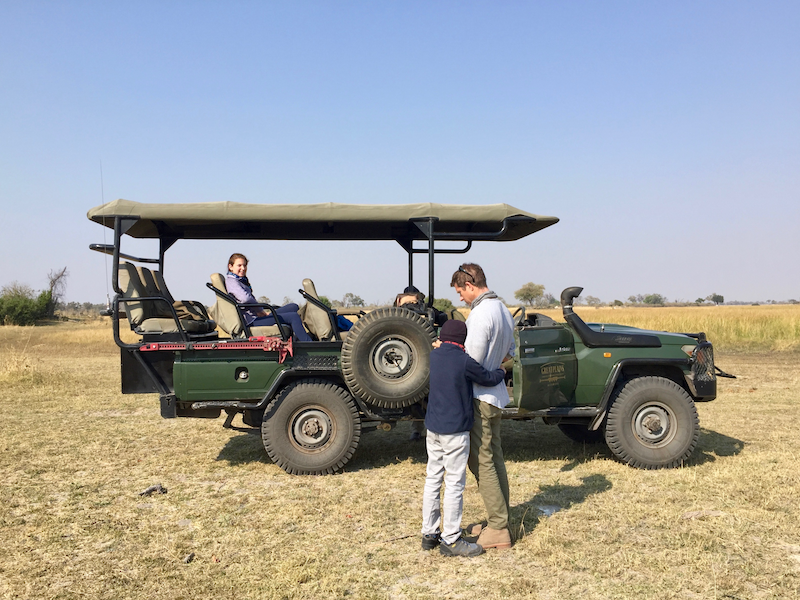
    We wake up at the crack of dawn. It’s still dark. The only sounds I hear are buzzing insects and the rustle of leaves in the breeze. Without speaking, the four of us trudge to the jeep, where our guide, Foster, waits with a wide smile. He looks at my 13-year-old daughter, who’s radiating snarky, salty tween vibes. She’s not smiling.

    “What is the purpose of this day?” Foster says to her in a slow, enchanting baritone. With sleep in her eyes, Ella looks up. I look up, too. Ella doesn’t know. I don’t know. Who thinks about things like that? Foster does.

    But I want to know. I’m guessing Ella does, too, based on how quickly she hops in the jeep. Foster revs the engine, and we set out to find the purpose of this day. It’s somewhere out in the Okavango Delta. The best journeys answer questions you never knew to ask. Keep asking, Foster. We’re all listening.


    Click here for my free ‘Ultimate Africa Safari Packing Lists’


    (Please note some affiliate links above. I may receive a small referral fee should a product be bought through my site, but rest assured, I only highlight products I own and would buy for myself.)

  • I wouldn’t go there if I were you (Why where we choose to travel matters)

    I wouldn’t go there if I were you (Why where we choose to travel matters)

    The landline rings. I immediately know it’s my mother calling. From the way she says ‘hello’ I know something else—that I’m not going to like the conversation. I’m tempted to feign a poor connection and hang up. 

    ‘A woman was kidnapped in Uganda’, my mother says, her voice measured, with frantic undertones. ‘At gunpoint’, she continues, ‘alone, while on safari.’

    ‘I’m not going to Uganda for four months, Mom’, I say, my voice measured, with annoyed undertones.

    ‘And, I’m 49 years old. I’m a grown-up.’

    ‘She was 35’, my mom replies.

    I hang up.

    The phone rings again. It’s my dad.


    I’m measured by nature. So much so that my baking skills are flawless. You can’t improvise a chocolate soufflé no matter what The Great British Bake Off would have us believe. I’m a recipe follower. A rule follower. I color inside the lines. 

    So while it’s true the unfortunate kidnapping in Uganda happened only a few months before I’m due to go. And also true I’m traveling solo to Queen Elizabeth National Park, the very park she was kidnapped from, I do what I do best—I measure.

    As departure day looms, I research as if my life depends upon it. Ultimately, I deem Uganda safe. Safer, I’ll add, than my current hometown. I tell my parents that lightning never strikes the same place twice.

    They don’t buy that, either.

    Landscape

    Where we choose to travel matters. Some of us choose to cage dive with sharks off the coast of South Africa for a high-adrenaline thrill. Others choose to restore coral reefs in Australia in order to help save the planet’s fragile ecosystems.

    Our adventure mindsets are decidedly different and have individual arcs—from dangerous to safe, worthless to worthwhile. I think of the center of this arc as my comfort zone. The times I step out of my comfort zone are rewarding beyond measure. Uganda is one such time. But there are others.


    GET MY TOP FIVE WISH LIST DESTINATION HOT SHEET FREE. JUST CLICK.


    Preconceptions aside

    Checking in with my good friend Merriam-Webster, I note the synonyms for ‘preconceived’. They include biased, bigoted, influenced, prejudiced, and opinionated. Preconception sure does come with a lot of heavy baggage.

    Over the years, I’ve been ‘encouraged’ to rethink travel plans. That encouragement may have been due to a particular country’s current state of civil unrest. Or, because the terrain is considered treacherous. Or, simply because it just doesn’t seem fun. Most of the time it’s due to preconceived notions about our destination. Notions that I’m keen to dispel.

    The unsolicited advice is well-intended, I know. Yet, in the end, we are masters of our own domains. Or in this case, travel itineraries. Sorry, mom.

    Scenery with woman

    You’ll get kidnapped in Uganda

    I possess a healthy fear of traveling to Uganda. I rarely travel solo. The last time I traveled alone was in 1994 when my then-boyfriend and I broke up and I booked a spontaneous flight to St. Thomas to cry. 

    My salty tears drip into plastic goblets of overpriced, oaky, California chardonnay. A few days later, two friends track me down to save me from myself (and to suggest a cold Carib, instead).

    Any fears I carry with me from DC to Uganda dissipate upon arrival. Reality versus preconception. The gap is deep and wide.

    I’m due to meet up with a friend in Bwindi National Park later on, which leaves me solo in the southern Ishasha sector of Queen Elizabeth National Park. I spend three nights at a remote tent camp alongside the Ntungwe river, where the sounds of wildlife begin to fill the warm African air just as I am heading to bed. 

    The savannah after dark is a universe unto its own. It is one of the only place I would rather be awake while everyone else is asleep. One night, I hear an elephant’s enormous body graze the side of my canvas tent. I note the natural tempo of his slow-paced, padded steps.

    My heart thumps so loudly that I’m sure he can hear it. In the dead of night, the chorus of animal life is nearly spiritual. Not much later, I feel the roar of a lion as much as I hear it. I try my best to stay awake, not wanting to miss a growl.

    tree climbing lions

    The famous tree-climbing lions are part of the reason I choose to visit Uganda. The Ishasha sector of Queen Elizabeth National Park is the only place in the world to see them. Lions that climb acacia trees to find shelter from the heat, take a well-earned nap, or spy on helpless prey. Another reason is to observe the Silverback gorillas, a species that can’t be found in any zoos or game parks.

    Ugandan kids

    Finding Gold, in Africa

    Yet, there are reasons beyond wildlife that make this trip remarkable. It’s the people. Not only the people who live and work in the destinations we are traveling to (bartenders, guides, trackers, and school kids) but the other adventure-seekers we meet along the way. 

    Whether that be the women I meet in seats 2B and 2C en route to Ishasha, the birders with whom I cross the Mabamba Swamp, or the digital nomad punching keys on the bar stool beside me. It’s all about the animals, in Uganda. But, it’s also all about the people.

    Wetlands of Mabamba

    The bush plane I take from Ishasha to Kihihi seats four people. Across the aisle sits a tall, elegant man with inquisitive eyes and an endearing smile. We chit-chat (an activity I love) while waiting for wheels-up. My husband is not a chit-chatter, so when I’m alone I chit-chat like there’s no tomorrow.

    I learn that although he currently lives in Milan, he’s originally from the small African nation of Burundi. I ask him about Burundi and why he is visiting Uganda. We exchange stories of our game drives and animal sightings. We compare kills in detail and count ourselves lucky for having seen one. He tells me about his twins and that he works for Nike.

    “Have you been to the United States?”, I ask.

    “Once”, he responds, “to Atlanta, back in 1996.”

    I feel creaky, rusty cogs turn slowly in my mind. My Trivial Pursuit general knowledge resurfaces and I imagine inserting a red wedge into a little, plastic wheel. 

    “Wait. Did you go to the Olympics?”

    Bashfully, he tells me he was in fact, in the Olympics. My jaw hits the tray table. I’m about to ask more but just then the engine sputters to life at a decibel level that renders speech useless. Stray zebras clear the runway. We’re off.

    Later, when I’m reunited with Wi-Fi, I google my humble seatmate, (you wouldn’t?). His name is Vénuste Niyongabo. I learned he trained to compete in the 1500-meter race for the ’96 Olympics. He was considered the clear favorite, but at the last minute forfeited his space to a teammate who hadn’t been able to compete in ’88 or ’92. Vénuste entered the 5000-meter race instead, one he hadn’t trained for. In his final lap, Vénuste went on to win an unexpected Olympic gold. 

    The only Olympic gold medal winner for Burundi. Ever.

    Silverbacks

    Where I choose to travel matters. I choose Uganda and expect to observe climbing lions and track Silverbacks. I don’t expect a chance encounter with an Olympic Gold medalist on a four-seater Cessna. As valuable a memory as any other I collect while in Uganda. Maybe the most valuable. Human connection trumps all.

    Oh, and no one gets kidnapped in Uganda that week. I check.


    GET MY TOP FIVE WISH LIST DESTINATION HOT SHEET FREE. JUST CLICK.


    Plaza life

    Drugs are everywhere in Colombia

    You’re going to Colombia? Haven’t you seen Narcos? Ahhh, if I had a peso for every time I heard that one. To those stuck in the Netflix version of Colombia, circa 1980, I ask you to join me in the present day.

    I visit Cartagena because I’d like to be dazzled by a Spanish colonial city in a Gabriel García Márquez kind of way. Magical Realism is a part of Colombia’s allure, at least in the literary sense. My expectations are unreasonably high. I picture men levitating in the streets and musical notes dancing in mid-air. I conjure up the aroma of deep-fried yucca from street vendors and imagine the echo of clomping horse hooves on cobbled streets.

    I read One Hundred Years of Solitude for the third time, in anticipation.

    Street vendors

    Many things are sold on the electrically-charged street corners of Cartagena, but as far as I see, none of them are drugs. The street corners I pass sell pineapples, papayas, and wedges of juicy watermelon. Messy perhaps, but not illegal, merchandise.

    The palenqueras are the glorious fruit sellers of Cartagena. Their bright clothing and broad smiles are colorfully woven into the fabric of the city. At one time, these iconic women carried baskets of fruit upon their heads from their Palanque village to the city center. Today, they find a shady patch of the street or plaza to offer their bounty of produce to tourists. 

    colombian men

    The World Cup: USA v. Colombia

    One day we walk to Getsemaní, a neighborhood just beyond the fortified walls of the old city. It’s gritty, raw, and all about street life. We stumble upon the chipped mustard-yellow walls of the Town Hall on Plaza de la Trinidad. The colors of Cartagena are kaleidoscopic—a harmonious match to the zeal of the city.

    We see young Colombian kids playing a game of pick-up soccer. They run as fast and effortlessly in torn flip-flops and battered Crocs as most American kids can in Nike Airs. Premier League jerseys hang loosely off their lanky frames. A group of men is stooping nearby, their faces weathered and grooved like an old LP. I take a mental photo. I still have it.

    My son is nine years old. Without warning, he dives headfirst into the game. My husband, daughter, and I sit on a bench nearby—front-row seats to an impromptu World Cup match. 

    Local pick up soccer game

    The kids don’t bat an eye at the American newcomer and absorb him into the game like an old friend. They don’t have language in common, but somehow figure out who is playing which position and who is on which team. Sport has a language all its own. 

    Goalposts are marked with soda cans. Yet, the game matters in ways beyond scoring. My son takes a shot on goal and misses. The game resets. A lesson in Latin American football, my husband muses on the sidelines. A lesson in a lot of things, I can’t help but think.

    Trees in the light

    Finnish Lapland doesn’t sound like fun

    “You do realize there are only a few hours of daylight in Finland during winter?”, chirps a nosy woman seated on my left. She is way too close to my screen, I think, as I scoot further down the banquette at my local coffee shop.

    Yes, I discover that little factoid while researching our post-Christmas trip to Finnish Lapland. A holiday of near-perpetual darkness isn’t for everyone. I’m hoping it’s for us.

    I want to tell her “if we all traveled to the same place, the Dominican Republic would sink to the bottom of the sea. So, while I appreciate your concern that we might not have fun in Finland, let me say one thing—I’m a grown-up. I can go where I want.”

    I don’t say any of that. But I want to.

    Finland turns out to be one of the funnest vacations we have as a family. I use ‘funnest’ deliberately here. I know it isn’t a real word—I have Grammarly.

    Northern Lights

    The main reason I want to go to Finland is to see the Northern Lights, which I hear is all but guaranteed in Finnish Lapland. Naturally, I don’t tell my family this. Instead, I google all the ways to have fun in the Arctic Circle in December. There are 35,800,000 results. Phew.

    I get the guaranteed aurora borealis on our first night in Lapland. Ticking that box early means I can fully embrace the other 35,799,000 fun things I’ve promised my family we can do. Among many fun activities, the funnest (again, for emphasis) takes the form of 17 yelping huskies pulling us on small metal sleds at breakneck speed at dusk (aka noon). 

    Toni, the dog whisperer of Finland, is our guide. He has an ease and lightness about him that belies his 20-something years. Before departing into the wilderness, Toni gives us vital instructions on how to maneuver the dogs. None of which I can hear. The dogs are barking so loudly they shake the snow off the trees.

    Once the dogs get mushing, the landscape deafens. It’s like someone muted Finland by remote control. The beauty of the landscape is enhanced by the centuries-old silence of dogsledding. 

    Dog sledding at noon

    Toni guides us over frozen lakes and under tall pines. The sky renders shades of lavender and pink. Then almost imperceptibly, those colors transform into magenta and orange. A setting from a fairy tale, the low-angled winter sun casts long shadows on the snow, which is far from snow white. It is purple-white, pink-white, and blue-white. Benjamin Moore could learn a thing or two about color in Finland.

    Night-filled days are fun, but tiring. After seven nights in the Arctic, I’m excited to get home for some vitamin D and to watch White Fang. The memory of Toni and his unwavering command over our pack of huskies will be hard to forget.


    GET MY TOP FIVE WISH LIST DESTINATION HOT SHEET FREE. JUST CLICK.


    Do you know about that terrifying runway in Bhutan?

    By the numbers, Paro, Bhutan’s only international airport, has incredible stats. Only 17 pilots are qualified to land there. The runway is a skimpy 6500 feet long and surrounded by steep 18,000-foot snow-covered Himalayan peaks. Airplanes need to carve a 45-degree angle around these dramatic peaks moments before touchdown. Oh, and flights are only allowed to land during the day, in good weather conditions, and when a full moon is rising.

    The full moon part is a joke. The rest is no joke.

    We go to Bhutan to celebrate my 40th birthday, despite the statistics people have kindly sent us regarding plane crashes. ‘Bhutan is the happiest place on earth!’, I read. If I have to turn 40, then I’m going to do it in the happiest place on earth, dammit.

    Tigers Nest

    Leopards, tigers, and dragons. Oh my.

    The Kingdom of Bhutan is known as the ‘Land of the Thunder Dragon’. One of its most famous sights is called The Tiger’s Nest. The Himalayan foothills are home to the elusive clouded leopard. Leopards, tigers, and dragons? Whoa. Bhutan is setting a high bar.

    The crowned jewel of Bhutan is the Tiger’s Nest (Paro Taktsang), an ancient monastery that hangs precariously off of a 10,000-foot cliff. The Tiger’s Nest is a sacred space built on a cave site where Indian gurus meditated in the 8th century. The cluster of temples that are perched there now was built in 1692. The Tiger’s Nest is why I choose to visit Bhutan—to absorb a small part of its immense spirituality. To get there, I will push myself physically and mentally.

    Pema, our Bhutanese guide, personifies the happiness index I have heard so much about. His dimpled smile radiates as he tells us the history of his country. He talks about his favorite Bhutanese dishes, his wife, and his kids. I again remember why I travel is as much about the people as it is about the destination.

    Prayer Flags

    The hike is rigorous, which we expect. Red, yellow, and blue prayer flags flap—primary colors fraying from years of wind and rain. An enormous prayer wheel meets us along the way and I attempt to channel the surrounding aura. Mountain peaks, craggy rocks, and cloudless, bright blue skies. I am looking for a sign—a way to connect, however unrealistic that is.

    From a physical point of view, I’m well within my comfort zone—the center of my personal arc. The terrain is tough to climb, but not impossible. Yet, from a spiritual viewpoint, I’m out of my depths. I’m eager to embrace it, but it’s a challenge. 

    Eventually, we enter a clearing—a break from the blue pine forest. I see the Tiger’s Nest directly across the valley, hanging onto a sheer rock face exactly where I expect it to be. I imagine the tigress in her lair as well as the generations of people who have trekked here before me. We have 700 steps to descend and another 250 to ascend before we reach our goal. Slightly out of breath, I stop to look up.

    Above me, I see a fully-formed 360-degree rainbow circling the sun. I’ll say that one more time for impact—a rainbow circling the sun.

    This phenomenon, I later discover, is a sun halo. It occurs when sunlight refracts millions of hexagonal ice crystals. Those crystals then become suspended in the atmosphere to cause an otherworldly ring around the sun. 

    I didn’t even know sun halos existed. I have yet to see one since. Maybe this is the goal? A sun halo—my forever connection to Bhutan. Who doesn’t believe in signs?

    Sun Halo

    Travel matters

    In Cartagena, I expect to be immersed in a magical, yet real, world of art, culture, and food. I don’t expect to watch an impromptu pick-up soccer game on a gritty Colombian plaza.

    In Finland, I expect to glimpse electric green brushstrokes of charged particles crossing a black sky—not to be immersed in the age-old sport of dogsledding within a world of white.

    In Bhutan, the Tiger’s Nest is my intended goal. Yet, it’s overshadowed, quite literally, by an ethereal atmospheric phenomenon.

    And in Uganda? In Uganda, I track mighty Silverbacks and see rare climbing lions. So-called ‘once-in-a-lifetime experiences.’ But, then I meet Vénuste Niyongabo—a man who brings home gold to the poorest country in the world.

    Why do I travel?

    One of my favorite authors says it best:

    “After all, we travel for the same reason we read: to remind ourselves of the existence, and also the inexplicability, of other lives, to recognize ourselves within that which is foreign to us. We are one person when we begin a trip, or a book or an article; we are another person when we conclude it. Another person, but also the same-we take the journey to see ourselves.” —Hanya Yanagihara

    Where I choose to travel matters. I take the journey to see myself. Although what I discover isn’t always what I expect, I wouldn’t have it any other way. The risks of my choices are mine to bear. I’ll take those risks because I value the rewards that accompany them.

    And also, because I’m a grown-up, dammit.


    GET MY TOP FIVE WISH LIST DESTINATION HOT SHEET FREE. JUST CLICK.


  • Uganda, what to see beyond the famous silverback gorillas

    Uganda, what to see beyond the famous silverback gorillas

    What to see, where to stay, and what to do, in Uganda / The famous silverback gorillas are certainly what put Uganda on the map for tourism. And rightly so, as it is the only part of the world where one can see these peaceful, majestic primates. There are none in captivity, so in order to spend any time with them, one must be prepared to travel far. And travel far I did, for a fleeting two hours observing them that I wouldn’t trade for anything.

    Silverbacks

    Yes, two hours. Each gorilla permit afforded me exactly sixty minutes with the silverbacks. So, what is there to do with the other 23 hours of the day? A lot, it turns out. Uganda has much more to offer tourists than the mighty silverbacks.

    Silverback and baby

    But there is far more to see in Uganda beyond the silverback gorillas. There are traditional safaris to admire the famous climbing lions of Ishasha, for example. Or, sighting the elusive shoebill in the Mabamba Swamp. A boat ride to an island of rehabilitated chimpanzees in Lake Victoria.

    Breakfast in Ishasha

    What to do in Uganda: A Wild Frontiers Safari

    Wild Frontiers was our tour operator, the frontrunner for gorilla tracking and safaris in Uganda. They helped us come up with a bespoke itinerary, secured our coveted gorilla tracking permits, and allowed for some flexibility on the ground. Flights, logistics, and accommodations were well organized and generally worked like clockwork. This is Africa, after all.

    sunset

    Our guides, lovely, warm-hearted locals, had studied for years to be able to tell the difference between the sound of a great blue turaco and a green-breasted pitta. Or, to be able to spot an African fish eagle from a kilometer away. They could drive for hours on end and still have the energy the next morning to prepare a pop-up omelet station on the plains.

    Breakfast in Ishasha

    We were in constant awe of the Ugandan guides and their wealth of knowledge about the wildlife, flora, and fauna, of their country.

    What to see in Uganda: Equatorial Entebbe

    Uganda is a landlocked country in eastern Africa. The small city of Entebbe, about 20 miles from the bustling capital of Kampala, is where Uganda’s only international airport resides. Entebbe sits on a peninsula on the northern shore of Uganda’s largest lake, Lake Victoria.

    Ngamba Island Chimpanzee Sanctuary

    We crossed the lake, and directly through the equator, within three hours of arrival, on the way to visit the Ngamba Island Chimpanzee Sanctuary. The lake seemed angry, and our little boat was tossed around violently for nearly an hour. Spray came at us from every angle, the boat pounded the waves. My eyes remained firmly shut to keep nausea at bay. Uganda—unpredictable from the start.

    Chimpanzee

    What to see in Uganda: Hungry, howling chimps

    We arrived at the sanctuary, bedraggled, and soaking wet, and set off to see the 49 orphaned chimpanzees who roam the 40-acre island. That’s in comparison to the single acre allotted to the humans who work there and rehabilitate them. The chimps come to the barrier four times a day for food, and then slowly slink back into the overgrowth until the next feeding.

    Chimpanzees

    Although the feeding ritual was exciting, we were glad we didn’t plan it after our gorilla tracking later that week, as it seemed a much more commercial endeavor. We were happy to see that the orphaned chimps were well cared for, in a safe environment, and had access to medical attention should they need it.

    Boutique Hotel No. 5 Fruit plate

    Where to stay in Uganda: Hotel No. 5

    Our boutique hotel, called No. 5, was hidden in a local neighborhood less than a ten-minute drive from the airport. Here, I was to spend two nights before heading off on my own to Queen Elizabeth National Park. From there, I was to meet up with my friend at our lodging in the Bwindi Impenetrable National Park to start tracking the gorillas.

    Boutique Hotel No. 5

    Each of the ten rooms at No. 5 faced a lush, intimate, courtyard, with overgrown tropical trees and plants. There was a charming pool set below the veranda where we would have meals and pre-dinner drinks while listening to the ongoing birdsong.

    Boutique Hotel No. 5 bedroom

    The rooms were modest, clean, and airy—the gauzy mosquito netting over the beds seemed more for show than necessity but did look quite pretty. Small balconies were a nice touch, a place to sit and listen to the hum of the surroundings. In the early morning, I heard the daily call to prayer as I drifted dreamily in and out of sleep.

     Boutique Hotel No. 5 lunch

    Although the menus and meals were very nice at No. 5, they were surprisingly formal, a bit too heavy, and geared toward foreigners. This became a slightly disappointing theme at the various lodges we stayed at, and if I were to do it again, I would ask for more local Ugandan preparations as menu options.

    Wetlands of Mabamba

    What to see in Uganda: The Mabamba Swamp

    While my friend worked for the few days we were in Entebbe, I took advantage of being alone with a guide and my camera. Wild Frontiers helped organize a boat trip through the wetlands of Mabamba. There, I spontaneously turned into a full-fledged bird geek. Don’t judge.

    Egret Egret Egret

    I saw statuesque egrets, metallic blue malachite kingfishers, and weightless African jacanas, to name a few aviary stand-outs.

    Egret

    The jacanas are often referred to as Jesus birds for the way they appear to walk on water. They have a uniquely evolved prenatal care system, and can often carry multiple babies under their wings at once. I was lucky enough to capture this maternal moment in real-time.

    African jacanas African jacanas African jacanas

    What to see in Uganda: The most famous bird you’ve never heard of

    The prehistoric-looking shoebill, named for its big, clunky bill, is endangered, and numbers only twelve total across the entire 2500-hectare swamp.

    Shoebill

    Having never heard of the shoebill, I wasn’t too bothered about finding it, but as beginners luck would have it, we saw one within the first ten minutes of the four-hour boat ride. Even my guide was thrilled to see this elusive and reclusive specimen and reached for his own camera to capture it among the reedy, wetland grasses. I was told it is one of the top five most sought-after birds to spot in Africa. Bucket list bird: check.

    Shoebill

    The Prettiest, Ugly Bird

    A few fun facts about a bird you also may have never heard of: shoebills can grow as tall as four or five feet when fully grown; they lay only two eggs, and after a year, kill the weaker one; they can remain motionless for extended periods of time stalking their prey. The idiom, ‘beauty is in the eye of the beholder’ came to mind as I thought it was, perhaps, the prettiest, ugly bird I had ever seen.

    Malachite kingfisher

    What to do in Uganda: Get local

    Instead of driving back to Entebbe from the wetlands, my guide suggested we take a car ferry across Lake Victoria. Flashbacks to yesterday’s tumultuous journey stirred in my mind, but in the name of adventure, I decided to go for it. Lake Victoria, thankfully, was much calmer, and I was able to cross with my internal organs completely intact.

     Ugandan kids Ugandan kids

    On the way to the ferry, I caught glimpses of rural Ugandan life: little girls danced in open wooden doorframes flaked with colorful paint; women peeled green bananas for makote (cooked plantains), toddlers shaved sugar cane with pangas (machetes). Mopeds kicked up clouds of red dust along the unpaved roads. Vegetable stands, roaming goats, pigs on leashes, women with bushels of fruit on their heads—an evolving portrait of village life.

    Ugandan kids Ugandan kids

    While waiting at the Nakiwogo ferry dock, I was swarmed by fresh-faced and bright-eyed Ugandan kids. We took a few selfies, and they laughed at seeing themselves on screen. Teens played soccer with empty soda cans, dogs chased their own tails, and mothers fed infants while chatting with friends. That time was a gift. Quietly, I observed the villagers and thought to myself how I’d forgotten how often the simplest things in life are the best.

    Two Friends Restaurant

    Where to eat in Uganda: Two Friends

    Local knowledge, as they say, trumps all, which is how we found Two Friends, a restaurant situated squarely on the banks of Lake Victoria. With a convivial, remote, rustic island vibe, dangling strings of twinkling tea lights, and a menu of freshly caught Lake Victorian fish, Two Friends was a hidden gem.

    Two Friends Restaurant

    Our fish came baked in green banana leaves, served in tin foil, with all of the savory juices to mop up with the rice and veggies. The meal for three, (actually four, as we sent our idling taxi driver his meal, too) and a bottle of wine came to the economical total of $60 USD. It was one of the best meals of the trip, made most memorable by its laid-back and carefree atmosphere.

    Bush plane

    Solo travels

    The next morning, I boarded a bush plane at Entebbe Airport and flew two hours to the Kihihi Airstrip located just outside of Queen Elizabeth National Park. Having never traveled solo before, I was both exhilarated and anxious. Moments after touching down, I met my guide Echy, and any fears I had dissipated. I was reminded of a Ted Talk by Ken Robinson, who advised, ‘Walk towards things that worry you.’ I started to walk.

    gray crowned cranes gray crowned cranes

    The safari begins

    On our first game drive, late that afternoon, Echy discovered a tree with a flock of gray-crowned cranes perched upon it. One by one, these magnificent birds flew effortlessly across the savannah, over the acacia and fig trees, and towards the descending sun.

    gray crowned cranes

    Also known as the crested crane, it is the national bird of Uganda, and its likeness sits proudly on its flag. Due, in part, to poaching, it is now sadly on the endangered species list and numbers less than 20,000 in the country.

    gray crowned cranes

    This majestic bird is distinguished by its head of rigid, golden feathers that look like the crown for which it is named. A large, fire-engine red throat pouch makes it especially easy to recognize.

    Ishasha Wilderness Camp Ishasha Wilderness Camp

    Where to stay in Uganda: Ishasha Wilderness Camp

    Remembering how much I had loved tent life while in Botswana a few years ago, I was excited to get to Ishasha Wilderness Camp, which is located inside Queen Elizabeth National Park, along the Ntungwe River.

    Ishasha Wilderness Camp

    The ten permanent canvas tents are rustic, yet have everything needed to enjoy wilderness life. Each tent had a wide, stone, porch with two chairs facing the lazy river.

    Ishasha Wilderness Camp elephant Vervet monkey

    The porch felt like a front-row IMAX theater seat for BBC’s Blue Planet. A few meandering and thirsty elephants drank from the river just a few hundred yards away. A troop of cheeky vervet monkeys ran circles around my tent, both skittish and curious at the same time, scooping up their rebellious babies in an all too human-like way.

    Ishasha Wilderness Camp Ishasha Wilderness Camp dinner

    The large, thatched-roof common area was ambient, and open-air, to the river. Here, even more, elephants came to share an afternoon sundowner with us.

    Ishasha Wilderness Camp Ishasha Wilderness Camp

    It was also where we had our meals. Being solo, I was paired with another lone traveler named Matthew—a charming headmaster from Botswana and an avid birder. Matthew became my safari partner-in-exploration for the following two days.

    ‘You won’t believe what I saw!’

    One of the best parts of being on safari is coming back to the lodge after a game drive to compare sightings and photos with other guests.

    Wildlife Wildlife

    Our camp had a magnetic board so we could place markers where we had seen various wildlife each day. Depending upon who you were comparing notes with that evening, the stories sometimes became a game of oneupmanship.

    Kob Kob Kob

    What to see in Uganda: Ishasha

    At Ishasha Wilderness Camp, as opposed to No. 5, the mosquito netting was less for show, and more out of need. Yet, as a point of comparison, I have been bitten by more mosquitos while walking my dogs in DC than in my entire ten days in Uganda.

    Sunset

    As is typical at safari camps, I was not allowed to wander back to my tent unsupervised, as the animals roam freely. No argument here. But the loveliest sounds were at night when the animals were awake, and I was tucked warmly under the covers listening to the chorus of wildlife. It was truly a shame when I finally dozed off, as hard as I tried not to, leaving the animal world behind until the morning.

    tree climbing lions tree climbing lions

    What to see in Uganda: Tree-Climbing lions

    Queen Elizabeth National Park’s claim to fame is the tree-climbing lion. They are an unusual phenomenon, as lions are not adapted evolutionarily to scale trees, like leopards, for instance. Queen Elizabeth National Park is one of only two places in the world where these rare lions can be found, the other being southern Tanzania. It is widely thought that the reason for their climbing is to escape not only the pesky flies but the severe temperatures.

    tree climbing lions tree climbing lions

    While lucky enough to spot a few of the beautiful lions, they simply refused to do any of their famed climbing. Content, we watched them lazing on the ground. The male lions of Ishasha are notably dark-maned, making them look even more magnificent and regal.

    Sundowner Sundowner

    What to do in Uganda: Sundowner on the plains

    There is nothing quite like sunset drinks on safari. After hours of being in a vehicle, bumping along dirt paths, it is a chance to embrace stillness and absorb the surrounding sounds. We spent an hour on the edge of a steep rift, overlooking the lush yellow and green valley below. Gin and tonic in hand, I was in my happy place.

    Kobs

    In the distance, elephants roamed, their trunks raised to grab leaves from the trees. Kobs glistened, golden and glorious, in the light. The sun tightened its grip on the landscape, wringing out the last rays of light, and casting vivid colors across the valley.

    Sunset

    As if on cue, the sun hovered behind a spindly tree, which created an eerie, stark silhouette against the blood-red sky.

    Always expect the unexpected

    Every game drive is unique, which is likely why guides never get bored with their jobs. The morning I was to leave Ishasha to meet my friend in Bwindi, was one of those unexpected experiences I should have expected.

    The drive was two hours, including 45 minutes to exit the boundary of Queen Elizabeth National Park. Five minutes or so into our journey, Echy jerked the jeep to a screeching halt. I did a quick scan, there was nothing to see, no animals, no movement.

    Martial Eagle

    He reversed five yards, and off to the right of the jeep, camouflaged in the tall wispy grass, was a martial eagle sitting on the ground, completely still. Echy whispered to us that the eagle was strangling its prey.

    Martial Eagle

    We sat silently. The eagle’s intense, beady, yellow eyes pierced through us like daggers. He was certainly not going to give up his catch on our part. A few minutes later, he flew off to a nearby dead tree to keep watch and protect his kill.

    Martial Eagle Baby kob

    A dead baby kob, (antelope), curled up in a fetal position, lay in his wake. The kob had likely been sleeping while its mom went out to find food, but was discovered by the hungry eagle. A sad, yet realistic portrait, of the animal kingdom. How Echy spotted the eagle while cruising along at 30 mph mystifies me to this day.

    Hyenas

    Final Notes

    I was giddy from the sighting, my first ever real-time kill, so I didn’t notice Echy speaking to the driver of a passing jeep. The other driver mentioned seeing two hyenas out hunting but had unfortunately lost the trail.

    Hyenas Hyenas

    Using what can only be described as ‘Spidey-sense’, Echy looked to the distant sky, saw vultures circling, and had a hunch. He threw the jeep into gear, and lo and behold, quickly found the two hyenas devouring their freshly caught prey—another poor kob.

    Hyenas

    The scene was spellbinding; the light, luminous, and the pond, seafoam blue. The kob was bloody and torn to shreds. We listened to the sound of bones being crushed by the hyena’s unyielding jaws. The vultures tried to close in but were steadily kept at bay. When the hyenas were finished, they knew all too well there would be nothing left.

    There is a world of adventure beyond the silverbacks in Uganda. Thank you, Echy, for showing it to me.

    Be the first to know when I find a new place to get lost

    Click here. Know first.

  • The Mighty Silverbacks of Uganda: How To Find Them

    Last January, I received a text from a friend of a friend: ‘Happy New Year! Would you like to go gorilla tracking with me in Uganda?’ I stared at the screen for a nanosecond and wrote back, ‘Yes!’

    A nanosecond later, I wrote, ‘Wait… what?’

    So began nine months of planning that would eventually take us to see the indigenous Batwa Pygmies, through dusty local villages, over the golden savannah of Ishasha, into the Bwindi Impenetrable Forest, and ultimately, to the magical moment of finding our first family of silverback mountain gorillas.

    View from plane

    Sabotage

    Even a few weeks before our trip, I still couldn’t believe that I was going to Uganda. Sabotage seemed to follow from the start. In March, the plane on which we were supposed to be flying, the Boeing MAX 737, was grounded after mechanical failures led it to crash.

    In April, a solo female traveler and her guide were kidnapped in Queen Elizabeth National Park, held for ransom, then released. As if that weren’t enough, the tour operator connected to the unfortunate kidnapping issue was, you got it, the one we had hired.

    Nevertheless, we remained on track, convinced that we would make it home with a few wild stories to tell. My husband started saving ransom money—just in case.

    Bwindi landscape

    Finding the silverbacks

    Nine months of planning had led up to these next few days, the inspiration and impetus for the trip—tracking the silverback gorillas. In the two-hour drive from Ishasha, (where I had spent the previous three nights) to Bwindi, the landscape shifted so dramatically that I could have been in an entirely different country.

    Bwindi landscape

    The Bwindi Impenetrable National Park and its surroundings are a never-ending panorama of steep, rounded hillsides, interlocking and overlapping in muted shades of green. Dense foliage replaced the vast golden savannah of Ishasha. Clusters of trees and steep, verdant tea fields took the place of flat, open vistas.

    Bwindi landscape

    A heavy mist enshrouded the landscape, and then suddenly the sun would break through. The rainforest did not disappoint.

    Bwindi is accessible only by foot, and is home to nearly 400 silverback mountain gorillas over 124 square miles. It is protected and owned by the Uganda Wildlife Authority and is a World Heritage Site. An impressive resume, indeed.

    Buhoma Lodge

    Family vibes

    Echy, my Ishasha guide, delivered me to Buhoma Lodge, which immediately felt like a home away from home. Not fancy or modern, it nailed the unassuming, homespun vibe I was hoping for during our few days of gorilla tracking. Buhoma Lodge and Sanctuary Gorilla Forest Camp are the only two lodges located within the park boundaries. My friend and I decided to spend two nights at each.

    Four nights, two camps

    Although Buhoma Lodge and Sanctuary Gorilla Forest Camp are right beside one another in proximity, they are quite different in many ways.

    Buhoma Lodge Buhoma Lodge

    The rooms at Buhoma ratchet up a steep hillside and required an amount of stair climbing that I hadn’t encountered since the Eiffel Tower. The views of the rainforest from our balcony made the climb worthwhile, and my aching quads eventually forgave me. Good practice for the gorilla tracking ahead.

    Sanctuary Gorilla Forest Camp

    Gorilla Forest Camp

    This differed greatly from GFC, whose eight tents are much lower to the ground, nestled, and virtually secluded in the foliage, and had a much more private, romantic feeling.

    Buhoma Lodge Buhoma Lodge

    Buhoma Lodge

    Buhoma’s effervescent staff acted like extended family, always with a warm smile and polite conversation. My favorite time of day was when everyone would come together after the day’s trek and swap stories like old friends.

    GFC’s staff was a touch more formal and allowed the guests to mingle among themselves. The managers of both lodges were as lovely and warm as the rainforest air and made many daily appearances to catch up with us.

    Buhoma Lodge Buhoma Lodge

    At both lodges, wine was ever-flowing. At Buhoma, hors d’oeuvres were passed and a hanging iron fire pit completed the convivial scene.

    Sanctuary Gorilla Forest Camp Sanctuary Gorilla Forest Camp

    GFC had an inviting nightly bonfire surrounded by a circle of chairs where we would curl up with a blanket, and watch the flames with a glass of wine in hand. An occasional storm would pass by, thunder and lightning in the distance. I felt like we were as far off the beaten path as the world would allow.

    Thoughtful touches appeared at both lodges; at Buhoma, a hot water bottle on the bed at night. At GFC, toasty electric blankets and a large soaking tub.

    Sanctuary Gorilla Forest Camp Sanctuary Gorilla Forest Camp

    Each lodge had convenient charging stations in the common areas so that one would never be caught with a dead battery. GFC offered coffee, tea, and wine service in your tent, and Buhoma’s open-air areas were piled high with coffee table photo books about Ugandan wildlife.

    Sanctuary Gorilla Forest Camp Sanctuary Gorilla Forest Camp

    Both/And When Searching for the Silverbacks

    GFC was a more modern and upscale lodge, overall. The parent company, Sanctuary, is steeped in philanthropy all over Africa, and in Uganda especially. A few of their impressive philanthropic efforts include supporting the Bwindi Community Hospital (which we visited), The Ebenezer Nursery and Primary School, as well as the Bwindi Women Bicycle Enterprise.

    In all of our lodges, we discovered the Ugandan effort to reduce plastic waste. We were encouraged to use reusable water bottles and had access to water stations to refill them.

    Buhoma Lodge Buhoma Lodge Buhoma Lodge

    While both lodges exceeded expectations, I’ll admit, that if I were to go back with friends, I would opt for the more rustic Buhoma Lodge due to its more relaxed vibe. Alternatively, GFC would be my choice if I wanted a more romantic atmosphere.

    Ham, our all-knowing guide, and the Silverbacks

    Our new guide was named Ham, who I immediately adored. Guiding since 1999, he had gentle, soulful eyes, and an understated demeanor. Ham was filled with local knowledge and stories from growing up in western Uganda. He told us that he didn’t get his first pair of shoes until he was twelve years old. I tucked that piece of info away in my head to pass on to my kids as soon as I got home.

    Silverbacks

    The Silverbacks

    The draw of this tiny patch of the globe, where Uganda, Rwanda, and The Democratic Republic of the Congo meet, is the endangered silverback mountain gorillas. There are none in captivity, and only about 1000 are left in the world, all found in this one remote spot. In order to see these noble animals, who, as an aside, share 98 percent of our DNA, I knew I had to be prepared to travel far, hike treacherous terrain, and have oodles of patience.

    Silverbacks Silverbacks

    As you may have guessed, the silverbacks get their name from the saddle of silver hair that develops on their backs as they age. Only the males, who can grow to nearly 500 lbs have this defining feature.

    Scenery with woman

    We had permits for two separate treks. Since we had booked this trip late (by African standards), we could only get permits for the Ruhija park entrance, which was two bumpy, pre-dawn hours away from our lodge. At first, this seemed like a setback, and we tried to change the permits, to no avail. In hindsight, it was a blessing.

    Bwindi landscape

    While the early morning wake-up was painful, the drive to the Ruhija entrance was breathtaking. We were able to watch the sunrise over the hilly tea fields, the sky changing from night to day before our sleepy eyes. We passed women carrying plastic water jugs to the communal wells, farmers tending the land, and the barefoot freedom of kids. All this would have been missed if our permits were at the Buhoma entrance. A serendipitous gift.

    Off the beaten path, literally

    Advance trackers go out in the early morning hours to help locate the meandering gorilla families. They then radio ahead to the main trackers, so that visitors can find them. Even though their whereabouts are generally known each morning, getting to them is still no easy feat.

    Silverbacks

    Gorillas, unfortunately, do not stick to the paths. They roam. Hiking to them required climbing over thick undergrowth, up and around cumbersome tree roots, and dodging biting safari ants, with the help of machetes to carve the way.

    Tracking

    Navigating Silverback Terrain

    Vegetation nearly swallowed me whole, and I lost my footing countless times. Safari ants somehow got to places that defied gravity, despite my pants being tucked firmly into my socks. For $20 USD, I hired a porter to carry my backpack. Money well spent, I thought, as she crushed a few safari ants on my back while I navigated the steep and unsteady terrain.

    Silverbacks

    There are about 13 habituated silverback families in Bwindi, and strict rules govern their viewing. Once we found our family, which took nearly two hours on our second trek, we had one hour to observe and photograph them. ‘Habituated’ refers to the fact that the gorilla family has been exposed to humans for enough time that they react normally in their presence.

    Silverbacks

    Silverbacks—The Bitukura Family

    The moment I saw my first silverback will be forever etched in my mind, no photo necessary. We were tracking the Bitukura group that morning, and came upon the mighty dominant male silverback, Mugisha, sitting on the ground eating shoots and leaves.

    The rest of his family, 12 in total, were mostly arboreal, swinging from the leafy canopy. The juveniles beat their chests (isn’t that a myth?) enjoying forest life. Barely noticing our existence, we were able to get as close as five feet away.

    Jungle Love

    A dense, deep quiet enveloped me and warmed me from the inside out. The only sounds are the rustling of branches, the low guttural grunts of the silverbacks, and the click click click of eight SLRs shooting simultaneously. Our group sat in relative silence, in mutual awe of the experience.

    At times, we jostled for better positioning, and the trackers used their pangas to help us get a clearer view, effortlessly chopping down anything that was in our way.

    And then, just like that, it was over. Our time was up. Who knew an hour could go by that quickly? We reluctantly made our way back to the lodge, thankful we had another day of gorilla tracking ahead.

    Baby silverback

    Silverbacks—The Muzika Family

    Our second trek managed to outdo our first, in the sense that most of the family was on the ground, and in a group, versus leaping from the treetops. The Muzika group was lively and rambunctious that morning, and after two arduous hours of trekking, we were ready to sit and watch the primate show.

    Baby silverback

    The highlight of that day was when the enormous silverback, Muzika, walked right past me, so close that if I had moved my arm at all, I would have felt his bristly hair on my skin. As per our guide’s instructions, I stayed frozen, allowing him to pass.

    Silverback

    Under the dense canopy of the Bwindi forest, the world dimmed. Every so often, a streak of sunlight found its way to the understory, illuminating the foliage, or, if we were lucky, the profile of a gorilla’s face. As much as I wanted to stop taking photos and purely observe, it was a challenging task. The silverbacks are natural models and the clock was ticking.

    Silverback

    Family Life in the Jungle

    Being such familial animals, I witnessed intimate moments between the silverbacks and their young that felt all too human. Mothers cuddling babies up to their faces, juveniles pushing each other around, and human-like grooming, not unlike the Lice Patrol in the DC School System, I thought.

    Silverback

    Silverbacks are distinguished by their nose prints, much in the way we are identified by our fingerprints. Apparently, no two are alike. Even after just an hour with the Muzika family, I could see how the trackers could begin to know one gorilla from another, both through their features, as well as their personalities. And then again, time ran out, and we began our long exit from the forest, happy and sad all at once.

    Airplane views

    Homeward-bound

    Fast forward to three flights and 7,000 Ethiopian Airlines miles. I’m at home, curled up on my couch, searching Verizon FIOS for Gorillas in the Mist. The silverbacks, I imagine, are peacefully roaming the forest, thirty lucky visitors on deck to watch them. Looking back, I am grateful to my friend for sending the text that set this entire experience into motion. Time to look ahead.

    Early Access to what’s hot

    Click here. Be the first to know when I find a new place to get lost!

    Where will you find yourself next? Just click.

    Take on the Medina, and more in Marrakech.
    Sail Croatia and the Adriatic Sea on a beautiful chartered gulet.
    Spend a few nights on a 15th c. village island in Montenegro.