Category: Wander Africa

  • How To Pack for an African Safari (Carry-On Only)

    How To Pack for an African Safari (Carry-On Only)

    Are you heading on safari for the first time? An African safari is an adventurer’s travel trifecta—a combination of breathtaking wildlife, stunning terrain, and unparalleled lodging and hospitality. With over 20+ game drives across four countries, I’ve learned a thing or two about how to simplify the preparation for this exciting experience. My packing lists follow—organized into four simple categories. You can also download my ‘Ultimate Safari Packing List’ to have them all in one easy-to-access place.

    And while it’s not necessary to travel with only a carry-on—if you can manage it, you won’t regret it.


    Coach bag

    The first time I went on an African safari was in 2002. It was my honeymoon. My soon-to-be husband had kept it a surprise until check-in at JFK—a gesture that felt romantic then, but would feel utterly controlling now. That’s twenty years of marriage for you.

    A few weeks before departure, Daniel gave me a gift—an overnight bag from Coach. I loved its cherry red canvas exterior, wide shoulder strap, and soft leather details. But as I’d come to expect from many of Daniel’s gifts, it came with a catch. 

    “It’s for our honeymoon!” Daniel chirped excitedly. “Oh, how cool! You mean it’s my carry-on bag?” I questioned, although I already knew the answer.

    tracking in Africa

    Being Prepared Is Isn’t Everything

    How I packed for a three-week trip to an unknown destination in a bag designed for a weekend getaway is baffling. As my faded disposable camera photos show, I packed the wrong clothes, the wrong gear, and way too many shoes. Yet, I can’t recall needing a single thing as we journeyed across Tanzania that June. That’s young love for you. 

    Despite my anecdotal story of unpreparedness, I vowed to be ready when we took our kids on safari years later. I googled safari clothing, what to wear on safari, safari must-haves, and safari packing lists. This time, I’d be prepared. This ain’t no honeymoon.  

    If a similar Google search got you here, congratulations—you have a safari on the horizon. It’s one of the world’s most intense, immersive, engaging, and magical experiences. I’ve been on safari in Tanzania, Botswana, South Africa, and Uganda. With each trip, I fine-tuned my packing skills, filing away tips for my future safari-bound self and my safari-bound friends and relatives. I figured out how to consolidate. And found my safari style without entirely forgoing fashion. I made peace with layers and colorless clothes.

    on safari

    Safari Style 101

    Safaris are considered once-in-a-lifetime experiences due to their high costs and far-flung locations. It’s painful to shell out even more money for clothing you may never wear again.

    Thankfully, safari clothing need not be expensive. The best way to dress for a safari is modestly and with a neutral color palette. Take advantage of a high/low buying strategy. This means spending more on certain pieces (like a good fleece or puffer) to balance items (like underlayers) where you can safely compromise fashion and durability.

    Bush plane

    In Africa, It’s All About Layers

    Safari game drives typically occur around sunrise and sundown. You don’t need David Attenborough to tell you these are the times of day when wildlife is most active. Unfortunately, these coincide with the times of day I am least active. But safari is well worth going outside of your comfort zone! Be suspicious of an outfitter that advertises a noon game drive. The leopards and lions will be enjoying a midday siesta. You should consider one, too. Game drives are tiring.

    As for safari clothing, it’s all about layering. Think about a tank top base layer, a lightweight, long-sleeved mid-layer, and a fleece and puffer outer layer. The thin mid-layer will be your new BFF, as it will protect your skin from the sun and pesky tsetse flies. Lightweight, long pants are better than shorts despite the temperature for the same reason. Invest in a good fleece and puffer, as you will wear them daily and likely beyond Africa.

    sunset

    And it’s all about the Sun

    Mornings in Africa are typically cool. You’ll be awake before the sun. Sunrises and sunsets are another reason why we go to Africa. The muted layers of the terrain will morph and change as the day breaks, adding another level of awe to an already awe-inspired morning. Sunsets are equally mesmerizing—with no air pollution or city lights to spoil them.

    As the temperatures rise, slowly peel off your layers. Settle into the sounds of the savannah. Get your camera ready and listen to your all-knowing guides. The fun is about to begin.

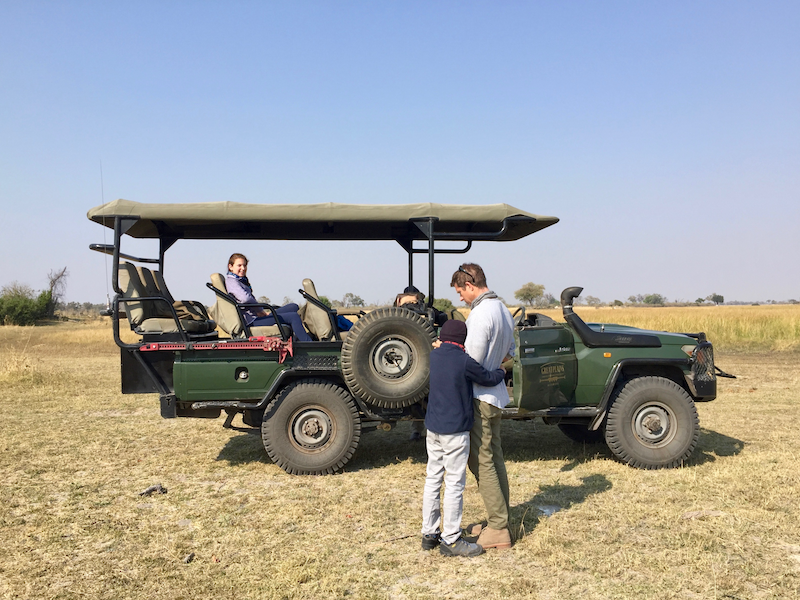
    Author and husband on safari

    Safari Clothing Packing List:

    2 x base layers (tank or short-sleeved shirts)
    2 x mid-layers (lightweight and long-sleeved, neutral colors)
    * 1 x fleece (neutral color)
    * 1 x lightweight puffer (I like this one from Patagonia because it folds down to the size of a paperback)
    1-2 linen shirts and/or shorts or, for women, a wrinkle-free dress (for evenings around the firepit comparing wildlife sightings, also doubles as a nice outfit for layover city days)
    2 x lightweight pants (zip-off ones are popular; I don’t know why)
    Buff (for dust, flies, and keeping hair off your face—the uses of a good buff are endless)
    2 x sports bras 
    7 x underwear (many lodges have complimentary laundry)
    7 x socks (at least two thicker and longer pairs to go over pants if on a walking safari or a trek in Uganda. Otherwise, prepare to meet the local fire ant community.)
    Hat (wide-brimmed to protect your neck and, yes, neutral)
    * Hiking shoes (broken in, in advance)
    Closed-toe shoes or sneakers 
    Flip flops (for hanging around the pool)
    1 x bathing suit (it’s tempting to take more—don’t. This isn’t Cabo.)

    * Splurge-worthy item


    Click here for my free ‘Ultimate Africa Safari Packing Lists’


    lion on Canon camera

    Gearing Up

    The right gear is integral to a safari experience, especially for wannabe wildlife photographers, bird nerds, and travel bloggers. But gear is cumbersome. Choose what to pack with care. Unless you’re applying for a job at Nat Geo, an iPhone may suffice—they take beautiful photos. My go-to is a combo—an iPhone (hanging from a lanyard around my neck at all times) and a Canon Rebel SL2, which is lightweight, user-friendly, and has WI-FI capabilities so I can post to Instagram in real-time. 

    Safari Gear Packing List:

    * Luggage (Eagle Creek is my go-to choice; this is my pick)
    Packing cubes (Eagle Creek packing cubes have endless uses: toiletries for plastic-free countries, dirty laundry, souvenirs)
    iPhone and charger
    iPhone lanyard (Somewhat dorky, yes—but you’ll thank me when baboons don’t steal your phone)
    * Camera and lenses (one good zoom will do—they’re expensive, consider renting one)
    Extra battery and/or SD card
    * Binoculars (sometimes provided, but having your own is worthwhile—these are the ones I use)
    Sunglasses
    Day pack (for your gear)
    Universal Travel Adapter (this is the one I have)

    * Splurge-worthy item

    White rhinos in Africa

    Little Things Count

    Don’t let the length of the following list scare you. In total, these self-care items take up less space than that extra pair of shoes you won’t wear. But little things count—especially things that protect our bodies and minds in one of the most unforgiving places on Earth.

    Safari Self-Care Packing List:

    Sunscreen (transferred into CVS travel-sized containers you can dispose of as you go)
    Lip balm with SPF
    Insect repellent (The National Capital Poison Center recommends a concentration of DEET no higher than 30%)
    Eye mask (this one is my go-to)
    Ear plugs (although the nightly chorus of wildlife is a highlight of safari) 
    Prescription meds (cute pillboxes are all the rage)
    Small medical kit (a nod to my paramedic husband, who doesn’t go to Safeway without one)
    Feminine products (because there’s no CVS in the Okavango Delta)

    Landscape

    Less is Less

    It’s human nature to be overprepared, especially in a place as foreign and remote as Africa. If you’ve chosen a reputable safari outfitter with your travel advisor, then you need not worry. Anything critical you may have forgotten will be taken care of. Strive to pack less. Make a carry-on bag a goal. Feeling unencumbered on a trip with so many moving pieces is liberating. 

    But no matter what you pack in, some things don’t belong on a safari in Africa. 

    What Not to Pack Packing List:

    Perfume (or creams/moisturizers with a strong scent that will attract or repel wildlife)
    Fine jewelry (the rhinos don’t care how many David Yurman bangles you have)
    Plastic bags (some countries, like Rwanda, are polythene-free)
    Dressy clothes and shoes (safari is decidedly casual)
    Drones (restricted in many African countries)
    Hair dryers (most lodges will have them)
    Anything you haven’t worn in the last 12 months (you think you’ll wear it in Africa—we all know you won’t)


    Click here for my free ‘Ultimate Africa Safari Packing Lists’


    Cheetah portrait

    Prepare to see the Unexpected

    One of the best things about an African safari is that anything can happen. One day, you might come across a pride of lions feasting on a wildebeest. On another, an elephant might stroll through your camp during lunch. At night, you may hear a pack of wild dogs on the hunt or discover a bush baby running circles around the inside of your tent.

    These moments define the experience—the moments you’ll retell at the firepit at night. Safari is fueled by adrenaline. Those who choose to go on safari are a self-selecting group of adventure seekers. Where the unexpected is expected, even sought out. Otherwise, we’d just go to the zoo.

    And while surprises are part of the thrill, some aren’t welcome. A few tips follow, most of which I learned from experience. 

    monkey in uganda

    Safari Travel Tips

    Luggage tip: Space in a carry-on bag is limited. So wear your heaviest items on the plane when possible. This includes hiking shoes and your fleece or puffer. You can read more about how I pack and my general packing tips here.

    Safari Planning Tip: Using a travel advisor to plan a safari makes it a stress-free experience. They work with the most well-known and reputable outfitters and can access perks and surprises you won’t get if you book it yourself. I use CIRE for all of my travel bookings. To learn more about why I use a travel advisor, read my post, “Who Needs a Travel Advisor? It Turns Out I Do.”

    Visa, vaccine, and passport tips: Travel advisors will be on top of the visa and vaccine requirements, but checking in advance is helpful. While you’re at it, make sure you have at least six months and one or more free spreads of passport space from the departure date of your trip.

    Clothing tip: As mentioned earlier, wearing neutrals is vital. But why? Colors to avoid wearing include red, yellow, orange, black, dark blue, and camo. Each of these colors has its own set of issues. In many African countries, camouflage is strictly reserved for the military. Dark colors attract tsetse flies, while bright colors make you look like prey. (Looking back at my color choices in 2002, it’s remarkable I’m alive.)

    Silverbacks

    Laundry tip: Many luxury lodges and tent camps include daily laundry. This removes the need for more clothes (and too many pairs of underwear). Get over the fact that you may wear the same pants five times. At least they will be clean. And nobody but you will notice anyway.

    Gear tip: Bring a small daypack in the Land Rover each morning. It’s a safe place to keep all those layers tidy and dust-free for future use.

    Tipping tip: If tipping makes you uncomfortable and anxious, consider choosing an outfitter that includes all gratuities. While the embedded tipping costs most certainly increase the cost of the trip, there are no awkward moments or need to fumble with local currency.

    Insurance tip: A must. Don’t leave home without it.

    Sunset Africa

    What is the Purpose of this Day?

    We wake up at the crack of dawn. It’s still dark. The only sounds I hear are buzzing insects and the rustle of leaves in the breeze. Without speaking, the four of us trudge to the jeep, where our guide, Foster, waits with a wide smile. He looks at my 13-year-old daughter, who’s radiating snarky, salty tween vibes. She’s not smiling.

    “What is the purpose of this day?” Foster says to her in a slow, enchanting baritone. With sleep in her eyes, Ella looks up. I look up, too. Ella doesn’t know. I don’t know. Who thinks about things like that? Foster does.

    But I want to know. I’m guessing Ella does, too, based on how quickly she hops in the jeep. Foster revs the engine, and we set out to find the purpose of this day. It’s somewhere out in the Okavango Delta. The best journeys answer questions you never knew to ask. Keep asking, Foster. We’re all listening.


    Click here for my free ‘Ultimate Africa Safari Packing Lists’


    (Please note some affiliate links above. I may receive a small referral fee should a product be bought through my site, but rest assured, I only highlight products I own and would buy for myself.)

  • Taking on the Medina, and More—What To Do In Marrakech

    Taking on the Medina, and More—What To Do In Marrakech

    What To Do In Marrakech, A Guide / 

    Were it up to me, The Caliph’s House by Tahir Shah would be required reading for anyone traveling to Morocco. Without reading this candidly funny novel, I would’ve been confused, baffled, and bewildered during our visit to Marrakech.

    After spontaneously moving his family to Morocco from the UK, Shah buys a home—the Caliph’s House —and begins the arduous task of renovating it. At the same time, he’s attempting to rebuild his family’s lives in a foreign country. They learn all too quickly that nothing in Morocco goes exactly as planned and never in a time frame that makes outward sense.

    Rational and irrational thinking collide in a whimsical and often unbelievable manner. I laughed out loud throughout the book, loving the effervescent and colorful prose.

    Marrakech buildings

    Magical Arrivals

    Shah’s story lingers in my mind as we exit the doors of Marrakech Airport, a piece of jaw-dropping architecture worth a visit in its own right. Our task? To locate our hotel sign among the several hundred Moroccan taxi and limo drivers. I think the logo, an iconic fan, should be pretty easy to spot.

    My husband and I take several loops of the crowd together. Then, we split up and took a few solo loops. No sign. No driver. Eventually, we stand at the center of the crowd, which forms a circle around us—a five-minute lapse. Then a strange thing appears on my left—a very large sign on a very tall stick with a very black fan logo. Our driver has materialized, seemingly out of thin air.

    I ask him where he’s been all this time. With absolute surprise and genuine sincerity, he replies, ‘Madame! But I have been standing right here the whole time!” My husband and I look at each other in disbelief. Then I remembered Shah’s story and relaxed. There’s no point in arguing with him. He’s been here the whole time, of course. We must have overlooked him. So begins our journey in Marrakech.

    Be the first to know when I find a new place to get lost. Just click.

    The souks

    What To Do In Marrakech: Get Lost In The Souks

    I have a list of adjectives that illustrate Marrakech—vibrant, eclectic, bustling, electric. However, the buzzy current of the Berber Empire is much more than what is seen on the surface. So what do we do during our week ahead in this energized city?

    First up is the Medina—the old walled medieval part of town. The Medina is a dense maze of Moroccan capitalism with a photo op at every turn. I learned that the souks (markets) are not solely for souvenir shopping. As I wander the narrow passageways, I see layers of activity.

    I stumble upon an entire alley of shoemakers. Each stall was about as wide as the shoemaker himself. In a series of memorized movements, he hammers, cuts, and then casually tosses the leather soles into a pile of identical soles. Another alley has lantern makers. The artisans punch through thin copper to create delicate pieces as they’ve likely been doing for a century. While it looks like a performance for tourists, it’s simply everyday life.

    Rug shop in the souks Elderly lady selling spices Woman selling spices

    What To Do In Marrakech: Hire A Guide

    We hire a private guide, knowing he will take us to his brother’s uncle’s best friend’s rug shop. His predictability makes me smile. Yet, how would we see market life in full swing without him? The haggling and negotiating. The rug seller’s touristy ceremonial show, with steaming hot mint tea. We’re told to go back the next day without a guide if we find something we’d like to buy. We will likely get a better price since no commissions will need to be paid—an insider tip.

     The ornate Bahia Palace The ornate Bahia Palace colorful light

    Our guide steers us towards beautiful architectural gems, including the ornate Bahia Palace. He secures a reservation at a lively rooftop restaurant and gives us enough sense of local history that we aren’t walking nose-deep in our guidebook. 

    Stalls in the Medina Stalls in the Medina Lantern shop in the Medina Stalls in the Medina

    We buy local argan oil from sellers promising eternal youth and an end to age spots and smell colorful spices waft through the air. Snake charmers fleece us after draping cobras around our necks, refusing to remove them until a suitable price is paid. We love every minute of the chaos (even the snakes) and give props to his entrepreneurial skills. 

    Lunch at Nomad restaurant

    What To Do In Marrakech: Eat Above The Markets

    Restaurant Nomad’s entrance is in the Medina’s dark, narrow corridor. We climb an equally dark, narrow staircase, wondering if this is really where we want to have lunch. We reach a door and then immediately shield our eyes. The sun is high in the sky above us on Nomad’s exposed rooftop patio overlooking the Medina.

    We are handed straw hats to deter the sun and settle into our seats as if on cue. We observe the markets from above and feel fortunate to have secured such a prime spot to eat. The food was classic Moroccan, with mezze platters and yogurts, house-marinated olives, tagines, and traditional briouat (savory puff pastry filled with meat, cheese, lemon, and pepper). A long, leisurely lunch ensues.

    Terrasse des Epices lunch

    Terrasse des Epices

    And while we love Nomad, we enjoy the next day’s rooftop lunch even more. Terrasse des Epices is a hot lunch ticket, with crowds from morning until night. Terrasse des Epices has sheltered alcoves to sit and absorb the convivial scene. The clientele is a mix of families and hipster tourists. A Moroccan DJ from Essaouira is set up in the middle of it all, dancing and having the time of his life.

    Our DJ doesn’t miss a beat and plays new remixes of old classics that inspire even the 40-somethings on the terrace. No one looks like they have any desire to leave. This may be partially because Terrasse des Epices is one of the only restaurants within the Medina walls to serve alcohol. We order a bottle of rosé and stay put for a while.

    Be the first to know when I find a new place to get lost. Just click.

    The Mandarin Oriental Hotel exterior The Mandarin Oriental Hotel pool villa exterior

    Grounds of The Mandarin Oriental

    What To Do In Marrakech: Stay At The Mandarin Oriental

    When traveling a city, we typically spend the morning wandering and sightseeing, have lunch, and then head back to our hotel to lounge for the afternoon. We chose the Mandarin Oriental, 10 minutes from the city center. It’s an enormous and tropical property, and we feel far from the hustle of town. The hotel has 54 stand-alone private villas, most with private pools in walled courtyards.

    The Mandarin Oriental Hotel lobby The Mandarin Oriental Hotel lobby

    The entire property is alive, with rose bushes in full bloom. 100,000 fragrant roses are spread over 20 hectares, and we admire them one afternoon via the hotel’s complimentary bikes. Bougainvillea, golden barrel cacti, climbing vines, and mature olive trees dot the landscape.—an explosion of flora.

    The hotel design is modern Moroccan decor: bold, graphic lines, black and white marble, tall, narrow archways, and shallow inner courtyard pools.

    Pool villa   Pool villa bedroom  Pool villa courtyard Pool villa jacuzzi

    What To Do In Marrakech: Don’t Leave The Room

    Our room feels like a home—but not my home, mind you. It has a living area with a daybed and a bar. A platform bed in the master suite looks squarely onto a long rectangular pool. The oversized bathroom has a personal hammam-style shower and a deep stand-alone tub.

    The outside space also boasts a daybed, an outdoor kitchen, and a beautiful fireplace the staff will light upon request. It’s a challenge to pull ourselves away for dinner. 

    Al Fassia dinner

    What To Do In Marrakech: Dine at Al Fassia

    Another Caliph’s House moment presents itself at dinner. I’d made a few early reservations, and Al Fassia, an all-women-run restaurant, was high on my list. I know there are two locations, so I’m sure to be clear about the location we would like to go. Fifteen minutes later, we are dropped off at Al Fassia.

    It’s a tranquil oasis—lush, romantic gardens and outdoor nooks. We walk in and give our name only to discover, you guessed it, we are at the wrong Al Fassia. And no, this location has no available tables this evening.

    We call another taxi and head to the other Al Fassia. The food is good, but the first Al Fassia would have been a better choice, as it was in a less urban environment—another exercise in patience in the frenetic world of Marrakech.

    Butcher in the Medina The Medina The Medina archways

    What To Do In Marrakech: Shop and Haggle

    The following day, we shop. We aimlessly wander the ancient passageways, picking up souvenirs for our families at home. While waiting for my friend to pay at a nearby stall, I stand against a wall to take in the whirlwind of market life. Perhaps, only because I’m not moving do I notice an interesting shop set further back from the others.

    I walk into a treasure trove of beautifully curated art pieces, ceramics, textiles, furniture, and rugs. Old and new, Moroccan and Persian—it’s a visual explosion. Hakim is the owner, and his warm and friendly manner entertains us as we shop. Hakim prepares tea for us. It has thick bundles of mint leaves overflowing from colorful rattan-wrapped glasses. It’s a welcome respite from the bustle of the souks.


    Click here for a self-guided tour of the souks! The best way to uncover the Medina’s secrets!


    La Porte D’Or shop Mint tea at La Porte D’Or

    A Story of Two Paintings Bought Six Years Apart

    Hakim’s hidden shop is called La Porte d’Or. His clientele includes interior designers, politicians, and celebrities who seek him out from across the globe. 

    My husband and I immediately zero in on a piece of art—a mixed-media piece with old, sepia-tinged pages floating amidst calligraphic Arabic typography. As is expected, we haggle and get to a price we can all live with. Then, I notice another piece by the same artist—the perfect companion to the one we are about to buy. I ask Hakim for the price, and he says it’s not for sale. I smirk. He’s kidding, of course; isn’t everything for sale here? 

    Artwork

    But Hakim holds firm, and we walk out with just one piece of art. For years after, Daniel and I have always wondered about that piece and why he wouldn’t sell it to us. 

    Scrolling Instagram six years later, I notice a friend from New York is in Marrakech on vacation. I DM him a shortlist of must-see spots, including Le Porte D’Or. I joke that if he sees Hakim, to tell him I’ve never forgotten about the artwork he refused to sell. 

    Within the hour, my friend is not only in the shop but has found our long-lost piece of art. After some haggling, a WhatsApp exchange, and a wire transfer, the art we’d fallen in love with in 2018 is bound for DC. I’m again reminded of the whimsy and serendipity of The Caliph’s House. The magic of Marrakech can’t be underestimated.

    The Royal Mansour The Royal Mansour detail The Royal Mansour gardens The Royal Mansour gardens

    What To Do In Marrakech: ‘Enjoy’ A Hammam Experience

    We’re told not to miss a hammam treatment (a traditional Moroccan cleansing and bathing ritual). A friend had recommended traveling to the spa at The Royal Mansour, although most hotel spas offer the hammam treatment.

    If Marrakech is a city of high-density, magnetic, and outrageous color, then the spa at the Royal Mansour is quite positively the total absence of it.

    The Royal Mansour hammam/spa

    I step through a dark, thick, wooden doorway and enter a world of double-height glass cathedral ceilings and white roses—set within a room of white wrought-iron latticework. It’s a stark contrast to the vibrancy of life outside. Then, I’m led to a lounge with cushy daybeds where I await my therapist. 

    The Royal Mansour hammam/spa white roses

    The Royal Treatment

    The treatment itself leaves my skin feeling like a newborn baby. First, I lay on a hot slab of marble where the therapist scrubs off layers of unwanted skin with an abrasive Kessa mitt. Next, warm water is poured (actually thrown) all over me. 

    A massage with various therapeutic oils is next, followed by an eye-popping cold water plunge that brings me back to reality. I’ll admit, it’s an unusual way to get pampered. Yet, I felt shockingly invigorated. The treatment awakens senses I didn’t even know I had.

    Man in the Medina Horse and buggy

    The Magic of Marrakech

    Marrakech is a city of layers, each revealing something unique and mesmerizing. I realize I’ve only just begun to scratch the surface. In hindsight, I wish I’d stopped more often to absorb it. Marrakech was constantly in motion, and I was too often caught in the wave. 

    Ceramics shop Souks detail

    Tahir Shah and his family had a year in Morocco to discover the culture, explore the country, and immerse themselves in the local traditions. We have two weeks. But I thank Shah for preparing us for the time we did have there through humor, candor, and wit. For allowing me to laugh things off that would have otherwise frustrated me.

    Marrakech is a city to unwrap, like a treasure. Perhaps one day, I will have another chance to explore it.

    The Caliph's House

    Book It:

    The Caliph’s House charts a year’s journey of Tahir Shah and his family. They uproot their lives by leaving dreary London for Casablanca’s colorful, captivating world. Funny, candid, and insightful, I couldn’t have enjoyed my trip to Morocco nearly as much if I hadn’t read this memoir first.

    Bonus: Take On The Countryside

    The scenic Atlas Mountains are only an hour outside of Marrakech. What better way to combine a little countryside with our busy city experience? Our next stop? The decadent and low-key  Kasbah Bab Ourika. Follow me there.

    Mandarin Oriental pool view

    (Please note a few affiliate links above for which I may receive a small referral fee. But rest assured, I only highlight products I fully stand behind.)

  • Uganda, what to see beyond the famous silverback gorillas

    Uganda, what to see beyond the famous silverback gorillas

    What to see, where to stay, and what to do, in Uganda / The famous silverback gorillas are certainly what put Uganda on the map for tourism. And rightly so, as it is the only part of the world where one can see these peaceful, majestic primates. There are none in captivity, so in order to spend any time with them, one must be prepared to travel far. And travel far I did, for a fleeting two hours observing them that I wouldn’t trade for anything.

    Silverbacks

    Yes, two hours. Each gorilla permit afforded me exactly sixty minutes with the silverbacks. So, what is there to do with the other 23 hours of the day? A lot, it turns out. Uganda has much more to offer tourists than the mighty silverbacks.

    Silverback and baby

    But there is far more to see in Uganda beyond the silverback gorillas. There are traditional safaris to admire the famous climbing lions of Ishasha, for example. Or, sighting the elusive shoebill in the Mabamba Swamp. A boat ride to an island of rehabilitated chimpanzees in Lake Victoria.

    Breakfast in Ishasha

    What to do in Uganda: A Wild Frontiers Safari

    Wild Frontiers was our tour operator, the frontrunner for gorilla tracking and safaris in Uganda. They helped us come up with a bespoke itinerary, secured our coveted gorilla tracking permits, and allowed for some flexibility on the ground. Flights, logistics, and accommodations were well organized and generally worked like clockwork. This is Africa, after all.

    sunset

    Our guides, lovely, warm-hearted locals, had studied for years to be able to tell the difference between the sound of a great blue turaco and a green-breasted pitta. Or, to be able to spot an African fish eagle from a kilometer away. They could drive for hours on end and still have the energy the next morning to prepare a pop-up omelet station on the plains.

    Breakfast in Ishasha

    We were in constant awe of the Ugandan guides and their wealth of knowledge about the wildlife, flora, and fauna, of their country.

    What to see in Uganda: Equatorial Entebbe

    Uganda is a landlocked country in eastern Africa. The small city of Entebbe, about 20 miles from the bustling capital of Kampala, is where Uganda’s only international airport resides. Entebbe sits on a peninsula on the northern shore of Uganda’s largest lake, Lake Victoria.

    Ngamba Island Chimpanzee Sanctuary

    We crossed the lake, and directly through the equator, within three hours of arrival, on the way to visit the Ngamba Island Chimpanzee Sanctuary. The lake seemed angry, and our little boat was tossed around violently for nearly an hour. Spray came at us from every angle, the boat pounded the waves. My eyes remained firmly shut to keep nausea at bay. Uganda—unpredictable from the start.

    Chimpanzee

    What to see in Uganda: Hungry, howling chimps

    We arrived at the sanctuary, bedraggled, and soaking wet, and set off to see the 49 orphaned chimpanzees who roam the 40-acre island. That’s in comparison to the single acre allotted to the humans who work there and rehabilitate them. The chimps come to the barrier four times a day for food, and then slowly slink back into the overgrowth until the next feeding.

    Chimpanzees

    Although the feeding ritual was exciting, we were glad we didn’t plan it after our gorilla tracking later that week, as it seemed a much more commercial endeavor. We were happy to see that the orphaned chimps were well cared for, in a safe environment, and had access to medical attention should they need it.

    Boutique Hotel No. 5 Fruit plate

    Where to stay in Uganda: Hotel No. 5

    Our boutique hotel, called No. 5, was hidden in a local neighborhood less than a ten-minute drive from the airport. Here, I was to spend two nights before heading off on my own to Queen Elizabeth National Park. From there, I was to meet up with my friend at our lodging in the Bwindi Impenetrable National Park to start tracking the gorillas.

    Boutique Hotel No. 5

    Each of the ten rooms at No. 5 faced a lush, intimate, courtyard, with overgrown tropical trees and plants. There was a charming pool set below the veranda where we would have meals and pre-dinner drinks while listening to the ongoing birdsong.

    Boutique Hotel No. 5 bedroom

    The rooms were modest, clean, and airy—the gauzy mosquito netting over the beds seemed more for show than necessity but did look quite pretty. Small balconies were a nice touch, a place to sit and listen to the hum of the surroundings. In the early morning, I heard the daily call to prayer as I drifted dreamily in and out of sleep.

     Boutique Hotel No. 5 lunch

    Although the menus and meals were very nice at No. 5, they were surprisingly formal, a bit too heavy, and geared toward foreigners. This became a slightly disappointing theme at the various lodges we stayed at, and if I were to do it again, I would ask for more local Ugandan preparations as menu options.

    Wetlands of Mabamba

    What to see in Uganda: The Mabamba Swamp

    While my friend worked for the few days we were in Entebbe, I took advantage of being alone with a guide and my camera. Wild Frontiers helped organize a boat trip through the wetlands of Mabamba. There, I spontaneously turned into a full-fledged bird geek. Don’t judge.

    Egret Egret Egret

    I saw statuesque egrets, metallic blue malachite kingfishers, and weightless African jacanas, to name a few aviary stand-outs.

    Egret

    The jacanas are often referred to as Jesus birds for the way they appear to walk on water. They have a uniquely evolved prenatal care system, and can often carry multiple babies under their wings at once. I was lucky enough to capture this maternal moment in real-time.

    African jacanas African jacanas African jacanas

    What to see in Uganda: The most famous bird you’ve never heard of

    The prehistoric-looking shoebill, named for its big, clunky bill, is endangered, and numbers only twelve total across the entire 2500-hectare swamp.

    Shoebill

    Having never heard of the shoebill, I wasn’t too bothered about finding it, but as beginners luck would have it, we saw one within the first ten minutes of the four-hour boat ride. Even my guide was thrilled to see this elusive and reclusive specimen and reached for his own camera to capture it among the reedy, wetland grasses. I was told it is one of the top five most sought-after birds to spot in Africa. Bucket list bird: check.

    Shoebill

    The Prettiest, Ugly Bird

    A few fun facts about a bird you also may have never heard of: shoebills can grow as tall as four or five feet when fully grown; they lay only two eggs, and after a year, kill the weaker one; they can remain motionless for extended periods of time stalking their prey. The idiom, ‘beauty is in the eye of the beholder’ came to mind as I thought it was, perhaps, the prettiest, ugly bird I had ever seen.

    Malachite kingfisher

    What to do in Uganda: Get local

    Instead of driving back to Entebbe from the wetlands, my guide suggested we take a car ferry across Lake Victoria. Flashbacks to yesterday’s tumultuous journey stirred in my mind, but in the name of adventure, I decided to go for it. Lake Victoria, thankfully, was much calmer, and I was able to cross with my internal organs completely intact.

     Ugandan kids Ugandan kids

    On the way to the ferry, I caught glimpses of rural Ugandan life: little girls danced in open wooden doorframes flaked with colorful paint; women peeled green bananas for makote (cooked plantains), toddlers shaved sugar cane with pangas (machetes). Mopeds kicked up clouds of red dust along the unpaved roads. Vegetable stands, roaming goats, pigs on leashes, women with bushels of fruit on their heads—an evolving portrait of village life.

    Ugandan kids Ugandan kids

    While waiting at the Nakiwogo ferry dock, I was swarmed by fresh-faced and bright-eyed Ugandan kids. We took a few selfies, and they laughed at seeing themselves on screen. Teens played soccer with empty soda cans, dogs chased their own tails, and mothers fed infants while chatting with friends. That time was a gift. Quietly, I observed the villagers and thought to myself how I’d forgotten how often the simplest things in life are the best.

    Two Friends Restaurant

    Where to eat in Uganda: Two Friends

    Local knowledge, as they say, trumps all, which is how we found Two Friends, a restaurant situated squarely on the banks of Lake Victoria. With a convivial, remote, rustic island vibe, dangling strings of twinkling tea lights, and a menu of freshly caught Lake Victorian fish, Two Friends was a hidden gem.

    Two Friends Restaurant

    Our fish came baked in green banana leaves, served in tin foil, with all of the savory juices to mop up with the rice and veggies. The meal for three, (actually four, as we sent our idling taxi driver his meal, too) and a bottle of wine came to the economical total of $60 USD. It was one of the best meals of the trip, made most memorable by its laid-back and carefree atmosphere.

    Bush plane

    Solo travels

    The next morning, I boarded a bush plane at Entebbe Airport and flew two hours to the Kihihi Airstrip located just outside of Queen Elizabeth National Park. Having never traveled solo before, I was both exhilarated and anxious. Moments after touching down, I met my guide Echy, and any fears I had dissipated. I was reminded of a Ted Talk by Ken Robinson, who advised, ‘Walk towards things that worry you.’ I started to walk.

    gray crowned cranes gray crowned cranes

    The safari begins

    On our first game drive, late that afternoon, Echy discovered a tree with a flock of gray-crowned cranes perched upon it. One by one, these magnificent birds flew effortlessly across the savannah, over the acacia and fig trees, and towards the descending sun.

    gray crowned cranes

    Also known as the crested crane, it is the national bird of Uganda, and its likeness sits proudly on its flag. Due, in part, to poaching, it is now sadly on the endangered species list and numbers less than 20,000 in the country.

    gray crowned cranes

    This majestic bird is distinguished by its head of rigid, golden feathers that look like the crown for which it is named. A large, fire-engine red throat pouch makes it especially easy to recognize.

    Ishasha Wilderness Camp Ishasha Wilderness Camp

    Where to stay in Uganda: Ishasha Wilderness Camp

    Remembering how much I had loved tent life while in Botswana a few years ago, I was excited to get to Ishasha Wilderness Camp, which is located inside Queen Elizabeth National Park, along the Ntungwe River.

    Ishasha Wilderness Camp

    The ten permanent canvas tents are rustic, yet have everything needed to enjoy wilderness life. Each tent had a wide, stone, porch with two chairs facing the lazy river.

    Ishasha Wilderness Camp elephant Vervet monkey

    The porch felt like a front-row IMAX theater seat for BBC’s Blue Planet. A few meandering and thirsty elephants drank from the river just a few hundred yards away. A troop of cheeky vervet monkeys ran circles around my tent, both skittish and curious at the same time, scooping up their rebellious babies in an all too human-like way.

    Ishasha Wilderness Camp Ishasha Wilderness Camp dinner

    The large, thatched-roof common area was ambient, and open-air, to the river. Here, even more, elephants came to share an afternoon sundowner with us.

    Ishasha Wilderness Camp Ishasha Wilderness Camp

    It was also where we had our meals. Being solo, I was paired with another lone traveler named Matthew—a charming headmaster from Botswana and an avid birder. Matthew became my safari partner-in-exploration for the following two days.

    ‘You won’t believe what I saw!’

    One of the best parts of being on safari is coming back to the lodge after a game drive to compare sightings and photos with other guests.

    Wildlife Wildlife

    Our camp had a magnetic board so we could place markers where we had seen various wildlife each day. Depending upon who you were comparing notes with that evening, the stories sometimes became a game of oneupmanship.

    Kob Kob Kob

    What to see in Uganda: Ishasha

    At Ishasha Wilderness Camp, as opposed to No. 5, the mosquito netting was less for show, and more out of need. Yet, as a point of comparison, I have been bitten by more mosquitos while walking my dogs in DC than in my entire ten days in Uganda.

    Sunset

    As is typical at safari camps, I was not allowed to wander back to my tent unsupervised, as the animals roam freely. No argument here. But the loveliest sounds were at night when the animals were awake, and I was tucked warmly under the covers listening to the chorus of wildlife. It was truly a shame when I finally dozed off, as hard as I tried not to, leaving the animal world behind until the morning.

    tree climbing lions tree climbing lions

    What to see in Uganda: Tree-Climbing lions

    Queen Elizabeth National Park’s claim to fame is the tree-climbing lion. They are an unusual phenomenon, as lions are not adapted evolutionarily to scale trees, like leopards, for instance. Queen Elizabeth National Park is one of only two places in the world where these rare lions can be found, the other being southern Tanzania. It is widely thought that the reason for their climbing is to escape not only the pesky flies but the severe temperatures.

    tree climbing lions tree climbing lions

    While lucky enough to spot a few of the beautiful lions, they simply refused to do any of their famed climbing. Content, we watched them lazing on the ground. The male lions of Ishasha are notably dark-maned, making them look even more magnificent and regal.

    Sundowner Sundowner

    What to do in Uganda: Sundowner on the plains

    There is nothing quite like sunset drinks on safari. After hours of being in a vehicle, bumping along dirt paths, it is a chance to embrace stillness and absorb the surrounding sounds. We spent an hour on the edge of a steep rift, overlooking the lush yellow and green valley below. Gin and tonic in hand, I was in my happy place.

    Kobs

    In the distance, elephants roamed, their trunks raised to grab leaves from the trees. Kobs glistened, golden and glorious, in the light. The sun tightened its grip on the landscape, wringing out the last rays of light, and casting vivid colors across the valley.

    Sunset

    As if on cue, the sun hovered behind a spindly tree, which created an eerie, stark silhouette against the blood-red sky.

    Always expect the unexpected

    Every game drive is unique, which is likely why guides never get bored with their jobs. The morning I was to leave Ishasha to meet my friend in Bwindi, was one of those unexpected experiences I should have expected.

    The drive was two hours, including 45 minutes to exit the boundary of Queen Elizabeth National Park. Five minutes or so into our journey, Echy jerked the jeep to a screeching halt. I did a quick scan, there was nothing to see, no animals, no movement.

    Martial Eagle

    He reversed five yards, and off to the right of the jeep, camouflaged in the tall wispy grass, was a martial eagle sitting on the ground, completely still. Echy whispered to us that the eagle was strangling its prey.

    Martial Eagle

    We sat silently. The eagle’s intense, beady, yellow eyes pierced through us like daggers. He was certainly not going to give up his catch on our part. A few minutes later, he flew off to a nearby dead tree to keep watch and protect his kill.

    Martial Eagle Baby kob

    A dead baby kob, (antelope), curled up in a fetal position, lay in his wake. The kob had likely been sleeping while its mom went out to find food, but was discovered by the hungry eagle. A sad, yet realistic portrait, of the animal kingdom. How Echy spotted the eagle while cruising along at 30 mph mystifies me to this day.

    Hyenas

    Final Notes

    I was giddy from the sighting, my first ever real-time kill, so I didn’t notice Echy speaking to the driver of a passing jeep. The other driver mentioned seeing two hyenas out hunting but had unfortunately lost the trail.

    Hyenas Hyenas

    Using what can only be described as ‘Spidey-sense’, Echy looked to the distant sky, saw vultures circling, and had a hunch. He threw the jeep into gear, and lo and behold, quickly found the two hyenas devouring their freshly caught prey—another poor kob.

    Hyenas

    The scene was spellbinding; the light, luminous, and the pond, seafoam blue. The kob was bloody and torn to shreds. We listened to the sound of bones being crushed by the hyena’s unyielding jaws. The vultures tried to close in but were steadily kept at bay. When the hyenas were finished, they knew all too well there would be nothing left.

    There is a world of adventure beyond the silverbacks in Uganda. Thank you, Echy, for showing it to me.

    Be the first to know when I find a new place to get lost

    Click here. Know first.

  • The Mighty Silverbacks of Uganda: How To Find Them

    Last January, I received a text from a friend of a friend: ‘Happy New Year! Would you like to go gorilla tracking with me in Uganda?’ I stared at the screen for a nanosecond and wrote back, ‘Yes!’

    A nanosecond later, I wrote, ‘Wait… what?’

    So began nine months of planning that would eventually take us to see the indigenous Batwa Pygmies, through dusty local villages, over the golden savannah of Ishasha, into the Bwindi Impenetrable Forest, and ultimately, to the magical moment of finding our first family of silverback mountain gorillas.

    View from plane

    Sabotage

    Even a few weeks before our trip, I still couldn’t believe that I was going to Uganda. Sabotage seemed to follow from the start. In March, the plane on which we were supposed to be flying, the Boeing MAX 737, was grounded after mechanical failures led it to crash.

    In April, a solo female traveler and her guide were kidnapped in Queen Elizabeth National Park, held for ransom, then released. As if that weren’t enough, the tour operator connected to the unfortunate kidnapping issue was, you got it, the one we had hired.

    Nevertheless, we remained on track, convinced that we would make it home with a few wild stories to tell. My husband started saving ransom money—just in case.

    Bwindi landscape

    Finding the silverbacks

    Nine months of planning had led up to these next few days, the inspiration and impetus for the trip—tracking the silverback gorillas. In the two-hour drive from Ishasha, (where I had spent the previous three nights) to Bwindi, the landscape shifted so dramatically that I could have been in an entirely different country.

    Bwindi landscape

    The Bwindi Impenetrable National Park and its surroundings are a never-ending panorama of steep, rounded hillsides, interlocking and overlapping in muted shades of green. Dense foliage replaced the vast golden savannah of Ishasha. Clusters of trees and steep, verdant tea fields took the place of flat, open vistas.

    Bwindi landscape

    A heavy mist enshrouded the landscape, and then suddenly the sun would break through. The rainforest did not disappoint.

    Bwindi is accessible only by foot, and is home to nearly 400 silverback mountain gorillas over 124 square miles. It is protected and owned by the Uganda Wildlife Authority and is a World Heritage Site. An impressive resume, indeed.

    Buhoma Lodge

    Family vibes

    Echy, my Ishasha guide, delivered me to Buhoma Lodge, which immediately felt like a home away from home. Not fancy or modern, it nailed the unassuming, homespun vibe I was hoping for during our few days of gorilla tracking. Buhoma Lodge and Sanctuary Gorilla Forest Camp are the only two lodges located within the park boundaries. My friend and I decided to spend two nights at each.

    Four nights, two camps

    Although Buhoma Lodge and Sanctuary Gorilla Forest Camp are right beside one another in proximity, they are quite different in many ways.

    Buhoma Lodge Buhoma Lodge

    The rooms at Buhoma ratchet up a steep hillside and required an amount of stair climbing that I hadn’t encountered since the Eiffel Tower. The views of the rainforest from our balcony made the climb worthwhile, and my aching quads eventually forgave me. Good practice for the gorilla tracking ahead.

    Sanctuary Gorilla Forest Camp

    Gorilla Forest Camp

    This differed greatly from GFC, whose eight tents are much lower to the ground, nestled, and virtually secluded in the foliage, and had a much more private, romantic feeling.

    Buhoma Lodge Buhoma Lodge

    Buhoma Lodge

    Buhoma’s effervescent staff acted like extended family, always with a warm smile and polite conversation. My favorite time of day was when everyone would come together after the day’s trek and swap stories like old friends.

    GFC’s staff was a touch more formal and allowed the guests to mingle among themselves. The managers of both lodges were as lovely and warm as the rainforest air and made many daily appearances to catch up with us.

    Buhoma Lodge Buhoma Lodge

    At both lodges, wine was ever-flowing. At Buhoma, hors d’oeuvres were passed and a hanging iron fire pit completed the convivial scene.

    Sanctuary Gorilla Forest Camp Sanctuary Gorilla Forest Camp

    GFC had an inviting nightly bonfire surrounded by a circle of chairs where we would curl up with a blanket, and watch the flames with a glass of wine in hand. An occasional storm would pass by, thunder and lightning in the distance. I felt like we were as far off the beaten path as the world would allow.

    Thoughtful touches appeared at both lodges; at Buhoma, a hot water bottle on the bed at night. At GFC, toasty electric blankets and a large soaking tub.

    Sanctuary Gorilla Forest Camp Sanctuary Gorilla Forest Camp

    Each lodge had convenient charging stations in the common areas so that one would never be caught with a dead battery. GFC offered coffee, tea, and wine service in your tent, and Buhoma’s open-air areas were piled high with coffee table photo books about Ugandan wildlife.

    Sanctuary Gorilla Forest Camp Sanctuary Gorilla Forest Camp

    Both/And When Searching for the Silverbacks

    GFC was a more modern and upscale lodge, overall. The parent company, Sanctuary, is steeped in philanthropy all over Africa, and in Uganda especially. A few of their impressive philanthropic efforts include supporting the Bwindi Community Hospital (which we visited), The Ebenezer Nursery and Primary School, as well as the Bwindi Women Bicycle Enterprise.

    In all of our lodges, we discovered the Ugandan effort to reduce plastic waste. We were encouraged to use reusable water bottles and had access to water stations to refill them.

    Buhoma Lodge Buhoma Lodge Buhoma Lodge

    While both lodges exceeded expectations, I’ll admit, that if I were to go back with friends, I would opt for the more rustic Buhoma Lodge due to its more relaxed vibe. Alternatively, GFC would be my choice if I wanted a more romantic atmosphere.

    Ham, our all-knowing guide, and the Silverbacks

    Our new guide was named Ham, who I immediately adored. Guiding since 1999, he had gentle, soulful eyes, and an understated demeanor. Ham was filled with local knowledge and stories from growing up in western Uganda. He told us that he didn’t get his first pair of shoes until he was twelve years old. I tucked that piece of info away in my head to pass on to my kids as soon as I got home.

    Silverbacks

    The Silverbacks

    The draw of this tiny patch of the globe, where Uganda, Rwanda, and The Democratic Republic of the Congo meet, is the endangered silverback mountain gorillas. There are none in captivity, and only about 1000 are left in the world, all found in this one remote spot. In order to see these noble animals, who, as an aside, share 98 percent of our DNA, I knew I had to be prepared to travel far, hike treacherous terrain, and have oodles of patience.

    Silverbacks Silverbacks

    As you may have guessed, the silverbacks get their name from the saddle of silver hair that develops on their backs as they age. Only the males, who can grow to nearly 500 lbs have this defining feature.

    Scenery with woman

    We had permits for two separate treks. Since we had booked this trip late (by African standards), we could only get permits for the Ruhija park entrance, which was two bumpy, pre-dawn hours away from our lodge. At first, this seemed like a setback, and we tried to change the permits, to no avail. In hindsight, it was a blessing.

    Bwindi landscape

    While the early morning wake-up was painful, the drive to the Ruhija entrance was breathtaking. We were able to watch the sunrise over the hilly tea fields, the sky changing from night to day before our sleepy eyes. We passed women carrying plastic water jugs to the communal wells, farmers tending the land, and the barefoot freedom of kids. All this would have been missed if our permits were at the Buhoma entrance. A serendipitous gift.

    Off the beaten path, literally

    Advance trackers go out in the early morning hours to help locate the meandering gorilla families. They then radio ahead to the main trackers, so that visitors can find them. Even though their whereabouts are generally known each morning, getting to them is still no easy feat.

    Silverbacks

    Gorillas, unfortunately, do not stick to the paths. They roam. Hiking to them required climbing over thick undergrowth, up and around cumbersome tree roots, and dodging biting safari ants, with the help of machetes to carve the way.

    Tracking

    Navigating Silverback Terrain

    Vegetation nearly swallowed me whole, and I lost my footing countless times. Safari ants somehow got to places that defied gravity, despite my pants being tucked firmly into my socks. For $20 USD, I hired a porter to carry my backpack. Money well spent, I thought, as she crushed a few safari ants on my back while I navigated the steep and unsteady terrain.

    Silverbacks

    There are about 13 habituated silverback families in Bwindi, and strict rules govern their viewing. Once we found our family, which took nearly two hours on our second trek, we had one hour to observe and photograph them. ‘Habituated’ refers to the fact that the gorilla family has been exposed to humans for enough time that they react normally in their presence.

    Silverbacks

    Silverbacks—The Bitukura Family

    The moment I saw my first silverback will be forever etched in my mind, no photo necessary. We were tracking the Bitukura group that morning, and came upon the mighty dominant male silverback, Mugisha, sitting on the ground eating shoots and leaves.

    The rest of his family, 12 in total, were mostly arboreal, swinging from the leafy canopy. The juveniles beat their chests (isn’t that a myth?) enjoying forest life. Barely noticing our existence, we were able to get as close as five feet away.

    Jungle Love

    A dense, deep quiet enveloped me and warmed me from the inside out. The only sounds are the rustling of branches, the low guttural grunts of the silverbacks, and the click click click of eight SLRs shooting simultaneously. Our group sat in relative silence, in mutual awe of the experience.

    At times, we jostled for better positioning, and the trackers used their pangas to help us get a clearer view, effortlessly chopping down anything that was in our way.

    And then, just like that, it was over. Our time was up. Who knew an hour could go by that quickly? We reluctantly made our way back to the lodge, thankful we had another day of gorilla tracking ahead.

    Baby silverback

    Silverbacks—The Muzika Family

    Our second trek managed to outdo our first, in the sense that most of the family was on the ground, and in a group, versus leaping from the treetops. The Muzika group was lively and rambunctious that morning, and after two arduous hours of trekking, we were ready to sit and watch the primate show.

    Baby silverback

    The highlight of that day was when the enormous silverback, Muzika, walked right past me, so close that if I had moved my arm at all, I would have felt his bristly hair on my skin. As per our guide’s instructions, I stayed frozen, allowing him to pass.

    Silverback

    Under the dense canopy of the Bwindi forest, the world dimmed. Every so often, a streak of sunlight found its way to the understory, illuminating the foliage, or, if we were lucky, the profile of a gorilla’s face. As much as I wanted to stop taking photos and purely observe, it was a challenging task. The silverbacks are natural models and the clock was ticking.

    Silverback

    Family Life in the Jungle

    Being such familial animals, I witnessed intimate moments between the silverbacks and their young that felt all too human. Mothers cuddling babies up to their faces, juveniles pushing each other around, and human-like grooming, not unlike the Lice Patrol in the DC School System, I thought.

    Silverback

    Silverbacks are distinguished by their nose prints, much in the way we are identified by our fingerprints. Apparently, no two are alike. Even after just an hour with the Muzika family, I could see how the trackers could begin to know one gorilla from another, both through their features, as well as their personalities. And then again, time ran out, and we began our long exit from the forest, happy and sad all at once.

    Airplane views

    Homeward-bound

    Fast forward to three flights and 7,000 Ethiopian Airlines miles. I’m at home, curled up on my couch, searching Verizon FIOS for Gorillas in the Mist. The silverbacks, I imagine, are peacefully roaming the forest, thirty lucky visitors on deck to watch them. Looking back, I am grateful to my friend for sending the text that set this entire experience into motion. Time to look ahead.

    Early Access to what’s hot

    Click here. Be the first to know when I find a new place to get lost!

    Where will you find yourself next? Just click.

    Take on the Medina, and more in Marrakech.
    Sail Croatia and the Adriatic Sea on a beautiful chartered gulet.
    Spend a few nights on a 15th c. village island in Montenegro.

  • Botswana is The Magic Kingdom

    Botswana is The Magic Kingdom

    Why go to Botswana? Traveling to Botswana for a safari with my family remains one of my top experiences. Having the opportunity to see the wildlife of remote Botswana and travel through the vast inlets of the Okavango Delta was life-altering. I hope that Botswana stays as untouched and wild as the week we spent there a few years ago. Read on to discover the magic of Africa, Botswana, and the animals of the Okavango Delta.


    There is no sound I can think of that compares to that of the African bush. Silence. Almost complete silence, except for the distant (and sometimes not so distant) roar of a lion, the slow, steady, padded thump of an elephant, and the crunch of teeth on bone. The chorus of the wildlife.

    What helps make Botswana especially magical is how remote and small you feel: hours and hours, sometimes an entire day, without seeing another soul apart from your guide. I can’t remember ever feeling so happily unplugged yet so blissfully connected.

    Selinda Camp view

    Into the Delta in Botswana

    We arrive by bush plane from Maun, having spent three nights in neighboring South Africa. A jeep picks us up on the tarmac, nothing more than a strip of land in the open plains. Iconic baobab trees, known as ‘trees of life,’ pop up in the distance.

    Giraffes in the distance

    My son asks how long it will take to get to Selinda Camp, our home in the delta, for the next few days. He is eager to start the safari. Little does he know that it has already begun. Two minutes into our drive, we spot a giraffe craning its long neck above the tree line. Hello, Botswana!

    Hippos in Botswana

    From the jeep, we hop into a small boat to take us to camp. We pass a pod of hippos who are visibly unhappy with us for invading their peaceful waters. Our guide, Foster, knows this pod well. He knows their habits and gives them a wide berth. It’s no less unnerving to see their dark eyes slowly dip below the surface, not knowing where they might pop up next. My daughter, Ella, is not amused.

    Selinda Camp dock

    As we motor towards the Selinda Camp dock, we notice a faint sound. It’s singing. As we get closer, the people attached to the lovely voices are the entire staff of Selinda Camp announcing our arrival in song. An unforgettable sound. An unforgettable welcome.

    Cheetah in Botswana

    Botswana: Life in the wild

    Throughout our three-day and six-game drives in Botswana, we are treated to one magical experience after another. We track a cheetah at sunrise and watch a pride of lions devour a cape buffalo.

    Cheetah at sunrise

    The next day, we catch a solitary elephant off guard as we barrel past it in our jeep en route to a possible leopard sighting. Quite disturbed, and rightly so, he bucks and trumpets in annoyance.

     Elephants in the fields

    Later that evening, we nearly crossed paths with a hungry hyena on our way back to our tent. As is required at night, we are with a guide. However, I’m slightly uneasy after being told that Botswana guides carry no weapons. They depend solely upon their skills to read the animal’s movements to keep guests safe. I tell myself to trust the system and, more importantly, the guides.

    Botswana’s Foster, the all-knowing guide

    Our soft-spoken, omniscient, gentle guide is named Foster. Without a doubt, Foster is one of the highlights of our Botswana journey. Foster knows the Delta like the back of his hand. He knows where we can safely cross the Okavango based on rainfall, vehicle type, and time of day.

    Foster knows just where to go ‘off-road’, and dive head-on into a wild patch of sage or scrub, to find a leopard lounging on a tree limb. He often yells out, ‘Hold on tight!’, and we do. It’s exhilarating.

    The wake-ups in Botswana are early. Our tween daughter is not amused again, complaining about waking up while it’s still dark. Sensing her pre-dawn dismay, Foster poses a question in his soothing and low baritone voice. ’Ella, what is the purpose of this day?” An interesting conversation between them follows. The sun rises and reveals the animals at their most active times. The early wake-up is quickly forgotten.

    Southern Pride of Botswana

    One afternoon, we come upon a pride of lions, the Southern Pride, as they are locally known. Foster kills the engine, and we spend a few hours observing them. The big cats laze about, yawn, and tend to their young.

    The cubs frolic in their happy and utterly carefree existence. A few times, the lions find shade in the shadow of our open Land Rover — an unnerving and utterly silent experience. As mentioned earlier, Foster was without a weapon. I repeat my mantra—trust the guides- as I pull my son tighter towards me. Lion by safari vehicle

    We are all holding our breath. In a low whisper, I lean in and ask Foster how he’s sure the lions won’t attack. They are curious and within two feet of us. There are no windows or barriers between us.

    Speaking softly and without taking his eyes from the lion’s face, he says he can read their movements. That he can sense agitation or contentment by the twitch of an eye. His concentration is absolute. I believe him. Do I have a choice? We later discover that Foster has not only been an experienced guide for many decades but was given the high honor of taking the president of his country on a safari.

    Do I trust him? Implicitly.

     Selinda Camp common areas and pool

    Camp Life, Botswana

    Our tent at Selinda is rustic-chic and luxurious. It dons safari-style campaign furniture originally designed to be folded up and transported distances. It looked like a window display for the Louis Vuitton showroom in NYC.

    Selinda Camp tent

    No detail is too small to be overlooked. Yoga mats sit in a basket beside the door. Powerful binoculars sit by the bed. A beautifully crafted vintage liquor cabinet is stocked with port, bourbon, and whisky. Etched crystal glasses and a bucket of ice on the ready. There are reading glasses and books for us, watercolors, and sketch pads for the kids. A claw-footed tub and rain shower. All we could want or need.

    We are told that Sydney, the ‘resident’ elephant, enjoys relaxing near our tent. One of my most memorable moments of the trip is hearing her gentle feet padding past our tent in the middle of the night. Her massive body scrapes the soft walls. I want to get out of bed and peek outside, but I’m paralyzed—both terrified and thrilled simultaneously.

    Elephants in the fields

    Botswana’s delta

    The Okavango Delta spans 15,000 square miles, and by August, the water fans out slowly, and sometimes randomly, throughout the southern regions of the delta. Not surprisingly, this often makes crossing it a challenge.

    Leopard in tree Botswana

    There are few bridges, as the water ebbs and flows differently throughout the year. Thankfully, Foster sees the waterways as we would see highways, and navigates with ease.

    Game drive

    Late one afternoon, we stop at the Delta’s edge for a sundowner on our way back to Selinda Camp. The crossing we made in the morning is hours away and in the opposite direction of the camp. “How will we get back?”, our daughter asks. He looked straight ahead and points to the Delta.

    Before we can say another word, he pulls up to the inlet and tells us to raise our feet as high as we can. I wonder if we will have to hold our breath. How does he know there aren’t any hungry hippos lurking below the surface?

    Foster confidently shifts into gear. Moments later, our Land Rover is halfway submerged in the Delta, nearly level with the exhaust pipe that pokes from the front hood like a submarine periscope.

    I pray to the hippo gods that today isn’t our last. Out of the hundreds of small waterways like this, how is he to know how deep this one is? Those few minutes of crossing the Delta may have taken years off my life but it did save us three hours of driving. Trust the guides.

    Gazelles

    Foster’s Surprise

    With a heavy heart, we find ourselves on our final night in Botswana. Yet, after a full afternoon’s game drive we are ready to shower off the dust and change for dinner. As we tumble from the jeep, Foster surprises us by saying he has one last thing to show us.

    Lions, cheetahs, leopards, rare birds, hippos, warthogs, and more—what is left to see, I wonder? Trusting Foster one last time, we pile our weary bodies back into the jeep just as the sun is starting its fiery descent.

    White Rhinos

    Twenty minutes of bouncing away from camp, away from a hot shower and food I think sadly. Then my gaze falls upon a distant field of blinking lanterns, which then lead up to a blazing bonfire. An open bar and an enormous communal dining table come into view.

    Sunset dinner

    Hemingway’s Africa

    The entire Selinda Camp staff is there to prepare and enjoy our final dinner with us by candlelight. Wine is free-flowing and the stories from the day’s drive get bigger and more fantastical. Food is in abundance. Music and laughter fill the sky. The guides, staff, and tourists share one last meal together as a group.

    The sun finally disappears behind a row of perfectly placed palm trees, and at that moment I decide I don’t want to go home.

    Hemingway wrote, in his book The Green Hills of Africa, “All I wanted to do was get back to Africa. We had not left it yet, but when I would wake in the night I would lie, listening, homesick for it already.”

    Cheetah at sunrise

    My emotions are captured to perfection. I am already missing the sounds of Africa, the hippos and lions in the distance, the cackle of a hyena, and the scurrying of small animals outside the tent. Going to sleep each night is the final act of an utterly fabulous show. In my tent, I imagine I was not the only one at camp who fought sleep, never wanting it to end.

    Leopard sighting in Botswana

  • 8 Amazing Days Exploring Cape Town, South Africa

    8 Amazing Days Exploring Cape Town, South Africa

    Wandering Cape Town and the Western Cape of South Africa /

    About 15 years ago my husband came back from a trip to Cape Town and declared it one of his favorite cities in the world. A bold and hyperbolic statement from an otherwise understated and pretty well-traveled guy. Fast forward a few years and I can’t disagree.

    Flowers in the wine country

    If there was ever a city that had it all, Cape Town is hard to beat. Beaches, museums, lush wine lands, world-class restaurants, and hotels. Unique ethnic neighborhoods, a hot urban city center, a lively waterfront, and a richly textured culture and history. All set within view of Cape Town’s centerpiece,  majestic Table Mountain. City, country, and seaside collide in what is possibly one of the most breathtaking settings a city can offer.

    Victoria and Albert Harbor and view of Table Mountain

    We spent eight leisurely days exploring Cape Town and its surroundings and could have happily added more. Rarely do we spend more than three nights in any given city, preferring the countryside or beaches to an urban bustle. But Cape Town defied that thinking. We still left much unseen, including a trip to the top of the iconic Table Mountain, which was one of our highest priorities.

    Due in part to the crowds, and the ever-changing weather that produced the aptly named ‘tablecloth’ cloud draping the mountain, we didn’t get a chance to catch the sweeping aerial views of the city. As my husband so optimistically noted, it gives us a reason to come back.

    Camp's Bay The Marley Hotel view from balcony The Marley Hotel room view

    Camp’s Bay, a seaside treasure

    We started our trip at Camp’s Bay, a trendy suburb of Cape Town. An eleven-suite boutique hotel on the beach. With a backdrop of the Twelve Apostles mountain range on one side and the mighty Lion’s Head on the other, it made for eye-popping views in every direction. Being winter in South Africa, the beaches were somewhat empty, but it was warm enough to take leisurely walks along the bay.

    The Marly Hotel

    The Marly Hotel is a great seaside find. Modern with an art deco edge, white and simple. Some rooms have large balconies facing either the water or the mountains. It’s tucked away on the second floor of an unassuming beachfront promenade of shops and restaurants. Buzzing sidewalk cafe culture takes over at this beachy retreat.

    The Marly has a cozy sitting area off the lobby complete with a library of books, a Nespresso machine, and DVDs for the taking. Wandering around the Marly, I felt like I was in a friend’s home rather than at a hotel. Just outside its front door is barefoot beach life in full swing.

    Bo Kaap, a colorful a Muslim community Bo Kaap, a colorful a Muslim community

    Exploring Cape Town’s Bo Kaap

    We spent our days exploring the unique neighborhoods of the city. Bo Kaap became an instant favorite. Bo Kaap is a Muslim community that is defined by its many narrow and cobbled streets of bright and cheerfully colorful buildings. Pinks, oranges, greens, and purples create a virtual rainbow of architecture set against the backdrop of Table Mountain. It was a photo opportunity at every corner. The building’s colors bounce dramatically off of the royal blue sky and layered puffy clouds.

    Robben Island

    The V&A Waterfront in Cape Town

    We also wandered the touristy Victoria and Albert Waterfront in Cape Town. It’s an interesting mix of hotels, markets, shops, museums, and even a large Ferris Wheel for a bird’s eye view of the area. We passed Nobel Square, a monument to South Africa’s four Nobel Peace Prize Laureates. The bronze sculptures are larger than life. They pay tribute to Nkosi Albert Luthuli, Archbishop Emeritus Desmond Tutu, former State President FW de Klerk, and former President Nelson Mandela.

    As jet lag worked in our favor that morning, we caught the early ferry to Robben Island, where Nelson Mandela was incarcerated for 27 years. It was declared a UNESCO World Heritage Site in 1999. If you have the chance, book the Robben Island tour well in advance, as it is understandably one of the busiest sites in the city.

    Inmate Tour at Robben Island

    A former inmate took us on a tour of the island, which was simultaneously harrowing and inspiring. A living museum in many ways, penguins still waddle around the bleak paths. We passed the rock quarry where Mandela labored for countless years. I could almost sense the ghosts of the past. It was a somber experience and gave great context to a remarkable and humble man.

    We saw Robben Island on a grim and windy day, which certainly added to the drama of the story our guide/inmate told. We were able to walk into Mandela’s cell for a moment and catch a second of panic as to how it might feel to be trapped there.

    Ferry view on the way to Robben Island

    On our way back to the harbor, the ferry captain slowed down and made a sharp turn, as he spotted a whale nearby. Everyone ran to the port side to catch a glimpse. After the whale had retreated into the water, the ferry captain made a wide turn, and slowly Table Mountain reappeared in the distance. We were transported back to our independent and free lives.

    The Test Kitchen

    Testing World-Class Restaurants in Cape Town

    It just so happens that two of the best restaurants in the world, according to the San Pellegrino list of the World’s Best Restaurants, are located in Cape Town. I had known the Test Kitchen (#50 on the San Pellegrino list, 2018) was a nearly impossible reservation to get and had turned away even A-List celebs who didn’t go through the proper process.

    I also knew that it was unlikely, given the time difference between DC and Cape Town, that I would get through by phone at exactly 8am one month to the day of the reservation date. On a whim, I emailed the Marly Hotel and told them our dates, and asked if they could possibly help. Sure enough, they came through with flying colors. Never underestimate the power of a great hotel concierge! 

    The Test Kitchen dark room Billionaires Shortbread Bread board at The Test Kitchen

    The Test Kitchen Delivers

    The Test Kitchen was a mesmerizing dining experience. We first entered a  ‘dark’ room lounge for cocktails and our first series of bite-sized courses. We were presented with a rolled-up parchment map that visually showed from where in the world each of our next courses was inspired. Then, we were escorted to a wooden door with a brass portal. After a sharp knock, we entered the ‘light’ room, where we continued our meal amidst the bright bustle of chef Luke Dale-Roberts’ open kitchen.

    A dining experience full of contrasts – from the atmosphere to the sound, to the food. Each course builds upon the last, artfully and whimsically presented. The highlight bite of all bites is the insane Billionaire Shortbread. A dazzling and unexpected combination of chili, dark chocolate, and duck. Suspend your disbelief and trust the chef, as it may be the best single bite you ever eat.

    Imiso Ceramics

    Galleries and boutiques in Woodstock

    On our way to dinner that evening, we found ourselves wandering the warehouse-like neighborhood of Woodstock. The Old Biscuit Mill now houses the restaurant, along with a crop of uber-trendy cafes and boutiques. Most were closed at that time of night, except for a brightly lit storefront.

    Handmade pottery lined the shelves throughout the minimal artist space. We walked in and were fortunate enough to meet the two lovely resident artists of Imiso Ceramics (Andile Dyalvane and Zizipho Poswa) whose work surrounded us.

    We fell in love with their work and went back the following morning with the intent to buy. One particularly intriguing collection of Mr. Dyalvane called ‘Scarified’ is an interpretation of a Xhosa ritual of scarring the skin. The clay of the vessels represents the cut skin. It is both haunting and beautiful simultaneously.

    La Colombe enchanted forest room La Colombe enchanted forest room

    Accidental Dining at La Colombe

    A few days later, we found ourselves at La Colombe (#73 on the San Pellegrino list, 2017) by accident. We had been in Constantia for the morning wine tasting and needed a lunch spot. La Colombe had caught our eye earlier on the drive. We knew nothing about it and certainly didn’t realize that people reserved so far in advance to dine there. They told us they were fully booked for lunch, but they had just had a dinner cancellation for that evening.

    We took advantage of the opportunity and found ourselves there five hours later enjoying an unforgettable meal. Complete with one course that took us from our table, behind a secret door, and into a room that can be best described as Alice in Wonderland meets Chef’s Table.

    Setting the dinner stage

    The mystery room had floor-to-ceiling green living walls, koi ponds, miniature gardens, and a Mad Hatter mixing drinks in the corner. We had two imaginative courses in this tiny hideaway before heading back into the otherwise formal dining room. It felt like we stepped into an alternate universe for a few minutes.

    La Colombe tasting menu La Colombe tasting menu

    Another distinct epicurean moment came soon after. This course was served on an ultra-thin white square plate, with pale green gelatin at the base. When we finished, a hidden message was revealed underneath that read: “Food is our theater. We hope you enjoy the show.” A memorable and apt quote from La Colombe, where we were the actors in the show.

    Truth Coffee Truth Coffee

    Truth in Cape Town

    The next morning, we made a necessary detour into Truth Coffee, which boasts itself as having the best coffee in the world. Signs berated us for using sugar. It’s not allowed, or available. The atmosphere is snobby warehouse chic. Exposed duct work, bare bulbs dangling from ultra-high ceilings. An industrial yet surprisingly warm vibe.

    We settled in for cappuccinos and pastries. This is the kind of place where time has no meaning, as it is busy from morning until night. But being a person who loves a little sugar in my cappuccino, I will have to remember to smuggle it in next time.

    The One & Only Cape Town

    Cape Town’s One & Only

    A few days later, we moved from Camp’s Bay to the One & Only Cape Town on the V&A Waterfront. The One & Only is centrally located and with magnificent views of Table Mountain. We were unexpectedly upgraded to an Island Suite that was set back from the main hotel on a small inlet accessible by bridges. The rooms are thoughtfully appointed, and beautifully modern while still warm and inviting in rich earth tones. An oasis within an oasis! 

    The V&A Waterfront area feels much more touristy and carnival-like but is still very worth a wander as it has access to Robben Island, shopping, museums, and markets, and is super high energy. It also has easy access to various neighborhoods to soak up the local vibe. 

    Buying groceries for Rosie’s Soup Kitchen Rosie’s Soup Kitchen Kids at Rosie’s Soup Kitchen Kids at Rosie’s Soup Kitchen

    Rosie’s kitchen, feeding kids in the townships

    While meandering around the energized waterfront, it is easy to forget that there is undeniably much poverty in Cape Town. The townships (the poverty-stricken areas on the outskirts of the city) are a heartbreaking contrast to the affluent suburbs. We had the opportunity to spend a few hours in the township of Khaleshita. On our way, we stopped at a market to buy produce for Rosie’s Soup Kitchen.

    Rosie feeds hundreds of kids each morning before school in a kitchen that is smaller than our hotel’s bathroom. It was a sobering and heart-warming experience. To see how far the money could go, and how many kids it could feed. To see the determination and love that Rosie had for the kids of the township. And mostly, to see how happy the kids were despite challenging life circumstances. 

    Boulders Bay penguins Boulders Bay penguins Cape of Good Hope, cliffside hiking Cape of Good Hope, ostriches

    Having it all, in Cape Town

    We then traveled south, to the southwesternmost point of Africa, the Cape of Good Hope. Cliffside hiking, on and off rickety wooden planks, along the Atlantic Ocean. We followed ostriches and other wild animals. It was a great way to walk off our decadent meals. The scenery was awe-inspiring and the air was crisp and clean. We then went further south to Boulders Bay, where we fell in love with the hundreds of African penguins that live there.

    The area is cordoned off so that they can live peacefully, and we spent hours watching them frolic and waddle around in their natural habitat. Being separated from the penguins by natural wooden fencing, it was easy to feel like we were the zoo animals and the penguins were watching us as entertainment.

    Oprah Winfrey has been quoted as saying, “You can have it all. Just not all at once.” Maybe Oprah had not yet traveled to Cape Town, where you can truly have it all, at once.

    Cape of Good Hope

  • An hour’s drive and a thousand miles away from Marrakech

    An hour’s drive and a thousand miles away from Marrakech

    Travel research makes me happy, and I can spend hours finding ‘the best’ of anything. Sometimes though, my husband just nails it, and discovers the best places to stay, or eat. In the case of Morocco’s Atlas Mountains, he won, finding the hidden, beautiful gem, Kasbah bab Ourika, just outside of Marrakech.


    Kasbah Bab Ourika, Atlas Mountains, Morocco / 

    Thirty minutes into the hour-long journey to Ourika from Marrakech, the road narrowed to a single lane, and became dark red packed earth. We slowed to about 5 mph and ambled past donkeys carrying bushels of barley, women with terra cotta tagines balanced gracefully on their heads, and the village elder, a 106 year-old man, staring absentmindedly into space. Welcome to village life around Ourika, nestled gently in the High Atlas Mountains.  

    Kasbah Bab Ourika interior common room Kasbah Bab Ourika interior detail Kasbah Bab Ourika detail

    Kasbah Bab Ourika is a unique rustic oasis. The rooms are classic Berber, but with a twist. Wool rugs, and lovely woven tapestries as you’d expect, but then they add in a stack of vintage radios, black and white 12-inch TVs, a phonograph player, and the occasional antique steamer trunk. And yes, somehow this mismatched decor works together beautifully. Hidden alcoves for playing cards and board games, drinking the ever-present mint tea, or reading. Fireplaces in the common rooms add to the cozy and intimate ambience. Think Berber shabby chic.

    Kasbah Bab Ourika pool suite Suite fireplace Bathroom with a view

    Rooms are minimal, yet thoughtfully-appointed, warm and sun-drenched. A daybed nook complete with novels and a reading lamp were especially inviting. We were welcomed to our room with rose petals flung all about, a deep sunken bathtub revealing a mountain panorama, and a garden roof top that boasted both sunrise and sunset views! At any moment, the attentive staff is happy to light the fire in your room, to warm up the cool nights.

    Kasbah Bab Ourika exterior view

    Mountain views

    Sweeping views

    But for all of the beauty that the kasbah has within it’s dusty orange earthen walls, it is equally, if not more about what is outside. The snow-capped mountain peaks, the flower gardens and olive groves, the mature fig trees that dot the property along with essence of lemon and orange trees. The quintessential reds and oranges of the kasbah juxtaposed beautifully against the cerulean blue sky. The air is crisp and clean, and you can hear the water flowing from the mountain into the gushing river nearby (which can oddly sound like traffic to those familiar with city life).

    Kasbah Bab Ourika exterior view Kasbah Bab Ourika garden view

    Clouds roll through, creating magical textured layers of blues and lavenders, while a sharp mountain silhouette completes the picture. Rosemary hedges surround the property and no matter where you are you can catch a telltale wisp of the herb.  Desert cacti, evergreens and tropical palms somehow live in harmony here, naturally irrigated by the mountain run-off. Lush, rich, verdant and alive…  the vegetable and herb gardens are the source of the decadent meals we came to love each day. Three course lunches and dinners, with just the perfect amount of variety, so much so, that we never tired of the Moroccan cuisine in our five night stay. Highlights, aside from the classic tagines, were lamb chops with roasted potatoes, slow-cooked chicken in herbs, homemade soups, and the many enticing salads that accompanied each meal. We drank Moroccan wine, which complimented the flavors of the tagines to perfection! 

    Kasbah Bab Ourika tagine dinner Dining room view Dining room view

    Dining took place in different areas around the property. Lunches under a bamboo-thatched rooftop on the patio facing the mountains and valleys, candlelit dinners in the inner courtyard, and places for cocktails in so many unique little spots that we often couldn’t choose. Kasbah Bab Ourika employs 60 villagers from the surrounding villages, which means 60 local families have steady income outside of farming. The staff is friendly and courteous, there to cater to your every need: mint tea in the library, a bottle of rosé on your terrace, or to light the fireplace in your room each night before you return from dinner. A prehistoric glow from the tiled fireplace casting an ethereal warmth on the earth-toned walls. Our hiking guides were also from the Berber villages, and were gentle and mindful, allowing us to get lost in our thoughts, and yet giving us enough local information as we wandered.

    Hiking the Atlas Mountains and villages Hiking the Atlas Mountains and villages Sheep

    At one point we hiked through a steep mountain village, passing it’s ubiquitous tall, rectangular mosque, and came upon a dramatic vista. I saw five village elders in their dark woolen robes, cowls draped over their heads. They were ratcheted one by one up a gentle slope with their backs to me, admiring the sweeping mountain peaks in front of them. The unending layered hues of green and blues in all their majesty, a mystical cloud of fog hovering below the peaks, it was a photo worthy of National Geographic, I was convinced! But, as I was well aware, it is considered rude to take photos of the Berbers without permission, and so with a sigh of defeat slowly lowered my camera in respect, and took a mental photo instead.

    Local home Mint tea ceremony in local village

    Hiking to a Berber Village

    On one morning hike, we trekked two or three hours into the mountains, and were welcomed by a village family. No roads to be found, only donkey tracks and the occasional moped. They taught us the ceremonial process of making Berber mint tea, which you can find in every incarnation throughout the country. The technique involved pouring and re-pouring, first of green teas leaves to coat the tea pot, then hot water, then the mint leaves themselves, then the steeping, straining and adding of sugar. Lastly, was the theatrical way the tea is poured, which was from much higher above the glass cup then is necessary, but adds such drama! The result? Well suffice it to say, it put Tazo to shame.

    Homemade bread Village women

    We were then served homemade breads along with freshly churned butter and pressed olive oil from the trees surrounding the village. The homes looked in a half-state of completion with up to six or more members of the family under the one roof, along with their livestock. It was a mystical experience, especially made so by the low-lying clouds that added to the striking backdrop. We felt like we were happily hidden away in the middle of nowhere.

    We had unseasonably cool weather for April, which made the hiking easier, yet we were still able to spend a few days lazing by the pool in an intimate setting among the wildflowers, vivd red poppies and olive groves. Since the only place you could capture any wi-fi was a twenty square foot area in the kasbah courtyard, everywhere else you felt completely disconnected from the outside world, which was heavenly. The courtyard became a hive of social activity for the guests, all trying to get their internet fix, post a pic, or send a text.

    The Berber Museum The Berber Museum

    The Berber Museum

    As difficult as it was to leave, we did manage a few other excursions from the kasbah grounds. While none of us had much of a desire to see the Berber Museum, it turned out to be a true highlight. Set in a small village, and having once been a traditional Berber home, our guide was charismatic and charming, and taught us much about Berber life in under an hour (which is my bandwidth for any museum). The stories of the tapestries being particularly fascinating, as the patterns woven determined if the rug was for a man, women, pregnant woman, or a even a wedding gift. The tapestries telling the stories of the villagers.

    Paradis du Safran Paradis du Safran garden patio Paradis du Safran garden patio

    Paradis du safran, a hidden gem

    We then went to Paradis du Safran, a hidden gem well off the main roads of Ourika, which was conceived and designed in 2012 by an entrepreneurial Swiss woman named Christine Ferrari. From nothing, she built the most awe-inspiring and verdant oasis. Paths of herbs, fruit trees, vivid gardens with flowers of every species, donkeys that look healthy (in contrast to nearly every other donkey we saw in Morocco), and even a resident peacock who kindly opened up it’s feathers to full plume as if on command. Ms. Ferrari served us rose petal water followed later by thyme tea as we sat and took in the expansive, colorful grounds.

    Paradis du Safran footpath Paradis du Safran foot bath

    She has uniquely created a textural path, meant to be walked through barefoot. Stepping on pinecones, straw, ropes and twigs, among other things, was a sensory obstacle course for your feet. Afterwards, you can soak in a sequence of herbal foot baths that re-invigorates your senses, before dining at her al fresco restaurant or perusing her small yet well-curated boutique. It is a blissful, natural wonderland she has built, and while it seemed off the beaten path, she has a devoted following as we could see from the pinned map of the world she has at her entry. People have traveled from all ends of the earth to visit. And it is not surprising why, as it is just about as close to garden perfection as you can get, set magically against the snow-capped Atlas Mountains. 

    Sunset over Kasbah Bab Ourika

    Cocktails and sunsets

    The famous African sunsets did not let us down, and were an illustrious show to be seen nightly. We would spend an hour or so watching the sun make it’s fiery descent, each night more spectacular than the last. Each time saying that it couldn’t get any better and yet, somehow it did. And while the sun went down, watching how the mottled clay facets of the kasbah walls changed with each passing minute.

    Sunset over Kasbah Bab Ourika

    Some sunsets looked dusty rose, while the others took on a much darker hue depending on where the light was coming from. The packed earth on the mountains taking an almost merlot to deep purple palette, the cocoa colored latticework of the windows adding to the contrast. Then the icy blues and layers of the Atlas mountains…. it looked like my daughter’s latest eyeshadow palette, all the colors of the terra cotta mixing and blending together at once. On one particular sunset, a layer of clouds formed and we oooh-ed and ahhh-ed as we saw the sun disappear and then re-appear from below it, forming a magical golden lining.

    Kasbah Bab Ourika view Church view

    We woke before sunrise on our final morning to catch an early flight. Dark at first, the full moon still casting an ethereal glow. Then the sun edged out the moon, it’s rays gently hitting the tips of the snow caps in all shades of pink. We slowly tumbled down the mountain road, careful not to hit any farmers, their donkeys in tow, on their way to the morning market. Past the vegetable sellers opening their stalls, the women laying out their wares, and groups of men crouching at the pop-up roadside stalls having breakfast. As we drove, a final poetic slice of life in Morocco: a group of twenty or more brown woolen cloaked sheep herders, each with their prize sheep at their feet. A tornado of activity as the trading began to unfold, furious waving and posturing, sheep wrangling, baaa-ing, and milling about. Watching the scene grow distant as I looked out the rear window, I smiled. Over three thousand miles away from my home, and I was already trying to figure out a way to come back. 

    Kasbah Bab Ourika gardens

    Five Reasons to get lost:

    • Hiking to a remote Berber village and being welcomed like family.
    • Meandering though the omnipresent arches of the kasbah, and finding a nook to enjoy nightly cocktails.
    • Indulging in a glass of mint tea with the locals.
    • Spontaneously coming upon a sheepherder and his flock in the mountains.
    • Catching a glimpse of market life at 6am on Mondays.


    Bonus:

    Spend a few nights in colorful Marrakech. The Mandarin Oriental was the perfect distance from the hustle and bustle, a true oasis in the city.

    Sheep Mountain views