Category: Stay in Europe

  • The Simple Life Reigns at the Thyme Hotel

    The Simple Life Reigns at the Thyme Hotel

    The villages of the Cotswolds have long been associated with fairytales and storybooks due to their limestone cottages, centuries-old churches, and well-tended gardens. The region of the Cotswolds evoke tales of simpler times, with sheep farmers, weavers, and oxen-led plows, lively pub dinners, and welcoming inns.

    But does the concept of the simple life still exist today? Or, is that just another fairytale? My stay at the Cotswold’s Thyme Hotel proves it does.


    Her fur-trimmed coat looks as soft and fluffy as the fleece of a newborn lamb. A string of pearls drapes elegantly around her neck, and a sparkling tiara crowns her tight silver curls. With her eyes gently closed, she seems entirely content in her surroundings.

    The feeling is mutual. This is a place that deserves a moment of quiet reflection. I’m still gazing at the portrait above the fireplace when my cappuccino appears, snapping me out of my reverie. I’ve only just arrived at the Thyme Hotel and I’m already smitten. I tamp down my excitement—I have five days ahead of me in the Cotswolds. 

    Taking my cue from Her Majesty The Queen, I sink back into the sofa. What’s the rush?

    Lambs

    Making a Case for the Simple Life

    If the Cotswolds conjure images of little lambs prancing beside their mamas, wisteria-clad cottages, and swans gliding along flowing rivers, you’d be spot on. It’s not a stretch to say that my first impressions of the Cotswolds had me wondering if I’d just strolled into a classic nursery rhyme.

    Sheep

    Roughly two hours from London, the Cotswolds are a landscape of rolling hills, meandering streams, and honey-colored villages that covers more than 800 square miles and spans six English counties. Our group has gathered here to celebrate a friend’s milestone birthday. And while we have different backgrounds, from creatives to conservationists to lawyers and even a former dolphin trainer, there is something in the Cotswolds to please us all.

    Five days ambling around the Cotswolds is hardly enough time to become an expert. It is, however, enough time to settle into the rhythm of the Thyme Hotel, our group’s blissful home base. 

    If there was ever a place to experience the pure, unadulterated joys of simpler times, this is it. 

    From Humble Beginnings

    Owners Caryn and Jerry Hibbert moved into Southrop Manor in 2002 and, along with Caryn’s father, began a slow and considered restoration of the property that would become the Thyme Hotel. By 2007, it opened as a cookery school, and in the years ahead, more conservation would follow, including the 19th-century Ox Barn, the Baa Bar, the Meadow Spa, and 31 accommodations.

    Thyme grounds

    Southrop’s historical significance is noted on Thyme’s website, ‘The estate dates from Roman times but is first clearly defined in the Domesday Book of 1086. The Manor House remains a private home and sits on the eastern side of its ancient Norman church. To the west of the church lie the manorial barns, houses and cottages which are at the heart of this medieval estate.’ 

    The Hibberts wanted to create a place that not only had minimal impact on the planet but also nurtured the environment, supported the local community, and inspired others to live more thoughtfully. With ground source heat pumps and wood chip boilers, spring-fed water, an extensive kitchen garden, and a nose-to-tail approach to cooking, it’s clear they’ve succeeded. 

    Farmhouse

    A Village Within a Village

    In 1801, the parish of Southrop had a recorded population of 238. By 2024, the population had grown—to 272. What makes Southrop so captivating is not its size, or lack thereof, but how little it has changed over the past two centuries. Under the Hibberts’ guidance, that sense of continuity and community extends to the Thyme Hotel.

    A village within a village, the hotel (originally Southrop Manor) provides all the necessities for a self-contained life; cloudlike mattresses in cozy rooms, multiple places to dine and imbibe, a pool and spa, numerous walking paths, gardens, and (this is England, mind you) a local pub.

    Table outside at Thyme

    There are guided activities on the property, like cocktail masterclasses, slow-flow yoga sessions, and garden walks. The ‘May Happenings’ board lists, How to Age, at 10am on Friday. Thank you, Thyme, but I have that one covered.

    Flower

    As the days go by, I fantasize about living at Thyme, watercoloring in the rapeseed and wheat-filled meadows, picking dill from the kitchen garden, learning how to pickle onions, and counting sheep. There’s something about the earthy wild grasses, the soft whistle of a European Starling, and the morning dew on my skin that makes this old-world existence so compelling.

    But all of this would require leaving my room, which is harder to manage than it sounds.

    Window view

    Thyme Living—Inspired by Nature

    Thyme’s impeccably designed rooms are spread in, among, and around the 17th-century Farmhouse and Georgian Rectory. Descriptive room categories defy typical hotel conventions, with names like Cosy, Teeny Cosy, Divine, Elegant, and Exquisite.

    Each botanically-inspired room, suite, and cottage feels like a precious jewel, especially the Teeny Cosy ones. And thanks to the inherent character of the original stone buildings, no two are alike.

    The birthday girl is in Phlox, which is papered in a mass of purple and mauve flowers and is even stitched into an oversized fabric headboard and lampshade. The effect is that of being completely enveloped in blooms.

    Fennel room

    Another friend is in Fennel, a multi-level suite which is a study in earth tones, and features a deep, standalone tub, and separate sitting room tucked into the eaves of the rectory.

    We unanimously covet Thyme’s fabrics and patterns, many of which are available in the boutique. Is life even worth living without owning a radish-covered tablecloth?

    Tablecloth

    The Ox Barn Delights

    The Ox Barn once housed the plowman’s oxen, but now serves as Thyme’s social hub and primary dining space. An adjacent lounge area has comfy sofas, chairs, ottomans. It’s a destination designed for lingering, reading, and dreaming—all activities that come effortlessly during my stay.

    Original timber beams and arches frame the high, vaulted ceiling. Floral arrangements adorn hand-picked pieces of furniture. I feel as settled here as I would at my BFF’s country manor, if I had a BFF with a country manor, that is.

    Ox Barn

    We enjoy one memorable meal after another, with locally-sourced delights like Aberdeen Angus with baby turnips and Grilled Polenta with ricotta with braised courgettes. But it’s breakfast that steals the show. Perfectly roasted asparagus spears and toasted soldiers served alongside a soft-boiled egg with a yolk as bright as a blooming marigold. A side of warm homemade sourdough is impossible to refuse.

    Sheep seats

    The Baa Bar’s Sheep Seats

    The Baa Bar becomes our favorite gathering spot—and not only for its botanical-infused cocktails, like the Rhubarb Royal and the Thyme Martini. An intimate space with velvet sofas, and floor-to-ceiling windows looking out towards manicured topiaries, the Baa Bar’s best feature is, you guessed it, the sheep.

    Created by Caryn Hibbert and paying tribute to Southrop’s farming heritage, these playful, oversized sheep seats (the stuffed synthetic variety) turn our group of relatively mature adults into raucous kids. Stuffed Cotswold Lions and Black Welsh Mountain sheep may sound kitschy, yet, they are anything but. 

    For those who are smitten, these ewe and ram settees are available for purchase. But be warned, if you have to ask the price, you probably can’t afford them.

    Estate in the Cotswolds

    Public Footpaths are for the People

    Public footpaths are a uniquely British enterprise. Where else in the world can the public legally cross private lands and farms without suffering consequences? The UK has over 140,000 miles of footpaths and bridleways where anyone and everyone is allowed to walk.

    Footpath

    One morning, a friend and I venture beyond the village, through a narrow, unmarked wall between two houses. We hop over a set of metal stiles and along the low fences of a vast estate before finding ourselves on one of these long-established footpaths.

    We meander along gurgling duck-filled brooks, through open fields edged with ancient stone walls, and past languid cows grazing in fields. My Merlin app is listening. Her What’s that Plant? app is identifying—a pair of amateur naturalists let loose in the English countryside. God help us.

    Cedar of Lebanon tree

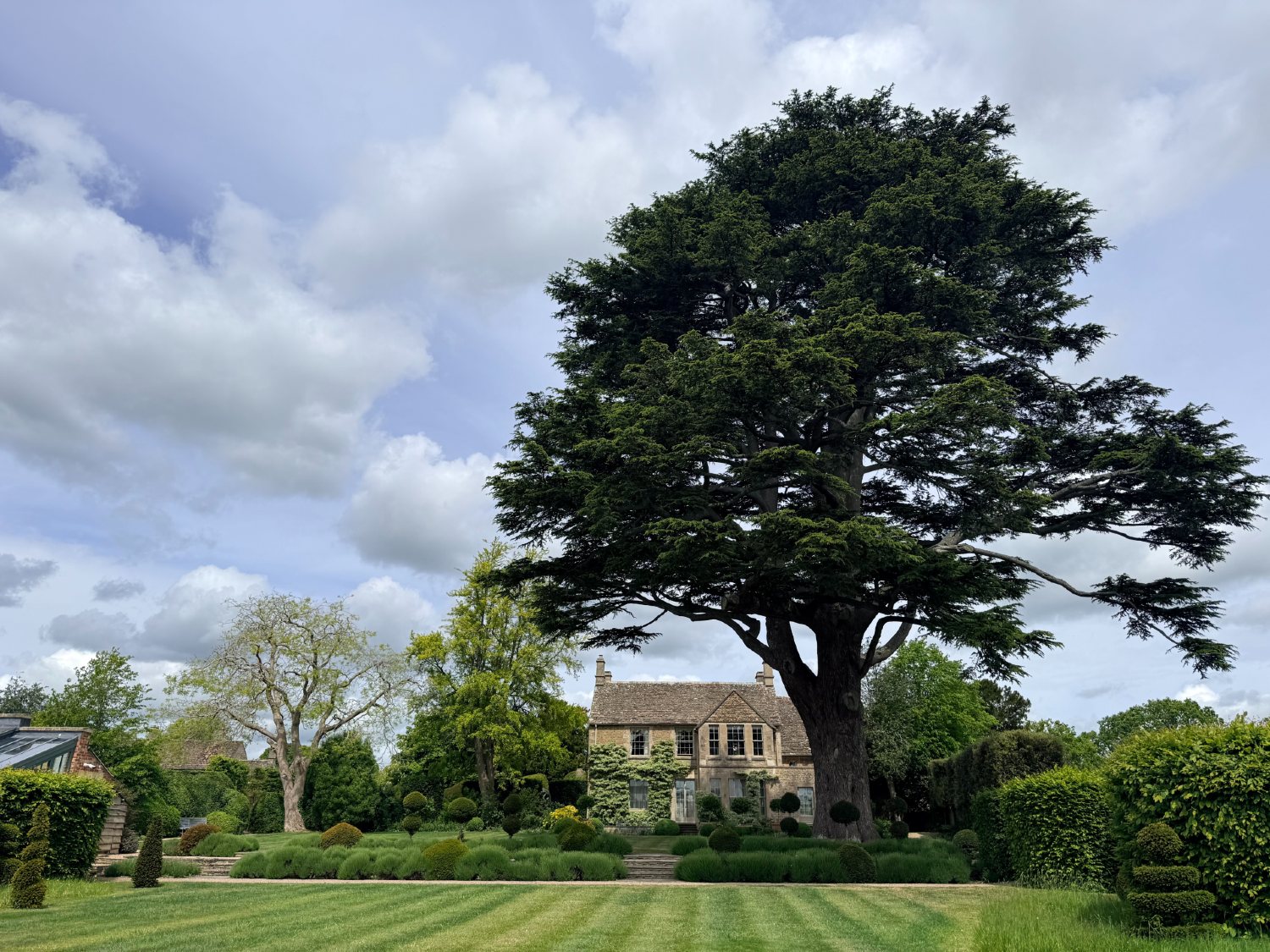
    We arrive back at Thyme just before lunch. Later, en route to the pool, I pass the property’s towering centerpiece, a majestic Cedar of Lebanon. This centuries-old tree measures more than 20 feet in diameter, with a dense canopy providing shelter for an infinite number of birds.

    It’s my favorite spot on the grounds, even topping the spa. And when I learn the Cedar of Lebanon is a symbol of peace and eternity, it further boosts my affection—a tree destined to turn even the most ardent city dweller into a tree-hugger.

    Bibury

    Village Days: Cotswolds Highlights

    It’s tempting to while away the days in and around the hotel, savoring farm-fresh eggs, listening for chirps and tweets, and relaxing on expensive stuffed sheep. But the Cotswolds are calling. With more villages than we have time to explore, we narrow down to a select few, including Daylesford, Bibury, Burford, and Stow-on-the-Wold.

    Asparagus spears

    In Daylesford, we beeline to its famous organic market and covet plants, flowers, and produce that Border Control won’t allow us to bring home. We gush over sticky honeycomb, sourdough starter, apricot marmalade, and heaps of artfully arranged asparagus. To offset our disappointment, we purchase more cheese, pâté, and baguettes than any group could reasonably consume for a late-afternoon picnic at the hotel.

    St Edwards Church

    The next day, the winding lanes of Stow-on-the-Wold enchant us with its lively market square, pubs, tearooms, and boutiques. But the main attraction is St. Edward’s Church. Built between the 11th and 15th centuries, the church’s hobbit-like north entry is framed by a pair of ancient yews that appear to be consuming the doorway. Stow’s Instagrammable hot spot, indeed.

    Arlington Row

    In picturesque Bibury, we circle the village and walk beside the swan-filled River Coln, making sure to stroll past picture-perfect Arlington Row. A 14th-century row of cottages, Arlington Row, was originally a monastic wool store that eventually became a place for weavers. Today, it is one of the most photographed spots in the country.

    Flower

    Burford is also visually stunning—showing off its golden limestone cottages and gardens with pride. Its countryside location on the River Windrush offers more public footpaths and lanes to explore. Particularly known for antiques and boutiques, the village of Burford is another haven for shoppers—should you have any pounds to spare after getting a tablecloth at Thyme.

    Slowing Down

    After five glorious days in the Cotswolds, our time is up. The birthday group will soon disperse, some heading to London for the Chelsea Flower Show, others heading home to needy kids, needy pups, and needy bosses. 

    The Thyme Hotel reminds me not only that there is a slower way to travel (the trend of the moment) but a slower way to live. The Cotswolds encourage me to take the small joys of village living home, like the canopy of a magnificent tree, a meadow walk, or a perfect egg.

    I wonder if I can.

    As I wait for my taxi, I savor one last coffee in the Ox Barn, taking in the sounds of clinking glasses and the subtle scent of bacon. Already, I miss breakfast. I gaze up at the serene portrait that greeted me on arrival. 

    Taking my cue from Her Majesty, once again, I settle back into the sofa and close my eyes.

    What’s the rush?

  • Inside the World’s Most Remarkable Destinations: Nusfjord Village & Resort

    Inside the World’s Most Remarkable Destinations: Nusfjord Village & Resort

    A hotel bed isn’t just someplace to rest your head at night. A hotel room isn’t just a place to store luggage and a toothbrush. After touchdown, your hotel becomes the first point of contact to shape your journey. The first impression that sets the tone. One step into the lobby can make you giddy with anticipation—or send you into a spiral of regret.

    Vacations are escapes from our daily lives. Taking us to places we’ve dreamed about, read about, coveted, and saved up for. That heart-pounding thump of wow, whoa, OMG, I can’t believe I’m in (insert: Morocco, Thailand, Japan, New York). The flip side? Oh no, ugh, gulp, ick, this is definitely not what I expected.

    Harness the wow, whoa, and OMG, and carry them with you—along with your sunscreen and sunglasses. Tuck them into your backpack for that hike, bike ride, or camel ride. At the end of the day, your reward will be a cushy bed to sink into, a hot soak for tight muscles, a view to set your spirit free, and a trendy bar to craft your favorite cocktail.

    Let’s explore some of the world’s most remarkable hotels. After all, it’s the gateway to your adventure.

    View over fjord

    Nusfjord Village & Resort, Lofoten Islands, Norway

    The Lofoten Islands, located just inside the Arctic Circle, are an archipelago of seven main islands bisected by glacial fjords. Travelers are rushing to this previously little-known Arctic destination because of its dramatic mountainscape, towering cliff walls, and deep, rocky fjords. Nusfjord Village & Resort sits at the end of a remote valley on one of these remote islands in the remote Arctic Circle. It doesn’t get more off the beaten path than Nusfjord.

    Nusfjord lobby

    Nusfjord was once a traditional fishing village, where fishermen spent the winter tackling the world’s toughest profession. (No, it isn’t travel writing.) That the soul of the village remains, along with nesting (endangered and protected) kittiwakes, the smithy, the General Store, the cod liver refinery, art gallery, and rorbus (traditional fishing cabins), is Nusfjord’s charm. And while tourists are free to roam this restored village by day, guests have it all to themselves come 5 pm. It’s then that I don my fluffy robe and slippers and slip into the sauna.

    Kittwakes

    Their website states, “The earliest settlements in Nusfjord date from 425 BC. Our unique cultural heritage makes this fishing village one of Norway’s oldest and best-preserved. In Nusfjord’s golden age, over 1,500 fishermen lived in the rorbu cabins. Today, there are only 16 people who can call Nusfjord their permanent home.”

    Nusfjord Arctic Resort

    Why Go to Nusfjord Village?

    Adventure, adventure, adventure. Views to knock the socks off even the most intrepid traveler. Hike, bike, kayak, RIB, SUP, surf, repeat. Nusjord Resort has it all (with Northern Lights streaking the winter skies). A spa and sauna with a window overlooking Arctic Circle views means never sacrificing a view for the sake of self-care.

    Nusfjord bedroom

    What About The Rooms? 

    Ranging from one-bedroom rorbus to ones with several rooms, a living room, a kitchenette, and a roaring fireplace, Nusfjord has added all the creature comforts those frozen fishermen had to live without. Original timber-clad walls, soft woolen blankets, Nespresso makers, tea kettles, and high-end amenities abound.

    For those who want to splurge, reserve Dahlgården, the home of the original landowner, Hans Dahl, and the most exclusive accommodation at Nusfjord. The House of Dahl is a private retreat in the village, offering views of the mountains and the sea and beautiful historic furnishings befitting a wealthy landowner.

    Karoline Restaurant

    And The Food? 

    Nusfjord Village & Resort has three dining options. Restaurant Karoline is the signature spot, with dark wooden walls, windows overlooking the harbor, and an ambience that has guests relaxed and cozy before they’re even seated. Karoline serves traditional Arctic fare like cod with smoked beurre blanc, Jerusalem artichoke with bleak roe, and pickled green apple, and crisp pork belly with beets, orange, and a touch of aquavit.

    Food at Nusfjord

    Oriana Taverna is a firelit pizza and wine bar located in what was once a whisky cellar. Serving everything from Margherita and Parma pies to more decadent options topped with champignons, chanterelles, and truffle oil, it’s a nice contrast to the more refined dishes at Karoline.

    Lastly, find Landhandleriet Café tucked away in the whimsical old General Store, dating back to 1907. Grab a table with a view and choose from a limited menu featuring simmering fish soup, homemade waffles, and various baked goods—a great option for lunch or breakfast.

    View over Nusfjord village

    Nusfjord’s Best Photo Op

    There are no bad shots of Nusfjord Village & Resort, just one picture-postcard after another. But for the best overview of the property, head to the upper parking lot. An unlikely and easily overlooked spot, it’s here where Nusfjord Village visually reigns.

    Rorbuer views

    The Lofoten Islands Are Waiting 

    Until not long ago, the Lofoten Islands were virtually unknown to the average traveler. But with the help of Instagram and TikTok, tourism is growing at a fast and furious pace. Lodgings here are finite. Book a year out if you want your first-choice accommodation.

    Nusfjord’s prime and central location in the Lofoten Islands makes it a fantastic base for exploring the entire archipelago. It’s an authentic, historic gem reimagined for the modern-day traveler. For those seeking a bit of hygge (Scandi-comfort realized through candlelight, coziness, and sheer ambience) on their adventure, there’s no place better positioned to deliver it.

    Intimate fishing cabins with plush down comforters, topped with piles of oversized pillows, make Nusfjord so much more than a place to rest your head.

    Don’t forget to ask for a late check-out. You’ve earned it.

  • Sveti Stefan, Modern Day Luxury in a 15th c. Village

    Imagining the past at Sveti Stefan, Montenegro 

    The 15th-century island village of Sveti Stefan is a dot in the Adriatic Sea—no cars, golf carts, or bicycles, just narrow pedestrian lanes and thousands of stone steps. The perimeter is a mere 1.2 miles, only accessible by foot along an isthmus from the mainland, and only if you are a guest at the hotel that now occupies the entire island.

    Yes, a dot in the Adriatic, but if someone asked me to spend a year there taking photographs, I doubt I would run out of material.

    Sveti Stefan, one of four churches on the island

    Village Life at Sveti Stefan

    First, there’s the light, which changes the colors on the sun-bleached stone walls dramatically, and without fail, each passing hour. Rustic reds and burnt oranges in the mornings were especially spectacular. Second, the sky. Some days, it is gray and lavender hues; other days, it is cerulean and bright blues—the color of the sea taking its cue from the sky above.

     Sveti Stefan from the causeway

    Third, the sea—in the mornings flat and as reflective as a mirror, glassy and ethereal, then later in the day with undulating rows of puffy whitecaps. Boats unceasingly circle and crisscross in all directions to catch sight of the exclusive private island — super yachts, schooners, gulets, and small, unassuming fishing boats all within view.

    Restaurant at the Aman at sunset

    Lastly, the mountains. Detailed during the day with razor-sharp green Adriatic pines and patches of steel craggy rocks. As the sun sets, they blur into a watercolor of overlapping shades of lavender, blue, and gray before finally sharpening to solid black against the final rays of sunlight that edge out the sky. On the island, you notice never-ending geometric patterns and colors to capture. Each day, I saw something that wasn’t there the day before. An artist’s playground in angle, palette, and dimension—a Bauhaus lover’s paradise.

    Rolling hills of Montenegro  Car ferry ride

    Black Mountains of Montenegro

    Montenegro, meaning ‘black mountain’, is a truly scenic and unspoiled country, home to the second tallest people in the world, as we were told on our drive from Dubrovnik to Sveti Stefan. The border crossing from Croatia to Montenegro typically takes three hours, but it took us six due to a travel error on my part that had us driving on a Saturday in the peak of summer.

    The upside? We could see the coastline, take a car ferry alongside a very pretty mountain pass, and admire the old town of Budva from afar. We passed Croatian and Montenegrin vineyards, looming mountain ranges, valley villages marked by a single church spire, and ancient buildings that looked as if they were hanging on to the mountainside for dear life.

    They say the mountains in Montenegro are some of the most rugged in Europe. I wish we could say we saw more of Montenegro than the drives to and from the airport, as we had every intention, but once we set foot within the walls of Aman Sveti Stefan, we knew we were there to stay.

    Sveti Stefan, interior of room Sveti Stefan, interior of room, bed Patio view

    If the walls could talk at Sveti Stefan

    The village of Sveti Stefan was purchased in 2007 by Aman Resorts, which invested significant time and money in creating a luxury resort while preserving the village’s authentic vibe. The rooms are modern and feature all your desired amenities, including free-standing soaking tubs in oversized bathrooms, intimate terraces, Nespresso machines, and complimentary wine.

    However, the details of the original village lovingly remain. The windows, sashes, walls, lantern lighting, and red ceramic rooftops are all restored in aesthetic harmony.

    Green ivy growing around the village Perfectly placed lanterns

    Gaze around any corner and notice the ivy climbing effortlessly along the thick, mortared walls, creating a lush blanket of green. The iron lanterns illuminate just enough of the pathways at night to find your way back to your room after an al fresco dinner at a table that appears to hover above the sea. The air feels steeped in history, in the way only a 600-year-old village can.

     Village of Sveti Stefan Stone archways

    Wander along the aptly named paths, Cliff Lane, Church Lane, and Oleander Walk, while admiring the eight hundred mature olive trees that seamlessly nestle into the landscape. White oleanders, wild rosemary, and wondrous cypresses fill up the nooks and crannies.

    Slits cut out in the stone walls that were once where bows and arrows were launched when the island had to defend itself still remain today, offering a perfect portal to take photos. The village winds up to its final elevation like a corkscrew, and every step up reveals a different view. I’ve never been so relaxed and happy while being so completely lost.

    Boat launch from Aman

    At Sveti Stefan, the Beaches are fit for a King

    The resort has three ‘private’ beaches on the mainland, and an Aman boat will shuttle you from the rocky island launch to the beach as you need. All beaches in Montenegro are public, but the Aman evades this in a crafty way, charging a mandatory 100 euros for the use of the beach umbrellas. 

    En route to Villa Milocer

    Built in the 1930s, Villa Miločer was the summer residence of Queen Marija Karadordevic of Serbia. It is now the mainland beach hotel of the Aman resort, with eight magnificent suites. The design is quite different from Sveti Stefan: sleeker and more modern, with touches of leather and suede, parquet floors, and white marble accents.

    There is a library in the communal area and mature gardens surrounding the villa. The boat will drop you at King’s Beach, where a passage through a dark cave reveals beach access to either King’s or Queen’s beaches.

     Lunch at Villa Milocer

    You can spend the day eating, drinking, swimming, and lounging—all within view of the island and its iconic terra cotta roof tiles. We spent days on stony King’s Beach, only getting up to have a Chablis-infused lunch under the lush wisteria canopy of Villa Miločer. The options include Mediterranean-style hummus, baba ganoush, tzatziki, and flatbreads, olives, olive oil, and various Montenegrin specialties.

    Terrace view from Villa Milocer

    Back to Sveti Stefan’s Villa Miločer

    We decided to come back for dinner that evening at Villa Miločer, as a particular dish on the menu caught our eye while we were enjoying lunch—a truffle-infused whole chicken baked in a thick crust of salt. Unfortunately, a 24-hour advance notice is required for preparation. But the waiter asked the chef, who kindly accommodated us that evening.

    The chicken was decadent and lived up to its reputation; the setting looked and felt like a completely different restaurant in the evening. It was still under the wisteria, but now highlighted with candles and dangling lights.

    We chose a unique red wine from Slovenia, a 2009 Carolina Select by Jakoncic Goriska Brda—a blend of Merlot and a bit of Cabernet Sauvignon that is powerful with intense flavors of spice, tobacco, and currant. We ordered it most nights; it was fantastic and went well with the Montenegrin meals.

    Aman restaurant terrace views

    Terrace Life perfected at Sveti Stefan

    Each evening, we made a point of arriving at the terrace of Sveti Stefan’s restaurant, Arva, for drinks by 7:30pm to catch the sunsets. It was like getting the best seats to a hot new Broadway show, but in this case, every seat had the best view.

    Aman restaurant terrace views at sunset Aman restaurant terrace views at sunset with church

    Each sunset was unique, the first with clouds high enough to reflect luminously in the outdoor pool, shades of pink and red mirroring the sky so spectacularly. The next night was cloudless, yet no less breathtaking. The other two nights were somewhere in between, with the clouds serving as the perfect vehicle to carry the sunset’s colors as they seemed to melt into the sky. In the background, the layered mountains in every shade of blue and charcoal add even more depth to the scenery.

    Aman restaurant terrace views

    The dinners at the Sveti Stefan restaurant will forever be chiseled in my mind as possibly the prettiest and most breathtaking, with the ultimate sweeping views of the sunset and the sea. The tables are first-come, first-served each night, with no reservations. We scoped out a particularly unique table at the tip of a triangular peak on the patio, with unobstructed views of the sea, sun, and beach.

    We lingered there for hours, capturing every nuance of the sun’s light until we could only see Mars and twinkling stars above us in the jet-black sky. Overall, the menu was international, but the sauces and flavors had lots of lovely Montenegrin touches.

    The service was effortless, and the banter was just friendly enough to make you feel comfortable. One night, a local Montenegrin guitar player spent a few hours playing folk music while we dined, an experience that added much magic to an already magical setting.

    Other churches on property

    Pool/beach? Both/and at Sveti Stefan

    Our mornings were spent at the beach after a leisurely breakfast at the restaurant in the central piazza at the top of the village. Two of the four village churches are within view, with white umbrellas to shield the sun while we gaze out towards the vast Adriatic. Lemon ricotta pancakes with blueberries and honeycomb, toasted homemade granola, banana porridge, and freshly baked warm pastries were among the choices.

    The service and staff at the Aman restaurants were friendly and intuitive. And they seemed to outnumber the guests 2:1, even at peak capacity. And with 50 rooms on the island, it was hard to believe, as it never felt crowded. There was always someone on hand to offer directions and a warm smile.

    Aman pool Pool umbrella refections

    Later in the day, we would head to one of the three pools on the island: one is for the private Adriatic Suite, another is for adults only, and one is for families. We only had one option, having our kids in tow, but truth be told, the family pool is by far more interesting than the adult pool, where I had the chance to relax alone one afternoon.

    Sveti Stefan main pool

    The views from the family pool are sweeping, intimate, and uncrowded. In fact, in four days, we only saw a handful of other guests, which made it feel like our own private pool, complete with bar and food service. The kids gulped down freshly made mango smoothies, and we treated ourselves to a bottle of rosé while reading books and settling into the afternoon.

    Viewpoint high above a local monastery of Sveti Stefan village island

    Chasing the view

    We did manage to leave the property once during our stay, on foot, to a steep viewpoint high above a local monastery. Our kids moaned the entire time, so we left them in the dust to bond over how annoyed they were with us for dragging them up a mountain in the heat.

    Chasing a view has always been a great pastime for us, and passing up the chance to see Sveti Stefan from above seemed unimaginable, as photo-ready as it is! For the five minutes we lingered at the top, it was worth the complaints, the intense heat, and the bushwacking through brambles on the way back.

    Beach umbrealla view of island village

    The photos above Sveti Stefan have likely been taken many thousands of times. While mine are no more or less unique than any other, I am glad I had the chance to see them and capture them for myself. 

    Village view

    Early mornings at Sveti Stefan

    On our last morning in Montenegro, I spent an hour or so watching life unfold on the sea and land from our terrace—the public beach filled with sun-seekers, inflatable flamingos, unicorns, and swans bobbing in the water.

    The Aman beaches were nearly empty, a lone man raking the quiet sand in anticipation of the day ahead. The entrepreneurial fishermen are checking their pots for lobsters, and the yachts are pulling up anchor and heading up the coast toward Kotor. The stone walls of the village were tinged with pale blues and dusty roses in the early morning light, the heavy white mortar creating mesmerizing patterns. I thought four days would be enough here, but I left wishing for more.

    Village view with blue sky

    They say that Aman put Montenegro on the map for American tourists, which is understandable, given that it is such a stellar brand of resort. However, we are now eager to come back and explore deeper into the country, the off-the-beaten-path villages, the vineyards, and the culture. Although we’d be hard-pressed not to incorporate another few nights at Sveti Stefan again.

    View of approach from causeway

    So, while I wait patiently to be hired as Instagrammer-in-Chief for Aman Sveti Stefan, I will have to settle for reliving my memories through thousands of photos, my crystal clear memories of the divine views, and the hope that I might find myself lost again in the never-ending passageways of this timeless village.


    Author’s Note: Aman Sveti Stefan is currently closed, but is due to reopen in the summer of 2026.

  • These Remote Norwegian Islands Have An Unusual Smell. It’s Money.

    These Remote Norwegian Islands Have An Unusual Smell. It’s Money.

    Our RIB slices through Trollfjorden towards Svolvær, the scenic capital of the Lofoten Islands. Twelve of us instinctively lean left—as if we have some control over the heeling boat. The narrow fjord’s steep-sided, jagged mountains rise dramatically from the sea. The water swirling beneath me is a shade of blue I’ve never seen. Overhead, the sea eagles we met earlier turn back towards Raftsundet strait, realizing their midday snack is officially over. The trolls remain hidden.

    As we get closer to the harbor, a stench hits me like a rogue wave. I look around. My face isn’t the only one scrunching in disgust. Our guide is watching. Is he smirking? The Brit behind me is the first to bite. “What’s that awful smell?” he asks. “Ahhhh,” Emil smiles and exhales slowly, deliberately. “That, my friend, is the smell… of money.”

    Twelve heads turn in unison, baffled.

    Reine

    Where Are The Lofoten Islands?

    I found the Lofoten Islands through my usual source of inspiration—Instagram. Those algorithms are eerily spot on, drawing me into little tiles of mesmerizing mountainscapes and fjords. I needed to know exactly where this magical place was and how soon I could get there. 

    The Lofoten Islands are in Northern Norway, I discovered, just inside the Arctic Circle. 

    Of course they are.

    Factually speaking, the Lofoten Islands are an archipelago of seven main islands bisected by glacial fjords. By the numbers, they are about 100 miles long, over 3 billion years old, and have roughly 25,000 residents. The Midnight Sun reigns from late May to mid-July. Intriguing facts, Wikipedia, but I don’t need them to inspire my trip—Instagram beat you to it.

    Illustration map of Lofoten

    The Scandinavia Travel Boom

    Scandinavia is on the cusp of a travel boom, partially as a reaction to the wildfires and raging heat from which the rest of Europe suffers. Some travelers are looking for more temperate climes. Others are seeking roads, or in this case, fjords less traveled—a response to overtourism plaguing countries like Italy, Spain, and Greece. 

    Nordic countries saw a surge in tourism last year, with Finland, Denmark, Sweden, and Norway reporting a record-breaking number of visitors. In Norway alone, nearly 17 million hotel nights were booked—a 3% increase from the previous year. Those numbers are expected to rise as more intrepid travelers view Scandinavia as the antidote to mainland Europe’s woes. But, the Lofoten Islands are remote even by Scandinavian standards. 

    It’s worth noting the emphasis on destinations yet to grace the covers of Travel+Leisure and Condé Nast Traveler. Travelers want bragging rights, to get to destinations first. If Scandinavia is the next travel hot spot, I want to get there first, too. I book my flights and ferries. Thank you, Meta. I’m on my way. 

    The Fish That Put Lofoten On The Map

    “That smell is stockfish,” Emil continues. “Stockfish is Norway’s most important export—and has been for centuries. To us, the smell of drying cod is considered the smell of money.”

    The Tørrfisk industry dates back to the Viking era. Tørrfisk (aka stockfish, or dried cod) was so lucrative that it lured over 30,000 fishermen to northern Norway each winter. Fishermen who endured the Arctic’s extreme and harrowing conditions to provide for their families back home. 

    Stockfish
    PC: Ruramos

    Once caught, the codfish, with their wiry whiskers and mouths agape, are placed on large pyramid-shaped wooden racks called fiskjehell. Norwegian winters are windy and well below freezing, thus creating a natural preservation system for the fish to dry without rotting.

    Fiskjehells are still used in the Lofoten Islands and can be seen (and detected sight unseen) in many seaside villages—a monument to the dedicated fishermen who endured Lofoten’s long, dark winters. 

    Stockfish’s Place on the Global Table

    The smell of stockfish also reminds us of Lofoten’s importance in commercial fishing. Of all the European nations that import dried cod from Norway, Italy is the largest. Stockfish is the central ingredient in their famous dish, Stoccafisso Accomodato (stockfish stew). It’s also a staple of Nigerian cuisine, often used for stews and soups. 

    Stockfish adorns the menus of Lofoten restaurants, from fine dining at the Kitchen at the End of the World to Svinøya Rorbuer’s humble restaurant, Børsen. Travelers can experience the fish that built Lofoten with dishes like Tørrfisk Royal, cod stew with carrots, egg, butter, and bacon, and stockfish filleted with baked leeks, wild mushrooms, and kale.

    The curious Brit quips, “I don’t see any fish, only empty racks.” Emil is ready. “The fish hang for three to four months,” he explains. “By May, about six million tons of cod hang in hjells, ready to be shipped. But, even when the racks are empty, the smell lingers.” Satisfied, the Brit settles.

    View of Reine with clouds

    The Fisherman’s Wife

    Emil cuts the motor, and the silence is welcome. We’ve been careening around the fjord, feeding sea eagles and troll-hunting for hours. That’s when I see her. Standing poised and strong against the wind on a rocky promontory, she clutches a shawl around her neck with one hand and waves longingly with the other. 

    “That’s Fiskerkona,” Emil says, reading my mind. “The Fisherman’s Wife. She represents the resilience of the women left behind to raise families during their husband’s long absences. Many would never see their spouses again.” This poignant statue quiets the group—even the inquisitive Brit.

    Nusfjord interior

    Turning Tradition into Luxury

    Thousands of fishermen traveled north each winter to hunt for Norway’s prized fish. They lived in rorbuer, traditional stilted, wooden huts. In Norwegian, ‘ror’ means row, and ‘bu’ means small house. Up to 12 fishermen shared each rorbu. Rorbuer were sheltered from the elements and divided into two parts, one for sleeping and one for gear. The ceilings were low, and the windows were small and inefficient. They had basic kitchenettes and uncomfortable beds. But, they provided what mattered most—direct and immediate access to their fishing boats.

    Rorbuer

    These seaside cabins, many restored to their original red and yellow colors, have been retrofitted as tourist accommodations. Some, however, are retrofitted better than others. Rorbuer are an integral part of Lofoten’s history, giving visitors a chance to imagine life within the same four walls as Nordic fishermen, albeit in some cases, on 600-thread-count sheets, with rain showers and Nespresso machines.

    Nusfjord bedroom

    Turning tradition into luxury is hard work. Not as hard as fishing for cod in the Arctic, but hard nonetheless. Although updated with modern conveniences and creature comforts, some rorbuer lack the sophisticated amenities often associated with high-end luxury. Others have found an idyllic balance,  elevating the rorbu by adding soft, plush duvets, Bluetooth speakers, and bespoke toiletries while keeping the cabins’ historical integrity intact.

    That said, rorbuer accommodations are in such high demand that some were fully booked as early as February for this coming summer. These rorbuer create a source of income beyond stockfish—attracting the kind of money that looks, feels, and smells like actual money.

    View of Nusfjord village

    The End Of The Road in the Lofoten Islands

    The Nusfjord Arctic Resort is tucked away at the end of a road in a secluded valley that hovers over the sea. A Small Luxury Hotel of the World, Nusfjord has managed to preserve the look and feel of a typical fishing village so vividly that I could swear I traveled through time.

    Many of Nusfjord’s rorbuer are several hundred years old. During the day, tourists come from near and far to explore the grounds, the general store, the bakery, the smithy, the boatshed, and the cod liver refinery. 

    Black-Legged Kittiwakes

    They dine at the property’s on-site restaurant, Karoline, and gaze at the mountain views. They order pizza from a small wooden shack, grab a cold beer, and sit among the protected Black-Legged Kittiwakes (Krykka) that nest on the cliffs and windowsills. From 9am-5pm, Nusfjord swells with tourism.

    Dock at Nusfjord Hotel

    But come 5:01pm, the property is reserved for guests only. Cue a mass exodus akin to heading west on Montauk Highway after Labor Day Weekend. It’s then that lucky Nusfjord guests peek out from their rorbu windows, making sure the coast is clear. They shuffle out in fuzzy slippers and fluffy robes one by one en route to the sauna.

    Lofoten Island’s Endless Days

    We’re getting closer to Svolvær’s docks. Our sea eagle safari will soon end. This high-speed RIB excursion has been a highlight of my trip. Not only because I saw so many of the promised eagles but also because of Emil’s insights into Lofoten’s history. 

    I look back at the scenery Instagram inspired me to come so far to admire. Hiking peaks like Reinebringen and Djevelporten provide an eagle-eye view of the islands that change with the sun, mist, and fog—each stunning in its own way. The mountains appear hand-painted and are set against layered clouds in a sky that never gets dark. Summer in Lofoten is an ongoing study in beauty. I could spend a lifetime of summers here and never tire of it.

    Svolvaer overview

    The Set-Jetting Travel Trend

    The Lofoten Islands aren’t the only Norwegian destination benefiting from a boost in tourism. Anyone who followed the black comedy Succession will recall the episode in which Shiv and Roman Roy visit Mattson’s homeland. The Roys stay at Juvet Landscape Hotel, a property entirely immersed in nature.

    Juvet is located on the west coast of mainland Norway. It’s a great example of ‘set-jetting,’ the travel trend best described as wealthy Americans spending gobs of money in places like Thailand and Dubrovnik courtesy of TV shows like The White Lotus and Game of Thrones. These days, Juvet is as hard to get into as the Vatican on Easter Sunday. Damn you, Roman.

    Achingly cinematic and designed with the environment as the star, Juvet’s seven minimalistic rooms include airy Birdhouses, glass-walled Landscape rooms, and the writer’s aerie, Scrivener’s Room. At Juvet, luxury is at its most understated, and the only tension lies in the ever-changing scenery.

    Boats at Svinoyer

    Past, Meet Present

    “Come back to Lofoten,” Emil calls out as we disembark. My heart sinks. The possibility of coming back seems unlikely. Who goes to the Arctic Circle twice? Hmmm. Maybe I do.

    The sun is high in the sky. Since it won’t fully set, we have endless hours ahead of us to explore and relax. I peel off my dry suit and take off my goggles and hat. It’s 36 degrees, and I’m freezing. I think of the fishermen. I wouldn’t have made it past Fiskerkona. 

    Nusfjord

    Although Lofoten’s fishing industry remains deeply rooted in history, some things have changed. The boats have been modernized with GPS and sonar radar for tracking schools of fish. Safety has improved with the addition of anti-slip surfaces and hydraulic winches. The fishermen sleep in heated cabins and have cell phones to call their wives (whether they consider that an improvement is unclear.)

    I turn towards Trollfjorden—contemplating those elusive trolls. I no longer detect the intrusive fishy smell. How quickly humans adapt—even to an unpleasant odor like dehydrated fish. Though surely not unpleasant to the residents of the Lofoten Islands—where the scent of dried cod symbolizes history, prosperity, and a tourist industry’s moment in the sun.


    Click here to learn more about what to do, what to see, and where to stay in the Lofoten Islands


  • The Best of Ibiza, Unabashedly

    The Best of Ibiza, Unabashedly

    “Aren’t you a little old for Ibiza?” became an ongoing refrain whenever I mentioned my upcoming trip. What is it about this island off the coast of Spain that prohibits anyone over a certain age from indulging?

    Jetty at villa

    I was never much for clubbing. In my 20s, I started a career in advertising and drank beer in basement bars. In my 30s, I started a family and spent weekends changing diapers and craving sleep. When in my 40s, I moved to Tokyo and dragged stubborn toddlers around Southeast Asia. 

    Now in my 50s, I’m heading off to the world’s biggest party island. Whoever says 50 is too old to go to Ibiza isn’t 50—and hasn’t been to Ibiza. At 50, we have the ultimate travel trifecta—the money we didn’t have in our 20s, the time we didn’t have in our 30s, and the subtle art of not giving a f*ck, perfected.

    Pool deck Ibiza

    The Ibiza Crew

    In June, sixteen of us head toward Ibiza like bees to honey. We fly in from all directions, Los Angeles, New York, Sweden, Miami, and DC. We’re a mixed bag: English, American, Greek, Swedish, Japanese, Swedish/Japanese, and Brazilian. Some of us are models. Some of us are Brazilian models. 

    Among us are a semi-professional DJ, two fashion influencers, and one mooching medium. Our group spans decades, from 30 to 60. An eclectic bunch, we’re in Ibiza for one reason—to celebrate our Queen Bee’s 50th birthday. We touch down to blindingly bright blue skies and set off for the villa—Casa Atlantis.

    Casa Atlantis dining

    Atlantis Reimagined, in Ibiza

    Naming a villa Casa Atlantis is a bold move. ‘Atlantis’ is synonymous with utopia, and utopia is pretty hard to live up to. Legend has it that the lost island of Atlantis was inhabited by spiritual people who, over time, became greedy, petty, and morally bankrupt. Their immoral behavior angered the gods. 

    Casa Atlantis views

    Maybe the villa-namers were onto something. What better place to reject conformity and anger gods than at a spiritual vortex like Ibiza? It seems no coincidence that non-conformist, bad-boy, rockstar Noel Gallagher of Oasis once owned Casa Atlantis. His energy is still bouncing around the wonderwalls of the villa.

    Casa Atlantis is perched above the Mediterranean Sea in an area of Ibiza called Es Cubells. The sprawling, multi-layered villa is carefully camouflaged in the cliffs. The only way to view Casa Atlantis in its entirety is from a boat, and even then, it isn’t easy to see. 


    Want all the decadent details of Casa Atlantis? Just click here.


    Casa Atlantis pool

    Oasis

    Casa Atlantis sleeps up to 20 guests. It has expansive sea views and endless amenities: a private chef and wait staff, an indoor/outdoor massage hut, a full gym, an enormous pool, and a hot tub. The villa has multiple areas to sit, lounge, and dine. Far below the villa, there’s a private jetty and beach. 

    Our chef cooks meals based on our culinary desires. Traditional Spanish, fancy dim sum, and street vendor Indian are all options. Thankfully, someone else has resolved these complex culinary issues. All I have to do is show up to dinner on time, which in Ibiza is rarely before 10pm.

    Getting around the steep, winding roads of the island is a breeze as the villa comes with two Mercedes vans, a Jaguar convertible, two Spyder three-wheelers, and a Vanquish boat. Oh, and for grins and giggles, a Mini Cooper.

    Casa Atlantis pool

    Electric blue Morning Glories climb the villa’s white-washed walls. Sea views stretch as far as the eye can see. It’s easy to question why we need to leave the villa at all. But we’re here to experience the whole island, not just this glorious little patch. Some days, we manage to pry ourselves away, albeit not until after breakfast, which ends about 1pm.

    Casa Jondal Ibiza

    Beachin’ at Casa Jondal

    Casa Jondal is on Ibiza’s southern coast, a 15-minute drive from Casa Atlantis. Although this glamorous beach restaurant came on the scene in 2020, it looks and feels like it’s been here much longer. Signature pines and junipers add a touch of dusty green to the nautical palette. Casa Jondal is a scene. We grab our sun beds and settle in for the afternoon.

    Rickety wooden tables are nestled in the fine white sand. Low-slung seats with comfy white cushions are strategically placed under stretched canvas sailcloths. The low-key vibe is ever-present. It’s just a part of what makes Casa Jondal the hottest beach restaurant in Ibiza. 

    Chef Rafa Zafra (of El Bullí fame) carefully tends the menu. We dine on lobster three ways, savor slivers of shrimp carpaccio, and mouthwatering croquettes—all from the luxury of our beachfront sunbeds. It’s easy to pass sun-drenched hours over crisp Verdejo and Albariño, taking refreshing dips in the sea between bottles. 

    Beach couple

    Get My Free Wish List Destinations Hot Sheet. Click Here!


    Es Vedra View

    The Path to Es Vedrà

    Es Vedrà is an uninhabited, jagged, and rocky island set off the southwest coast of Ibiza. At 413 meters tall with dozens of seabirds swooping and darting, the island looks like the set of a fantasy film. Some believe Es Vedrà is home to sirens and sea nymphs. Some believe Es Vedrà has magical powers. One morning, we wake up at the crack of dawn noon to harness some magic for ourselves.

    We all know hiking is an activity best done in the morning. But this is Ibiza, where time is measured around DJ sets and dinner reservations. The Swiss guide who leads our troop is uber-fit and no-nonsense. If he’s annoyed we’re starting our hike when the UV index is at its peak, it doesn’t show.

    I forget our guide’s name, but let’s call him Jan. Jan is a safety-first kind of guy. He warns us about loose rocks and tree roots, reminds us to hydrate, and reapply sunscreen. Does he not realize some of us are old enough to be his parents? I know all about the benefits of sunscreen, Jan. Thank you.

    But, the viewpoint is worth Jan’s running safety commentary—uninterrupted and crowd-free views of Es Vedrà. 

    Eye of Es Vedra

    With military precision, Jan leads us to the ‘Eye of Es Vedrà’—a natural rock formation that frames the island to picture-postcard perfection. He has the birthday girl scramble to the center of the eye and takes Oscar-worthy panoramic videos of her while hanging from the rocks with his one free hand. I post the video on Instagram, and all my followers think it’s me. I don’t correct them.


    Get Your Guide To Es Vedra at Sunset! Click Here for details.


    Es Vedra View

    Daytrip to Formentera

    The next day, a pair of black Vanquish boats pick us up at Casa Atlantis’ private jetty. The aluminum finishes and sleek torpedo shape feel very 007. We’re on our way to the island of Formentera for lunch. We take a loop around Es Vedrà on the way. I search for sirens and sea nymphs. 

    Es Vedra View

    As we circle the island, the sun’s angle changes, creating dramatic shadows on the cliffs. We hear birds squawking. Despite how stealthy our Vanquish boats are, the birds are rattled by our approach. The captain cuts the engine, and I close my eyes to soak up Es Vedrà’s magic. If I were a bird, this is where I’d live, too. 

    Formentera lunch at beach

    Formentera is the smallest of Spain’s Balearic Islands. We approach the shore, and I notice unspoiled beaches against Windex-blue water. Our boats bob and weave around a few anchored yachts until we reach the dock. Es Molí de Sal is low-key, open-air, and uber-chill. We disembark and head to our table—ravenous from a morning where our only activity was getting out of bed.


    Want to spend the day Sailing Formentera? Click here to learn more!


    We promptly open the champagne we’ve brought along to toast the birthday girl and sink into the restaurant’s easy, natural rhythm. While Es Molí de Sal serves various Mediterranean specialties like tapas, oysters, and caviar, we’ve come for the paella. 

    Paella Formentera

    After appetizers of fresh salad topped with thin ribbons of carrots and burrata with olives and tomato jam, two enormous paella pans arrive. Plump pieces of spiny lobster and fire-engine red giant shrimp are nestled in the rice—the texture is sublime. Various spices complement the seafood without overpowering it. Our group leaves no grain behind. 


    Get My Free Wish List Destinations Hot Sheet. Click Here!


    Sunset views

    What’s so special about Ibiza?

    By now, it’s clear why Ibiza has such a strong magnetic pull. But I’m curious to learn more about the island’s history. Back at the villa, I start Googling. In the 1960s, I read hippies and bohemians descended upon Ibiza to take advantage of its spiritual energy. The island quickly became a magnet for hedonists. 

    Sunset in Ibiza

    By the ‘80s and ‘90s, the die was cast. Ibiza became Europe’s pinnacle party hot spot—the epicenter for raves, drawing celebrities, rockstars, and pleasure seekers from around the world. I stop scrolling and glance at tonight’s itinerary:

    11pm: Dinner at La Torreta
    After: Pacha, DJ Solomun

    Then, I glance at my phone. It’s 3pm. I have eight hours. Yikes.

    DJ Solomun at Pacha

    The King of Ibiza

    DJ Solomun is one of the world’s most famous DJs. Seeing him perform at Pacha, where he plays over twenty Sundays each summer, is an Ibiza highlight. A highlight of staying up until the wee hours of the morning listening to deep, funky baselines and euphoric melodies is your thing. The last time I stayed up until the wee hours, I was watching Seinfeld reruns while breastfeeding. At 5pm, I nap to prepare for the night ahead.

    Of Bosnian/German descent, Solomun was born in 1975. I quickly calculate that Solomun and I are nearly the same age. With his long, wavy hair, rugged beard, and broad jawline, Solomun is good-looking in a Ned Stark Game of Thrones kind of way. Solomun is often referred to as the King of Ibiza, although rumor has it he isn’t fond of the title. Regardless, his reign is powerful. The lines snaking out of the club doors at 1am (which is when we arrive) prove it.

    I discover tonight’s a ‘special’ night at Pacha—Solomun is doing an extended set. “What does that mean?” I ask the experienced clubbers in my group. “It means that Solomun will play until 7am!” one of the Brazilian models exclaims. 

    I smile, but I want to cry. 

    DJ Solomun at Pacha

    Hey, Mr. DJ

    Our planner-in-chief has curated our Ibiza trip to perfection. We have the best table in the club—a cordoned-off, spacious platform behind the DJ booth. Thousands of other clubbers are sandwiched together on the floor like sardines. They’re in their 20s, so they don’t care. 

    The alcohol is free-flowing, and when Solomun starts his set at 3am, the crowd is charged with electricity (and various other things). We are masses of people, all feeling the same vibe, all letting the base sink into our souls. The beat builds, then drops, builds, then drops.

    Hours pass. Hours and hours and hours.

    At 630am, I walk outside, squinting my eyes at the brightening sky. Lavender and periwinkle hues touch the clouds. All is muted. Or, is that because my inner ears have stopped functioning? It’s the start of another extraordinary day. Yet, it isn’t. Instead, it’s the end of an extraordinary night. I turn around. Hundreds of people are in my wake, exiting the club after an extended set by Ibiza’s legendary resident DJ.

    That was crazy, I think to myself. Then, I pop into the white Mercedes van waiting for me at the curb.

    Sunset in Ibiza

    In Ibiza, Age is Just a Number

    Sadly, the week ends. I’m not sure my liver could survive another day anyway. We sing one last refrain of Happy Birthday to our host, who orchestrated an unforgettable Ibiza experience. If her goal was to show her friends the Ibiza she loved from her youth, but with a grown-up spin, mission accomplished. I think about what I’ll say to those questioning if I was too old to come here. 

    “In Ibiza, age is just a number.” I’ll say, not so subtly, “No one really gives a f*ck.”


    There’s no shortage of fabulous activities and excursions on Ibiza.

    Grab your bikini, hiking boots, and sense of adventure, and try these:

    Hike with a private guide to Ibiza’s most secret spots

    A sunset boat trip with five of your BFFs

    Half-day island tour with built-in Insta-photo op stops

    Sail to fabulously understated Formentera with beach stops

    SUP to Ibiza’s secret caves


    Travel Coaching Logo

    Ready to travel—but can’t find the time to plan?

    Anyone can Google a destination, but finding the right sources, the hidden gems, the places worth your time—well, that’s an art that takes time. I’ll cut through the noise, saving you from hours of searching in the wrong places. Each of my recommendations is researched with your specific trip in mind.

    After visiting 70 countries on 7 continents, I know how overwhelming travel planning can be.

    But I also know how to make it easy. And exciting. And stress-free.

    Click here to learn more about Jamie Edwards Travel Coaching

    My research. Your adventure.


    Are you seeking a job in International Relations that allows you to work from anywhere? Check out Jooble; they have remote job opportunities available almost anywhere.

  • Where in the World is Manshausen Island?

    Where in the World is Manshausen Island?

    A tiny square on Instagram stops me mid-scroll—a photo of a glass cabin perched above a stone jetty cantilevered over the sea. Through plate glass windows, a seated woman with a book on her lap gazes towards the horizon. The caption reads, “Can you see yourself in this chair?”

    That was six years ago. If I’d seen it today, I would’ve been convinced the image was computer-generated. But in 2018, Instagram still depicted reality. Well, sort of.

    “Yes!” I think to myself as that familiar swell of travel lust washes over me. “Yes, I can see myself there!” I look at the geo-tag, eager to learn the location of this enchanting chair.

    Manshausen Island: 67°50.163’N, 14°46.462’E

    I click on the map. Then zoom out. And out. And out. Finally, I recognize the shape of the country—Norway. I sigh. Not just Norway but a remote island off of a mainland village called Nordskot. Nordskot, population 56. The Arctic Circle. Manshausen Island is about as accessible as the moon. I swipe out of Instagram and put my phone away. I sigh again, this time in defeat. 

    Six years later, when planning our summer vacation, I remember that tiny square. Then, I build an itinerary around it.

    Cabins at Manshausen

    Instagram vs. Reality

    Who doesn’t love Instagram? Instagram is a portal to an alternate reality. Its mesmerizing photos pull us into a world of swoon-worthy vistas, avant-garde fashion, and food as art. 

    In 2018, the same year I covet that tiny square, Merriam-Webster declared ‘Instagram’ a verb. Hotels start dedicating Instagrammable spots to encourage social media posts, like Moet Chandon vending machines or waterfall swings. On Instagram, all the world’s a show, and everyone wants to be in it—or at least photograph it.

    Jetty

    How would real-life Manshausen compare to its Instagram feed? I recognized the geographic hurdles and inherent risks. Getting there will take three planes, a ferry, and a speedboat. The weather could be hot and sunny or cold and rainy. The food could be inedible. The activities underwhelming. What if the island doesn’t even exist? I was acting on a gut feeling—hoping my family would trust it.

    “Ummmm, I found this cool place on Instagram,” I tell them. “Ok, boomer,” my son shoots back, even though I’m not. My daughter raises an eyebrow. My husband says, “What could possibly go wrong?” Exactly.


    Click Here for a Free List of all my Wish List Destinations


    Backpack on ferry

    It’s the Journey and the Destination

    So begins our journey to the Arctic Circle. We fly to Oslo, where we spend two nights at the architectural beauty, The Sommerro Hotel. From Norway’s capital city, we fly to the port town of Bodø to await the 7pm ferry. With hours to spare, we find an outdoor restaurant. I order a Pimms Cup in honor of Wimbledon just as Djokovic and Alcaraz amble onto the court. The sun is shining. We settle in for the match.

    The ferry is the first of many surprises in Norway—a glorious introduction to the Arctic landscape and the power of the midnight sun. Passengers disembark at ports called Moskenes and Helnessund. Their spouses, dogs, and kids welcome them eagerly at the dock. I wonder what their stories are. What happens here in Helnessund? Do they know their village is all the rage on Instagram?

    When we glide into Nordskot at 9pm, the sun is still high in the sky and casts a golden glow over the towering mountainscape. I imagine few places on Earth evoke a sense of utter breathlessness. The Norwegian islands in the Arctic Circle are some of them.

    Angus Staples, one of Manshausen’s two hosts, meets us at the dock and lowers our bags into the boat. He looks like a mountain climber—rugged, compact, and deeply tanned. He whisks us to the island, the final leg of the journey that began with a tiny square on Instagram. 

    Chair

    Instagram vs. Reality—the Moment of Truth

    Any anxieties I have dissipate once Manshausen comes into view. I breathe a sigh of relief—thankful it exists. The glass cabins act like beacons, welcoming us to the island. The sun radiates off their metal exteriors, and the floor-to-ceiling windows mirror the placid, tranquil water. I see a wide dock stacked with yellow and red kayaks. A wooden sauna and a dozen bleating sheep are not far beyond it. We hear the low-piercing calls of seagulls above.

    I hop off the boat to find my chair.

    View from dock

    The Manshausen Story Started in 1698

    Manshausen is a small, flat, rocky island. A mere 14 acres in all, its roots date back to 1698 when it was a part of the Grøtøya trading post. Its sheltered location made it ideal for the area’s thriving fishing industry. Until the 1800s, Manshausen was used as a fish export storage location. But by the 1900s, ships were just too large to reach the island, and the trading post went bankrupt. After that, the island went through several iterations (none Insta-worthy) until a man named Børge came along.

    Views from the sea

    Børge Ousland bought Manshausen in 2010. And, along with award-winning architect Snorre Stinessen, built a destination for intrepid travelers. Børge is a real-life polar explorer, having spent over 30 years traversing the Arctic and Antarctic regions, often in the bleakest and darkest months.

    I imagine when he visits Manshausen between treks, it’s a true respite, with its intimate sauna, simple and flavorful food, and majestic sea eagles soaring overhead.

    Sea Eagle

    Norwegian-born Ousland was the first to complete an unsupported solo crossing of Antarctica. He was a deep-sea diver in the North Sea, a Navy Special Forces Officer, and was married at the North Pole. Børge Ousland is an all-around badass. I want to meet him. Sadly, he isn’t at Manshausen when we visit. He’s probably taming orcas, wrestling polar bears, or swimming the Drake Passage.

    I overcome my disappointment and focus on more important matters—the sea cabins.

    Views over Manshausen

    Manshausen’s Award-Winning Cabins

    The nine sea cabins and two towers at Manshausen have won over 40 design and architectural awards, hence their inherent stopping power on Instagram. To me, the cabins artfully honor the traditional rorbu (fishing cabins) of the early 1900s. Communities of brightly painted rorbus were positioned in protected harbors with the harbor-facing side of the cabin on poles. This design meant fisherman could easily access their boats each morning. 

    Today, most rorbus have been retrofitted as picturesque accommodations for travelers. Their fiery red exteriors pop against the green and blue landscape—the kind of imagery that, if you catch the light right, can go viral. Although not mine, unfortunately.

    Set on stilts above rocks and the ebbing tide, Manshausen’s nine modern cabins are made of wood, glass, and metal. Their angles and stark edges contrast the natural elements yet meld harmoniously within the scenery. The warm wooden interiors are simple and highly functional, with cubbies, hooks, and storage nooks in all the right places—except for the bathroom. Angus, a few more towel hooks would be helpful, please.


    Click Here for a Free List of all my Wish List Destinations


    Franz Josef, Grønland, or Patagonia?

    Each sea cabin on the island is named for one of Børge’s expeditions. The towers, Nansen and Amundsen, pay homage to his idols in polar exploration. It won’t surprise anyone who knows me that I heavily researched the ‘best cabin on Manshausen’ before booking. Phone calls were made. Aerial maps were navigated. Leaving this very important decision to fate was not an option.

    Franz Josef sits just above the water and has uninterrupted mountain views. Its location at the far edge of the island means no one walks past our cabin, which is fairly important since they’re made almost entirely of glass. 

    The sea cabins advertise to sleep four people. In hindsight, we should have booked two cabins. During our stay, Norway experienced warmer-than-usual temperatures, and the second bedroom became an unwanted in-room sauna. I’m guessing this isn’t typical—unless you believe in global warming—otherwise, Manshausen should consider central air. Next time, we’ll book Patagonia, too.

    Crab tartlet

    Beach Mustard, Bread Ice Cream, and Other Culinary Surprises

    Our three days on Manshausen are filled with round-the-clock sunshine, blue skies, and temperatures in the mid-70s. The weather is a gift in this part of the world known for highly changeable microclimates. I sit in my chair, but not as much as I thought I would. There’s too much to see and do.

    Mornings on Manshausen are leisurely. Angus visits each guest at breakfast in the main house to confirm plans for the day. Ondrej, Manshausen’s chef and island co-host, creates magic in the open kitchen with a friendly and seasoned staff. 

    Haibut and beach mustard

    Ondrej tells us nearly all the ingredients he uses are foraged and sourced from the island and local area. On our first night, we have halibut topped with a plant I’d never seen. “It’s beach mustard,” Ondrej says, then mentions he’d found it earlier while walking. I later learn beach mustard is an aquatic herb with a salty, juicy flavor. It’s a spicy contrast to his light, flaky fish and poached tomatoes.

    Dining Room Manshausen

    Overall, the food quality, presentation, and variety is another surprise. I’d been anticipating small, oily fishy fish like sardines and anchovies. Instead, we dine on freshly caught halibut and cod. Ondrej pairs unusual ingredients with familiar ones. We enjoy root vegetables like beets, cabbage, and parsnips in multiple ways. Truffle seaweed, pine shoots, and pine cones adorn our plates. Ondrej makes ice cream from leftover bread that he roasts and infuses with milk. Bread ice cream. Brilliant.

    Row boat

    A Typical Day on Manshausen is Never Typical

    One of the perks of never-ending sunlight is that activities are pretty much available 24/7. One night, our kids take the rowboat to Nordskot at 10pm in search of gummy bears. My husband and I watch from the cabin. Though we can’t hear them, it’s pretty clear from how the boat is rocking that they’re arguing. We look the other way.

    Layers of mountains provide endless viewing entertainment. Norway’s mountainous mainland changes from green to blue to deep purple, and far beyond it, the Lofoten Island archipelago’s jagged peaks look like they were cut with a razor’s edge.

    Manshausen offers adventures for every type of traveler. One morning we kayak, spotting our first sea eagles of the trip. Another day we fish, and my son catches four large halibut Ondrej will likely serve for dinner. 

    Resshola Cave

    There’s hardcore mountain climbing along the Nordskot Traverse and more moderate hikes like the one we take to Resshola Cave. Otherwise known as ‘Troll’s Cave,’ it’s 140 meters deep and blankets us in complete darkness for the first time since arriving in Norway. Those trolls really know how to hide. I didn’t see a single one.

    Each day, I walk the island, searching for treasures and following the sheep. All they do is eat and bleat. Bessie is my favorite, as she’s the hungriest and always lets me feed her. 

    Sheep

    Another woolly ewe wears a bell around her neck. I ask Ondrej if it’s so the staff knows where the sheep are at all times. “Actually, no.” He says, “It’s for the sheep. They get distressed when they can’t find each other, so the bell keeps them from getting lost.” At 2am, that very bell tells me the flock is grazing outside Franz Josef’s cabin. Such is life on Manshausen Island. 

    Sauna

    Sauna Culture

    Sauna has been an integral part of Scandinavian culture since, well, forever. Many consider the sauna a sacred space, ‘Nature’s Church,’ a place to cleanse the mind, body, and spirit. It’s easy to see the allure. The mystical and traditional characteristics of the island permeate everything.

    The wooden sauna sits beside a natural pool of water. Although the air temperature is warm, the water is anything but. Yet, it’s the best way to prepare, so we jump in and brave the chill. I cleanse my mind, body, and spirit multiple times a day. It’s so restorative my husband now wants one at home. Sauna—the ultimate Scandinavian souvenir. 

    Manshausen is Unreal/Real

    After three days on Manshausen, we gather our things and get ready to meet the ferry. From Nordskot, we will head north to tackle the luminous Lofoten Islands, whose peaks we’ve been admiring in the far distance. 

    When the ferry floats in, it unloads a few new travelers destined for Manshausen. I wonder how they found it. Did they see it on Instagram? Which cabin did they get? I want to tell them to feed Bessie because she’s always hungry. And I want to prepare them for the ethereal colors of the sky at one o’clock in the morning. I want to hear what they think about bread ice cream. 

    I want to stay.

    Author on the jetty

    Manshausen blurs the lines between illusion and reality. Its location at the edge of the world furthers its dreamlike qualities. Once it’s entirely out of view, I turn around and face north. The Lofoten Islands are waiting. ‘But where will we go next?’ I can’t help but wonder.

    I open Instagram and start scrolling.


    Click Here for a Free List of all my Wish List Destinations


    Author’s Note: For those who wonder how we packed for this trip, it was carry-on only all the way to the Arctic. My go-to brand is Eagle Creek. Their Gear Warrior Backpack was ideal for my 18-year-old son, pictured below.

    Backpack on ferry
  • Where’s Corsica? The Ultimate Guide To Our Corsica Travels

    Where’s Corsica? The Ultimate Guide To Our Corsica Travels

    Our Corsica travels take us canyoning through mountains and hiking to mountaintop lakes. Our Corsica travels take us from party beaches to remote ones. Traveling in Corsica is an adventure a day, sprinkled with riverside retreats, clifftop restaurants, and the occasional wild pig.

    Where’s Corsica, exactly? And does it belong on your travel wish list? Read on.


    Hiking near Corte

    “If you don’t project yourself outwards,” our canyoning instructor says calmly, “it will end—how do you say in English—badly.” 

    I peer over the granite ledge. A gushing waterfall lies to my left, and a rock face extends 30 feet below. I feel, rather than see, my husband and kids doubting me from the water below. ‘Terrified’ vastly understates my singular emotion.

    “Project outwards”, our guide repeats. Ever the rule follower, I close my eyes and— 

    Don’t panic, Mom; it ends well.

    Where’s Corsica, exactly?

    “Corsica is Italian.”, one friend says. Another assures me it’s Greek. The island of Corsica is closer to mainland Italy than any other country. Yet, surprise!—it’s a territory of France. 

    Who knew? I sure didn’t. Corsica is as elusive as Keyser Söze in The Usual Suspects. We meet only three other Americans on our trip. A testament to how relatively unknown Corsica is in the United States.

    Why visit Corsica? I’ll pretend you asked. Follow along on our island adventures to discover what makes Corsica worth finding on a map.

    As an aside, if The Usual Suspects reference escaped you, head over to your sofa and watch it. I’ll wait.

    waterfall

    Corsica: What I wish I knew

    Corsica is the fourth-largest island in the Mediterranean. There is no public transportation, so renting a car is a must. But be warned: Narrow roads and lanes run serpentine around colossal boulders and cliffs. Hairpin turns are frequent and hair-raising.

    There are few, if any, barriers between cars and sudden death. Corsican drivers take to the roads like Lewis Hamilton wannabes. They drive like angry wasps. They laugh at lanes. According to my kids, I gasp 3,000 times. And that number doesn’t include the times I disguise my gasp as a cough.

    I’m not making a case for Corsica. Bear with me. It gets better.

    MAP

    Corsica: by the numbers

    Corsica is 112 miles long at its longest and 52 miles wide at its widest. It has 620 miles of coastline with 200 beaches. It’s home to the world-famous GR 20 Trail and has over 120 summits. Simmer down Corsica, my flights are booked.

    We have 12 days. I want to cover ground but not feel rushed. Visit areas with different terrain and activities. Dine on authentic Corsican food and drink local wine. It’s a tall order, but Corsica delivers.

    In Corsica, there are no bad regions (only bad drivers). Note the map of our route above. Those art school fees are really paying off, Dad.

    Instead of a linear path (hahaha, there are no linear paths in Corsica!) I’ve outlined the highlights from our three destinations in Corsica. Will any of our adventures inspire you to visit? Let’s find out.


    Click here for my FREE Corsica Hot Sheet (with links to my favorite spots)


    Hiking near Corte

    Corsica Travels: Canyoning, Haut-Corse

    I jump—plunging into the cold canyon water with semi-wild abandon. I emerge, still holding my nose, to looks of disbelief (my kids, our guide) and pride (my husband). See, Mom? No need to panic.

    “What is canyoning?” you ask. A friend aptly describes canyoning as ‘white water rafting without a raft.’ Hmmm, I don’t even enjoy white water rafting with a raft. The gorges and valleys of the Restonica River are widely known for the sport. If I’m going to try it, I’m in the right place.

    After a sweaty 45-minute bathing-suit-clad hike, we put on our wetsuits, helmets, and water shoes. This isn’t pretty. Note the lack of photographic evidence. You’ll have to take me at my word.

    We wade into a crystal clear pool of water. It’s crazy fun—to use a technical canyoning term. We scale boulders, swim under waterfalls, jump off cliffs, slide over rocks, and zip line above the river with child-like joy.

    White water rafting without a raft turns out to be my new favorite sport.

    Lac de Melu

    Corsica Travels: Hiking, Haut-Corse

    Our holiday wouldn’t be complete without a treacherous hike organized by my husband. The fact that Daniel and I fight when we hike would lead one to think it’s an activity to be avoided. But, no.

    The ride to the trailhead is short yet harrowing. Blind corners with unyielding boulders on one side and unnerving precipices on the other. My kids will say I’m being hyperbolic. Wait. They don’t know what hyperbolic means. They’ll say I’m being emo.

    Our goal is a 4-mile in-and-out hike to Lac de Melu in Haut-Corse. The lake sits at an elevation of 5,610 ft. Why we never visit sea-level lakes as regular people do baffles me. The views, (it pains me to admit), are worth the struggle. Don’t tell Daniel.

    The landscape is prehistoric. I feel small—like ‘on the set of Jurassic Park’ small. Instead of ferocious dinosaurs, though, we encounter docile cows. Tall pines and fragrant alders look tiny against the towering, jagged mountains that loom in the distance. 

    Rangy rock faces glisten in the colors of Olympic medals. A gold medal is exactly what I’ll deserve after a day dodging cow dung with two moody teenagers. That, and a vodka tonic. 


    Bonifacio Cliffs

    Corsica Travels: Coastal Towns and Vineyards

    Choosing which towns to visit on an island with 650 miles of coastline is challenging. But I rise to it. Three exceptional examples follow.

    PORTO-VECCHIO

    Porto-Vecchio is a harbor town in southeast Corsica. Its focal point is Eglise St. Jean-Baptiste, a 19th-century church tower. Beside the church, an old-fashioned merry-go-round slowly rotates, delighting children. 

    Boutiques, wine shops, and restaurants are abuzz on the piazza. The heartbeat of Porto-Vecchio is palpable. A lovely introduction to Corsican life.

    Bonifacio Cliffs

    BONIFACIO

    Bonifacio towers over the southernmost tip of Corsica. Its sculpted chalk-white limestone cliffs plunge dramatically into the Mediterranean Sea. These imposing sea walls make Bonifacio one of the most popular places to visit in Corsica.

    Bonifacio is as picturesque as it is historical. The Staircase of King Aragon sits 200 feet above the sea. It was built in 1420 to access a freshwater well. Each of the 189 irregular stone steps is an accident waiting to happen, yet they are the highlight of my day.

    After I reach the bottom, I walk along and under caves of eroding limestone. The Mediterranean views are interrupted only by paper-white sails of passing schooners. The water is luminous.

    The downside of King Aragon’s arduous steps is as clear as the sea. What goes down must come up. I curse you, King Aragon. My quads still hurt. 

    Vineyard View

    PATRIMONIO

    Patrimonio is considered Corsica’s best-known wine region. Our drive through Patrimonio reveals patterns of terraced vineyards in the foreground and Saint Florent Bay in the background. It’s a spectacular setting to sample the wines of the region. As an added bonus, it requires no death-defying roads.

    We visit Domaine Leccia and Orenga de Gaffory wineries. Since I’m the only one in my family who enjoys wine tasting, I’m forced to drink at record speed. Corsicans do nothing at record speed except drive. Needless to say, I do nothing to alter American stereotypes. I hope the other three Americans in Corsica are better behaved.


    Click here for my FREE Corsica Hot Sheet (with links to my favorite spots)


    Oletta views

    Corsica Travels: Hilltop Villages

    While visiting Corsica’s numerous hilltop villages, we hear pealing church bells celebrating a local wedding. We sit on lively piazzas with glasses of cloudy Pastis—a centuries-old pastime. Visiting these villages is another highlight of our Corsica travels.


    Learn about private wine-tasting tours near Calvi. Click here!


    NONZA

    Nonza is located along another sea cliff wall. This time on the west coast of Cap Corse. Nonza is so tiny that by the time we realize we’ve reached it, we’ve passed it. My husband does an 18-point K-turn and finds a place to park. I make a mental note that arguing while driving has surpassed arguing while hiking. 

    The village centers around the 16th-century church of Saint-Julie. Its bright orange facade stands out against the village’s otherwise white-washed, ancient buildings. Wild oleander is in bloom, in colors to inspire Nars’ next lip gloss shades.

    La Sassa View

    We have lunch at La Sassa, an outdoor-only restaurant with a low-key party vibe and Michelin-worthy food. It is 160 meters above the beach and overhangs the sea.

    White-capped waves swirl below, and the Genoese Tower of Nonza soars above—an unparalleled lunch setting, indeed.

    Reservations are a must at La Sassa. I’m not proud to admit it, but I felt smug watching hungry onlookers envy my tuna tartare.

    Corte

    CORTE

    Corte lies deep in the mountainous interior of the island. The air smells of pine, the humidity is low, and rivers and waterfalls rumble gently in the distance. 

    Although crowded, the town of Corte feels untouched by mainstream tourism. The piazza overflows with locals. A musician croons. I notice people sitting on windowsills above—catching notes as they rise into the sky. I capture a snapshot of Corsican life in my mind rather than with my camera. 

    Corte steals my heart in the subtlest ways, with its hidden pottery studios, produce markets, and a spectacular citadel piercing the sky. When I return home, I’ll remember these moments—the simplicity and authenticity—and I’ll miss them.


    Oletta streets

    OLETTA

    Oletta is the opposite of the lively and musical Corte. It’s eerily quiet, with jagged stone steps and paths that weave intricately around the village. Flowers and vines climb crumbling stone walls and overflow from ceramic pots. How they grow is a mystery, as Oletta’s narrow, sleepy streets hardly allow for sunlight to reach them.

    One evening, we dine in the village, and the residents magically appear—playing cards, laughing, and drinking. Where have they been hiding?

    We sit outdoors at A Forge, a restaurant overlooking the valley. By the time we head back to our hotel, everyone has disappeared, and the town is silent again.

    Corsica Travels: Beaches

    The beaches surrounding Corsica range from nearly deserted, boat-access only to restaurant-lined with a party vibe. For the sake of keeping my audience engaged (are you still with me?), two of many standouts follow.

    THE LAVEZZI ISLANDS ARCHIPELAGO

    The Lavezzi Islands Archipelago, in southern Corsica, is just a few miles from Bonifacio’s formidable limestone walls. Accessible only by boat, it’s an aquatic playground for divers and snorkelers alike. 

    ISLANDS

    Some islands are quiet, with gigantic granite boulders that break the water’s glassy surface. Coral reefs are chock full of colorful schools of fish. 

    Lavezzi Islands

    Other islands are a party on the sea with tranquil, waist-deep water. This creates a pop-up pool party atmosphere that is impossible not to enjoy. Think bikini-clad (and yikes, Speed-O-clad) people dancing on boats, in-water volleyball games, and colorful inflatable rafts floating on the placid Mediterranean Sea.


    Discover the Lavezzi islands and the cliffs of Bonifacio by boat! Click here.


    beach

    AGRIATES DESERT

    The Agriates Desert, in Northern Corsica, is a barren and dry coastline mainly accessible by boat. Any day in Corsica that doesn’t require driving is my kind of day. 

    But calling this 40km stretch of protected land a desert is misleading. The Agriates Desert is home to Corsica’s most remote beaches: Windswept, scrub-covered, wild, and sun-scorched.

    Windex-colored waters, pale limestone boulders, and wide stretches of golden sand make this part of the Corsican coast so appealing. The air is heavy with history and the scent of the island’s ubiquitous maquis. 

    Maquis is a scrubby, untamed shrub that covers much of Corsica’s hills. Its scent combines at least nine herbs, including eucalyptus, juniper, rosemary, and heather. The scent is so popular that the famous French perfumery Diptique makes a maquis-scented candle. For $72, I can relive my Corsica memories from home.


    Hotel les Bergeries pool

    Corsica Travels: Retreats and Hotels

    Each of our three accommodations in Corsica is equally enchanting—from riverside retreats to hilltop and beachside boutique hotels. When I ask the kids which place is their favorite, they can’t decide. Well done, me. 

    LES BERGERIES DE PALOMBAGGIA

    Les Bergeries de Palombaggia, in Porto-Vecchio, is a Relais & Chateaux property seven miles from Sardinia. This Italian island’s silhouette provides a never-ending and beautiful backdrop to our stay. Grazie, Italia.

    Hotel les Bergeries de Palombaggia Pool

    Life at Les Bergeries centers around its inviting infinity-edged pool. The views at sunset, when the sky mirrors the sea, are especially spectacular. Palombaggia Beach is a short, convenient, and pretty walk from the hotel.

    Sunset at Hotel les Bergeries de Palombaggia

    The sea air is filled with the aromatic herbs of the maquis. Les Bergeries’ old terra cotta roof tiles have faded to rich hues of sienna and mocha. I spot olive trees with silvery sage leaves and vibrant green umbrella pines. Les Bergeries’ color palette is as French as it gets. The overall vibe is ‘low-key fancy’—my favorite kind.

    HIGHLIGHTS Breakfast with locally made jams, crêpes, brioches, and traditional Fiodone (Corsican cheesecake) / La Table de Mina’s poolside dining patio at sunset / Suites with hydrangea-filled balconies overlooking the pool and sea


    Check Availability at Les Bergeries de Palambaggia here


    Dominique Colonna Hotel

    HOTEL DOMINIQUE COLONNA

    Dominique Colonna, in Corte, is a riverside boutique hotel. Inspired by nature, its charm lies in sheer simplicity. Intentionally spartan in design, the rooms are divine, with small balconies facing the river. 

    The hotel’s low-impact exterior respectfully sits within the dramatic mountainous scenery. Dominique Colonna is a sublime spot from which we launch our Haut-Corse adventures. But the grounds are so welcoming and intimate that I’m hard-pressed to leave it each day.

    HIGHLIGHTS Impeccably-maintained Mediterranean gardens that showcase dwarf olive trees, climbing white jasmine, and Florentine cypresses / The tiered riverside terrace for a breakfast of housemade granolas and local honey / A private massage cube made of wood and glass, nestled in the woods by the pool


    Check Availability at Hotel Dominique Colonna here


    Aethos view

    AETHOS U PALAZZU SERENU

    U Palazzu Serenu, in Oletta, was once a 17th-century palace. After a complete restoration, this nine-room hotel is now basking in its original glory. This classic, austere, contemporary boutique hotel has rooms and common spaces designed in layers of white. 

    Our suite’s white-louvered windows have all-encompassing views of vineyards and Saint Florent Bay. Recycled wood, museum-worthy art, and artfully chosen coffee table books make the rooms feel personal and homey.

    U Palazzu Serenu’s unique selling point is its secret access to Oletta. A creaky back gate hidden behind the pool’s tiered lounging area allows me to explore Oletta whenever I want. I go each day, searching for signs of life. Mainly, I see feral cats. 

    Aethos dining

    HIGHLIGHTS The small, sheltered dining space by the pool is by reservation only. It serves ‘Italian classics with a Corsican twist.’ The artwork and sculptures are by renowned artists such as Paul de Pignol, Wendy Wischer, and Udo Nöger. The pool. Views from the pool. Drinks at the pool.

    Aethos pool view

    In Corsica, All’s Well That Ends Well

    It’s pretty hard not to fall for Corsica. Even if that means intentionally falling from a 30-foot granite ledge into a gurgling river. I placed my trust in this rugged, craggy, and far-flung island. I was ever-rewarded.

    Oletta views

    The beauty of Corsica is in the adventures, but it’s also in the details—the colorful facade of a hilltop church against emerald green mountains. Wild oleander poking through an ancient stone wall beside an abandoned Genoese tower. A pottery studio found only by following wooden signs through a maze-like village. Wild pigs grazing on the side of the road. 

    As I said, it’s hard not to fall for Corsica. Just don’t forget to project outwards. You won’t regret it.


    Travel Coaching Logo

    Ready to travel—but can’t find the time to plan?

    Anyone can Google a destination, but finding the right sources, the hidden gems, the places worth your time—well, that’s an art that takes time. I’ll cut through the noise, saving you from hours of searching in the wrong places. Each of my recommendations is researched with your specific trip in mind.

    After visiting 70 countries on 7 continents, I know how overwhelming travel planning can be.

    But I also know how to make it easy. And exciting. And stress-free.

    Click here to learn more about Jamie Edwards Travel Coaching

    My research. Your adventure.


    (Please note a few affiliate links above for which I may receive a small referral fee. But rest assured, I only highlight products I fully stand behind.)

  • 5 Travel Wish List Destinations That Will Inspire

    5 Travel Wish List Destinations That Will Inspire

    I am Lost and Found’s original tagline was ‘Luxury Travel.’ Over the years my travel tastes evolved and ‘luxury travel’ felt limiting. Plus, I wasn’t only traveling to luxury hotels anymore. So I changed it to ‘Adventure and Luxury Travel.’ Eventually, even that felt limiting. I thought about the goals of my site. I am Lost and Found inspires travel—so ‘Inspiring Travel’ it is. Ready for inspiration? Follow along for five travel wish list destinations I’m dreaming about right now. 


    It’s another sticky, steamy day in DC. I should be doing something productive. Instead, I’m at my local coffee shop sipping an iced latte and daydreaming about future travels. I spin the globe in my mind. Green continents and blue oceans swirl together like a Van Gogh immersion experience. It takes my attention away from today’s news where most of the world is covered in a sheath of orange and red.

    I pause over Norway—an appealing place right now for obvious reasons. Breathing crisp, cool, Arctic air sounds blissful. I take another sip of coffee and add it to my travel wish list, suddenly energized to write.

    I keep spinning the globe. The next few hours unfold easily.

    Join me as I waste time. Time that could be spent figuring out the dinner my kids will complain about least or watching the next intestine-twisting episode of The Bear. Read along for the next installment of my top five travel wish list destinations. Lord knows my husband will regret he didn’t join me this morning. This post is going to cost him.

    Norway drone shot

    Travel Wish List:  5 / Manshausen Island, Norway

    A telling indicator a place belongs on my travel wish list is when I can’t contain my emotions after discovering it. Those times I frantically fire off picturesque screen grabs to my husband, Daniel, and impatiently wait for a thumbs-up emoji—eager to book it before he can blink. This is exactly how I feel when I look at Manshausen Island’s website. Obsessed. 

    Manshausen’s seven modern sea cabins and two sea towers hover over the water. Glass windows take full advantage of the spectacular views. It’s easy to see why the sea cabins have won so many design awards. They’ve adopted a ‘compact living’ mentality, focusing on comfort and ‘calm minimalism’. I’ve never heard of calm minimalism but I’d love to book a one-way ticket there and never look back.

    Sea cabins

    Where is Manshausen Island?

    Manshausen is a 55-acre island off the coast of northern Norway, across the fjord of the Lofoten Islands. In the late 1600s, Manhausen was a trading post. Today, it’s owned by famous polar explorer, writer, and photographer, Børge Ousland who turned Manshausen into one of the world’s best-kept secret adventure destinations. 

    I deep dive into Børge Ousland’s Wikipedia page. Ousland began his career as a Norwegian Special Forces Officer. In 1994, he made the first unsupported trek to the North Pole from Russia’s Arctic Cape. Then, as if that wasn’t bad-ass enough, in 1996 Børge Ousland was the first person to cross Antarctica solo. That he did it unsupported, on skis, and over 58 days makes my head spin like the globe I was daydreaming about earlier. Oh, and then he got married at the North Pole in 2012. Ok, Børge, simmer.

    Hiking in Norway

    What to do on Manshausen Island?

    Some activities on Manshausen Island abide by the seasons while others are enjoyed year-round. Sea kayaking, fishing, trekking, mountain climbing, traversing, cave touring, and eagle spotting are just a few of the Nordic adventures on hand. Add on wellness and culinary programs that touch upon all of the senses and it’s pretty clear why this island north of the Arctic Circle is so captivating.

    Børge Ousland notwithstanding, visitors don’t need to be polar explorers or Special Ops to fall for Manshausen. Coastal museums, fortresses, fishing villages, and the original 1690 trading post are travel-worthy attractions nearby. Personally, I’d be content sitting at my panoramic sea cabin window with a cozy blanket, the latest Ann Patchett novel, and a glass of wine. 

    USP (Unique Selling Point) #1: The Northern Lights in the winter or the midnight sun in the summer? How to choose when to visit this Arctic escape from reality? Manshausen Island will just have to count as two travel wish list destinations. Do I see another thumbs-up, Daniel?

    USP #2: Børge Ousland.


    Click Here. Get My Wish List Destination Hot Sheet Free.


    Katmai bear in water

    Travel Wish List:  4 / Katmai National Park, Alaska 

    I count eight brown bears wading in the current. I see two bear cubs lumbering over slick boulders, pawing one another like feisty toddlers. A gull swoops overhead catching the attention of mama bear, who is competing with another bear for a fishing spot. The gulls’ caws, the gurgling river, and the steady gush of waterfalls are the only discernable sounds.

    I’m not at Katmai National Park, but oh how I wish I was. Instead, I’m one of 2393 wildlife geeks enthusiasts simultaneously viewing Alaskan brown bears on the Brooks Falls bear cam. I’ve been watching them for longer than you’d imagine possible and have even started giving names to my faves. 

    Where is Katmai National Park?

    Located on the Alaskan peninsula across from Kodiak Island, Katmai National Park and Preserve is 300 miles south of Anchorage. Katmai was designated a national monument in 1918 in order to protect it after a volcanic eruption in 1912. The area, 18 volcanoes strong (seven active), is also known as the Valley of Ten Thousand Smokes. Whoever’s in charge of Katmai’s branding deserves a raise. I’d visit based on the name of that valley alone.

    Katmai bear cam

    What to do at Katmai National Park?

    The bears are the main attraction in this incredibly remote and untamed part of the American wilderness. That’s why I want to go. I want a front-row seat to see Yogi, Baloo, and Teddy catch sockeye salmon in real-time. The grainy webcam footage, while highly addictive, just isn’t cutting it. 

    Katmai is one of the top ten least visited national parks in the United States with just under 25,000 tourists last year. Compare that to Yellowstone’s 3 million and I’ve easily uncovered another great reason to visit.

    The park is home to more than 2000 Alaskan brown bears. Grizzlies are the smaller species of brown bears and live further inland. If bears aren’t your thing, feel free to move on to my next travel wish list entry. But, if bears aren’t your thing, we should reconsider our friendship. Just kidding, I have lots of friends who don’t like bears.

    Bears at Katmai

    Flightseeing, boating, catch-and-release fishing, backcountry hiking, and camping make Katmai National Park a haven for adventure seekers. There aren’t enough luxury hotel products on Earth to get me to camp in the backcountry though. That’s where the grizzlies are! My adventure mindset has limits.

    USP: Grizzly bears, Alaskan brown bears, bear cubs, bears catching sockeye salmon, bears swimming, bears frolicking beneath waterfalls, Yogi, Baloo, and Teddy…

    Wildflower Farms

    Travel Wish List:  3 / Wildflower Farms, New York

    Built in 2022, Wildflower Farms is a modern ode to the Hudson Valley. Its tranquil and serene landscape seems to have sprouted up like the wildflowers for which it is named. An all-season boutique property, Wildflower Farms has an epicurean program that celebrates the region and a wellness program that celebrates healthy living. It’s clear there is much to celebrate at Wildflower Farms.

    Wildflower Farms

    Where is Wildflower Farms?

    Those who hail from the East Coast will have likely heard of the Hudson Valley. Just 90 miles north of New York City, the Hudson Valley is so renowned for natural beauty, it inspired an artistic movement. In the 19th century, the Hudson River School was founded by Thomas Cole and other landscape artists who were influenced by Romanticism.

    The Hudson River School’s realistic paintings depict a pastoral world where humans and nature coexist in harmony. A romantic notion indeed! With 65 free-standing cabins and cottages set on 140 secluded acres, Wildflower Farms, an Auberge property, artfully continues the movement’s philosophy of awe and wonder.

    yoga studio

    What to do at Wildflower Farms?

    The valley’s Hudson School may have been heavily influenced by romance but Wildflower Farms appeals to both couples and families alike. There are so many activities I want to take part in I’m considering asking if I can be a summer intern. Fall intern? Carrot peeler?

    I can tell that a weekend at Wildflower Farms won’t be enough time for me to express my inner artist. Do I take a class in Botanical Mixology or Botanical Baking?  Should I make pressed flower pottery or bake floral focaccia? 

    How do I choose the best ways to activate my sporty side (yes, Daniel, I have a sporty side)? Do I fly fish or forage, e-bike, or wine taste? Wine tasting is a sport, right? I scan the wellness menu. What if I can’t fit in Mountain Mat Pilates or a Sound Bath? Champagne problems at Wildflower Farms abound.

    USP: Ridge Suites have views of the Shawangunk Mountain Range interrupted only by fields of wildflowers. We can either climb the rugged Shawangunks, admire them from the suite’s floor-to-ceiling windows, or grab a brush and start painting. Given enough time, I would happily do all three.


    Click Here. Get My Wish List Destination Hot Sheet Free.


    ULUM Moab tent

    Travel Wish List:  2 / ULUM Moab, Utah

    Some of our favorite vacations have been to national parks located in desert locations: Joshua Tree, Canyonlands, and Arches, among them. We’ve stayed at AirBNBs, rustic lodges, and super swanky hotels. But glamping at ULUM Moab is a class of accommodation all its own. 

    For anyone not familiar with glamping, it means ‘glamourous camping’, a term open to wide interpretation. I’ve glamped in places that were a far cry from the ‘glamour’ advertised. ULUM Moab appears to have found the sweet spot for adventure and luxury to coexist. 

    Its 50 safari-styled tent suites have private viewing decks. There are three dipping pools, a yoga deck, and modern common spaces that embrace indoor/outdoor life. Add in Parachute Linens, Aesop products, and bespoke Pendleton wool blankets, and this glamping destination offers better amenities than most traditional hotels.

    ULUM Moab arch

    Where is ULUM Moab?

    Located 25 miles south of Moab and within reach of multiple national and state parks, ULUM Moab is a secluded desert paradise. The camp is set on 200 acres of red rock formations and mesas and is just steps from Looking Glass Arch. ULUM Moab is the ultimate introduction to the beauty of the American Southwest.

    ULUM moab lobby

    What to do at ULUM Moab?

    On-site activities at ULUM Moab range from relaxing guided nature walks, sound bath meditations, yoga, and stargazing. Your Adventure Concierge (yes, that’s a thing) will help curate off-site excursions like white-water river rafting, kayaking, paddleboarding, National Park tours, and canyoneering. If you haven’t canyoneered, you haven’t lived. It’s one of the funnest activities of all time (and yes, I’m aware funnest isn’t a real word).

    At night, as you prepare to stargaze, sit by the bonfire and make polite chit-chat with other like-minded adventurers. Swap stories about the slot canyons you discovered while canyoneering or how you snored through the sound bath. Then grab your Pendleton blanket, a bottle of wine, and settle into the dark skies and constellations above.

    USP: With 360 mountain views by day and starry skies by night, ULUM Moab has perfected glamping—the ultimate way to get comfortable in nature.

    Forestis dolomites

    Travel Wish List:  1 / Dolomites, Italy

    The last time my insides physically ached from witnessing natural beauty was a few summers ago in Jackson, Wyoming. The Tetons were so striking, so unbelievably scenic in their razor-cut jaggedness, that I was compelled to photograph them for hours each day. By day three, my husband wanted to feed me to the bears. If the Italian Dolomites are making my insides ache just from my Instagram feed, I can’t imagine what would happen if I saw them in real life. 

    Where are the Dolomites?

    The Dolomites are a mountain range in northeastern Italy. They are sometimes referred to as the ‘Pale Mountains’ due to the carbonate minerals in the rocks. In 2009, they were officially named a UNESCO World Heritage Site. The Dolomites have been around for millennia. Why it took so long for UNESCO to recognize them is a mystery.

    The Dolomites boast some of the most unique and beautiful hotels in the world. Many of them have won awards for design and architecture. The hotels are so swoon-worthy, I wouldn’t know how to choose one without having FOMO about the others.

    Hubertus hotel

    What to do in the Dolomites?

    While renowned for winter skiing, there is much to do in the Dolomites in the summer months, too. This mesmerizing mountain range is the center of the region’s universe. It’s where the luckiest hotels face and the point from which many adventure activities revolve. 

    Some of the hotels in the Dolomites defy gravity, like the ultra-modern Alpin Panorama Hotel Hubertus. Others, like Forestis, have mountain-facing private pools that make it impossible to leave the room. Aman’s Rosa Alpina (soon to reopen) embraces traditional alpine architecture and has a restaurant with three Michelin stars. 

    Climbing, hiking, waterfall chasing, rafting, and mountain biking will appease those with an adventurous spirit. Wellness retreats, spas, and woodland walks will satisfy those looking to reset and recharge.

    USP: With over 20 Michelin-starred restaurants in the region, the Dolomites are a wish list destination for foodies, too.

    Wasting Time

    It’s hot in DC, and just about everywhere else in the world right now. I’m sure the oppressive heat has much to do with how these travel wish list destinations came about. Fresh, crisp, mountain air, fields of wildflowers, calm desert-scapes, and bear-filled streams are all pretty enticing right now. 

    I imagine myself sitting here next January—cupping my latte, complaining about the cold, and daydreaming about warmer climes. I’ll once again spin the globe in my mind, excited to see where I land, and ready to write another batch of travel wish list destinations.


    Click Here. Get My Wish List Destination Hot Sheet Free.


    Author’s Note: I am grateful to the hotels who kindly gave me high-res photos for use in this post. I’m also using Unsplash for the first time, and praise the photographers who are giving away their gorgeous photos for free. Typically, I only feature my own photos. But alas, if I had my own pictures of these wish list destinations, they wouldn’t be on my wish list.

  • This Lake Como Hotel Has Great Expectations

    This Lake Como Hotel Has Great Expectations

    The Lake Como hotel everyone is talking about these days is Il Sereno. With a Michelin-starred restaurant and all-encompassing lake views, it’s no wonder this lakeside gem is so hot. Take a peek inside this glamorous, yet understated, Lake Como hotel and start packing.


    It’s hard to think of a destination with more at stake than Lake Como. Famous for extravagant villas, breathtaking views, Neoclassical hotels, decadent food, and the Clooneys, of course. Lake Como has a lot to live up to. Choosing a Lake Como Hotel, however, is a no-brainer.

    Villa view from Lake Como

    Where is Lake Como?

    Lake Como is about an hour from Milan airport, but in many ways, a world apart from the busy city. It’s a wonder there aren’t more accidents on the narrow, winding roads that curve serpentine around the lake. We aren’t the only ones with mouths agape, trying desperately to catch a view as we peel around corners. It’s like we are in fear that the lake may vanish if we didn’t see it at that very moment.

    Boats dot the water, looking computer-generated and perfectly placed Truman Show-style. Sailboats mix in with wooden Rivas, Vaporetto water taxis, and other flashy speedboats. One especially unique sight is of two nearly naked Italian men in a narrow canoe, most certainly intoxicated, rowing their hearts out to American jazz. The lake offers all kinds of entertainment!

    Pool view from il sereno

    When it comes to Lake Como Hotels: Research pays off

    After a fair amount of hotel research, we opt to go against the Renaissance and Neoclassical grain. We choose a new, mid-century modern Lake Como hotel. Il Sereno sits quietly on the edge of the lake, in one of the prettiest spots on the eastern bank.

    It’s a stark contrast to the lakes’ expected architecture. A contrast that calls for a moment’s pause, as it somehow naturally feels like it belongs in that very spot. A wondrous feat by acclaimed Milan-based designer, Patricia Urquiola/ She created it in tandem with botanist Patrick Blanc in 2016. I read that she didn’t want to produce a ‘fake, old’ hotel. Instead, she was inspired to be modern in a sea of tradition.

    The gardens are wild, yet elegant, with an ever-so-slightly haphazard feeling. But, make no mistake—each plant, flower, and tree has been purposefully and thoughtfully placed by Mr. Blanc to achieve this laissez-faire effect. One of the best moments of each day is the short walk to the hotel’s entrance. Vivid flowers line the entryway and spill out onto the path.

    Village creeping up hillside

    Lake Como’s Lake Drama

    Part of what makes Lake Como so dramatic is how it looks magically dropped between the tall mountains like a puddle. No beaches, just the idyllic villages that cluster at the base of the mountains and on the edge of the water, usually with a church tower in sight.

    Villas of all sizes creep up the steep hills, which makes Lake Como feel hidden away from the rest of the world. The ubiquitous Italian terra cotta and slightly sloped rooftops lump together. They form a soothing warm palette against the green mountains and the brilliant blue lake.


    Click here for my Free Wish List Destination Hot Sheet


    Street view of Bellagio

    Lake Como’s Glitzy Side

    Lake Como, the third largest lake in Italy, is famously shaped like an upside-down ‘Y’, with the glitzy town of Bellagio at the crux of the three branches. We take a water taxi one morning from Il Sereno to the bustling village. It’s clear early on that Bellagio is destined to be a tourist trap, and we settle into a café for a cappuccino to discuss our next move.

    Bellagio is pretty in a fairytale kind of way. It’s home to many Lake Como hotels along its steep, narrow lanes and cobbled streets. But, it’s heaving with uninspired and uninspiring boutiques, souvenir shops, and tourists. We think ahead to what lies beyond Bellagio.

    Bellagio in background with flowering trees in foreground

    The Other Bellagio

    Google Maps pinpoints we are a 20-minute walk from the ‘other’ Bellagio. Quiet, unassuming homes, cobbled streets, and only one restaurant—a world away from the masses. We finish our espressos and take a scenic walk through Villa Melzi d’Eril Gardens en route to find the other Bellagio.

    The villa and gardens of Villa Melzi d’Eril date back to the 1800s. While the villa itself is not open to visitors, the stroll through the gardens is a highlight of our trip. We pass Japanese maples and koi ponds with large flowering lily pads. Enormous trees, oversized rhododendron, and clusters of mature hot pink azalea bushes line the paths. Some trees are so old and knotted they hang precariously over the lake like frail, flowered limbs.

    Ancient cedar trees and various Egyptian and Roman sculptures complement the botanical scene. Twenty minutes later we find ourselves in a little village where time seems to have completely stopped.

    View from Silvios' Restaurant veranda

    Finding Silvio in Lake Como

    There are no shops or boutiques in this other Bellagio, just quiet, peaceful, steep lanes. We meander towards Silvio’s. We arrive at noon, early by Italian standards, and the kitchen isn’t open. Ordering a bottle of white wine seemed the Italian thing to do. So we do it and settle into the afternoon. It’s the antithesis of our early morning start in Bellagio, which is already a distant glitzy memory.

    Silvio’s is a genuine European throwback. Built in 1919, this Lake Como hotel has only 21 rooms and is simple and lovely in a timeless way. The vine-covered garden patio where we have lunch slowly begins to fill up, and a muted buzz sets in. Fresh fish, local homemade pasta, and delicious olive oil for the warm bread have us taking our time. Soon enough two hours have passed.

    Deck view

    The Lake Como Hotel with 360 views

    Our room at Il Sereno is a corner suite that boasts a long outdoor terrace and unobstructed lake views through the floor-to-ceiling glass windows. This Lake Como hotel is a mix of contemporary and functional design and uses a combination of natural materials. Ms. Urquiola is adventurous in her scope. Leather, fabric, stone, wood, and metal, all feel as if they are meant to be combined.

    The exterior lines of the hotel itself are a lesson in geometry—a Bauhaus lover’s dream. Offset by the lush gardens, Il Sereno, while über-modern in architecture, looks inviting and warm, rather than severe and angular.

    Despite the fabulous materials, architecture, and gardens—natural light is the ultimate design component in this Lake Como hotel. And it comes at no cost. When light is used the way it is at Il Sereno, every room and detail naturally reaps the benefits.

    Lake Como view

    Lake Life and Pool Life at Il Sereno

    The large, rectangular pool at Il Sereno looks as if it is hovering above the lake itself. At 60 feet long and dotted with well-placed loungers and teepee-like canopies, it’s a perfect spot to waste time. The dedicated pool staff is on hand with wine, water, towels, and just about anything else we need. Clouds roll past and create different patterns on the lake’s surface. I find it impossible to concentrate on my book. Eventually, I give up altogether and succumb to the views.


    Click here for my free wish list destination hot sheet


    Dining room at Berton al Lago

    The Lake Como Hotel with a Michelin Star

    One of the main draws of Il Sereno is its restaurant, Berton Al Lago. Milan-based restauranteur/Michelin-starred chef, Andrea Berton, and Executive Chef Raffaele Lenzi team up to create a chic vibe in a grotto-like Venetian stone setting.

    The original stone archways are over 100 years old and create an intimate dining experience. They artfully frame the awe-inspiring mountains. Each time I walk past an archway, a new and slightly different view appears.

    The food is modern Italian, using ingredients sourced from Il Sereno’s own gardens. The wall-to-ceiling glass wine cellar, with its sleek, modern fixtures, is a dramatic focal point. The wine list is equally dazzling. We choose the tasting menu and put ourselves in the chef’s hands.

    It’s one of those moments when Lake Como decidedly lives up to its amplified reputation. The service may have been a touch slow, but we soon realize that is just the Italian way. Slow and relaxed, leisurely and calm. Maybe we have something to learn from Italian life?

    Ristorante Crotto dei Platani view of veranda

    Food for Thought in Lake Como

    Having only three dinners in Lake Como, we give some thought to satiating our inner foodies. My husband had seen an Instagram post for Ristorante Crotto dei Platani, and we spontaneously booked it based on the idyllic lake setting.

    The veranda at Crotto dei Platani floats above the lake, with snow-capped Italian Alps in the distance. It’s a bucolic scene worthy of its many insta-likes. But truth be told, the food is conventional, and we felt that the restaurant relies on its epic views at the sacrifice of the food.

    The next night we drive inland for a Northern Italian meal. We sacrifice the lake view for an intimate, hilltop village restaurant in Cernobbio. In the early 1900s, Trattoria del Glicine was a rest stop and community center for passing villagers. Now, it’s a beautiful family-run trattoria.

    Its outdoor veranda is on a quiet street and ancient wisteria hangs en masse overhead. Our waiter jokes that he isn’t sure ‘if the canopy is holding up the wisteria, or the other way around’. Either way, it’s a tranquil and serene dining experience. Diners hoping to walk in for a coveted table are sadly turned away. I try not to look smug.

    The food is local, fresh, and authentic—exactly what we are hoping for. It’s worth passing on the lake for this tucked-away spot in the middle of nowhere.

    Coastal view of Lake Como

    Great Expectations in Lake Como

    As we prepare to leave this idyllic Lake Como hotel, I’m reminded of a moment just a few days earlier when we first drove into the town of Como.

    That Sunday morning the crowds were minimal, the shops closed, and from the medieval side streets, we heard only the occasional clanking from kitchens preparing for lunch. I didn’t know what to expect then. I didn’t know if Lake Como was just an overhyped tourist destination that couldn’t live up to expectations.

    Sometimes, it’s nice not knowing what to expect.


    Click here for my free wish list destination hot sheet


  • The best ways to explore Croatia. Land and sea.

    The best ways to explore Croatia. Land and sea.

    Croatia is one of the most alluring countries in Europe. I say that with conviction, having visited three times in the past decade. Why is Croatia’s magnetic pull so strong? It is the rich cultural roots, devastatingly beautiful scenery, and welcoming people, for a start. Read on to discover two of the best ways to explore Croatia.

    “Land or sea, which is better?”, I’ve often been asked since returning from Croatia last month. Why don’t we have a friendly competition? Allow me to introduce the players.

    The Land

    The Istrian peninsula, in the northwestern corner of Croatia, is shared by three countries: Croatia, Slovenia, and Italy. While Croatia possesses the largest part of this heart-shaped land mass, Italian and Slovenian influences are strong. Italy is so easily accessible, that the seaside town of Rovinj offers day trips to Venice. 

    Zlarin church views

    Istria’s landscape is carpeted in trellised vineyards and gnarled olive trees. Clusters of flowering oleander hug crumbling rock walls in colors that might inspire Nars’ next shade of lip gloss.

    Pula Arena

    The hilltop village of Motovun has dense, oak forests filled with prized truffles. In Pula, a 1st century AD Roman amphitheater is the historic centerpiece of the city. Pula Arena now welcomes visitors, rather than gladiators. 

    Istria, a treasure trove of riches.


    Early access to what’s hot.

    Click here. Be the first to know when I find a place to get lost.


    Villa Barbara, in the center of Istria’s heart, is where we spent our week on land. The villa offered manageable drives to picturesque villages and local restaurants, while also providing on-property entertainment.

    Overview of croatia

    The Sea

    With over 1200 islands, the Dalmatian Coast of Croatia has no trouble exceeding expectations. The islands of Croatia surrounding Dubrovnik are so tempting, and so sought-after, that we decided to seek adventures farther afield. 

    In both 2015 and 2018, we chartered a gulet, and navigated popular tourist routes. Either starting in Dubrovnik or Split, and visiting the islands of Hvar, Korčula, Brač, Mljet, and Vis, along the way. This summer, we started our journey in historic Šibenik, where the river Krka flows gently into the Adriatic Sea.

    A gulet is a traditional wooden sailing vessel, usually with two or three masts. Many gulets have been repurposed as private charters to take visitors around the Mediterranean in comfort and luxury. For anyone raising an eyebrow in doubt, this is not your grandmother’s Celebrity cruise.

    Villa Barbara Exterior

    Accommodations in Croatia: Land

    Set on nearly six acres, Villa Barbara has everything a large family gathering could want. Tennis and basketball courts, and a golf range, for the most active among us. Ping pong, foosball, billiards, and bicycles, for the slightly less active. A pool, sun loungers, and hot tub, for the essentially inactive (ummm, me).

    Poolside, I would watch swallows dip into the water for a sneaky sip. I noticed the billowy clouds which would later create dramatic sunsets. The property is surrounded by stone walls that are edged with hydrangeas exploding in pink. The air is heavily scented with lavender and rosemary.

    Villa Barbara is modern, with modern amenities, and easily accommodated our group of 13. It has six bedrooms, seven bathrooms, and an enormous open-plan living space.

    Space—a non-negotiable requirement when traveling with family. Floor-to-ceiling windows open to the pool, which made indoor and outdoor life blur together.

    Gulet Perla

    Accommodations in Croatia: Sea

    If Villa Barbara struck the utopian combination of indoor and outdoor living, the gulet Perla is full-tilt outdoor life. 99% of our waking hours were enjoyed on deck in the Croatian summer sun.

    Roughly 100ft in length, the Perla has seven cabins (each with an en-suite bathroom). Finding that all-important personal space is hardly an issue. There are soft lounge cushions on the deck towards the bow, and a wide, shaded daybed, at the stern.

    In between, are several other areas to (quite, literally) check out. Some are just right for coffee, others for late-afternoon cocktails. There is a spot at the very tip of the bow to recreate that famous Titanic moment. (Not the one with the troublesome iceberg).

    lounging on boat

    Our days at sea took on a rhythmic flow—a natural migration from the stern to the bow. Around 8am, we’d emerge from below deck for breakfast, then flop onto the daybed as the crew pulled up anchor. Some of us would begin to head towards the sun loungers, with books, coffee, and SPF 50, in hand. 

    A siesta would beckon around 2pm, induced by a hearty lunch and a few bottles of white wine. By late afternoon, we would settle towards the bow, ready to anchor and let the afternoon activities begin. 

    The sea has its own agenda. Glassy, flat, and still in the morning, as if it too, had trouble waking up. Breezes would gather, and by midday, the sea is a hive of activity. Naturally, easing the passage for sailboats and schooners alike. Stillness returns in the late afternoon—the color of the water mirroring the colors in the sky. 

    A gulet is a playground on the sea. I didn’t have to be ten years old to enjoy jumping from the deck into the gentle, turquoise waters. (However, I do think there should be an age limit on backflips).

    The Perla has more toys than necessary, as the sea itself provides endless entertainment. Nevertheless, we’d make constant use of the kayak, two stand-up paddle boards, waterskis, wake board, and donut. Snorkeling equipment, and colorful noodles, are ready and waiting for the anchor to drop.

    Rovinj harbor

    Exploring Croatia: Land

    It is always hard to leave the grounds of a great villa, and many of us didn’t. Those of us interested in touring the countryside and seaside ports of Istria took small trips to satiate our curiosity. (aka: bribing kids with gelato to join).

    Rovinj is undoubtedly the star of Istria’s coast. A fishing port with narrow, cobbled pedestrian-only streets to explore. A marina filled with super yachts to ogle over. A Michelin-starred restaurant at which to dine, and a storybook old town to over-photograph.

    Town of Rovinj

    Pealing church bells would mark the hour. At noon, Rovinj is at the height of activity (and heat) which is an excellent time to leave. I took one last look upwards at the looming church tower punctuating the cloudless sky. 

    For a moment I wished I was still at the top of the town, admiring the Basilica of St Euphemia’s, and stealing licks from my niece’s gelato. But, the villa pool called, as did lunch, and a glass of chilled rosé.

    There was far more to see in Istria than time would allow. Like, medieval Motovun which hovers at 900 feet above sea level. Also, the settlement of Hum, is known for being Croatia’s smallest village, with a population of 30.

    boat life

    Exploring Croatia: Sea

    On land, we explored Croatia by car, finding villages with the help of Google maps and Waze. Karlo, Perla’s expert captain, and his skilled crew steered us directly to islands in the Adriatic Sea. It is the ultimate way to get a full sense of the coast. However, it’s not the ultimate way to burn calories. Note to self: turn off the step counter app at embarkation.

    Life at sea is inherently nomadic. A constant and mesmerizing world streaming like BBC’s Blue Planet docu-series. Every so often, the barren landscape is interrupted by the distinct terracotta roof tiles of a village. On a lucky day, we might spot a pod of dolphins, or a lone tuna thrashing through the water’s surface.

    The beauty of visiting some of Croatia’s lesser-known islands is the lack of tourist traps, cruise ships, and tatty souvenir shops. Instead, insert gelato shops, lined with locals still dripping in wet bathing suits. Insert kids selling shells, rather than lemonade, along the waterfront.

    Croatia’s best places to visit; a shortlist

    Zlarin: I am inclined to deny the existence of Zlarin, for fear that tourists will overrun it. Fishing boats, smaller than most American SUVs, bob gently in the marina, their Yamaha engines pulled up for the day. 

    Mustard yellow paint peels from Zlarin’s humble church tower. Kids’ bike bells ding as they race past their grandfathers playing bocce in the town square. A fairytale existence, playing out in real-time, against a dramatic sunset on this small island. Zlarin—my favorite Croatian island.

    Murter island

    Murter: Murter doesn’t get the airtime of Korčula or Brač, but this island is as scenic as any other. And, without the heaving crowds. Its main town is confusingly also called Murter. At dusk, we strolled leisurely along the harbor, noticing kids playing with old-school toys, rather than new-age gadgets. 

    I could hear music escaping from windows embellished by sea foam-colored shutters. Restaurant patios began to fill up with salty, sandy diners, just in from a day at the beach. Murter—my favorite Croatian island.

    Murter island

    Primošten: Cruising into the harbor of Primošten just might be my favorite moment of the trip. The sun was just beginning to set behind this medieval fishing village and created a fiery orange aura around it. We were all enchanted, nearly silent, as the sun dipped further and cast the island into a black silhouette. 

    Primosten from boat at night

    While I could have watched the island from the boat all night, the town beckoned. In August, Primošten has a buzzy summer holiday vibe, and restaurant tables pool into the streets. The sound of laughter, lapping waves, and clinking glasses fill the air.

    Our group dispersed, some on the hunt for gelato, others for a pint of Guinness. Primošten—my favoite Croatian island.

    Flowers at villa

    Feasting in Croatia: Land

    Understanding a place by its regional spices, local ingredients, and culinary traditions, is one of the more entertaining ways to explore a country. It would be somehow unfair of me to ignore Croatia’s viticultural landscape. 

    The wines produced in Croatia naturally accompany the food—and are a part of the country’s culinary history and soul. Croatia—consider me your humble student.

    Some evenings, we hired a local chef on-site for dinner. On other nights we would cook for ourselves. We would form groups. For reasons that need no explanation, husbands, wives, and kids, from the same family were not grouped together.

    Home cooking presented yet another interesting way to explore the Istrian culture. Supermarket culture, that is. Countless trips to Plodine (the Safeway of Croatia) ensued. We hunted unsuccessfully for mint and basil. We received frantic gestures from Croatian shoppers—our mysterious supermarket faux pas to be forever unknown.

    Suckling pig

    Roasted suckling pig at the villa was a dinner highlight. Known in Croatian as Odojak na ranznju, it was not only delicious but a large form of entertainment. The kids watched it rotate for hours on the spit. 

    Meneghetti Wine Hotel

    Meneghetti Wine Hotel and Winery, Bale, Croatia

    A wine hotel? If I had known such a place existed, I would have visited Istria years ago. With an amphitheater of vines, centuries-old, stone buildings, a Relais & Chateaux restaurant, and a 15-suite hotel, Meneghetti is an oenophile’s paradise. 

    We decided to have a pre-lunch wine tasting. This is a wine hotel, after all. We lost ourselves in the light, pale, citrus, notes of Malvazija Istarska (Malvasia), among other varieties. 

    An hour later, we stumbled to our shaded spot at Oliveto. Light breezes ruffled the patio umbrellas. Waiters moved effortlessly from table to table. They delivered beautifully prepared entrées, like pasta with shaved summer truffles, veal Osso Bucco, and bottles of Meneghetti wine.

    We were overdue for a long, boozy, lunch, and the al fresco patio at Oliveto beckoned us to linger.


    Early access to what’s hot.

    Click here. Be the first to know when I find a place to get lost.


    Hiša Franko, Kobarid, Slovenia

    Would you drive three hours for a three-hour lunch? How about crossing an international border to get there? If it were served, would you try bear paw? It turns out there is very little I won’t do or try, when it comes to food. Especially when that food is created by one of the world’s top chefs, Ana Roš.

    Our prix-fixe, 23-course lunch at Hiša Franko, (currently ranked the 38th best restaurant in the world, with two-Michelin stars), is worthy of a post of its own. Watch this space.

    A dining experience like this requires a culinary leap of faith. I placed myself in Chef Ana’s skillful hands, and let go of any food perceptions I harbored. 

    Hiša Franko glows from the inside out. The farmhouse exterior has warm, salmon-colored walls, while the interior is painted a rich, tomato red. The red walls, and avant-garde lighting, highlight the eclectic artwork that adorns them. Flowers are in abundance, and the verdant green mountains are particularly rich against the blue sky.

    slovenia view

    Chef Ana describes her menu, called Reincarnation, as ‘curious, fun, and confusing’. She exceeds on all points in the most enticing ways. Ana’s food is as artistic and innovative as the paintings we sat beside, perhaps even more.

    The corn beignet with fermented cottage cheese, smoked trout, and wild chives, was an unexpected standout, among many unexpected standouts. Tortilla with alpine mole, rowan berry oil, fermented beets, and roasted lamb, was another. But perhaps, nothing surprised us more than chestnut dumpling filled with bear paw, topped with a forest consommé. 

    My 17-year-old daughter asked if it was really a bear paw. It was a question the rest of us were too intimidated to ask. And indeed, it was. Wild brown bears overpopulate Slovenia, so bear hunting is allowed (and actually provides very tender meat.)

    Hiša Franko: A journey for the most adventurous foodies.

    Feasting in Croatia: Sea

    Our days on the Perla would revolve around food. One perk of boat life is never having to worry about finding a dinner reservation for thirteen. Not to mention, overordering, underordering, or miscalculating the currency conversions.

    Our talented chef, Boke, understood our dining style from the first day. That is not to be underestimated when you consider that he must cater to different nationalities, eating habits, food allergies, and tastes, every week. 

    Mornings would start with the smell of bacon (no one is allergic to bacon). A continental-style breakfast of yogurts, cereals, fresh-cut fruit, and eggs, would follow.

    Lunch was served around 130pm, and might include a salad of local peppers with zesty onions, feta, and olives. Filets of local monkfish or other local fish would grace the table. 

    We devoured hearty bread that stood up to the Istrian olive oil we would slather it in. Boke would always surprise us with a simple dessert to top off the meal. By 230pm, I often lapsed into a food coma.

    Dinner, typically served between 8-9pm, was my favorite meal. By then we had all showered off the day’s salt water and sun and were ready to reminisce about the day’s antics. Some nights we would have simply grilled meats, with salads, and vegetables.

    Other dinners were fish-based, like Croatian Shark (dogfish), or swordfish. Each night, Boke would create a surprise dessert that satisfied those of us with a demanding sweet tooth (re: everyone). 

    Primosten from boat

    Land or Sea, who wins?

    One could argue neither wins, as it comes down to personal tastes. Both, however, gave me permission to slow down and to be pulled out of my daily routine. Even if only for a few weeks. Permission to relax, engage with my kids, play games, and get lost in thought. Isn’t that the point of a well-earned holiday with family we may not have seen in far too long?

    I wonder where I draw my energy from. Is it the land, or the sea? Do I prefer a fixed, or a nomadic, life? Would I ever eat bear paw again? These are questions I am happy to keep pondering. Maybe, one more visit to Croatia will help.


    Early access to what’s hot.

    Click here. And, be the first to know when I find a place to get lost.


    Author’s Note: I’ve cruised the islands of Croatia multiple times. And have formed a wonderful relationship with the owners of Adriatic Cruising, who own a fleet of four lovely gulets. If you have any interest in being introduced, please contact me. My email is: [email protected] and I will happily put you in touch.

    Where will you find yourself next? Just click:

    Tack Dubrovnik on to your Adriatic adventure and stay at, hidden-in-plain-sight, Villa Dubrovnik.

    Montenegro is practically next door. Consider a stay at the 15th c. island village—Aman Sveti Stefan.

    Prefer to sail in the Caribbean? The Windward Islands are calling.