The villages of the Cotswolds have long been associated with fairytales and storybooks due to their limestone cottages, centuries-old churches, and well-tended gardens. The region of the Cotswolds evoke tales of simpler times, with sheep farmers, weavers, and oxen-led plows, lively pub dinners, and welcoming inns.
But does the concept of the simple life still exist today? Or, is that just another fairytale? My stay at the Cotswold’s Thyme Hotel proves it does.
Her fur-trimmed coat looks as soft and fluffy as the fleece of a newborn lamb. A string of pearls drapes elegantly around her neck, and a sparkling tiara crowns her tight silver curls. With her eyes gently closed, she seems entirely content in her surroundings.
The feeling is mutual. This is a place that deserves a moment of quiet reflection. I’m still gazing at the portrait above the fireplace when my cappuccino appears, snapping me out of my reverie. I’ve only just arrived at the Thyme Hotel and I’m already smitten. I tamp down my excitement—I have five days ahead of me in the Cotswolds.
Taking my cue from Her Majesty The Queen, I sink back into the sofa. What’s the rush?

Making a Case for the Simple Life
If the Cotswolds conjure images of little lambs prancing beside their mamas, wisteria-clad cottages, and swans gliding along flowing rivers, you’d be spot on. It’s not a stretch to say that my first impressions of the Cotswolds had me wondering if I’d just strolled into a classic nursery rhyme.

Roughly two hours from London, the Cotswolds are a landscape of rolling hills, meandering streams, and honey-colored villages that covers more than 800 square miles and spans six English counties. Our group has gathered here to celebrate a friend’s milestone birthday. And while we have different backgrounds, from creatives to conservationists to lawyers and even a former dolphin trainer, there is something in the Cotswolds to please us all.
Five days ambling around the Cotswolds is hardly enough time to become an expert. It is, however, enough time to settle into the rhythm of the Thyme Hotel, our group’s blissful home base.
If there was ever a place to experience the pure, unadulterated joys of simpler times, this is it.

From Humble Beginnings
Owners Caryn and Jerry Hibbert moved into Southrop Manor in 2002 and, along with Caryn’s father, began a slow and considered restoration of the property that would become the Thyme Hotel. By 2007, it opened as a cookery school, and in the years ahead, more conservation would follow, including the 19th-century Ox Barn, the Baa Bar, the Meadow Spa, and 31 accommodations.

Southrop’s historical significance is noted on Thyme’s website, ‘The estate dates from Roman times but is first clearly defined in the Domesday Book of 1086. The Manor House remains a private home and sits on the eastern side of its ancient Norman church. To the west of the church lie the manorial barns, houses and cottages which are at the heart of this medieval estate.’
The Hibberts wanted to create a place that not only had minimal impact on the planet but also nurtured the environment, supported the local community, and inspired others to live more thoughtfully. With ground source heat pumps and wood chip boilers, spring-fed water, an extensive kitchen garden, and a nose-to-tail approach to cooking, it’s clear they’ve succeeded.

A Village Within a Village
In 1801, the parish of Southrop had a recorded population of 238. By 2024, the population had grown—to 272. What makes Southrop so captivating is not its size, or lack thereof, but how little it has changed over the past two centuries. Under the Hibberts’ guidance, that sense of continuity and community extends to the Thyme Hotel.
A village within a village, the hotel (originally Southrop Manor) provides all the necessities for a self-contained life; cloudlike mattresses in cozy rooms, multiple places to dine and imbibe, a pool and spa, numerous walking paths, gardens, and (this is England, mind you) a local pub.

There are guided activities on the property, like cocktail masterclasses, slow-flow yoga sessions, and garden walks. The ‘May Happenings’ board lists, How to Age, at 10am on Friday. Thank you, Thyme, but I have that one covered.

As the days go by, I fantasize about living at Thyme, watercoloring in the rapeseed and wheat-filled meadows, picking dill from the kitchen garden, learning how to pickle onions, and counting sheep. There’s something about the earthy wild grasses, the soft whistle of a European Starling, and the morning dew on my skin that makes this old-world existence so compelling.
But all of this would require leaving my room, which is harder to manage than it sounds.

Thyme Living—Inspired by Nature
Thyme’s impeccably designed rooms are spread in, among, and around the 17th-century Farmhouse and Georgian Rectory. Descriptive room categories defy typical hotel conventions, with names like Cosy, Teeny Cosy, Divine, Elegant, and Exquisite.

Each botanically-inspired room, suite, and cottage feels like a precious jewel, especially the Teeny Cosy ones. And thanks to the inherent character of the original stone buildings, no two are alike.
The birthday girl is in Phlox, which is papered in a mass of purple and mauve flowers and is even stitched into an oversized fabric headboard and lampshade. The effect is that of being completely enveloped in blooms.

Another friend is in Fennel, a multi-level suite which is a study in earth tones, and features a deep, standalone tub, and separate sitting room tucked into the eaves of the rectory.
We unanimously covet Thyme’s fabrics and patterns, many of which are available in the boutique. Is life even worth living without owning a radish-covered tablecloth?

The Ox Barn Delights
The Ox Barn once housed the plowman’s oxen, but now serves as Thyme’s social hub and primary dining space. An adjacent lounge area has comfy sofas, chairs, ottomans. It’s a destination designed for lingering, reading, and dreaming—all activities that come effortlessly during my stay.
Original timber beams and arches frame the high, vaulted ceiling. Floral arrangements adorn hand-picked pieces of furniture. I feel as settled here as I would at my BFF’s country manor, if I had a BFF with a country manor, that is.

We enjoy one memorable meal after another, with locally-sourced delights like Aberdeen Angus with baby turnips and Grilled Polenta with ricotta with braised courgettes. But it’s breakfast that steals the show. Perfectly roasted asparagus spears and toasted soldiers served alongside a soft-boiled egg with a yolk as bright as a blooming marigold. A side of warm homemade sourdough is impossible to refuse.

The Baa Bar’s Sheep Seats
The Baa Bar becomes our favorite gathering spot—and not only for its botanical-infused cocktails, like the Rhubarb Royal and the Thyme Martini. An intimate space with velvet sofas, and floor-to-ceiling windows looking out towards manicured topiaries, the Baa Bar’s best feature is, you guessed it, the sheep.
Created by Caryn Hibbert and paying tribute to Southrop’s farming heritage, these playful, oversized sheep seats (the stuffed synthetic variety) turn our group of relatively mature adults into raucous kids. Stuffed Cotswold Lions and Black Welsh Mountain sheep may sound kitschy, yet, they are anything but.
For those who are smitten, these ewe and ram settees are available for purchase. But be warned, if you have to ask the price, you probably can’t afford them.

Public Footpaths are for the People
Public footpaths are a uniquely British enterprise. Where else in the world can the public legally cross private lands and farms without suffering consequences? The UK has over 140,000 miles of footpaths and bridleways where anyone and everyone is allowed to walk.

One morning, a friend and I venture beyond the village, through a narrow, unmarked wall between two houses. We hop over a set of metal stiles and along the low fences of a vast estate before finding ourselves on one of these long-established footpaths.
We meander along gurgling duck-filled brooks, through open fields edged with ancient stone walls, and past languid cows grazing in fields. My Merlin app is listening. Her What’s that Plant? app is identifying—a pair of amateur naturalists let loose in the English countryside. God help us.

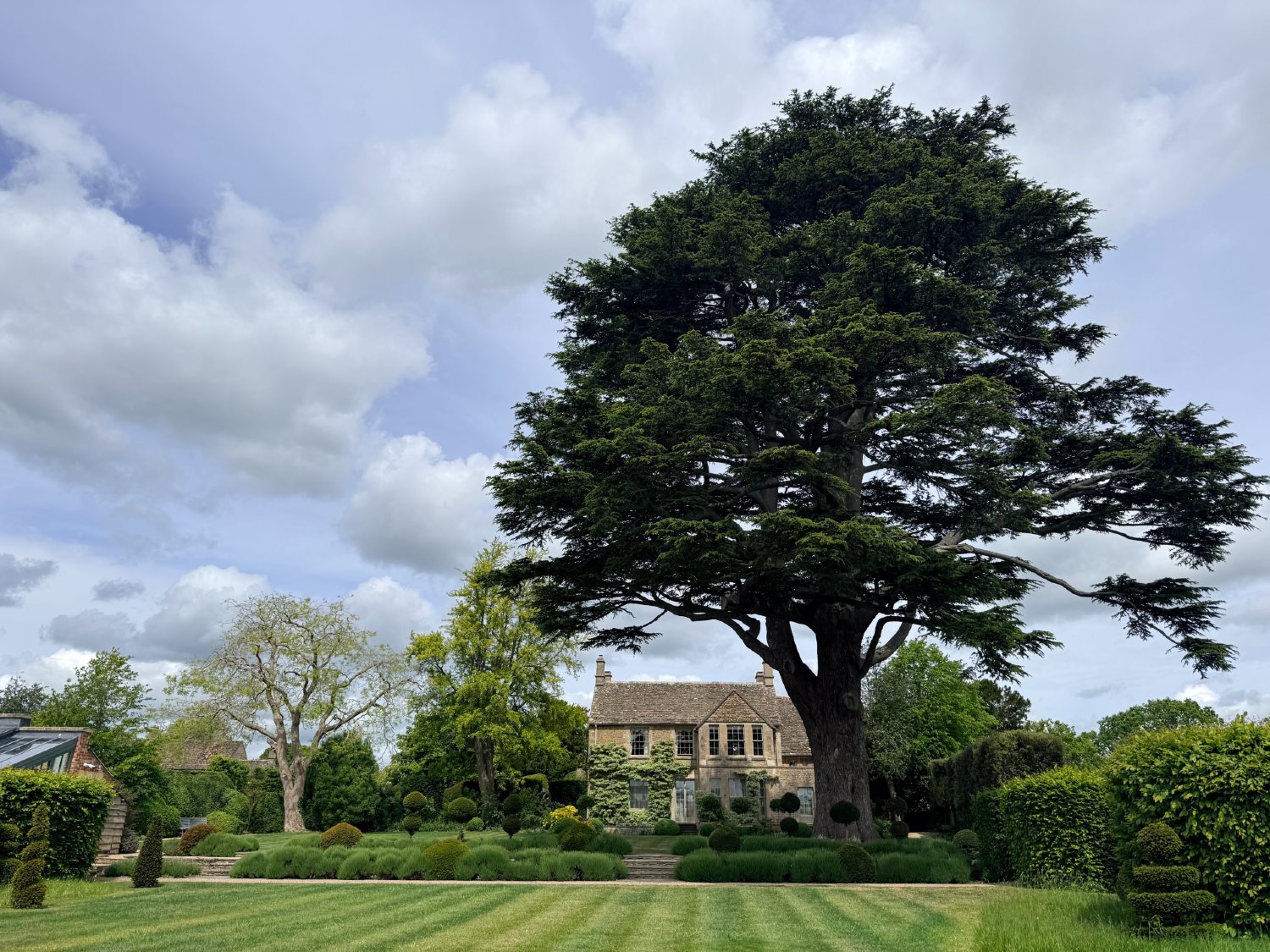
We arrive back at Thyme just before lunch. Later, en route to the pool, I pass the property’s towering centerpiece, a majestic Cedar of Lebanon. This centuries-old tree measures more than 20 feet in diameter, with a dense canopy providing shelter for an infinite number of birds.
It’s my favorite spot on the grounds, even topping the spa. And when I learn the Cedar of Lebanon is a symbol of peace and eternity, it further boosts my affection—a tree destined to turn even the most ardent city dweller into a tree-hugger.

Village Days: Cotswolds Highlights
It’s tempting to while away the days in and around the hotel, savoring farm-fresh eggs, listening for chirps and tweets, and relaxing on expensive stuffed sheep. But the Cotswolds are calling. With more villages than we have time to explore, we narrow down to a select few, including Daylesford, Bibury, Burford, and Stow-on-the-Wold.

In Daylesford, we beeline to its famous organic market and covet plants, flowers, and produce that Border Control won’t allow us to bring home. We gush over sticky honeycomb, sourdough starter, apricot marmalade, and heaps of artfully arranged asparagus. To offset our disappointment, we purchase more cheese, pâté, and baguettes than any group could reasonably consume for a late-afternoon picnic at the hotel.

The next day, the winding lanes of Stow-on-the-Wold enchant us with its lively market square, pubs, tearooms, and boutiques. But the main attraction is St. Edward’s Church. Built between the 11th and 15th centuries, the church’s hobbit-like north entry is framed by a pair of ancient yews that appear to be consuming the doorway. Stow’s Instagrammable hot spot, indeed.

In picturesque Bibury, we circle the village and walk beside the swan-filled River Coln, making sure to stroll past picture-perfect Arlington Row. A 14th-century row of cottages, Arlington Row, was originally a monastic wool store that eventually became a place for weavers. Today, it is one of the most photographed spots in the country.

Burford is also visually stunning—showing off its golden limestone cottages and gardens with pride. Its countryside location on the River Windrush offers more public footpaths and lanes to explore. Particularly known for antiques and boutiques, the village of Burford is another haven for shoppers—should you have any pounds to spare after getting a tablecloth at Thyme.

Slowing Down
After five glorious days in the Cotswolds, our time is up. The birthday group will soon disperse, some heading to London for the Chelsea Flower Show, others heading home to needy kids, needy pups, and needy bosses.
The Thyme Hotel reminds me not only that there is a slower way to travel (the trend of the moment) but a slower way to live. The Cotswolds encourage me to take the small joys of village living home, like the canopy of a magnificent tree, a meadow walk, or a perfect egg.
I wonder if I can.
As I wait for my taxi, I savor one last coffee in the Ox Barn, taking in the sounds of clinking glasses and the subtle scent of bacon. Already, I miss breakfast. I gaze up at the serene portrait that greeted me on arrival.
Taking my cue from Her Majesty, once again, I settle back into the sofa and close my eyes.
What’s the rush?
Leave a Reply