Tag: England

  • The Simple Life Reigns at the Thyme Hotel

    The Simple Life Reigns at the Thyme Hotel

    The villages of the Cotswolds have long been associated with fairytales and storybooks due to their limestone cottages, centuries-old churches, and well-tended gardens. The region of the Cotswolds evoke tales of simpler times, with sheep farmers, weavers, and oxen-led plows, lively pub dinners, and welcoming inns.

    But does the concept of the simple life still exist today? Or, is that just another fairytale? My stay at the Cotswold’s Thyme Hotel proves it does.


    Her fur-trimmed coat looks as soft and fluffy as the fleece of a newborn lamb. A string of pearls drapes elegantly around her neck, and a sparkling tiara crowns her tight silver curls. With her eyes gently closed, she seems entirely content in her surroundings.

    The feeling is mutual. This is a place that deserves a moment of quiet reflection. I’m still gazing at the portrait above the fireplace when my cappuccino appears, snapping me out of my reverie. I’ve only just arrived at the Thyme Hotel and I’m already smitten. I tamp down my excitement—I have five days ahead of me in the Cotswolds. 

    Taking my cue from Her Majesty The Queen, I sink back into the sofa. What’s the rush?

    Lambs

    Making a Case for the Simple Life

    If the Cotswolds conjure images of little lambs prancing beside their mamas, wisteria-clad cottages, and swans gliding along flowing rivers, you’d be spot on. It’s not a stretch to say that my first impressions of the Cotswolds had me wondering if I’d just strolled into a classic nursery rhyme.

    Sheep

    Roughly two hours from London, the Cotswolds are a landscape of rolling hills, meandering streams, and honey-colored villages that covers more than 800 square miles and spans six English counties. Our group has gathered here to celebrate a friend’s milestone birthday. And while we have different backgrounds, from creatives to conservationists to lawyers and even a former dolphin trainer, there is something in the Cotswolds to please us all.

    Five days ambling around the Cotswolds is hardly enough time to become an expert. It is, however, enough time to settle into the rhythm of the Thyme Hotel, our group’s blissful home base. 

    If there was ever a place to experience the pure, unadulterated joys of simpler times, this is it. 

    From Humble Beginnings

    Owners Caryn and Jerry Hibbert moved into Southrop Manor in 2002 and, along with Caryn’s father, began a slow and considered restoration of the property that would become the Thyme Hotel. By 2007, it opened as a cookery school, and in the years ahead, more conservation would follow, including the 19th-century Ox Barn, the Baa Bar, the Meadow Spa, and 31 accommodations.

    Thyme grounds

    Southrop’s historical significance is noted on Thyme’s website, ‘The estate dates from Roman times but is first clearly defined in the Domesday Book of 1086. The Manor House remains a private home and sits on the eastern side of its ancient Norman church. To the west of the church lie the manorial barns, houses and cottages which are at the heart of this medieval estate.’ 

    The Hibberts wanted to create a place that not only had minimal impact on the planet but also nurtured the environment, supported the local community, and inspired others to live more thoughtfully. With ground source heat pumps and wood chip boilers, spring-fed water, an extensive kitchen garden, and a nose-to-tail approach to cooking, it’s clear they’ve succeeded. 

    Farmhouse

    A Village Within a Village

    In 1801, the parish of Southrop had a recorded population of 238. By 2024, the population had grown—to 272. What makes Southrop so captivating is not its size, or lack thereof, but how little it has changed over the past two centuries. Under the Hibberts’ guidance, that sense of continuity and community extends to the Thyme Hotel.

    A village within a village, the hotel (originally Southrop Manor) provides all the necessities for a self-contained life; cloudlike mattresses in cozy rooms, multiple places to dine and imbibe, a pool and spa, numerous walking paths, gardens, and (this is England, mind you) a local pub.

    Table outside at Thyme

    There are guided activities on the property, like cocktail masterclasses, slow-flow yoga sessions, and garden walks. The ‘May Happenings’ board lists, How to Age, at 10am on Friday. Thank you, Thyme, but I have that one covered.

    Flower

    As the days go by, I fantasize about living at Thyme, watercoloring in the rapeseed and wheat-filled meadows, picking dill from the kitchen garden, learning how to pickle onions, and counting sheep. There’s something about the earthy wild grasses, the soft whistle of a European Starling, and the morning dew on my skin that makes this old-world existence so compelling.

    But all of this would require leaving my room, which is harder to manage than it sounds.

    Window view

    Thyme Living—Inspired by Nature

    Thyme’s impeccably designed rooms are spread in, among, and around the 17th-century Farmhouse and Georgian Rectory. Descriptive room categories defy typical hotel conventions, with names like Cosy, Teeny Cosy, Divine, Elegant, and Exquisite.

    Each botanically-inspired room, suite, and cottage feels like a precious jewel, especially the Teeny Cosy ones. And thanks to the inherent character of the original stone buildings, no two are alike.

    The birthday girl is in Phlox, which is papered in a mass of purple and mauve flowers and is even stitched into an oversized fabric headboard and lampshade. The effect is that of being completely enveloped in blooms.

    Fennel room

    Another friend is in Fennel, a multi-level suite which is a study in earth tones, and features a deep, standalone tub, and separate sitting room tucked into the eaves of the rectory.

    We unanimously covet Thyme’s fabrics and patterns, many of which are available in the boutique. Is life even worth living without owning a radish-covered tablecloth?

    Tablecloth

    The Ox Barn Delights

    The Ox Barn once housed the plowman’s oxen, but now serves as Thyme’s social hub and primary dining space. An adjacent lounge area has comfy sofas, chairs, ottomans. It’s a destination designed for lingering, reading, and dreaming—all activities that come effortlessly during my stay.

    Original timber beams and arches frame the high, vaulted ceiling. Floral arrangements adorn hand-picked pieces of furniture. I feel as settled here as I would at my BFF’s country manor, if I had a BFF with a country manor, that is.

    Ox Barn

    We enjoy one memorable meal after another, with locally-sourced delights like Aberdeen Angus with baby turnips and Grilled Polenta with ricotta with braised courgettes. But it’s breakfast that steals the show. Perfectly roasted asparagus spears and toasted soldiers served alongside a soft-boiled egg with a yolk as bright as a blooming marigold. A side of warm homemade sourdough is impossible to refuse.

    Sheep seats

    The Baa Bar’s Sheep Seats

    The Baa Bar becomes our favorite gathering spot—and not only for its botanical-infused cocktails, like the Rhubarb Royal and the Thyme Martini. An intimate space with velvet sofas, and floor-to-ceiling windows looking out towards manicured topiaries, the Baa Bar’s best feature is, you guessed it, the sheep.

    Created by Caryn Hibbert and paying tribute to Southrop’s farming heritage, these playful, oversized sheep seats (the stuffed synthetic variety) turn our group of relatively mature adults into raucous kids. Stuffed Cotswold Lions and Black Welsh Mountain sheep may sound kitschy, yet, they are anything but. 

    For those who are smitten, these ewe and ram settees are available for purchase. But be warned, if you have to ask the price, you probably can’t afford them.

    Estate in the Cotswolds

    Public Footpaths are for the People

    Public footpaths are a uniquely British enterprise. Where else in the world can the public legally cross private lands and farms without suffering consequences? The UK has over 140,000 miles of footpaths and bridleways where anyone and everyone is allowed to walk.

    Footpath

    One morning, a friend and I venture beyond the village, through a narrow, unmarked wall between two houses. We hop over a set of metal stiles and along the low fences of a vast estate before finding ourselves on one of these long-established footpaths.

    We meander along gurgling duck-filled brooks, through open fields edged with ancient stone walls, and past languid cows grazing in fields. My Merlin app is listening. Her What’s that Plant? app is identifying—a pair of amateur naturalists let loose in the English countryside. God help us.

    Cedar of Lebanon tree

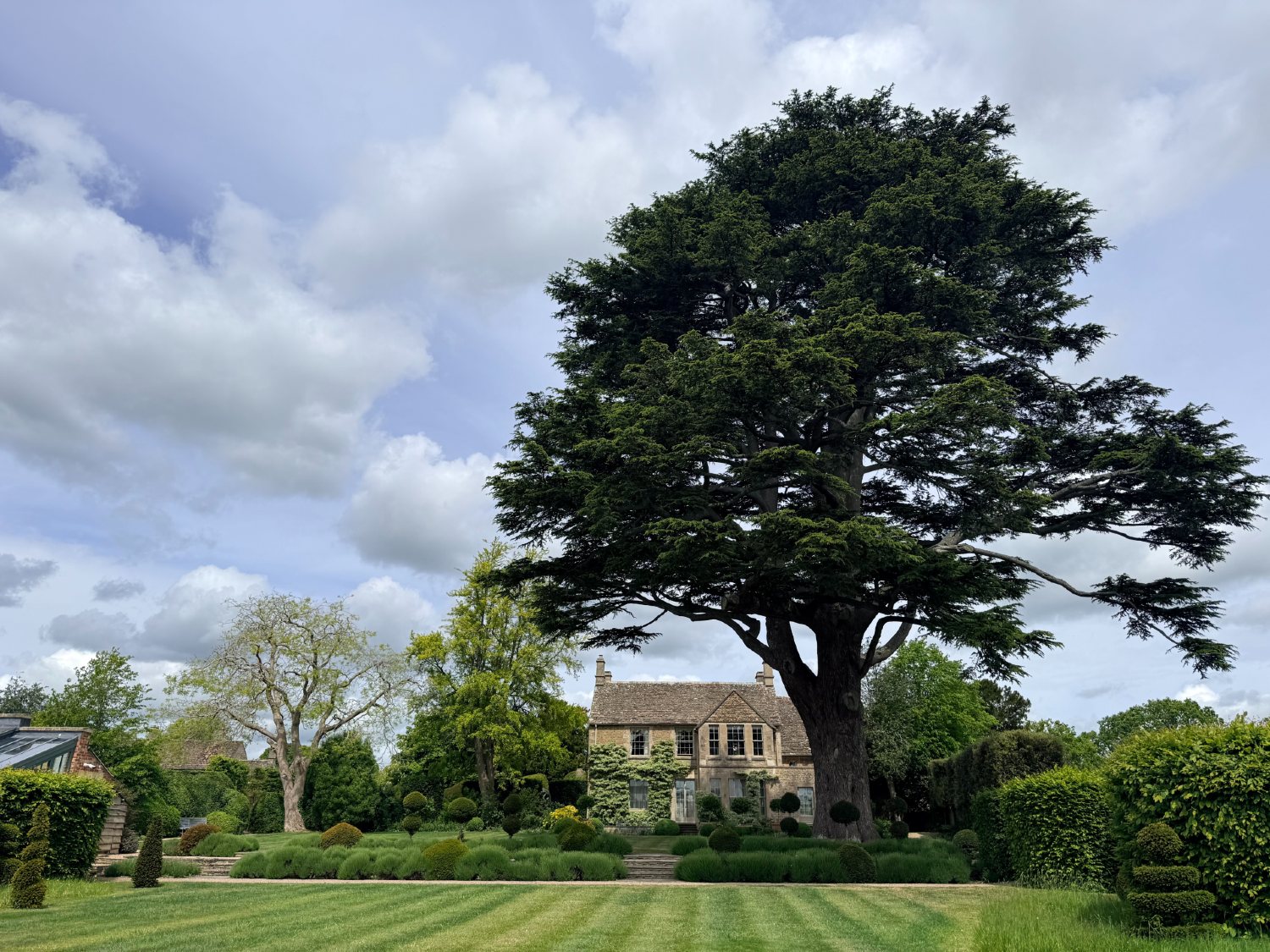
    We arrive back at Thyme just before lunch. Later, en route to the pool, I pass the property’s towering centerpiece, a majestic Cedar of Lebanon. This centuries-old tree measures more than 20 feet in diameter, with a dense canopy providing shelter for an infinite number of birds.

    It’s my favorite spot on the grounds, even topping the spa. And when I learn the Cedar of Lebanon is a symbol of peace and eternity, it further boosts my affection—a tree destined to turn even the most ardent city dweller into a tree-hugger.

    Bibury

    Village Days: Cotswolds Highlights

    It’s tempting to while away the days in and around the hotel, savoring farm-fresh eggs, listening for chirps and tweets, and relaxing on expensive stuffed sheep. But the Cotswolds are calling. With more villages than we have time to explore, we narrow down to a select few, including Daylesford, Bibury, Burford, and Stow-on-the-Wold.

    Asparagus spears

    In Daylesford, we beeline to its famous organic market and covet plants, flowers, and produce that Border Control won’t allow us to bring home. We gush over sticky honeycomb, sourdough starter, apricot marmalade, and heaps of artfully arranged asparagus. To offset our disappointment, we purchase more cheese, pâté, and baguettes than any group could reasonably consume for a late-afternoon picnic at the hotel.

    St Edwards Church

    The next day, the winding lanes of Stow-on-the-Wold enchant us with its lively market square, pubs, tearooms, and boutiques. But the main attraction is St. Edward’s Church. Built between the 11th and 15th centuries, the church’s hobbit-like north entry is framed by a pair of ancient yews that appear to be consuming the doorway. Stow’s Instagrammable hot spot, indeed.

    Arlington Row

    In picturesque Bibury, we circle the village and walk beside the swan-filled River Coln, making sure to stroll past picture-perfect Arlington Row. A 14th-century row of cottages, Arlington Row, was originally a monastic wool store that eventually became a place for weavers. Today, it is one of the most photographed spots in the country.

    Flower

    Burford is also visually stunning—showing off its golden limestone cottages and gardens with pride. Its countryside location on the River Windrush offers more public footpaths and lanes to explore. Particularly known for antiques and boutiques, the village of Burford is another haven for shoppers—should you have any pounds to spare after getting a tablecloth at Thyme.

    Slowing Down

    After five glorious days in the Cotswolds, our time is up. The birthday group will soon disperse, some heading to London for the Chelsea Flower Show, others heading home to needy kids, needy pups, and needy bosses. 

    The Thyme Hotel reminds me not only that there is a slower way to travel (the trend of the moment) but a slower way to live. The Cotswolds encourage me to take the small joys of village living home, like the canopy of a magnificent tree, a meadow walk, or a perfect egg.

    I wonder if I can.

    As I wait for my taxi, I savor one last coffee in the Ox Barn, taking in the sounds of clinking glasses and the subtle scent of bacon. Already, I miss breakfast. I gaze up at the serene portrait that greeted me on arrival. 

    Taking my cue from Her Majesty, once again, I settle back into the sofa and close my eyes.

    What’s the rush?

  • Cumbria. Many Lakes. One Star.

    Cumbria. Many Lakes. One Star.

    The Lake District may be England’s best kept secret.


    The Lake District, England /

    Dungeon Ghyll, Crinkle Crags and Harrison Stickle. No, these aren’t characters from a Harry Potter novel, they are the illustrious names for ravines and peaks in the majestic Lake District of England. Where, if you are American, you won’t see a fellow countryman for days and wonder why this place has seemingly escaped our radar. It is a mere four hour drive from London, which by US standards, is a typical Sunday outing. Some might say, well we have Vermont, or the Finger Lakes, and while those are truly gorgeous lake areas in the US, what we don’t possess are the fairytale hamlets, the tall, spired edifices and the Hobbitt-like thatched rooftop villages that accompany the lakes of Cumbria. Rolling hills, a patched quilt of vivid yellows and lush greens, ancient slate, hand-built stone walls that act as property dividers weaving like a thread throughout the landscape. It is a scene from another era.

     Tombstone of William Wordsworth Village of Grasmere

    Living the fairytale

    Our first day in Cumbria started with a leisurely drive to the village of Grasmere, where we lined up for freshly baked squares of gingerbread in the very place that gingerbread was invented back in 1854 by Sarah Nelson. We were far from the only ones waiting patiently at the old stone house where she perfected her recipe (and later kept handwritten in a bank vault) and the spicy sweet combination did not disappoint! The streets we walked were long and winding, the stream banks lined with sheep. We ambled past the eroding tombstone of William Wordsworth and the very daffodil fields that inspired his famous poem.

    Village of Grasmere, fields

    The remainder of the day was spent driving up and around roads (a generous term!) that are supposed to accommodate two cars but can barely fit one, a virtual game of shark as we held our breath around each curve, praying no one was coming from the other direction. There is no shoulder, no give—in fact only stone walls, so that if you do come face to face with another car, (and you will) someone has to back up indefinitely in order to let the other pass. And here I thought the hiking was going to be the most treacherous part of the trip!

    Wray Castle

    Meandering our way around the snake-like roads that hug the lakes, trying to find the elusive, and unfortunately for us, closed in June, car ferry to take us back to our hotel, we stumbled upon Wray Castle. Best seen from the outside than in, it is a Gothic Revival castle that was built in 1840. The grounds and exterior are beautiful but the inside was never restored to it’s 19c glory and is disappointingly used mainly as an exhibition space and for kid’s events.

    Orrest Head hike view

    The peaks of Cumbria

    We were told that there are maybe fifteen days a year of cloudless skies in the Lake District, and we were lucky enough to get them, especially since we had a few days of strenuous hiking ahead. Our past track records for hiking having not been so fortunate, hiking three plus hours to the summit only to see a lovely view of drizzle and fog. My husband told me after our trip that at least three people and a dog were blown to their death off Helvellyn last year due to weather conditions. I’m relieved not to have known that sobering fact earlier. But in our case, the UK weather reported, “another glorious day with spells of unbroken sunshine.” British weather reports are truly inspired.

    Orrest Head hike view

    Orrest Head was a warm-up hike the day before our trek up to Helvellyn, which is the third tallest peak in England. There we saw panoramic views of Windermere Lake and various peaks in the distance. We could just make out a string of sailboats in the distance as we took a seat on a wooden bench and admired the hushed landscape, the immense sky swallowing the sun, the birdsong in the foreground and the baa-ing of sheep in the background. The well-known British fellwalker (well-known mainly in the UK, I’m guessing), Alfred Wainwright, wrote of Orrest Head, ‘…quite suddenly, we emerged from the shadow of the trees and were on a bare headland, and, as though a curtain had dramatically been torn aside, beheld a truly magnificent view…”

    The Gilpin Hotel

    Spending time in Crook

    We checked into our room at our hotel, The Gilpin, which is located in the fantastically named village of Crook in County Cumbria. The Gilpin is a place of opposites. At first a lovely old historic inn with 26 rooms and a Michelin-starred restaurant, and second, a modern feat of architecture, with separate unique, geometric stand alone rooms made of wood and glass, cedar hot tubs and modern amenities, somehow living together in harmony in this bucolic part of the country. It has been family run for 100 years, and you immediately feel as if you are part of their family.

     The Gilpin Hotel patio for drinks Canapes at the Gilpin Hotel

    The communal sitting areas, complete with coffee tables and books, comfy chairs and sofas on which to nap, make you feel as if you are in your own home. There is an inviting and elegant bar, wine room, and a gorgeous garden patio to have pre-dinner drinks and canapés. The owners are always wandering around and happy to chat about your day. The atmosphere is as warm and inviting as you could possibly want.

    The Gilpin Hotel sitting room

    Our room had a spacious outdoor patio and a two-person round cedar hot tub that was sunken into the deck and somehow always at the perfect temperature. Bamboo and other wildflowers dotted the property, the air was dry and sunny, and it was nearly impossible to drag ourselves to the 60 second walk to dinner that evening.

    Restaurant HRiSHi The Gilpin Hotel wine room and cocktail bar Restaurant HRiSHi wine table

    A star among the lakes

    Part of the allure of Gilpin, other than it’s lovely location nestled in the heart of the lakes, was the on-site restaurant HRiSHi, which boasts a Michelin star, among other awards, for it’s executive chef Hrishikesh Desai. Never ones to pass on a chef’s tasting menu (wine-paired!), we put ourselves in the chef’s hands for the night.

    Restaurant HRiSHi tasting menu Restaurant HRiSHi tasting menu Wye Valley Asparagus, with pickled mushrooms and saffron aioli

    As a true nod to the chef’s talent, it was the first time we have ever chosen a vegetarian tasting menu. It was just too good to pass up, even for a carnivore like me. So we split the difference, my husband ordering the Signature Tasting Menu and me ordering the vegetarian option. Highlights were many, too many to count, but if I had to pick, the Lemon Gnocchi with marinated halloumi and wild mushrooms over cépe foam, paired with a delicate Albarino from Rias Baixas, Spain was an instant favorite. That, as well as the Wye Valley Asparagus, with pickled mushrooms and saffron aioli, on toasted almond cream, paired with a lovely white from Puglia, Italy. Each course more decadent and artfully designed than the last. Two plus hours later we trekked the 60 second uphill back to our room, wondering how we were going to manage in the morning.

    Gilpin House breakfast in a sun-lit room

    Tackling Helvellyn

    The next day started off with a lovely breakfast in a sun-lit room in the main house before we drove to the base of Helvellyn in Ambleside. I overheard a grandmother, who sounded eerily like Maggie Smith, explaining to her granddaughter, the game of cricket, “Nothing much happens. And it takes about three days to do it. “

     Hiking Helvellyn Hiking Helvellyn, views

    It was a gorgeous day and once at the top, we were assured we’d be able to see as far as the Irish Sea. We reached the trailhead via Kirkstone Pass, which was a road with one of the most dramatic views of the Lake District. At that time of day, it was just us and the cyclists, which made the drive even more serene, the lakes seemingly frozen in time and the reflections razor sharp. We parked, and then began our trek along the Hobbit-like countryside, passing wildflowers, sheep, lambs, waterfalls and streams, stone walls that curled along the route like a miniature Great Wall of China, watching the villages recede further into the distance as we gained altitude and took in the drama of it all. Two and half hours of uphill later, we found ourselves scrambling over the jagged rocks and tricky knife edge ridge known on the map as Striding Edge, the place where some have met an untimely death. ‘Striding’ seemed a bit too ambitious a term, as I was on all fours, refusing to look any way but dead ahead, and cursing my husband underneath my breath. 

    Striding Edge Hiking descent views of greenery

    Thankfully there was no wind and conditions were in our favor, but admittedly it was the most exhilarating part of the hike, every sense on high alert to make it at last to the summit at 3,120 feet, passing high above the Red Tarn and looking down into the valleys. Truth be told, the views were worth every gray hair I earned that day. The way down, the hike making a natural loop, was a little more leisurely, apart from the scramble along Swirral Edge, and filled with the most verdant of landscapes. Foxgloves popped out like hot purple pokers from in and around the ancient stone walls. The villages materialized, and civilization and a cold beer were in our immediate sights.

    The Giplin House exterior

    world cup: England v. Belgium

    The last night of our time in the Lake District was spent at the casual restaurant at Gilpin, The Spice House, watching England lose to Belgium in a group match during the World Cup. I was assured this loss didn’t matter, which was confirmed as no one seemed particularly upset by it. The Indian menu was a nice contrast to our previous meals and the atmosphere relaxed and casual. We ordered a bottle of Grüner Veltliner and settled in for the match. Being as far north as we were, it amazed me to see light still clinging to the sky at nearly 11pm.

    Mountains and sheep

    The next day was an early rise and on to the next stop of our European journey. In some ways, I felt like the sole American discoverer of the glorious Lake District. I would encourage anyone to add it to their bucket list of travels while in the UK, as it is a fairy-tale inspired moment in time you will not easily forget. As we headed out of town, one last moment of being wonderstruck by the rolling hills, mountains, valleys, hamlets and mirror-calm lakes, I saw a sign for The Sun Inn and smiled. Maybe I was in a Harry Potter novel after all.

    Cumbrian countryside

    Want to find out what’s hot before anyone else? Click here.

    Five Reasons to get lost:

    • Spending time pre-dinner on the patio at the Gilpin and watching mama birds feed their babies under the eaves.
    • The hair-raising drives around the lakes, wanting to watch the view but needing to watch the roads!
    • Making it to the summit of Helvellyn on a rare sunny day and popping open a well-deserved can of Coke.
    • Having warm gingerbread at the birthplace of gingerbread, then roaming the very streets that Wordsworth and Beatrix Potter once walked.
    • Hearing phrases like ‘dilly-dally’ and ‘higgledy-piggledy’ used in every day conversation.

    Where will you find yourself next?

    Consider a short flight from London to Milan and head to Lake Como for a few days.

    Live in an ancient 15th c. village in Montenegro while overlooking the Adriatic Sea.

    Take on the Medina, and more, in Marrakech.