Tag: family travel

  • These Remote Norwegian Islands Have An Unusual Smell. It’s Money.

    These Remote Norwegian Islands Have An Unusual Smell. It’s Money.

    Our RIB slices through Trollfjorden towards Svolvær, the scenic capital of the Lofoten Islands. Twelve of us instinctively lean left—as if we have some control over the heeling boat. The narrow fjord’s steep-sided, jagged mountains rise dramatically from the sea. The water swirling beneath me is a shade of blue I’ve never seen. Overhead, the sea eagles we met earlier turn back towards Raftsundet strait, realizing their midday snack is officially over. The trolls remain hidden.

    As we get closer to the harbor, a stench hits me like a rogue wave. I look around. My face isn’t the only one scrunching in disgust. Our guide is watching. Is he smirking? The Brit behind me is the first to bite. “What’s that awful smell?” he asks. “Ahhhh,” Emil smiles and exhales slowly, deliberately. “That, my friend, is the smell… of money.”

    Twelve heads turn in unison, baffled.

    Reine

    Where Are The Lofoten Islands?

    I found the Lofoten Islands through my usual source of inspiration—Instagram. Those algorithms are eerily spot on, drawing me into little tiles of mesmerizing mountainscapes and fjords. I needed to know exactly where this magical place was and how soon I could get there. 

    The Lofoten Islands are in Northern Norway, I discovered, just inside the Arctic Circle. 

    Of course they are.

    Factually speaking, the Lofoten Islands are an archipelago of seven main islands bisected by glacial fjords. By the numbers, they are about 100 miles long, over 3 billion years old, and have roughly 25,000 residents. The Midnight Sun reigns from late May to mid-July. Intriguing facts, Wikipedia, but I don’t need them to inspire my trip—Instagram beat you to it.

    Illustration map of Lofoten

    The Scandinavia Travel Boom

    Scandinavia is on the cusp of a travel boom, partially as a reaction to the wildfires and raging heat from which the rest of Europe suffers. Some travelers are looking for more temperate climes. Others are seeking roads, or in this case, fjords less traveled—a response to overtourism plaguing countries like Italy, Spain, and Greece. 

    Nordic countries saw a surge in tourism last year, with Finland, Denmark, Sweden, and Norway reporting a record-breaking number of visitors. In Norway alone, nearly 17 million hotel nights were booked—a 3% increase from the previous year. Those numbers are expected to rise as more intrepid travelers view Scandinavia as the antidote to mainland Europe’s woes. But, the Lofoten Islands are remote even by Scandinavian standards. 

    It’s worth noting the emphasis on destinations yet to grace the covers of Travel+Leisure and Condé Nast Traveler. Travelers want bragging rights, to get to destinations first. If Scandinavia is the next travel hot spot, I want to get there first, too. I book my flights and ferries. Thank you, Meta. I’m on my way. 

    The Fish That Put Lofoten On The Map

    “That smell is stockfish,” Emil continues. “Stockfish is Norway’s most important export—and has been for centuries. To us, the smell of drying cod is considered the smell of money.”

    The Tørrfisk industry dates back to the Viking era. Tørrfisk (aka stockfish, or dried cod) was so lucrative that it lured over 30,000 fishermen to northern Norway each winter. Fishermen who endured the Arctic’s extreme and harrowing conditions to provide for their families back home. 

    Stockfish
    PC: Ruramos

    Once caught, the codfish, with their wiry whiskers and mouths agape, are placed on large pyramid-shaped wooden racks called fiskjehell. Norwegian winters are windy and well below freezing, thus creating a natural preservation system for the fish to dry without rotting.

    Fiskjehells are still used in the Lofoten Islands and can be seen (and detected sight unseen) in many seaside villages—a monument to the dedicated fishermen who endured Lofoten’s long, dark winters. 

    Stockfish’s Place on the Global Table

    The smell of stockfish also reminds us of Lofoten’s importance in commercial fishing. Of all the European nations that import dried cod from Norway, Italy is the largest. Stockfish is the central ingredient in their famous dish, Stoccafisso Accomodato (stockfish stew). It’s also a staple of Nigerian cuisine, often used for stews and soups. 

    Stockfish adorns the menus of Lofoten restaurants, from fine dining at the Kitchen at the End of the World to Svinøya Rorbuer’s humble restaurant, Børsen. Travelers can experience the fish that built Lofoten with dishes like Tørrfisk Royal, cod stew with carrots, egg, butter, and bacon, and stockfish filleted with baked leeks, wild mushrooms, and kale.

    The curious Brit quips, “I don’t see any fish, only empty racks.” Emil is ready. “The fish hang for three to four months,” he explains. “By May, about six million tons of cod hang in hjells, ready to be shipped. But, even when the racks are empty, the smell lingers.” Satisfied, the Brit settles.

    View of Reine with clouds

    The Fisherman’s Wife

    Emil cuts the motor, and the silence is welcome. We’ve been careening around the fjord, feeding sea eagles and troll-hunting for hours. That’s when I see her. Standing poised and strong against the wind on a rocky promontory, she clutches a shawl around her neck with one hand and waves longingly with the other. 

    “That’s Fiskerkona,” Emil says, reading my mind. “The Fisherman’s Wife. She represents the resilience of the women left behind to raise families during their husband’s long absences. Many would never see their spouses again.” This poignant statue quiets the group—even the inquisitive Brit.

    Nusfjord interior

    Turning Tradition into Luxury

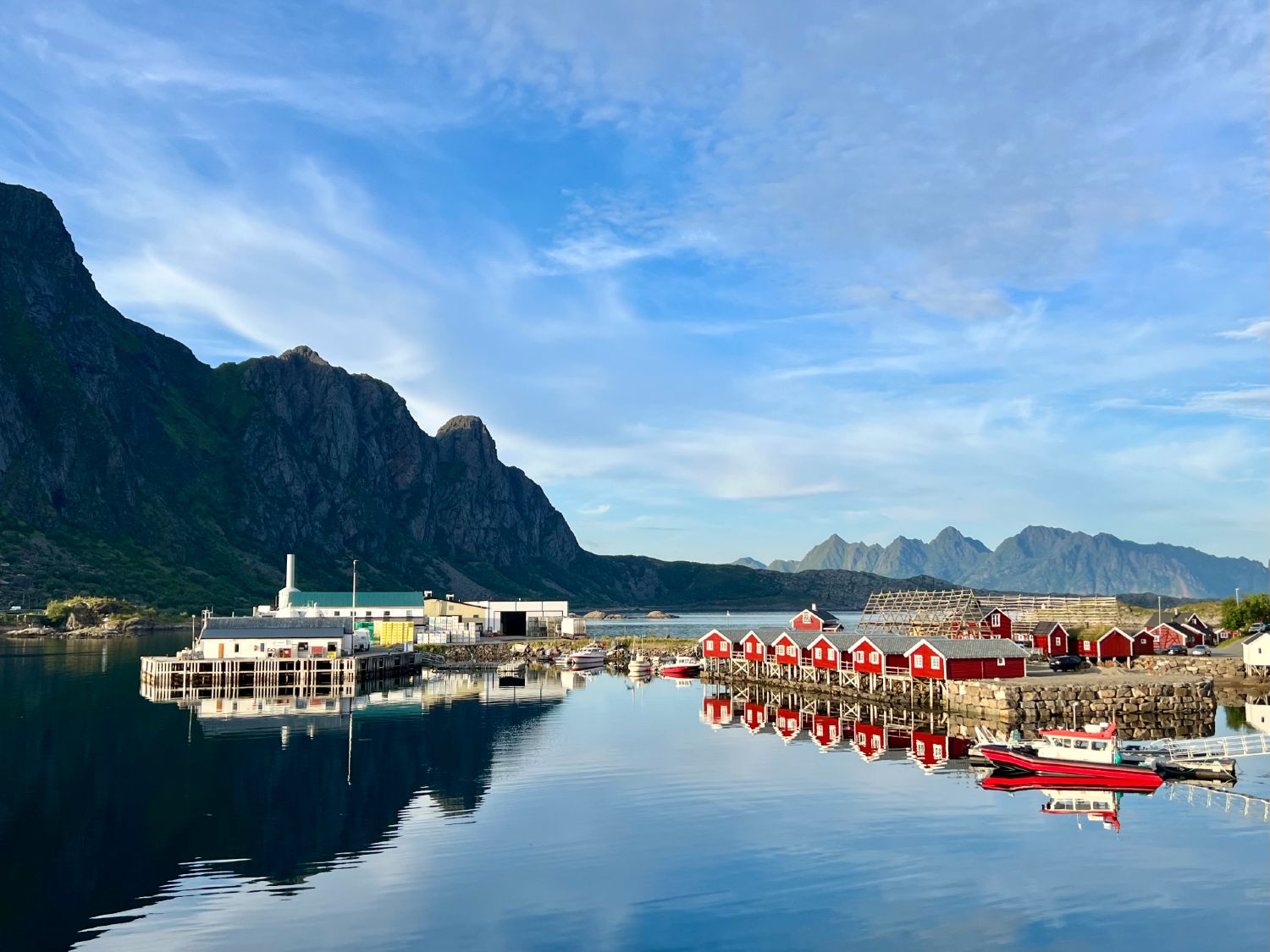
    Thousands of fishermen traveled north each winter to hunt for Norway’s prized fish. They lived in rorbuer, traditional stilted, wooden huts. In Norwegian, ‘ror’ means row, and ‘bu’ means small house. Up to 12 fishermen shared each rorbu. Rorbuer were sheltered from the elements and divided into two parts, one for sleeping and one for gear. The ceilings were low, and the windows were small and inefficient. They had basic kitchenettes and uncomfortable beds. But, they provided what mattered most—direct and immediate access to their fishing boats.

    Rorbuer

    These seaside cabins, many restored to their original red and yellow colors, have been retrofitted as tourist accommodations. Some, however, are retrofitted better than others. Rorbuer are an integral part of Lofoten’s history, giving visitors a chance to imagine life within the same four walls as Nordic fishermen, albeit in some cases, on 600-thread-count sheets, with rain showers and Nespresso machines.

    Nusfjord bedroom

    Turning tradition into luxury is hard work. Not as hard as fishing for cod in the Arctic, but hard nonetheless. Although updated with modern conveniences and creature comforts, some rorbuer lack the sophisticated amenities often associated with high-end luxury. Others have found an idyllic balance,  elevating the rorbu by adding soft, plush duvets, Bluetooth speakers, and bespoke toiletries while keeping the cabins’ historical integrity intact.

    That said, rorbuer accommodations are in such high demand that some were fully booked as early as February for this coming summer. These rorbuer create a source of income beyond stockfish—attracting the kind of money that looks, feels, and smells like actual money.

    View of Nusfjord village

    The End Of The Road in the Lofoten Islands

    The Nusfjord Arctic Resort is tucked away at the end of a road in a secluded valley that hovers over the sea. A Small Luxury Hotel of the World, Nusfjord has managed to preserve the look and feel of a typical fishing village so vividly that I could swear I traveled through time.

    Many of Nusfjord’s rorbuer are several hundred years old. During the day, tourists come from near and far to explore the grounds, the general store, the bakery, the smithy, the boatshed, and the cod liver refinery. 

    Black-Legged Kittiwakes

    They dine at the property’s on-site restaurant, Karoline, and gaze at the mountain views. They order pizza from a small wooden shack, grab a cold beer, and sit among the protected Black-Legged Kittiwakes (Krykka) that nest on the cliffs and windowsills. From 9am-5pm, Nusfjord swells with tourism.

    Dock at Nusfjord Hotel

    But come 5:01pm, the property is reserved for guests only. Cue a mass exodus akin to heading west on Montauk Highway after Labor Day Weekend. It’s then that lucky Nusfjord guests peek out from their rorbu windows, making sure the coast is clear. They shuffle out in fuzzy slippers and fluffy robes one by one en route to the sauna.

    Lofoten Island’s Endless Days

    We’re getting closer to Svolvær’s docks. Our sea eagle safari will soon end. This high-speed RIB excursion has been a highlight of my trip. Not only because I saw so many of the promised eagles but also because of Emil’s insights into Lofoten’s history. 

    I look back at the scenery Instagram inspired me to come so far to admire. Hiking peaks like Reinebringen and Djevelporten provide an eagle-eye view of the islands that change with the sun, mist, and fog—each stunning in its own way. The mountains appear hand-painted and are set against layered clouds in a sky that never gets dark. Summer in Lofoten is an ongoing study in beauty. I could spend a lifetime of summers here and never tire of it.

    Svolvaer overview

    The Set-Jetting Travel Trend

    The Lofoten Islands aren’t the only Norwegian destination benefiting from a boost in tourism. Anyone who followed the black comedy Succession will recall the episode in which Shiv and Roman Roy visit Mattson’s homeland. The Roys stay at Juvet Landscape Hotel, a property entirely immersed in nature.

    Juvet is located on the west coast of mainland Norway. It’s a great example of ‘set-jetting,’ the travel trend best described as wealthy Americans spending gobs of money in places like Thailand and Dubrovnik courtesy of TV shows like The White Lotus and Game of Thrones. These days, Juvet is as hard to get into as the Vatican on Easter Sunday. Damn you, Roman.

    Achingly cinematic and designed with the environment as the star, Juvet’s seven minimalistic rooms include airy Birdhouses, glass-walled Landscape rooms, and the writer’s aerie, Scrivener’s Room. At Juvet, luxury is at its most understated, and the only tension lies in the ever-changing scenery.

    Boats at Svinoyer

    Past, Meet Present

    “Come back to Lofoten,” Emil calls out as we disembark. My heart sinks. The possibility of coming back seems unlikely. Who goes to the Arctic Circle twice? Hmmm. Maybe I do.

    The sun is high in the sky. Since it won’t fully set, we have endless hours ahead of us to explore and relax. I peel off my dry suit and take off my goggles and hat. It’s 36 degrees, and I’m freezing. I think of the fishermen. I wouldn’t have made it past Fiskerkona. 

    Nusfjord

    Although Lofoten’s fishing industry remains deeply rooted in history, some things have changed. The boats have been modernized with GPS and sonar radar for tracking schools of fish. Safety has improved with the addition of anti-slip surfaces and hydraulic winches. The fishermen sleep in heated cabins and have cell phones to call their wives (whether they consider that an improvement is unclear.)

    I turn towards Trollfjorden—contemplating those elusive trolls. I no longer detect the intrusive fishy smell. How quickly humans adapt—even to an unpleasant odor like dehydrated fish. Though surely not unpleasant to the residents of the Lofoten Islands—where the scent of dried cod symbolizes history, prosperity, and a tourist industry’s moment in the sun.

    Click here to learn more about what to do, what to see, and where to stay in the Lofoten Islands


  • How To Pack for an African Safari (Carry-On Only)

    How To Pack for an African Safari (Carry-On Only)

    Are you heading on safari for the first time? An African safari is an adventurer’s travel trifecta—a combination of breathtaking wildlife, stunning terrain, and unparalleled lodging and hospitality. With over 20+ game drives across four countries, I’ve learned a thing or two about how to simplify the preparation for this exciting experience. My packing lists follow—organized into four simple categories. You can also download my ‘Ultimate Safari Packing List’ to have them all in one easy-to-access place.

    And while it’s not necessary to travel with only a carry-on—if you can manage it, you won’t regret it.


    Coach bag

    The first time I went on an African safari was in 2002. It was my honeymoon. My soon-to-be husband had kept it a surprise until check-in at JFK—a gesture that felt romantic then, but would feel utterly controlling now. That’s twenty years of marriage for you.

    A few weeks before departure, Daniel gave me a gift—an overnight bag from Coach. I loved its cherry red canvas exterior, wide shoulder strap, and soft leather details. But as I’d come to expect from many of Daniel’s gifts, it came with a catch. 

    “It’s for our honeymoon!” Daniel chirped excitedly. “Oh, how cool! You mean it’s my carry-on bag?” I questioned, although I already knew the answer.

    tracking in Africa

    Being Prepared Is Isn’t Everything

    How I packed for a three-week trip to an unknown destination in a bag designed for a weekend getaway is baffling. As my faded disposable camera photos show, I packed the wrong clothes, the wrong gear, and way too many shoes. Yet, I can’t recall needing a single thing as we journeyed across Tanzania that June. That’s young love for you. 

    Despite my anecdotal story of unpreparedness, I vowed to be ready when we took our kids on safari years later. I googled safari clothing, what to wear on safari, safari must-haves, and safari packing lists. This time, I’d be prepared. This ain’t no honeymoon.  

    If a similar Google search got you here, congratulations—you have a safari on the horizon. It’s one of the world’s most intense, immersive, engaging, and magical experiences. I’ve been on safari in Tanzania, Botswana, South Africa, and Uganda. With each trip, I fine-tuned my packing skills, filing away tips for my future safari-bound self and my safari-bound friends and relatives. I figured out how to consolidate. And found my safari style without entirely forgoing fashion. I made peace with layers and colorless clothes.

    on safari

    Safari Style 101

    Safaris are considered once-in-a-lifetime experiences due to their high costs and far-flung locations. It’s painful to shell out even more money for clothing you may never wear again.

    Thankfully, safari clothing need not be expensive. The best way to dress for a safari is modestly and with a neutral color palette. Take advantage of a high/low buying strategy. This means spending more on certain pieces (like a good fleece or puffer) to balance items (like underlayers) where you can safely compromise fashion and durability.

    Bush plane

    In Africa, It’s All About Layers

    Safari game drives typically occur around sunrise and sundown. You don’t need David Attenborough to tell you these are the times of day when wildlife is most active. Unfortunately, these coincide with the times of day I am least active. But safari is well worth going outside of your comfort zone! Be suspicious of an outfitter that advertises a noon game drive. The leopards and lions will be enjoying a midday siesta. You should consider one, too. Game drives are tiring.

    As for safari clothing, it’s all about layering. Think about a tank top base layer, a lightweight, long-sleeved mid-layer, and a fleece and puffer outer layer. The thin mid-layer will be your new BFF, as it will protect your skin from the sun and pesky tsetse flies. Lightweight, long pants are better than shorts despite the temperature for the same reason. Invest in a good fleece and puffer, as you will wear them daily and likely beyond Africa.

    sunset

    And it’s all about the Sun

    Mornings in Africa are typically cool. You’ll be awake before the sun. Sunrises and sunsets are another reason why we go to Africa. The muted layers of the terrain will morph and change as the day breaks, adding another level of awe to an already awe-inspired morning. Sunsets are equally mesmerizing—with no air pollution or city lights to spoil them.

    As the temperatures rise, slowly peel off your layers. Settle into the sounds of the savannah. Get your camera ready and listen to your all-knowing guides. The fun is about to begin.

    Author and husband on safari

    Safari Clothing Packing List:

    2 x base layers (tank or short-sleeved shirts)
    2 x mid-layers (lightweight and long-sleeved, neutral colors)
    * 1 x fleece (neutral color)
    * 1 x lightweight puffer (I like this one from Patagonia because it folds down to the size of a paperback)
    1-2 linen shirts and/or shorts or, for women, a wrinkle-free dress (for evenings around the firepit comparing wildlife sightings, also doubles as a nice outfit for layover city days)
    2 x lightweight pants (zip-off ones are popular; I don’t know why)
    Buff (for dust, flies, and keeping hair off your face—the uses of a good buff are endless)
    2 x sports bras 
    7 x underwear (many lodges have complimentary laundry)
    7 x socks (at least two thicker and longer pairs to go over pants if on a walking safari or a trek in Uganda. Otherwise, prepare to meet the local fire ant community.)
    Hat (wide-brimmed to protect your neck and, yes, neutral)
    * Hiking shoes (broken in, in advance)
    Closed-toe shoes or sneakers 
    Flip flops (for hanging around the pool)
    1 x bathing suit (it’s tempting to take more—don’t. This isn’t Cabo.)

    * Splurge-worthy item


    Click here for my free ‘Ultimate Africa Safari Packing Lists’


    lion on Canon camera

    Gearing Up

    The right gear is integral to a safari experience, especially for wannabe wildlife photographers, bird nerds, and travel bloggers. But gear is cumbersome. Choose what to pack with care. Unless you’re applying for a job at Nat Geo, an iPhone may suffice—they take beautiful photos. My go-to is a combo—an iPhone (hanging from a lanyard around my neck at all times) and a Canon Rebel SL2, which is lightweight, user-friendly, and has WI-FI capabilities so I can post to Instagram in real-time. 

    Safari Gear Packing List:

    * Luggage (Eagle Creek is my go-to choice; this is my pick)
    Packing cubes (Eagle Creek packing cubes have endless uses: toiletries for plastic-free countries, dirty laundry, souvenirs)
    iPhone and charger
    iPhone lanyard (Somewhat dorky, yes—but you’ll thank me when baboons don’t steal your phone)
    * Camera and lenses (one good zoom will do—they’re expensive, consider renting one)
    Extra battery and/or SD card
    * Binoculars (sometimes provided, but having your own is worthwhile—these are the ones I use)
    Sunglasses
    Day pack (for your gear)
    Universal Travel Adapter (this is the one I have)

    * Splurge-worthy item

    White rhinos in Africa

    Little Things Count

    Don’t let the length of the following list scare you. In total, these self-care items take up less space than that extra pair of shoes you won’t wear. But little things count—especially things that protect our bodies and minds in one of the most unforgiving places on Earth.

    Safari Self-Care Packing List:

    Sunscreen (transferred into CVS travel-sized containers you can dispose of as you go)
    Lip balm with SPF
    Insect repellent (The National Capital Poison Center recommends a concentration of DEET no higher than 30%)
    Eye mask (this one is my go-to)
    Ear plugs (although the nightly chorus of wildlife is a highlight of safari) 
    Prescription meds (cute pillboxes are all the rage)
    Small medical kit (a nod to my paramedic husband, who doesn’t go to Safeway without one)
    Feminine products (because there’s no CVS in the Okavango Delta)

    Landscape

    Less is Less

    It’s human nature to be overprepared, especially in a place as foreign and remote as Africa. If you’ve chosen a reputable safari outfitter with your travel advisor, then you need not worry. Anything critical you may have forgotten will be taken care of. Strive to pack less. Make a carry-on bag a goal. Feeling unencumbered on a trip with so many moving pieces is liberating. 

    But no matter what you pack in, some things don’t belong on a safari in Africa. 

    What Not to Pack Packing List:

    Perfume (or creams/moisturizers with a strong scent that will attract or repel wildlife)
    Fine jewelry (the rhinos don’t care how many David Yurman bangles you have)
    Plastic bags (some countries, like Rwanda, are polythene-free)
    Dressy clothes and shoes (safari is decidedly casual)
    Drones (restricted in many African countries)
    Hair dryers (most lodges will have them)
    Anything you haven’t worn in the last 12 months (you think you’ll wear it in Africa—we all know you won’t)


    Click here for my free ‘Ultimate Africa Safari Packing Lists’


    Cheetah portrait

    Prepare to see the Unexpected

    One of the best things about an African safari is that anything can happen. One day, you might come across a pride of lions feasting on a wildebeest. On another, an elephant might stroll through your camp during lunch. At night, you may hear a pack of wild dogs on the hunt or discover a bush baby running circles around the inside of your tent.

    These moments define the experience—the moments you’ll retell at the firepit at night. Safari is fueled by adrenaline. Those who choose to go on safari are a self-selecting group of adventure seekers. Where the unexpected is expected, even sought out. Otherwise, we’d just go to the zoo.

    And while surprises are part of the thrill, some aren’t welcome. A few tips follow, most of which I learned from experience. 

    monkey in uganda

    Safari Travel Tips

    Luggage tip: Space in a carry-on bag is limited. So wear your heaviest items on the plane when possible. This includes hiking shoes and your fleece or puffer. You can read more about how I pack and my general packing tips here.

    Safari Planning Tip: Using a travel advisor to plan a safari makes it a stress-free experience. They work with the most well-known and reputable outfitters and can access perks and surprises you won’t get if you book it yourself. I use CIRE for all of my travel bookings. To learn more about why I use a travel advisor, read my post, “Who Needs a Travel Advisor? It Turns Out I Do.”

    Visa, vaccine, and passport tips: Travel advisors will be on top of the visa and vaccine requirements, but checking in advance is helpful. While you’re at it, make sure you have at least six months and one or more free spreads of passport space from the departure date of your trip.

    Clothing tip: As mentioned earlier, wearing neutrals is vital. But why? Colors to avoid wearing include red, yellow, orange, black, dark blue, and camo. Each of these colors has its own set of issues. In many African countries, camouflage is strictly reserved for the military. Dark colors attract tsetse flies, while bright colors make you look like prey. (Looking back at my color choices in 2002, it’s remarkable I’m alive.)

    Silverbacks

    Laundry tip: Many luxury lodges and tent camps include daily laundry. This removes the need for more clothes (and too many pairs of underwear). Get over the fact that you may wear the same pants five times. At least they will be clean. And nobody but you will notice anyway.

    Gear tip: Bring a small daypack in the Land Rover each morning. It’s a safe place to keep all those layers tidy and dust-free for future use.

    Tipping tip: If tipping makes you uncomfortable and anxious, consider choosing an outfitter that includes all gratuities. While the embedded tipping costs most certainly increase the cost of the trip, there are no awkward moments or need to fumble with local currency.

    Insurance tip: A must. Don’t leave home without it.

    Sunset Africa

    What is the Purpose of this Day?

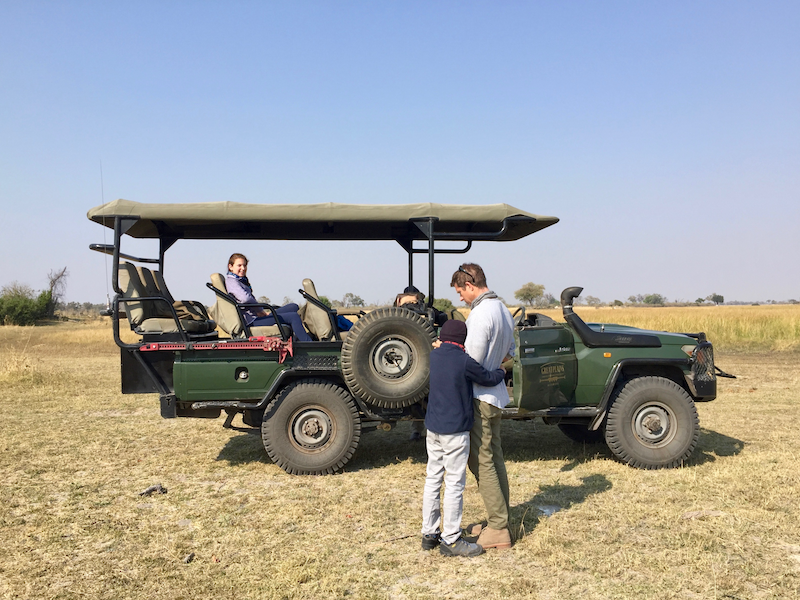
    We wake up at the crack of dawn. It’s still dark. The only sounds I hear are buzzing insects and the rustle of leaves in the breeze. Without speaking, the four of us trudge to the jeep, where our guide, Foster, waits with a wide smile. He looks at my 13-year-old daughter, who’s radiating snarky, salty tween vibes. She’s not smiling.

    “What is the purpose of this day?” Foster says to her in a slow, enchanting baritone. With sleep in her eyes, Ella looks up. I look up, too. Ella doesn’t know. I don’t know. Who thinks about things like that? Foster does.

    But I want to know. I’m guessing Ella does, too, based on how quickly she hops in the jeep. Foster revs the engine, and we set out to find the purpose of this day. It’s somewhere out in the Okavango Delta. The best journeys answer questions you never knew to ask. Keep asking, Foster. We’re all listening.


    Click here for my free ‘Ultimate Africa Safari Packing Lists’


    (Please note some affiliate links above. I may receive a small referral fee should a product be bought through my site, but rest assured, I only highlight products I own and would buy for myself.)