There’s a certain kind of giddiness I feel when exploring a place that is not only so far removed from the grid of my normal life but seemingly unknown. Slightly off-balance, a bit lightheaded, with a flutter in my stomach that makes me want to simultaneously keep it a secret and immediately post it all over Instagram.
Villages of the Côte d’Azur
Tourrettes-sur-Loup is not the first (second, third, or even fourth) village one visits on the Côte d’Azur, aka French Riviera. A quick Google search for ‘best villages Côte d’Azur’ doesn’t even list Tourrettes-sur-Loup in the top 30, reserving the highest accolades for hilltop beauties like Saint-Paul-de-Vence, Èze, and Gourdon. They are all worthwhile, with their vine-covered vaulted stone houses, flower-filled window boxes, and endless narrow, arched alleys.
Yet, visiting these fairytale villages comes at a cost, especially during the summer months. There are simple tricks to beating the crowds—the early bird catching the worm and all that. But that’s content for another post.
Arriving in Saint-Paul-de-Vence, one of the oldest medieval villages on the French Riviera, at 9 am means no traffic and a prime parking spot. It guarantees an outdoor table at Café de la Place, which overlooks the market square. Many shops are still shuttered, creating an opportunity to linger over coffee and take in the scene, whether spying a Jack Russell terrier curled up and snoozing on a chair or noting the faint scent of lavender in the air.
Until recently, Saint-Paul-de-Vence was my favorite village on the Côte d’Azur. This famous and achingly pretty village was once home to Picasso, Braque, Chagall, and Matisse. It’s easy to sense the impressions they’ve left behind among the cobbled streets and along the uneven stone steps.
Saint-Paul-de-Vence is hilltop heaven, with the restaurant La Colombe d’Or serving as a culinary magnet that draws foodies from near and far. A veritable museum, La Colombe d’Or draws art aficionados, as well. The village showcases high-end art, features perfumes from the nearby Grasse, and offers countryside views that stretch for miles. It has sophistication (and soft cheeses) to spare.
Finding Tourrettes-sur-Loup: A Mini-Solo Adventure
But, just fifteen minutes west, another mountain village lives quietly in the shadow of its flashier, more popular sibling. Earlier, I’d read about Tourrettes-sur-Loup’s understated, slow-paced vibe. I’d scrolled through photos of its raggedy ramparts and Romanesque rooflines. Despite never having heard of Tourrettes-sur-Loup before now, I wonder how I could possibly leave France without visiting it?
A plan starts to take shape. I finish my cappuccino and bid adieu to the sleeping terrier. My kids and extended family head off in toutes directions: Cannes, Antibes, and Nice—places I’ve already been.
For a brief moment, I panic, and consider bailing on my mini-solo adventure. Then I remember that I’m a grown-up, that I’ve been driving for over 35 years, and that the French (who round corners like it’s the final lap of F1) at least drive on the same side of the road as I’m used to.
I plug Tourrettes-sur-Loup into my maps and go.
The 40 Artisans of Tourrettes-sur-Loup
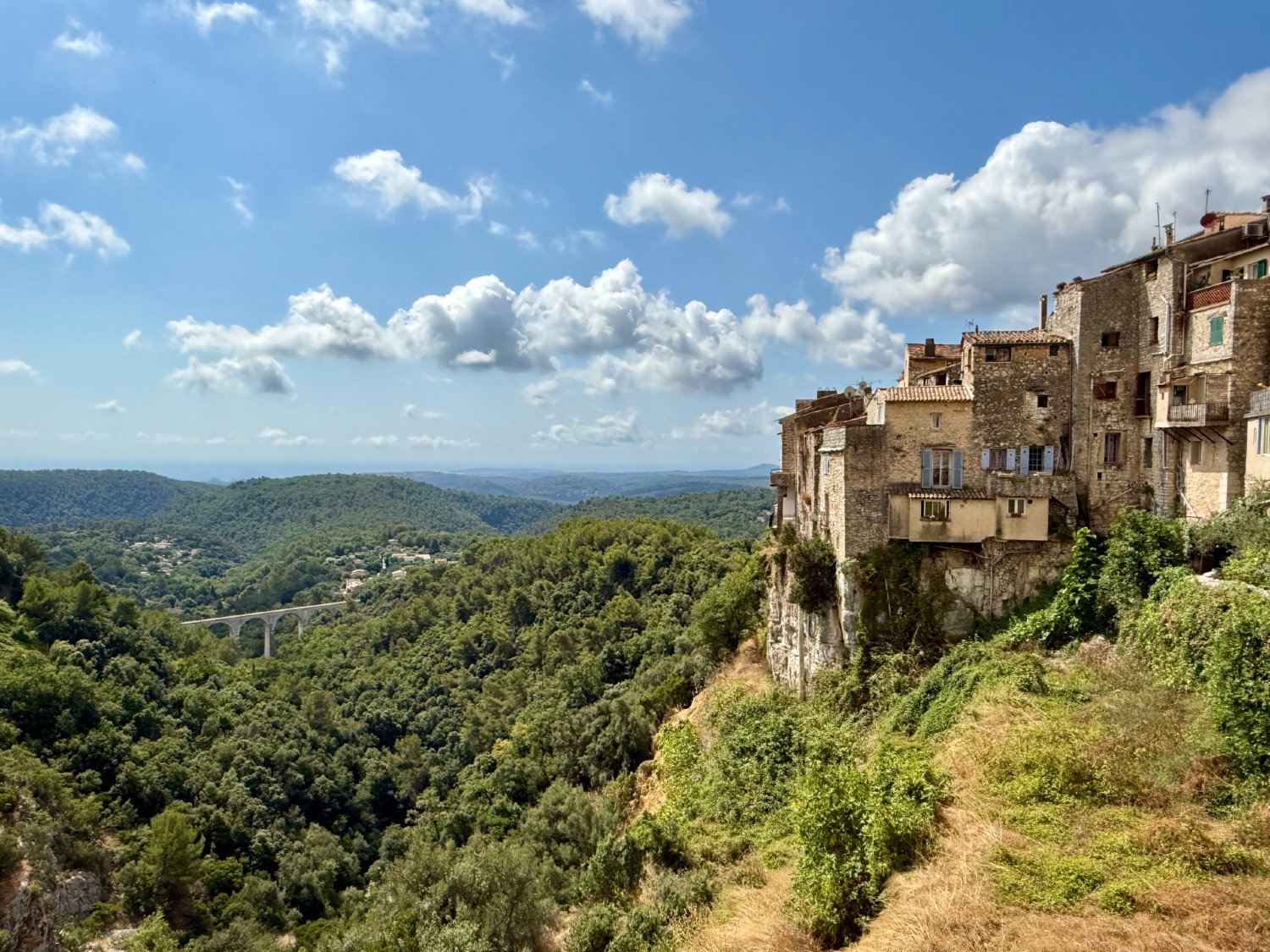
As Google promised, I reach the village in 15 minutes. Parking is easy. Despite it being the end of July, there’s no one here. The quiet is what sparks my initial excitement. Then I catch sight of the village, clinging for dear life to the steep hillside with vines crawling up the facades. The flutter in my stomach intensifies, and I resist the urge to call my family and tell them to stop everything and join me.
The medieval buildings are worn and ragged, as if on the edge of collapse. The village houses are situated around a half-moon-shaped path that forms a natural loop for exploration. Tourrettes-sur-Loup, with just over 4000 residents, is first and foremost an artisan village.
The forty artisans who live and work here collectively contribute to the village’s economy. They are weavers, painters, potters, jewelry designers, leathersmiths, and sculptors. The creativity in the air is so powerful, I can feel it. The smell of croissants coming from the boulangerie is just as powerful.
An Unhurried Life
I meander from boutique to gallery, passing trellis-covered cafés and glimpsing countryside views peeking through the narrow streets. I watch an older man, tanned and weathered with salt-and-pepper hair, carefully repainting his shutters. He may as well be painting the sky; they are the same, unmistakable Provençal blue. His strokes are unhurried and even, with a calm I dare myself to channel when I get home.
Tourrettes-sur-Loup is known for its 15th-century church of St. Gregory, the chapel of St. John, and its annual Violet Festival, held each March. I learn that violets, which grow in rocky terraces and olive groves, have been the village’s main agricultural activity since 1880. I imagine the new life this tranquil village takes on during the spring. How it becomes a vision in violet, emanating soft, sweet, woodsy floral notes.
Today, I’m content to circle and wander—meeting artists and ceramicists along the way. I stop into a mid-century modern furniture shop that could as easily be found in East Hampton. I fall in love with a 1960s sideboard and a set of etched crystal coupes. I duck into local markets where plump ripe peaches sit in neat little rows. Walking without a destination, I have no one to please but myself.
My Favorite Village
Ninety minutes have passed, and I’ve twice looped Tourrettes-sur-Loup. In no rush to get back behind the steering wheel, I stand on the edge of the village and look out towards the verdant countryside, so close to the sea, yet centuries away from the bustle of Nice and Antibes.
I picture the violets struggling to emerge from spaces between the craggy rocks. I think about the villagers who carefully pick them, as they grow in places machinery can’t reach. I listen to the church bell toll and glimpse artists in their studios, working with the focus only someone fully committed to their craft can convey. The outside world is breaking down, but within these walls, everything is okay.
The flutter in my stomach is less intense, but still there. It’s one part longing, and another part pure childlike giddiness. A telltale sign that I’ve found my new favorite village on the Côte d’Azur.
Our Corsica travels take us canyoning through mountains and hiking to mountaintop lakes. Our Corsica travels take us from party beaches to remote ones. Traveling in Corsica is an adventure a day, sprinkled with riverside retreats, clifftop restaurants, and the occasional wild pig.
Where’s Corsica, exactly? And does it belong on your travel wish list? Read on.
“If you don’t project yourself outwards,” our canyoning instructor says calmly, “it will end—how do you say in English—badly.”
I peer over the granite ledge. A gushing waterfall lies to my left, and a rock face extends 30 feet below. I feel, rather than see, my husband and kids doubting me from the water below. ‘Terrified’ vastly understates my singular emotion.
“Project outwards”, our guide repeats. Ever the rule follower, I close my eyes and—
Don’t panic, Mom; it ends well.
Where’s Corsica, exactly?
“Corsica is Italian.”, one friend says. Another assures me it’s Greek. The island of Corsica is closer to mainland Italy than any other country. Yet, surprise!—it’s a territory of France.
Who knew? I sure didn’t. Corsica is as elusive as Keyser Söze in The Usual Suspects. We meet only three other Americans on our trip. A testament to how relatively unknown Corsica is in the United States.
Why visit Corsica? I’ll pretend you asked. Follow along on our island adventures to discover what makes Corsica worth finding on a map.
As an aside, if The Usual Suspects reference escaped you, head over to your sofa and watch it. I’ll wait.
Corsica: What I wish I knew
Corsica is the fourth-largest island in the Mediterranean. There is no public transportation, so renting a car is a must. But be warned: Narrow roads and lanes run serpentine around colossal boulders and cliffs. Hairpin turns are frequent and hair-raising.
There are few, if any, barriers between cars and sudden death. Corsican drivers take to the roads like Lewis Hamilton wannabes. They drive like angry wasps. They laugh at lanes. According to my kids, I gasp 3,000 times. And that number doesn’t include the times I disguise my gasp as a cough.
I’m not making a case for Corsica. Bear with me. It gets better.
Corsica: by the numbers
Corsica is 112 miles long at its longest and 52 miles wide at its widest. It has 620 miles of coastline with 200 beaches. It’s home to the world-famous GR 20 Trail and has over 120 summits. Simmer down Corsica, my flights are booked.
We have 12 days. I want to cover ground but not feel rushed. Visit areas with different terrain and activities. Dine on authentic Corsican food and drink local wine. It’s a tall order, but Corsica delivers.
In Corsica, there are no bad regions (only bad drivers). Note the map of our route above. Those art school fees are really paying off, Dad.
Instead of a linear path (hahaha, there are no linear paths in Corsica!) I’ve outlined the highlights from our three destinations in Corsica. Will any of our adventures inspire you to visit? Let’s find out.
I jump—plunging into the cold canyon water with semi-wild abandon. I emerge, still holding my nose, to looks of disbelief (my kids, our guide) and pride (my husband). See, Mom? No need to panic.
“What is canyoning?” you ask. A friend aptly describes canyoning as ‘white water rafting without a raft.’ Hmmm, I don’t even enjoy white water rafting with a raft. The gorges and valleys of the Restonica River are widely known for the sport. If I’m going to try it, I’m in the right place.
After a sweaty 45-minute bathing-suit-clad hike, we put on our wetsuits, helmets, and water shoes. This isn’t pretty. Note the lack of photographic evidence. You’ll have to take me at my word.
We wade into a crystal clear pool of water. It’s crazy fun—to use a technical canyoning term. We scale boulders, swim under waterfalls, jump off cliffs, slide over rocks, and zip line above the river with child-like joy.
White water rafting without a raft turns out to be my new favorite sport.
Corsica Travels: Hiking, Haut-Corse
Our holiday wouldn’t be complete without a treacheroushike organized by my husband. The fact that Daniel and I fight when we hike would lead one to think it’s an activity to be avoided. But, no.
The ride to the trailhead is short yet harrowing. Blind corners with unyielding boulders on one side and unnerving precipices on the other. My kids will say I’m being hyperbolic. Wait. They don’t know what hyperbolic means. They’ll say I’m being emo.
Our goal is a 4-mile in-and-out hike to Lac de Melu in Haut-Corse. The lake sits at an elevation of 5,610 ft. Why we never visit sea-level lakes as regular people do baffles me. The views, (it pains me to admit), are worth the struggle. Don’t tell Daniel.
The landscape is prehistoric. I feel small—like ‘on the set of Jurassic Park’ small. Instead of ferocious dinosaurs, though, we encounter docile cows. Tall pines and fragrant alders look tiny against the towering, jagged mountains that loom in the distance.
Rangy rock faces glisten in the colors of Olympic medals. A gold medal is exactly what I’ll deserve after a day dodging cow dung with two moody teenagers. That, and a vodka tonic.
Choosing which towns to visit on an island with 650 miles of coastline is challenging. But I rise to it. Three exceptional examples follow.
PORTO-VECCHIO
Porto-Vecchio is a harbor town in southeast Corsica. Its focal point is Eglise St. Jean-Baptiste, a 19th-century church tower. Beside the church, an old-fashioned merry-go-round slowly rotates, delighting children.
Boutiques, wine shops, and restaurants are abuzz on the piazza. The heartbeat of Porto-Vecchio is palpable. A lovely introduction to Corsican life.
BONIFACIO
Bonifacio towers over the southernmost tip of Corsica. Its sculpted chalk-white limestone cliffs plunge dramatically into the Mediterranean Sea. These imposing sea walls make Bonifacio one of the most popular places to visit in Corsica.
Bonifacio is as picturesque as it is historical. The Staircase of King Aragon sits 200 feet above the sea. It was built in 1420 to access a freshwater well. Each of the 189 irregular stone steps is an accident waiting to happen, yet they are the highlight of my day.
After I reach the bottom, I walk along and under caves of eroding limestone. The Mediterranean views are interrupted only by paper-white sails of passing schooners. The water is luminous.
The downside of King Aragon’s arduous steps is as clear as the sea. What goes down must come up. I curse you, King Aragon. My quads still hurt.
PATRIMONIO
Patrimonio is considered Corsica’s best-known wine region. Our drive through Patrimonio reveals patterns of terraced vineyards in the foreground and Saint Florent Bay in the background. It’s a spectacular setting to sample the wines of the region. As an added bonus, it requires no death-defying roads.
We visit Domaine Leccia and Orenga de Gaffory wineries. Since I’m the only one in my family who enjoys wine tasting, I’m forced to drink at record speed. Corsicans do nothing at record speed except drive. Needless to say, I do nothing to alter American stereotypes. I hope the other three Americans in Corsica are better behaved.
While visiting Corsica’s numerous hilltop villages, we hear pealing church bells celebrating a local wedding. We sit on lively piazzas with glasses of cloudy Pastis—a centuries-old pastime. Visiting these villages is another highlight of our Corsica travels.
Nonza is located along another sea cliff wall. This time on the west coast of Cap Corse. Nonza is so tiny that by the time we realize we’ve reached it, we’ve passed it. My husband does an 18-point K-turn and finds a place to park. I make a mental note that arguing while driving has surpassed arguing while hiking.
The village centers around the 16th-century church of Saint-Julie. Its bright orange facade stands out against the village’s otherwise white-washed, ancient buildings. Wild oleander is in bloom, in colors to inspire Nars’ next lip gloss shades.
We have lunch at La Sassa, an outdoor-only restaurant with a low-key party vibe and Michelin-worthy food. It is 160 meters above the beach and overhangs the sea.
White-capped waves swirl below, and the Genoese Tower of Nonza soars above—an unparalleled lunch setting, indeed.
Reservations are a must at La Sassa. I’m not proud to admit it, but I felt smug watching hungry onlookers envy my tuna tartare.
CORTE
Corte lies deep in the mountainous interior of the island. The air smells of pine, the humidity is low, and rivers and waterfalls rumble gently in the distance.
Although crowded, the town of Corte feels untouched by mainstream tourism. The piazza overflows with locals. A musician croons. I notice people sitting on windowsills above—catching notes as they rise into the sky. I capture a snapshot of Corsican life in my mind rather than with my camera.
Corte steals my heart in the subtlest ways, with its hidden pottery studios, produce markets, and a spectacular citadel piercing the sky. When I return home, I’ll remember these moments—the simplicity and authenticity—and I’ll miss them.
Oletta is the opposite of the lively and musical Corte. It’s eerily quiet, with jagged stone steps and paths that weave intricately around the village. Flowers and vines climb crumbling stone walls and overflow from ceramic pots. How they grow is a mystery, as Oletta’s narrow, sleepy streets hardly allow for sunlight to reach them.
One evening, we dine in the village, and the residents magically appear—playing cards, laughing, and drinking. Where have they been hiding?
We sit outdoors at A Forge, a restaurant overlooking the valley. By the time we head back to our hotel, everyone has disappeared, and the town is silent again.
Corsica Travels: Beaches
The beaches surrounding Corsica range from nearly deserted, boat-access only to restaurant-lined with a party vibe. For the sake of keeping my audience engaged (are you still with me?), two of many standouts follow.
THE LAVEZZI ISLANDS ARCHIPELAGO
The Lavezzi Islands Archipelago, in southern Corsica, is just a few miles from Bonifacio’s formidable limestone walls. Accessible only by boat, it’s an aquatic playground for divers and snorkelers alike.
Some islands are quiet, with gigantic granite boulders that break the water’s glassy surface. Coral reefs are chock full of colorful schools of fish.
Other islands are a party on the sea with tranquil, waist-deep water. This creates a pop-up pool party atmosphere that is impossible not to enjoy. Think bikini-clad (and yikes, Speed-O-clad) people dancing on boats, in-water volleyball games, and colorful inflatable rafts floating on the placid Mediterranean Sea.
The Agriates Desert, in Northern Corsica, is a barren and dry coastline mainly accessible by boat. Any day in Corsica that doesn’t require driving is my kind of day.
But calling this 40km stretch of protected land a desert is misleading. The Agriates Desert is home to Corsica’s most remote beaches: Windswept, scrub-covered, wild, and sun-scorched.
Windex-colored waters, pale limestone boulders, and wide stretches of golden sand make this part of the Corsican coast so appealing. The air is heavy with history and the scent of the island’s ubiquitous maquis.
Maquis is a scrubby, untamed shrub that covers much of Corsica’s hills. Its scent combines at least nine herbs, including eucalyptus, juniper, rosemary, and heather. The scent is so popular that the famous French perfumery Diptique makes a maquis-scented candle. For $72, I can relive my Corsica memories from home.
Each of our three accommodations in Corsica is equally enchanting—from riverside retreats to hilltop and beachside boutique hotels. When I ask the kids which place is their favorite, they can’t decide. Well done, me.
LES BERGERIES DE PALOMBAGGIA
Les Bergeries de Palombaggia, in Porto-Vecchio, is a Relais & Chateaux property seven miles from Sardinia. This Italian island’s silhouette provides a never-ending and beautiful backdrop to our stay. Grazie, Italia.
Life at Les Bergeries centers around its inviting infinity-edged pool. The views at sunset, when the sky mirrors the sea, are especially spectacular. Palombaggia Beach is a short, convenient, and pretty walk from the hotel.
The sea air is filled with the aromatic herbs of the maquis. Les Bergeries’ old terra cotta roof tiles have faded to rich hues of sienna and mocha. I spot olive trees with silvery sage leaves and vibrant green umbrella pines. Les Bergeries’ color palette is as French as it gets. The overall vibe is ‘low-key fancy’—my favorite kind.
HIGHLIGHTS Breakfast with locally made jams, crêpes, brioches, and traditional Fiodone (Corsican cheesecake) / La Table de Mina’s poolside dining patio at sunset / Suites with hydrangea-filled balconies overlooking the pool and sea
Dominique Colonna, in Corte, is a riverside boutique hotel. Inspired by nature, its charm lies in sheer simplicity. Intentionally spartan in design, the rooms are divine, with small balconies facing the river.
The hotel’s low-impact exterior respectfully sits within the dramatic mountainous scenery. Dominique Colonna is a sublime spot from which we launch our Haut-Corse adventures. But the grounds are so welcoming and intimate that I’m hard-pressed to leave it each day.
HIGHLIGHTSImpeccably-maintained Mediterranean gardens that showcase dwarf olive trees, climbing white jasmine, and Florentine cypresses / The tiered riverside terrace for a breakfast of housemade granolas and local honey / A private massage cube made of wood and glass, nestled in the woods by the pool
U Palazzu Serenu, in Oletta, was once a 17th-century palace. After a complete restoration, this nine-room hotel is now basking in its original glory. This classic, austere, contemporary boutique hotel has rooms and common spaces designed in layers of white.
Our suite’s white-louvered windows have all-encompassing views of vineyards and Saint Florent Bay. Recycled wood, museum-worthy art, and artfully chosen coffee table books make the rooms feel personal and homey.
U Palazzu Serenu’s unique selling point is its secret access to Oletta. A creaky back gate hidden behind the pool’s tiered lounging area allows me to explore Oletta whenever I want. I go each day, searching for signs of life. Mainly, I see feral cats.
HIGHLIGHTSThe small, sheltered dining space by the pool is by reservation only. It serves ‘Italian classics with a Corsican twist.’ The artwork and sculptures are by renowned artists such as Paul de Pignol, Wendy Wischer, and Udo Nöger. The pool. Views from the pool. Drinks at the pool.
In Corsica, All’s Well That Ends Well
It’s pretty hard not to fall for Corsica. Even if that means intentionally falling from a 30-foot granite ledge into a gurgling river. I placed my trust in this rugged, craggy, and far-flung island. I was ever-rewarded.
The beauty of Corsica is in the adventures, but it’s also in the details—the colorful facade of a hilltop church against emerald green mountains. Wild oleander poking through an ancient stone wall beside an abandoned Genoese tower. A pottery studio found only by following wooden signs through a maze-like village. Wild pigs grazing on the side of the road.
As I said, it’s hard not to fall for Corsica. Just don’t forget to project outwards. You won’t regret it.
Anyone can Google a destination, but finding the right sources, the hidden gems, the places worth your time—well, that’s an art that takes time. I’ll cut through the noise, saving you from hours of searching in the wrong places. Each of my recommendations is researched with your specific trip in mind.
After visiting 70 countries on 7 continents, I know how overwhelming travel planning can be.
But I also know how to make it easy. And exciting. And stress-free.
(Please note a few affiliate links above for which I may receive a small referral fee. But rest assured, I only highlight products I fully stand behind.)
Provence has its own aura, its own colorful, magical, vibe. It was hard to decide where, in all of Provence, we wanted to use as our base. In the end, we chose Les Baux de Provence, and the bucolic hotel Baumanière to stay in. It was truly the most lovely place from which to explore the French countryside, not to mention being one of the best hotels among so many beautiful choices.
Bucolic Baumanière, Les Baux de Provence /
In Provence, I fell in love — with an electric bike. I actually fell in love with many things in Provence, but the brand new matte black electric Peugeot was unexpected, I’ll admit. It had four speeds to help even the least fit cyclist tackle the ever-rolling hills of Les Alpilles. To be fair, I still found it quite challenging at times, even when I eventually needed to kick into turbo mode, as the ‘rolling’ hills at times felt, to me, like the Tour de France.
It was undoubtedly a spectacular way to see this beautiful piece of Provence, passing olive groves, vineyards, and pine forests, stumbling upon tiny hilltop villages along the way.
Past. meet present, in Les Baux de Provence
Our five days in Provence were spent at the magnificent and secluded property of Baumanière. Set on nearly 50 acres, and at the base of the prehistoric and looming limestone rocks and village of Les Baux de Provence, Baumanière has both a timeless and modern quality all at once.
Neo-classical French fountains and water features are woven into the hardscape and landscape, details found in some of the intimate and perfectly manicured grass surrounded pools. Garden pools that make you feel like you are at the manor home of an eccentric and wealthy French uncle. Then there are the modern touches, the electric bikes, for instance, and the uber-stylized main building with its severe architectural lines and geometric sculptures.
Most of Baumanière, in Les Baux de Provence, takes its cue from the past, the five manor houses that have now been turned into charming hotel suites, some with balconies overlooking bundles of hydrangeas and koi-filled ponds, some with large patios where you can order picnics and share a bottle of wine while reading Madame Bovary.
Climbing roses, purple agapanthus, pear trees, and pink oleanders are a mere fraction of what there is to discover while walking the grounds. Washed golden ochre walls from which green ivy delicately hangs. Large, ornate urns filled with overflowing petunias — all make for a setting that feels absolutely fairytale in nature.
Click here. Be the first to know when I find a new place to get lost.
Garden hideaway in Les Baux de Provence
There are gardens at every turn, some displayed in a more typical French style while others feel wild and English. Roaming the property, your nose catches the scents of roses, lavender, and rosemary.
Wander further, and you may find the more secluded pools, with their low wrought iron gates that squeak to announce your arrival. The pool attendant appeared as if on cue with water, rosé, or a plush towel. The cicadas strike up a chorus, low at first, almost unnoticeable, and then slowly ascending into a full crescendo, before becoming so dramatically silent, that the silence itself is startling.
Soft, green, iconic French poplars are perfectly positioned, giving height to the landscape in all the right places. Archways covered in lush jasmine, natural canopies of flowers, and secluded sitting areas dot the meandering acres of Baumanière. You could stay a week and never need to sit in the same place twice, so many alcoves and paths to explore.
Les Baux de Provence
It was hard to leave Baumanière at all but knew we would have missed out on what Provence had to offer us in beautifully arid July. We walked the steep hill to the village of Les Baux de Provence, and while more touristy as the day went on, we enjoyed getting lost in the maze of narrow, cobbled, pedestrian-only streets that seemed to switch back on themselves in every direction.
Slowly, we made our way upwards to catch the views from the 10th c. clifftop castle that sits, in all its glorious ruins, at the highest point of Les Baux. We made a note to come back at sunset, excited to watch the sun’s fiery descent create a magical light show over the landscape and craggy rocks.
Biking Les Alpilles near Les Baux de Provence
Les Alpilles, the mini-Alps, is a low range of mountains that encompass fifteen lovely communes including Les Baux-de-Provence, Eygalières, and Saint Rémy-de-Provence. Our ten-mile bike ride to the tiny, quiet, hilltop village of Eygalières was the catalyst for my love of electric bikes, as well as all things Provence.
We passed fields of sunflowers bowing their large heads towards the eastern sun, as well as gated villas with long lavender-lined entryways. I imagined a future where I could bike to town, pick up a warm baguette, and bike home for lunch — on my beautiful electric bike, naturally.
ancient hilltop villages
We locked the bikes at the base of the village and hiked up the narrow streets, passing sea foam green and ice blue colored shutters that lay against the ancient stone-walled homes. Shutters, that in this part of the world, are functional, not merely decorative.
Lovely flower pots and window boxes sit in doorways, looking well cared for yet in the most nonchalant way. We sat for lunch at Le Progrès, a simple French bistro where we could watch the nuances of village life unfold around us.
We then walked to the church at the top of Eygalières and stopped to take in the quiet that surrounded us. Birds were silently swooping past, and we admired the way the light created shadows through the windows of the ancient church which sat high above the village.
Stars under the stars
L’Oustau Baumanière Restaurant, with its two Michelin stars, is a short walk from the manor houses of the hotel, and along a pretty, quiet lane dotted with houses and views up to Les Baux. Butterflies followed us as we walked as if they already knew how spectacular our dinner was going to be, and hoped to get an invitation.
Walking out onto the sprawling sunlit patio of the restaurant, I still felt that I was playing the role of the manor guest. Mature trees acted as natural umbrellas, and waiters dressed in dark, tailored suits, seemed to outnumber the guests 2:1. The waiters were nearly invisible, as they were so swift and silent.A well-orchestrated dining ballet of sorts.
There was a lovely buzz that surrounded the veranda, all of the guests dressed with an air of old-world elegance, and seemingly from all corners of the earth. I noticed one woman smoking leisurely at her table, looking like a movie star from days gone by.
Champagne and cheese
As a nod to days of formal dining, the champagne and cheese trolleys slowly wove in and around the tables throughout the night. Never one to pass on a cheese course, we let the waiter choose an array of local varieties and enjoyed a 2007 Châteauneuf du Pape, Clos du Pape from Baumanière’s enormous cellar.
We were told the cellars of Baumanière house more than 50,000 bottles of wine from all of the treasured wine regions of France. I had the wonderful opportunity to visit one of the cellars during our stay. Some vintages were from the turn of the century, and first-growth verticals that would make any wine lover’s head spin.
Kindly, the sommelier indulged my love of wine and spent 30 minutes or so showing me around the collection. We had just discovered that he had been the mentor of our sommelier from Albert 1er Restaurant in Chamonix, where we had been staying only a week before. The wine world of France is certainly small and tightly connected!
Boutique-y Saint Rémy
Art galleries, boutiques, and charming sidewalk café life kept us busy for a morning in bustling Saint Rémy-de-Provence. There is a varied mix of locals and tourists, as Saint Rémy is certainly more of a town than a village. We walked among the cheese, wine, and chocolate shops of the old town and used another coffee break as an excuse to sit and watch the world pass us by.
It was especially humbling to see the house where Nostradamus was born, dating back to the year 1503, and realize just how much history this part of France has to offer.
The Golden Goat
We didn’t see a single cloud for days. Dry air, warm temps, and aquamarine skies added to the dream-like quality of Provence. Our breakfasts were spent at the more casual restaurant at Baumanière, Le Cabro d’Or. It was there that I fell in love again—this time with lavender honey. I could happily spend hours on that veranda, fresh berries, granola, nuts, yogurts, all drizzled in local lavender honey—there was no need to ever leave!
At night, Le Cabro D’Or doubled as the other dining option, and the food was as magical as the setting—wrought iron tables and chairs with simple white linens, which allowed the stunning scenery and setting sun to take center stage. Again, impeccable service, and the vast wine list, together created an atmosphere that reiterated why you never ever have to leave the property.
Au Revoir
While it was hard to imagine leaving bucolic Baumanière and Les Baux, part of me knew that it was a special enough place to return to one day. Maybe, in fifteen years or so, I will have my electric bike, my warm baguette, and my own long, lavender-lined entryway to my gated villa in Provence. Just maybe.
You don’t have to be an intrepid mountaineer to get up close and personal with majestic Mont Blanc in Chamonix. You can do as we did, which was to take the first cable car up and be gratified instantly. We stood on the chilly observation deck, gawking at the looming mountain, not believing it could be so cold up here, while at the base the July temps were soaring into the high 70s.
Suddenly, what could have been a scene from Into Thin Air played out before us. A group of four climbers, wearing full climbing gear, complete with ice axes and crampons, quite literally threw a line over the observation deck and hoisted themselves onto the tourist-filled platform. Here we were, dressed in flip flops and t-shirts, a sharp contrast to the mountaineers’ Arctic attire.They had just summited Mont Blanc, the highest mountain of the Alps at 15,781ft, and were headed down.
They spent a few minutes basking in the bright sun, accepting kudos from the crowd, contemplating what they had achieved, and taking obligatory selfies, before riding the gondola down with the rest of us mere mortals.
L’Aiguille du Midi
L’Aiguille du Midi cable car links the idyllic town of Chamonix to Aiguille. In looking back at that day, I would have been better off not knowing I was about to step onto one of the highest cable cars in the world. I’m not afraid of heights, and have been on my fair share of cable cars in the past, but something about a system originally built in the 1920s (albeit modernized many times over the following century) would have felt unsettling. Fortunately, I overcame my fear, otherwise I would have missed the remarkable panorama of Mont Blanc and the Alps.
Above the clouds
Mont Blanc towers gloriously and steadfast above the charming ski town of Chamonix, which sits on the southeastern edge of France. Spanning the French-Italian border, it is forever capped in snow, and draws many fearless climbers and hikers each year. And while we had hiking plans during our stay there, Mont Blanc is in a league of its own, the highest mountain in the Alps, where crampons, ropes, and deep reserves of stamina are critical gear.
Ski towns in the summer always seem to have a special feeling about them, the greens richer due to the winter run-off, the blues deeper against the pine-filled mountains. I have spent many green summers in Vermont which has an equally beautiful vibe. However, Chamonix has an almost magical aura to it, crowded with adventure seekers, off-season ski bums and tourists alike. Paragliders seemingly so close to the mountains that they could comfortably throw a snowball.
Charming Chamonix
Chamonix is unique in that you feel that you are tucked secretly away at the base of the sloping mountains, the Alps soaring high above you in every direction. It is incredibly dramatic, the razor sharp evergreen pines look like soldiers standing in rows at attention with military precision. Patches of the pine give way to different layers of trees, scrub and rock and then eventually snow caps, like icing on a cake. The glaciers are iridescent, often looking icy blue or even purple depending upon the light. But always moving, so we were told, at a surprising rate of 1000ft per year.
Hôtel Hameau Albert 1er
Perhaps one of the best parts of visiting Chamonix in the summer months is that all the colors of the flowers and greenery are brilliantly juxtaposed against the blue skies and white alpine mountain tops.A botanical rainbow of sorts. Tiger lilies were in season, and the orange and black-speckled wildflowers created another layer of colorful drama in an already dramatic setting.
That said, flowers of every color and variety were on full polychromatic display at our hotel, which was just outside of the village center. The Hôtel Hameau Albert 1er is a Relais & Chateaux chalet-like lodge with its gaze firmly set upon Mont Blanc. Cozy, wooden, rustic rooms, many with balconies or patios that displayed window boxes overflowing with ivy and climbing red geraniums.
The swimming pool is indoor/outdoor in a unique way. A vaulted ceiling and panels of glass and wood allow the sun to stream inside, and when outside, those glass panels become reflective. So, even if your lounge chair isn’t facing the mountains, you can see them in all of their splendor.
Between the glaciers
Our first hike, with the help of a cable car, started at an elevation of 4400ft and climbed virtually straight up to 8500ft. Daniel predicted it would take us about three hours. Fifteen minutes into the ascent, I was sure I was doomed. But then I settled into a comfortable pace and started to admire the surroundings, which took my mind off the challenge ahead. The terrain changed from pine, with brown needles that carpeted the ground, to hot pink wild azaleas and scrub, then further along we snaked high above the tree line where the flowers struggled to survive. Daniel, whether as a motivator to keep me moving, or not to hear any complaints, kept a solid ten yard distance between us. Smart man.
We scrambled over rocks and boulders, passing along a knife-edge ridge between two ominous glaciers, Bossons and Taconnaz, their menacing crevasses distinctly visible. We could hear deafening waterfalls as we turned one corner, then noticed the sound magically disappear as we rounded the next. It was mystifying how the mountains so abruptly absorbed the acoustics. We surprised some wildlife along the way, a lonely ibex leapt across our path, then later a fearless marmot followed us nearer to the summit.
Just before the three hour mark, we came upon a solo Austrian hiker on his way down. Daniel had thought we still had at least 30 minutes or so to summit, and the clouds were closing in, but the Austrian told us we were a mere ten minutes from the top, as we were just about to pass the famous sheltered boulders, Gîte à Balmat, where the first summiters of Mont Blanc spent their first night in 1786. Daniel was elated, we were ahead of the game, and maybe ahead of the weather.
As per the norm with our hikes, we were without a clear view when we reached La Jonction at 8500ft. We had been relatively lucky on the way up, and, thankfully, I capitalized on the views then, sometimes disguising rest stops as photo ops.
Summit sans view
We sat proudly at the summit, despite the clouds and impending rain, our ham sandwiches, chips and bottles of Coke tasted like the best lunch we’d ever had. As we were finishing up, it started to drizzle, and we zipped up to start the scramble down, a little more challenging due to the slippery rocks. The weather presented a unique sequence for us that day: thunder, rain, sun, hail, repeat.
The fog and clouds first obscured our views and then dramatically gave way to sunny patches that looked like a flashlight spotlighting Chamonix village far below. It was a spectacular day overall, and we felt we earned our upcoming two-star Michelin dinner that night at the hotel.
Albert 1er Restaurant
The spare, elegant, wood-paneled, and white table-clothed dining room of Albert 1er Restaurant effortlessly allows the cuisine to take center stage. Not that it wouldn’t if in the most ornate of settings, as the plates are so artfully designed and visually enticing. The flavors blend together harmoniously, as they are partially sourced from the herb and kitchen gardens on the property. The fare is traditional French, using traditional French ingredients, but presented in an entirely non-traditional way.
The written menu cleverly defies what you see on your plate when it arrives. The leeks, calf’s foot, egg yolk and Ossetra caviar dish, for example, looks completely different than what you would have perceived in your mind. Modern, artful, and skillfully designed. Chef Maillet succeeds in challenging every sense in just about every way.
A family affair
Chef Pierre Maillet’s culinary story is also a love story. Having worked for the original chef, Pierre Carrier, Maillet went on to marry Carrier’s daughter, Perrine. Together they have looked after the restaurant and preserved its two star status in the prestigious Michelin Guide. Perrine is visible nightly, greeting guests while gliding around the restaurant and glamorous Quartz Bar, which is complete with a lovely grand piano. You imagine that the French equivalent of Harry Connick Jr. could appear at any moment and start crooning.
Wine-ing and dining
Head sommelier, Marc-Henri Mialon seemed to be the lead player on the dining room floor with his subtle and mischievous sense of humor. We chose the set menu, paired with wine, which led with an intriguing Vin Mystère. At first glance, the mystery wine looked effervescent, like champagne. But that answer seemed too obvious. We spent some time thinking about it and incorrectly came up with a sparkling wine from Alsace. The correct answer? A sparkling Vouvray. Mialon luckily has much to choose from for his wine challenges, as the cellar at Albert 1er houses about 19,000 bottles.
It was a fun and lively way to start the evening, taking away any stuffiness you might associate with a restaurant of this status. I appreciated the lighthearted approach to the wine, which can be an intimidating part of any dining experience. As an aside, we discovered a week later, while at La Baumanière in Provence, that the sommelier there had worked not long ago with Marc-Henri Mialon while at Albert 1er. A small wine world, indeed!
The food and wine became more decadent with each course, from tomatoes, burrata and mackerel with kitchen garden herbs, to dace with pine bud honey, carrots, gingerbread and preserved lemon. Ten courses—an epicurean adventure—including a roving and overflowing cheese trolley. The final hurrah was a Crêpe Suzette made table-side, which actually wasn’t on the tasting menu, but that Daniel had his heart set on and we ordered anyway. Needless to say, we were happy we only had to walk about 100ft to our room. After the day’s colossal hike, and the night’s equally colossal dinner, we were officially ‘fini’.
World Cup France v. Belgium
Being in France during the World Cup frenzy was both a blessing and a curse. The village of Chamonix was pulsing with fans amped up for the matches. Finding a place that we could both enjoy a good meal as well as watch the soccer was a feat. After annoying my husband by walking aimlessly around town trying to find the ‘perfect’ spot, then vetoing a place he found with a large tv, (but no diners, bad sign!), we finally hit the jackpot. A bistro with one recently abandoned outdoor table that had pole position in front of the TV. We conspired to eat and drink as slowly as possible over the remainder of the 90 minute match as we couldn’t bear to give up our prime seats.
France won and Chamonix erupted. It was a fantastic night, made even better by the much needed low-key contrast to the previous evening’s meal. Chamonix has lovely narrow streets filled with hidden dive bars, bistros and shops, many of which are geared towards the outdoor adventure set. The slightly intoxicated bartender at the bar we had visited pre-dinner was so excited when France scored that he abandoned his post, and headed to a neighboring bar to celebrate with a fellow bartender. He reappeared 15 minutes later, more intoxicated, and sent around complimentary shots. A win for everyone!
Lac Blanc
Our second hike in Chamonix proved less lucky than the first weather-wise (not that our first was ideal, mind you) as we set out in clouds and spent the majority of the day in them as well. Yet, the Alps look breathtaking no matter what the weather, and being above the clouds created an alternate yet equally devastatingly scenic view. We were on our way to a reflective lake called Lac Blanc, known to be the most celebrated walk the Chamonix Valley.
Accessible by La Flégère cable car in Les Praz, the hike was shorter and less strenuous than La Jonction thankfully, but had more snow with which to contend. We inched across a few steep, icy passages, now wishing that we had our own crampons and ice axe. The lake was beautiful and serene, and while both Daniel and I had hoped the sun would make an appearance, even for just a few minutes, it refused. So we spent the remainder of the rainy day in the spa and indoor pool at the Hameau Albert, which felt well-deserved after our morning of hiking.
Final views
Three days in Chamonix was just not enough, as I would have loved a few more hikes and maybe a bit more sun. We were due to leave early the next morning, but when we woke up, the shining sun was too good to pass on, so we delayed our departure for one last ride on La Flégère to catch the views that had eluded us the day before.
That morning, I stepped onto the platform of the cable car without fear, and with utter happiness that I was one of the ones wearing flip flops rather than hiking boots this time. We spent a few quiet minutes taking in the awesome panorama of the Alps, then hopped back onto the cable car. Next stop, Provence.