A hotel bed isn’t just someplace to rest your head at night. A hotel room isn’t just a place to store luggage and a toothbrush. After touchdown, your hotel becomes the first point of contact to shape your journey. The first impression that sets the tone. One step into the lobby can make you giddy with anticipation—or send you into a spiral of regret.
Vacations are escapes from our daily lives. Taking us to places we’ve dreamed about, read about, coveted, and saved up for. That heart-pounding thump of wow, whoa, OMG, I can’t believe I’m in (insert: Morocco, Thailand, Japan, New York). The flip side? Oh no, ugh, gulp, ick, this is definitely not what I expected.
Harness the wow, whoa, and OMG, and carry them with you—along with your sunscreen and sunglasses. Tuck them into your backpack for that hike, bike ride, or camel ride. At the end of the day, your reward will be a cushy bed to sink into, a hot soak for tight muscles, a view to set your spirit free, and a trendy bar to craft your favorite cocktail.
Let’s explore some of the world’s most remarkable hotels. After all, it’s the gateway to your adventure.
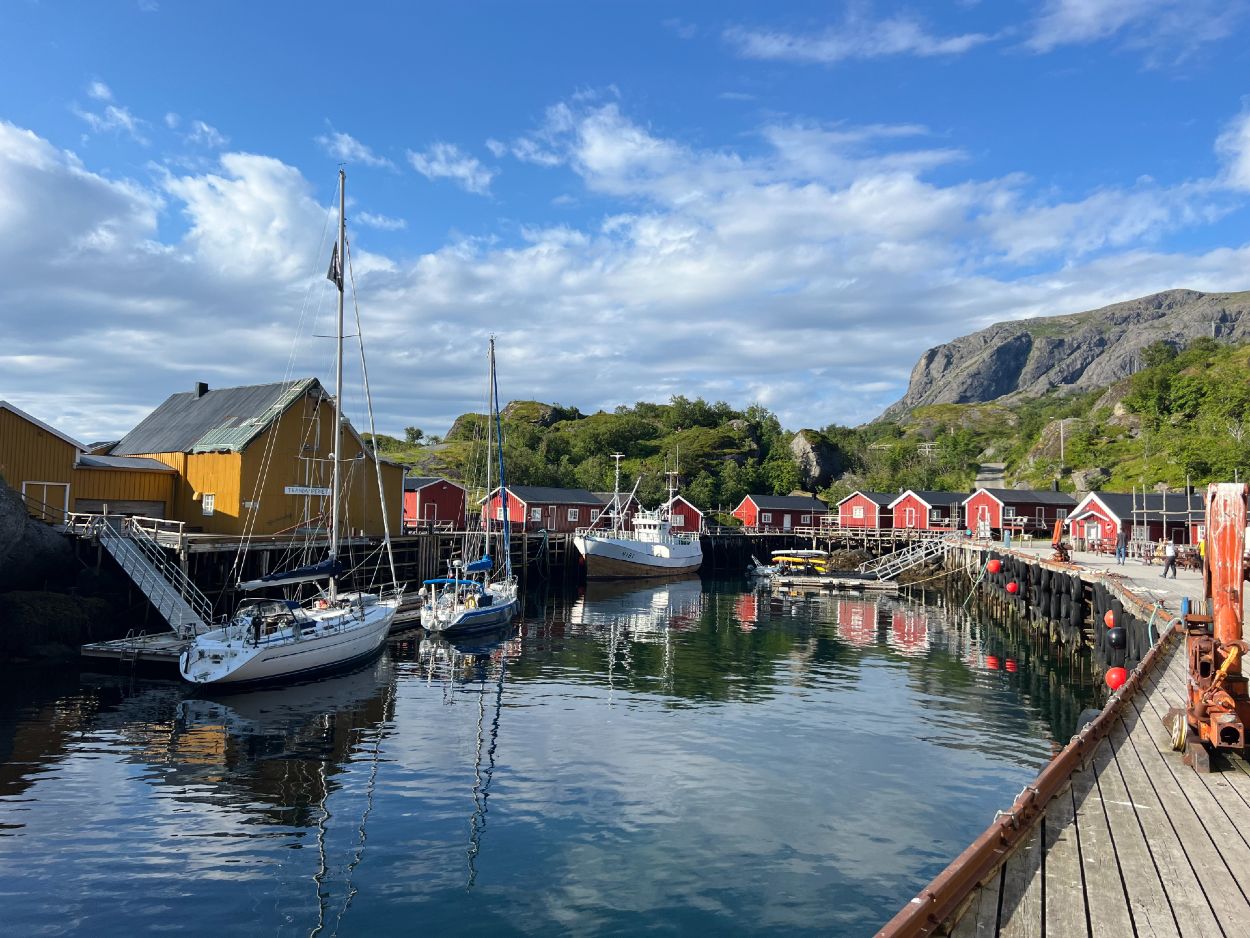
Nusfjord Village & Resort, Lofoten Islands, Norway
The Lofoten Islands, located just inside the Arctic Circle, are an archipelago of seven main islands bisected by glacial fjords. Travelers are rushing to this previously little-known Arctic destination because of its dramatic mountainscape, towering cliff walls, and deep, rocky fjords. Nusfjord Village & Resort sits at the end of a remote valley on one of these remote islands in the remote Arctic Circle. It doesn’t get more off the beaten path than Nusfjord.
Nusfjord was once a traditional fishing village, where fishermen spent the winter tackling the world’s toughest profession. (No, it isn’t travel writing.) That the soul of the village remains, along with nesting (endangered and protected) kittiwakes, the smithy, the General Store, the cod liver refinery, art gallery, and rorbus (traditional fishing cabins), is Nusfjord’s charm. And while tourists are free to roam this restored village by day, guests have it all to themselves come 5 pm. It’s then that I don my fluffy robe and slippers and slip into the sauna.
Their website states,“The earliest settlements in Nusfjord date from 425 BC. Our unique cultural heritage makes this fishing village one of Norway’s oldest and best-preserved. In Nusfjord’s golden age, over 1,500 fishermen lived in the rorbu cabins. Today, there are only 16 people who can call Nusfjord their permanent home.”
Why Go to Nusfjord Village?
Adventure, adventure, adventure. Views to knock the socks off even the most intrepid traveler. Hike, bike, kayak, RIB, SUP, surf, repeat. Nusjord Resort has it all (with Northern Lights streaking the winter skies). A spa and sauna with a window overlooking Arctic Circle views means never sacrificing a view for the sake of self-care.
What About The Rooms?
Ranging from one-bedroom rorbus to ones with several rooms, a living room, a kitchenette, and a roaring fireplace, Nusfjord has added all the creature comforts those frozen fishermen had to live without. Original timber-clad walls, soft woolen blankets, Nespresso makers, tea kettles, and high-end amenities abound.
For those who want to splurge, reserve Dahlgården, the home of the original landowner, Hans Dahl, and the most exclusive accommodation at Nusfjord. The House of Dahl is a private retreat in the village, offering views of the mountains and the sea and beautiful historic furnishings befitting a wealthy landowner.
And The Food?
Nusfjord Village & Resort has three dining options. Restaurant Karoline is the signature spot, with dark wooden walls, windows overlooking the harbor, and an ambience that has guests relaxed and cozy before they’re even seated. Karoline serves traditional Arctic fare like cod with smoked beurre blanc,Jerusalem artichoke with bleak roe, and pickled green apple, and crisp pork belly with beets, orange, and a touch of aquavit.
Oriana Taverna is a firelit pizza and wine bar located in what was once a whisky cellar. Serving everything from Margherita and Parma pies to more decadent options topped with champignons, chanterelles, and truffle oil, it’s a nice contrast to the more refined dishes at Karoline.
Lastly, find Landhandleriet Café tucked away in the whimsical old General Store, dating back to 1907. Grab a table with a view and choose from a limited menu featuring simmering fish soup, homemade waffles, and various baked goods—a great option for lunch or breakfast.
Nusfjord’s Best Photo Op
There are no bad shots of Nusfjord Village & Resort, just one picture-postcard after another. But for the best overview of the property, head to the upper parking lot. An unlikely and easily overlooked spot, it’s here where Nusfjord Village visually reigns.
The Lofoten Islands Are Waiting
Until not long ago, the Lofoten Islands were virtually unknown to the average traveler. But with the help of Instagram and TikTok, tourism is growing at a fast and furious pace. Lodgings here are finite. Book a year out if you want your first-choice accommodation.
Nusfjord’s prime and central location in the Lofoten Islands makes it a fantastic base for exploring the entire archipelago. It’s an authentic, historic gem reimagined for the modern-day traveler. For those seeking a bit of hygge (Scandi-comfort realized through candlelight, coziness, and sheer ambience) on their adventure, there’s no place better positioned to deliver it.
Intimate fishing cabins with plush down comforters, topped with piles of oversized pillows, make Nusfjord so much more than a place to rest your head.
Don’t forget to ask for a late check-out. You’ve earned it.
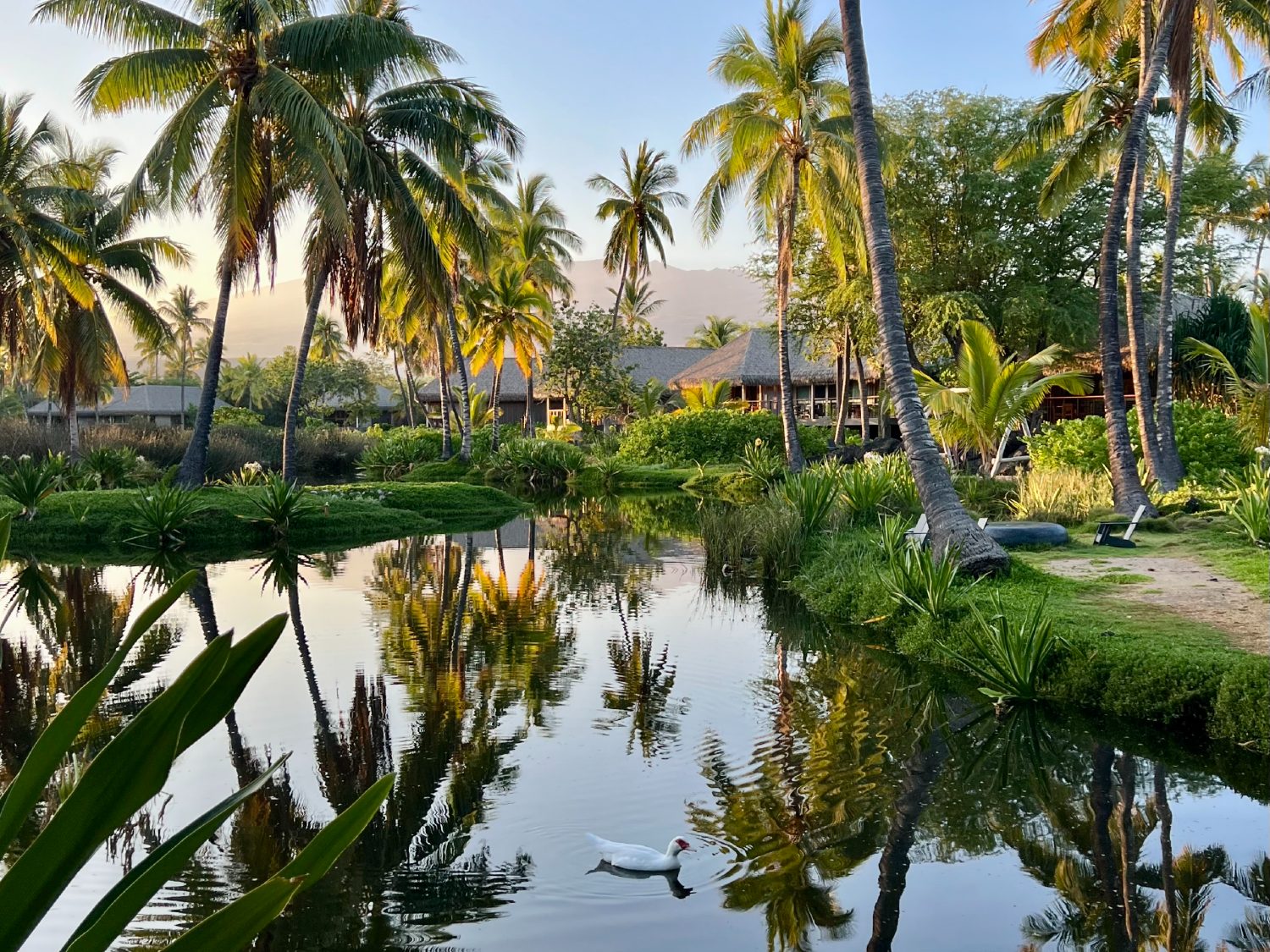
Why is Kona Village, A Rosewood Resort, so well-loved? Maybe it’s their prized location, a crescent bay where the Pacific Ocean stretches into the horizon without interruption. Or, the well-appointed ‘hales’ and locally-sourced cuisine. Maybe it’s the staff who welcome every guest with a natural smile. It’s all of that, and more. But what truly sets Kona Village apart is its connection to the past, where the traditions of this former fishing village are literally etched into the island’s volcanic landscape.
We peel off the long, flat highway. The sun is strong and high overhead. It would be simple to say the landscape is black and leave it at that. It’s more than black. It’s layers of charcoal, soot, and smoke. Its textures are made of craggy, cratered, and coarse rocks. Dry grasses struggle to take root in spaces between them, adding a wisp of gold to the otherwise bleak terrain. Petroglyphs scrawled on flat boulders evoke an ancient blackboard. Fields of lava tumble towards the sea, frozen in time.
Beyond the lava fields, palm trees rise like a mirage sprung to life—their green fronds swaying, vibrant and alive against the mighty Pacific. Kona’s history is one of devastation, renewal, and resilience. The energy here feels sacred.
Another left. Then, a long palm tree-lined road leads to Kona Village. A few Premier League hopefuls kick a ball across grass so perfectly green and manicured, I’m convinced it’s fake. Ahead, the Kahuwai Bay comes into view.
The History of Kona Village
Johnno and Helen Jackson happened upon Kahuwai Bay in 1965, arriving on their schooner after sailing the South Pacific. On the site of an abandoned village, they built Kona Village Resort—a secluded retreat that thrived for decades, drawing visitors from around the world to their sliver of Hawaiian paradise.
That is, until March of 2011, when a tsunami ripped through the Big Island of Hawaii, taking Kona Village Resort with it. The land lay barren and vacant, waiting patiently for its next chapter.
Twelve years later, Rosewood recaptures the beauty and traditions of the past and rebuilds Kona Village. It restores the property thoughtfully, with raised hales (thatched Hawaiian huts) that complement the landscape. It brings in local artisans, solar power, and green initiatives. But most importantly, it honors Kona’s history.
Today, village life thrives again in and around the Kahuwai Bay. Whether found in carved stones or imprinted in the dark skies overhead, Kona Village may have been reimagined, but it hasn’t lost its soul.
Setting the Scene(ry) at Rosewood Kona Village
Kona Village, a Rosewood Resort, has 150 villas and suites across 81 lava rock-covered acres. Low-arching bridges connect lagoons. A volcanic mountain range looms in the distance. Despite being the height of spring break, there isn’t a time during our stay that the resort feels overcrowded.
Black-crowned night herons hunch over the lagoon like statues, foraging for frogs and insects. Koloa Maoli ducks glide across the water. A train of baby Francolin follows Mama Francolin, leaving little tracks in the sand. White egrets with golden beaks fly past low palms filled with red-crested cardinals. I geek out with my binoculars, embracing my inner birder with pride.
Complimentary cruising bikes can be found throughout Kona Village. As hard as it is to leave the lagoon, I grab one and start exploring. The resort’s oceanside looks and feels like another planet. Villas on this side of Kona Village have infinity pools and quiet beaches dotted with stone fire pits and sun loungers facing the sea.
The shoreline is encrusted with lava rocks, black sand beaches, arched stone caves, and lava tubes.
The Pacific Ocean crashes violently against the rocks. In the distance, I see Mauna Kea, a volcano that last erupted 4500 years ago. I think it’s due, and only hope this isn’t the week Mother Nature has scheduled her next performance.
It’s wild and untamed. Desolate and raw. Completely unlike my Disney-esque lagoon. I love them both for different reasons.
Lagoon Life
I’d thought long and hard about our room choice at Kona Village. Had we not just spent three nights sea-facing on Maui, I would have most likely chosen an oceanfront villa. Who stays in Hawaii and doesn’t opt for an ocean view?
But the lagoon villa surprises me. The entrance is discreetly tucked away among the flowers and trees. The raised lagoon-facing deck spans the length of the villa, optimal for birding. Wooden slatted walls, a warm, neutral palette, and contemporary decor are a study in timeless understatement. Every book, lamp, and piece of furniture looks hand-picked.
Bowls of ripe fruit, cocktail mixers, and fresh flowers are details worth savoring. The living space is open and airy, and our bathroom has a concrete standalone tub and outdoor shower. It’s twice the size of my first NYC apartment.
This is the magic of Kona. Despite its size, everything feels small, welcoming, and intimate. Like a village.
Kona History, in Surround Sound
The Kona Village Resort encourages a conversation with the past. With 22 anchialine pools and 21 archeological sites across the property, the lands are not only well-maintained but well-loved. One morning, I stumble upon an area once the site of a village kitchen. Later, I see a pockmarked slab of stone that reminds me of checkers. A nearby plaque confirms it was a traditional board game.
Not far from the lagoon, I find a raised wooden boardwalk where ancient petroglyphs are carved into stones and slabs. Ala Hele Papa is an on-property open-air museum, filled with archaeological treasures. These petroglyphs reveal the stories of the past.
One carving, Honu I Ka ‘Upena, shows a sea turtle in an intricate net pattern. Another, Hapi Kanaka, depicts a burial procession—two human figures carrying a third between them.
There are 440 documented drawings in the area, some of which are almost 1,000 years old. Rosewood binds the art and stories of the past to the present day. The petroglyphs and relics are complemented by common areas filled with bold and dramatic modern art.
Nearly all the commissioned artwork around the property is created by artists who are native Hawaiians or current residents.
In Hawaii, Jetlag is your BFF
I head to The Market around 7am, ready to embrace the day with the help of a strong cappuccino. The Market is Kona’s hub, located beachside and stocked with baked goods and complimentary fresh fruit alongside matchas, espressos, and cold brews.
The Market opens at 5:30am. Anywhere else, this would seem absurd. But in Hawaii, most of the guests have traveled from mainland USA and are jetlagged. 7am Hawaii Standard Time (HST) looks and feels like lunchtime Eastern Standard Time (EST). Kids run amok. Snorkels pop out of the water. Some intrepid travelers have already returned from a morning hike.
On (and Off) Property at Kona Village
As one would expect from a world-class resort, endless activities, excursions, spa treatments, and water sports are on hand. The tiered adults-only pool is steps from the beach. After our fair share of adventures on the Road to Hana the previous week, we’re happy to do the bare minimum: eat, drink, caffeinate, and sunbathe.
We get off property a few times, if only to justify the rental car. Those excursions are worth it. We see more of the island’s beauty, hike beside royal burial grounds, and watch a giant sea turtle play in a shallow rock pool. Natural beauty and wildlife are ever-present in Kona.
But there’s nothing like coming ‘home’ after a few hours away. It was especially important to get to Talk Story Bar, Kona Village’s beach cocktail shack, before sunset. I’ll always remember Talk Story as the place I saw the green flash—a phenomenon that occurs when the sun’s final rays disappear into the horizon. Until that night at precisely 6:42pm, I was convinced it was pure myth.
Moana, Shipwrecks, and Cowboys
There are three restaurants at Rosewood Kona Village. Over our five nights, we eat twice at open-air Moana, twice at beachfront Kahuwai Cookhouse, and on our final night, score a coveted seat at the Shipwreck Bar for sushi. This shipwreck is no beach gimmick. It’s Johnno Jackson’s beloved schooner, restored as a place to gather and imbibe—a nod to the resort’s fishing village past.
At Kahuwai Cookhouse, wooden tables dig into the sand under twinkling lights mimicking the constellations overhead. The menu celebrates Hawaii’s cowboy (paniolo) culture with Hawaiian specialties, like huli huli chicken and steak tacos.
Restaurant Moana may double as a breakfast venue, but it feels completely different at dinner time. It serves Pacific Rim-to-table cuisine with sustainably sourced ingredients. The high-pitched roof, open-air setting, and amber lighting create a vibe worth dressing up for. Meals are long and relaxed. The lapping waves provide a lulling soundtrack to accompany the clinking glasses and low laughter.
Did I mention the flip side of jetlag? Everyone is asleep by 9pm.
Daily Rhythms
The days take on the slow island rhythm I crave after our many near-death experiences on the Road to Hana. Early mornings with the sunrise and the birds. The Market for coffee and a leisurely breakfast at Moana. A few hours in the sun, then a stroll along the bay searching for shells.
Later, beachside ceviche with a bottle of chilled wine. A nap (because why not?) under a thatched umbrella. Reading, biking, swimming, and scouting for sea turtles and whales. More birding. More biking. Sunset at Talk Story Bar and then another dinner under the stars. This pace is so unlike my real life. What a vacation is meant to be.
It Takes a Village
I grab my last Kona cappuccino and scan the horizon for whales. I’m so busy looking into the distance, I nearly miss a seal belly-rolling towards the shore less than ten yards away. She bounces her weight back and forth using her flippers to propel her massive body onto the beach.
This is 403, a regular guest at Kona Village. She’s an endangered monk seal, one of only ten around the islands, and she’s ready for a nap after a long swim from Maui.
The beach staff springs into action. “It takes a village,” the young, shirtless Hawaiian says with a smile, as he cordons off the area around her. (Not creative license, he really said that!) A quiet crowd gathers. Cameras click. Then, just as naturally, village life resumes. 403 may nap for up to 24 hours. And while she takes up prime beach real estate, no one seems to mind.
Kona Village is a sacred place. I imagine the villagers who lived here centuries ago. They left behind a road map in their petroglyphs and carvings. An insight into their lives. Those who visit Hawaii’s Kona Village can retrace their paths. Follow in their steps. Their fishing village may no longer exist, but it’s honored here.
A new life, built on the memories of the past.
Ready to travel—but can’t find the time to plan?
Anyone can Google a destination, but finding the right sources, the hidden gems, the places worth your time—well, that’s an art that takes time. I’ll cut through the noise, saving you from hours of searching in the wrong places. Each of my recommendations is researched with your specific trip in mind.
After visiting 70 countries on 7 continents, I know how overwhelming travel planning can be.
But I also know how to make it easy. And exciting. And stress-free.
When my kids were little, the 100th day of school was a very big deal. In the days leading up to the 100th day, the excitement was exponential. There were 100th-day projects, 100th-day activities, and 100th-day surprises—all culminating in a 100th-day celebration with a guest appearance by Zero the Hero (a masked superhero played by their teacher’s fiancé).
I never questioned why the 100th day of school was such a big deal. I was knee-deep in 100 Honey Nut Cheerios, 100 LifeSavers, and 100 cotton balls—all glued to neon construction paper courtesy of Elmer. Elementary school was a blur of sticky little fingers wreaking havoc on our black labs and white sofas.
The 100th day of school. For teachers—a way to nurture a love of math. For parents—a categorical mess.
This is my 100th post. I’m as excited by this number as any 1st-grader about to meet their first superhero. To mark the occasion, I won’t abuse processed oats or hard candy. I won’t use glue. Instead, I’ll list 100 places I want to go.
As a point of clarification, these are not 100 places to visit before you die, not the top 100 places to visit in 2025, and definitely not 100 places to see after you die (wow, sometimes Google suggestions are entirely off the mark).
Just 100 (amazing) places.
Lists of lists
My travel wish list has lived in my phone’s Notes App for years, quietly snowballing with conversations overheard in coffee shops, inspiring Instagram posts, friend recommendations, and sidebars in Travel + Leisure magazines. I’ve grouped them into a few broad categories to add structure. But that’s about it. A random, cobbled assortment of (amazing) places to go. 100 places to inspire your next trip. 100 places to add to your travel wish list.
Do you have a travel wish list?
It’s time to create one.
Mustique
Counting to 100
Listing these 100 places was an interesting exercise—sort of like time travel. I thought back to how, years ago, my list was filled with fancy beach hotels in Mexico—places with kids’ clubs so I could have lunch with my husband without cutting quesadillas into poquito pieces. Back then, Caribbean resorts mesmerized me with miles of pristine coastline where my kids would argue over one square foot of sand.
Later, my list included glamorous city hotels so Daniel and I could dine at Michelin-starred restaurants and sit for hours at sidewalk cafés. The kids were the ideal ages to stay with grandparents. Grandparents who thought sno-cones for lunch was perfectly acceptable.
Montenegro(even from behind, Ella looks completely unimpressed)
As the kids got older, we found places with activities we could do as a family—adventurous spots that didn’t solely revolve around the beach or pool. Our kids will deny it, but they hated hiking from the ages of 8-18. Daniel and I selfishly marched them up mountains, forcing them to admire views in places like Montenegro, Mallorca, and Montana. The only times our kids got along was when they were lagging fifty feet behind, complaining about these (their words) god-awful, miserable hikes. They cried child abuse. We hiked faster.
Now, they act like they invented hiking. Jimmy Chin is Ella’s idol. Chase races us to the summit. Parenting is a thankless job.
100 (Amazing) Places To Go
It’s worth mentioning this list is aspirational. If you hope to find budget-friendly and easy-to-get-to destinations, you’re reading the wrong blog. But—if you’re hoping to get inspired and find a few splurge-worthy vacation spots, read on—100 very expensive ideas await!
And lastly, those marked ( * ) are currently at the tippy top of my list.
I started this blog, (I mean, website), in 2018 with a handful of subscribers and even fewer Instagram followers. Today, I’ve reached my 100th post, have several thousand subscribers, and over 10K Instagram followers. No one is more surprised by these stats than me—and probably my daughter.
I love this blogwebsite blog. It’s given me a creative outlet beyond helping my kids find 100-round things to glue to construction paper. It’s taken my travels to new levels, as I’m constantly thinking about how to best describe what I’m seeing and experiencing, which, in turn, helps me see and experience things differently. 100 posts (often with suspect grammar and incorrect punctuation) about travel.
What’s the point?
I think about this list. What’s the point? I won’t get through 10% of it in my lifetime. But that’s precisely the point. The list will change as I change. Some places will fall off my radar as others replace them. Some will make no sense—did I really want to go to Easter Island??? Others will attempt to recapture those years when my kids waddled along the beach in saggy, swimmy diapers.
I’ll never finish my list. I’ll never win. The hard-core list makers of the world might have trouble with this concept. I know I do. Or, I did. Until I realized that’s the best part: adding, subtracting, and multiplying (the math metaphors are neverending!) destinations. It’s ok to lose.
My kids are adults now. They stopped believing in Zero the Hero around the same time they found out about the tooth fairy. But I thank the teachers, especially Mrs. Haese and her long-suffering husband Derek (aka Zero the Hero), for doing their job. My kids can count. And because they can count, they have lists of their own. Lists that will expand and change as their lives expand and change.
Those elementary school years are a sticky, messy blur. My clearest memories are from our family vacations. So, I’ll keep adding.
Will my list look completely different in ten years? Or even five?
Do you ever wonder how to find the best hotel for your next adventure? It isn’t rocket science, but I do have my approach to finding what I consider the ‘best’ hotels. Think you have nothing left to learn? Let’s compare notes. And enjoy photos from some of my favorite hotels, resorts, and villas along the way.
“How did you find that adventure lodge in Iceland?”
“Where was that surfing resort in Nicaragua you loved?”
“What time of year is the best to go to Tuscany?”
Villa Laura, Italy
I love questions like these. Sourcing travel ideas and inspiration is my straight-up obsession. Sharing those ideas and inspiration is where I really thrive.
Decades of research, legwork, and exploration have led me here. A space where I can share what to do, and what not to do when it comes to finding hotels. Strategies and tips for practical travelers, as well as indulgent ones.
Take it from me—the most indulgent, practical traveler I know.
Click here. Be the first to know when I find a new place to get lost!
My Process
Finding a hotel is pretty straightforward. Finding the one that suits your specific needs, fits your budget, and style, and is in exactly the right location? Well, that’s not as straightforward.
Aman Sveti Stefan, Montenegro
For those who believe a hotel room is merely a place to rest your head, this post isn’t for you. A vacation extends beyond the top sights, activities, and beaches. Where I choose to spend my time, hotel-wise, matters.
The Four Seasons, Punta Mita
We all have our non-negotiable points when choosing a place to stay. That might be a sprawling property with an infinity-edged pool for the kids. Or on-site surfing for the adventure-seekers.
Gilpin Hotel, England
A boutique hotel with a 10-seat Michelin-starred restaurant for the foodies. Or, a UNESCO World Heritage Site nearby for the history buffs. Knowing your travel style and travel needs is paramount.
Choose Keywords With Care
Google is designed with the user in mind. She’s a crowd-pleaser. But be prepared to put in some work to make sure you get what you want. The keywords you choose are essential.
For some, diving into a Google search is a rabbit hole with overwhelming information. For others, it’s second nature. Like turning the pages of Amor Towles’ latest novel. Use Google to narrow down to a place that fits the bill budget-wise, size-wise, and location-wise. It’s far easier when you have a system.
Blackberry Mountain, Tennessee
If you are on my site often enough, you know that I lean toward places that combine luxury and adventure. For instance, when I travel, I often start my search with keywords like ‘luxury hotel in ________’ and ‘adventure luxury hotel in ________’.
Let’s work with an example. Alaska is a destination on my radar for next summer. While that sounds far off, consider that many hotels and resorts are fully booked for Christmas 2021.
My keywords and phrases:
Best luxury hotel in Alaska
Luxury lodges in Alaska
Best resorts for wildlife in Alaska
Top places to see wildlife in Alaska
Broadening to other interests, I might also search:
Alaska hotels for foodies
Best restaurants in Alaska
Top wellness resorts in Alaska
As common sense dictates, the more narrow a keyword search is, the better the results. Since I’m open to going anywhere in Alaska, I can afford to be broad. Naturally, finding the hotel with my wishlist becomes easier with the right keywords in place.
Other keywords I use:
Adventure travel for couples
Remote spa destinations
Bucket list travel ideas
Luxury hotels for families
Remote escapes for foodies
Best family hiking locations
Luxury family travel
Villa Ixfalia, St Barths
Consider The Source
Once I land on a page, I immediately skip past the ads. I scan for my trusted travel sources. Those websites and publications have time and again proven to be worthy.
My sources include Travel+Leisure, Condé Nast Traveler, Forbes, and Afar. Combined, these sites begin to uncover the ideal hotel for my specific destination.
I start to notice where the hotel recommendations overlap and consider the positives and negatives of each review. I take note of the hotels that show up across multiple sources. Cross-referencing is key.
I’d be remiss if I didn’t cite my beloved New York Times as a primary source. I always google ’36 hours in _______’ to see if my destination has been recently reviewed. Inevitably, I discover a wealth of info worth saving beyond hotel choices, like a local coffee shop or a lesser-known museum.
Nobu Ryokan, Malibu
Follow The Bloggers
Unsurprisingly, I also follow blogs. Here are a few that are especially helpful to me.
hotelsabovepar: A self-acknowledged ‘boutique hotel pundit and enthusiast’, Brandon Berkson is my hotel hero (if such an entity exists).
thegoodthebadandtheluxurious: Prepare to be amused or cringe. A quick-witted (and sometimes scathing) review of the most expensive hotels in the world.
thisistheplaceiwastellingyouabout: Two young Texans created this well-curated lifestyle blog that combines photography, food, coffee, and travel. My people.
Click here to be the first to know when I find a new place to get lost.
Know Thyself
It’s as important to note what I don’t like in a hotel as much as what I do like. Take the case of Alaska. Do I want a 500+ room hotel spread over three towers, with four restaurants, and an athletic club? (No, thank you.)
Would I like a remote, fly-in-only wilderness lodge that prides itself on conservation and sustainability? (Yes, please.)
What if I’m keen on discovering the next Alaskan hot spot? That takes more digging. This brings me to my next point.
1 Hotel, South Beach
Visit the Google Graveyard
The Google Graveyard—page two of a Google search. Likely because most users find the information they need on page one and have no need to venture beyond.
Being the intrepid explorer that I am, I like to head out as far as pages three or four. I enjoy reading what the lesser-known bloggers (like me) and alternative online sources have to say. Don’t be afraid, there is compelling content to be found beyond page one.
Viceroy Sugar Beach, St Lucia
Re-Search
Experiment with a search that goes outside of the box. Going back to Alaska, I might search “unusual places to stay in Alaska” or “luxury cabin stays in Alaska”. Oftentimes, I’ve widened my preconceived thoughts about a destination with a more specific or quirky search.
For example, when I once used the keywords, ‘resorts with private villas in the Caribbean’. I discovered Viceroy Sugar Beach in St Lucia. We have now been twice.
In fact, let me try that again now. “Unusual places to stay in Alaska” reveals a site about an Alaskan Treehouse on the eastern Kenai Peninsula. Another link uncovers a luxury glacier camping site. New searches, new ideas. I also research if the hotel has a ‘best room’—a seat guru-like technique for hotels instead of planes. For example, we stayed at the Hotel Lydmar in Sweden a few years ago. Happening upon Condé Nast Traveler’s monthly feature, ‘Room With A View’, I discovered Room 512.
Distinctly nautical, the 5th floor offered lovely views of Stockholm through unique portholes. Room 512 was the best room on the 5th floor.
How did I get Room 512? I asked for it.
Check Your Dates
Not your travel dates (although certainly important). The post dates. Who wants to stay at the ‘most Instagrammable hotel of 2016’ or ‘the hottest resort of 2019?’ Post dates are easy to identify, so no time is wasted on dated data.
Looks Matter
A three-second website scan is all I need to tell if a hotel isn’t the place for me. How? The design. Is it laid out with easy-to-read typography, an enticing color scheme, and a gallery of beautiful photos? Are those photos captivating? Most importantly, do I see myself there?
If the site is challenging to navigate or cluttered with bold, italic, or (gasp!) multi-colored, multi-sized fonts, I move on. The art director in me prevails. I prefer to visit a place that prioritizes design and readability and delivers high-quality content. They will likely care about the details I care about.
I go with my gut. If the site feels good, I add it to my shortlist.
Dunton Hot Springs, Colorado
Deep Dive
Having narrowed it down to my top three stand-out hotel or resort choices, I take a deep dive into each site.
1. First, I check that the hotel locations are correct. I once booked a hotel I assumed was in Positano but (surprise!) ended up being in Amalfi.
2. Then, I search ‘the best month to travel to _______. I still remember booking a villa in Thailand during the rainy season.
3. Are my travel dates available? Is there a minimum stay? Am I being fleeced by a resort during the festive season? And if so, can I live with that?
4. What does the fine print say? Is there ongoing construction next door?
5. Which hotel makes me feel like I’ll regret my choice forever if I don’t go? That’s the one I choose.
Then, I book it.
Overshare
I pride myself on finding the right (hotel, villa, or resort) for me and my family. Sometimes I get it wrong (as noted above). Often, that tends to happen when I haven’t done the research. Even my biggest travel flubs tend to have a good outcome. The hotel in Amalfi was divine—a happy Italian accident.
Wildflower Farms, an Auberge property in New York’s Hudson Valley, is the antidote to city life.Discover why it’s on everyone’s hot list.
Ryan puts our bags in the back of the motorized cart. Our bungalow is a short walk away, but it’s drizzling, so we welcome the ride. After a few social niceties, ‘Where are you from?’ ‘Is this a girls’ trip?’ ‘Are you sisters?’ Ryan slams the brakes. “I just saw a bald eagle—want to see his nest?” My jaw drops. Does my 16-year-old niece want to meet Taylor Swift? “Yes!” we say in unison. Ryan kicks the cart into gear.
So begins our wildlife-filled weekend at Wildflower Farms. My friend and I have come to this Hudson Valley resort to relax before the upcoming chaos of our sons’ high school graduations. I’m happy, but it’s a bittersweet happiness. That we see a bald eagle guarding her nest within minutes of our arrival seems timely. Symbolic, even.
I’m on the cusp of a major life change—the dreaded empty nest. As melodramatic as it sounds, this eagle sighting becomes a soppy, emotional metaphor for my stay. I have three days in the Hudson Valley to contemplate it.
The Hudson Valley—a Natural Getaway
The Hudson Valley is New York’s fastest-growing hot spot. Boutique hotels pop up like spring daffodils, luring New Yorkers from the concrete jungle. Only 90 minutes from the city, it’s a natural getaway. With deep roots in farming and agriculture, the Hudson Valley has some of the oldest wine-producing areas in the country. It has a thriving food and farmer’s market scene and challenging mountains to hike. The scenery is so bucolic it inspired the Hudson River School, a group of painters whose muse was the verdant landscape.
The Hudson Valley is a destination for art and nature lovers, history buffs, and gourmands. Wildflower Farms couldn’t be better placed to satisfy them all. But be warned. Guests will be hard-pressed to leave the property. The only way to do it all is to build in more time.
The Birth of an Art Movement
One reason guests flock to Wildflower Farms is its delicate balance between indoor and outdoor living. Another is the chance to walk in the footsteps of 19th-century artists like Thomas Cole and Frederic Edwin Church. Among other Hudson River School artists, their romantic vision of the landscape was born and cultivated in this very place. Focusing on three themes of Americana: discovery, exploration, and settlement, the movement’s goal was to portray a place where humans and nature could peacefully coexist.
Although Wildflower Farms caters to the well-heeled city crowd, the parking lot license plates prove people come from farther afield. Black, navy and gray apparel appear to be the uniform of choice, offset by squeaky clean, neon-colored Hokas. Despite the moody apparel and dark skies, Wildflower Farms is inherently bright. The staff seems to be living under an ever-moving sunbeam. Chipper, but not annoyingly so. Welcoming, but not overly eager.
Ryan is spot-on. We find the eagle sitting in a tall Eastern White Pine beside her nest. Thankfully, Ryan had the wherewithal to stop at our cottage so we could grab our binoculars. They aren’t necessary. The aerie is so big LeBron James could use it for his pre-game nap. Fun fact: aerie is a fancy word for eagle’s nest. I have Will Shortz to thank for this tidbit of bird trivia. It’s one of his favorite New York Times crossword clues.
I see the eagle’s beady, honey-colored eyes through the lens, but I don’t need them to feel her intense stare. Is she counting down the weeks until her eaglets fly away? Is she sad? What will she do with all her downtime once they leave? I told you this would get soppy. Don’t judge until your kids fly the coop.
Welcome to Grand Central Station
An oversized open-air central firepit area called The Great Porch is the entry point of Wildflower Farms. It’s also the resort’s social and culinary hub. We go there for morning cappuccinos, rosé-infused lunches, and pre-dinner cocktails—all complemented by majestic Shawagunk mountain views. Banquettes circle the ever-blazing firepit. Should it be chilly, like during our stay, woolly blankets are within reach.
One morning, a black Suburban ambles up to reception. The trunk pops open, and two big doodles tumble out. Within minutes, water bowls, treats, and two cushy dog beds are placed fireside. The doodles look unfazed—as if this kind of treatment happens wherever they go. I notice their matching Valentino Rockstud collars. Maybe it does.
You Belong Among the Wildflowers
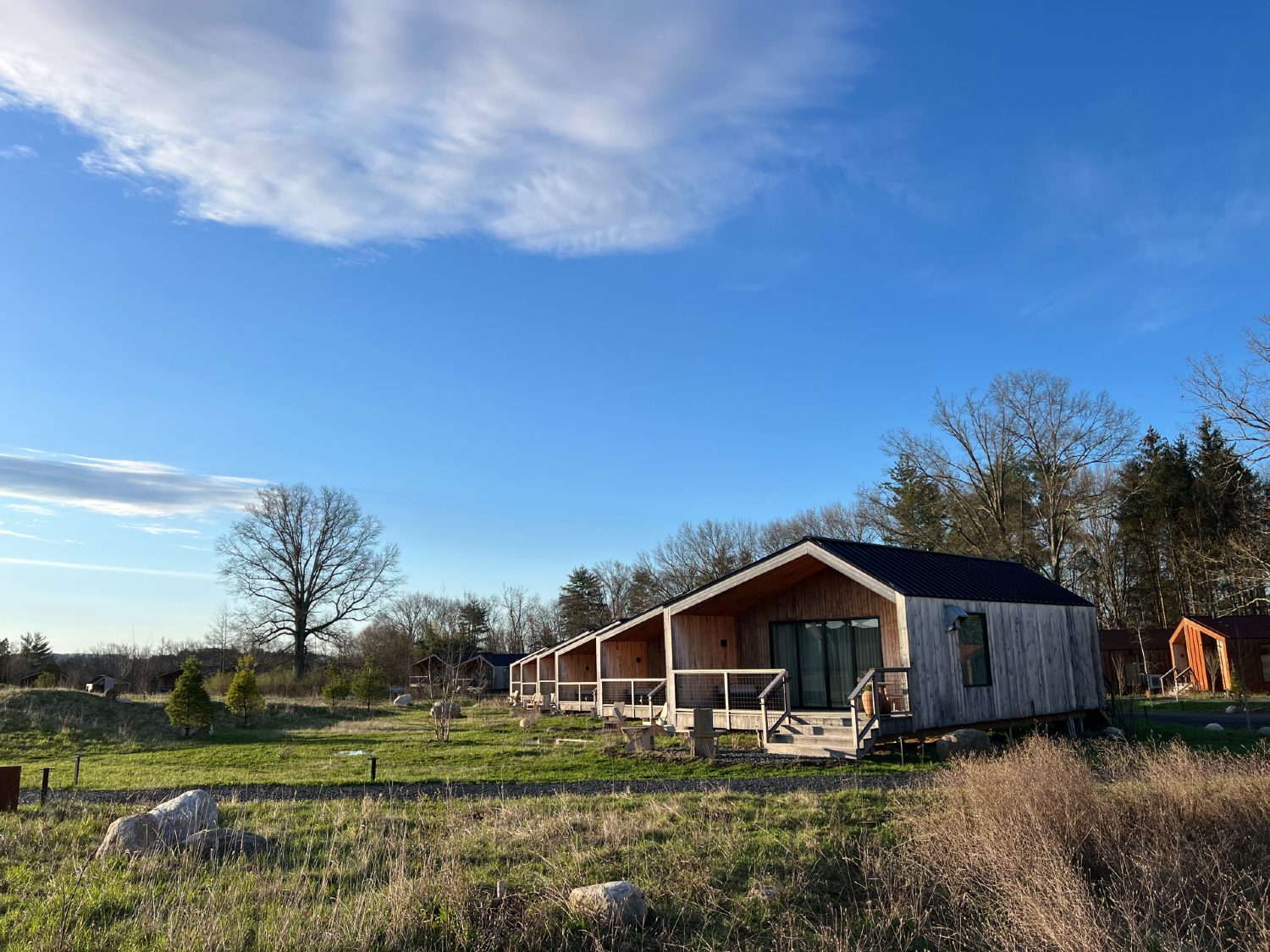
Sixty-five freestanding cabins and cottages are scattered throughout Wildflower Farms’ 140 acres in Gardiner, New York. Deceptively simple from the outside, each cabin is a highly curated gem. I can’t stop humming Tom Petty’s classic tune. I belong here.
The cabins are a destination unto themselves—beautifully appointed and chock full of welcoming treats, like shears for cutting flowers and a miniature glass vase to display them. The Bower Cabins are situated under a canopy of trees and have outdoor spaces to admire the scenery, birdwatch, and listen to the sounds of nature.
Meadow Cottages have vaulted wooden ceilings, wood-burning fireplaces, and private back gardens with daybeds facing the meadow. One morning, instead of racing to breakfast, I open the sliding glass doors to take in the breeze and the view. At Wildflower Farms, I’m constantly reminded to slow down.
Cabin interiors mirror the landscape in ways that would make the Hudson River School painters proud. A moss-green velvet couch sits on top of a stormy-blue patterned rug. A patchwork quilt that looks anything but old-fashioned is draped across a contemporary wood-framed bed. It’s Modern Americana. The rooms are light-filled and airy, with local artisan touches, hand-chosen books, and an inviting window seat to read them.
What to do at Wildflower Farms
Wildflower Farms Resort is like a sleepaway camp for grown-ups. Crafty on-site activities include watercolor classes, floral focaccia baking, botanical mixology, and pressed flower pottery workshops. There are opportunities to make body oils and perfume, shear sheep, take a sound bath, and unlock the astrological secrets of your birth chart.
Off-property activities are equally enchanting: fly fishing, hiking, mountain climbing, and cycling for the active-minded are offset by the treasure trove of wellness experiences at the Thistle Spa. For those who’d rather relax, Body Botany, Restorative River Stone Massage, and the Remodeling Facial are a few of the many treatments they offer. I learn that the spa uses ‘hand-harvested, small-batch oils with floral remedies.’ Bravo, Wildflower, I expect nothing less.
Two outdoor hot tubs, an indoor pool, a relaxation area with platform daybeds, and a sauna are dreamy ways to pass the day, rain or shine. Complimentary yoga classes and a gym are offered in a nearby cottage overlooking a quiet pond. For those who want to splurge, a sailboat can take up to six guests on the Hudson River for a decadent champagne picnic.
Farm to Pocket to Table
Set in the heart of the Hudson Valley, the traditional farm aspects of the property don’t feel contrived. Visitors can opt into as much or as little ‘farm life’ as they’d like. For instance, each morning, guests are invited to feed the farm animals and collect eggs. Later, they can take the eggs to Clay, Wildflower’s restaurant, and have them prepared ‘your way’ for breakfast.
I close my eyes and delicately reach under a fat hen, trying to decide ‘which way’ I want my eggs prepared for breakfast. It’s still raining. But if the chickens aren’t bothered, then neither am I. Move over, Sarah Jessica Parker; I can be a farmer when I want to be. I’m baffled but not surprised when one pushy woman fills her pockets with six eggs, leaving many of us eggless. I resist the urge to accidentally bump into her shiny Moncler vest, hoping karma will prevail.
Clay, named for the rich soil where Wildflower’s vegetables are grown, serves breakfast, lunch, and dinner. Its enormous yet intimate dining room has a stone fireplace, vaulted ceilings, and a unique seating layout.
Over our three days, I’m determined to sit in them all: the low, curved-back chairs that flank the central fireplace, the high-top tables with a bird’s-eye view into the kitchen, and the convivial banquettes that line the outer walls. Rugs, throw pillows, and upholstery patterns that shouldn’t look good together somehow do and reinforce why I will never be an interior designer.
My traveling companion is plant-based. Executive Sous Chef Kyle Chandler takes this as a personal challenge, creating culinary magic with plants, flowers, and vegetables. I’m secretly envious of her flower and herb-infused Pad Thai entrée, a dish created solely for her that evening. We share the light-as-air sweet potato tempura served with togarashi aioli and basil three nights in a row. Yes, they were that good.
Other menu highlights include farm-roasted carrots with tamarind and watermelon radish, and halibut accompanied by Brussels sprouts, pecans, and lemon. Yet, I will forever associate the humble olive oil pancake with our stay. The size of a standard-issue frisbee, topped with berries and a large dollop of lemon chantilly, it has forever ruined me for breakfast. I have no doubt that everyone who orders it swears it’s too big to finish—then completely devours it.
My Best Friend, Merlin
The rain allows me to experience Wildflower Farms in ways I didn’t anticipate. Instead of sitting by the pool with my nose buried in a book, I open the wide glass doors of our cabin and do pilates while watching mist fall on the meadow. I spot the eagle in a distant tree, this time with her mate. ‘Who’s guarding the nest?’ I wonder. Reading my mind, she takes flight. I watch her wingspan unfold in absolute awe as she soars over my head and out of frame.
The weather doesn’t stop us from exploring the property’s meandering trails. I use my Merlin Bird ID app without fear of ridicule, as my kids are hundreds of miles away. At one point, Merlin picks up seven different bird species chirping at once. If there’s ever a place to embrace your inner birder, Wildflower Farms is that place.
Yet, birds aren’t the only wildlife we see in the Hudson Valley. On one of our morning walks, a large cotton-tailed deer hops across our path. Another afternoon, we see a gray fox on the hunt. I revert to my love of collective nouns and discover that a group of eagles can be called an aerie, a convocation, or a soar. A group of foxes is called a skulk. A female fox is called a vixen, and male foxes are called dogs (how apt!). Who has this coveted collective noun naming job? I want to apply.
The Empty Nest
On our last morning at Wildflower Farms, I’m sitting fireside at The Great Porch when a spectacular thing happens—the sun comes out. I throw off my woolly blanket, abandon my cappuccino, and dash outside to take photos. The clouds part, and a double rainbow ekes its way through them. Gold cascades over the meadow, lighting the tips of the grasses. I see the doodles running amok. The rainbows arch over Wildflower Farms in a way that looks AI-generated. I watch them until they disappear.
There’s only one thing to do before the drive home. I grab my binoculars and walk towards the aerie, excitedly anticipating my last encounter with the eagles. I wait and wait, but they’re a no-show. The waiting gives me time to wallow in my soon-to-be empty nest sadness. Maybe it’s time to look at it in a new light.
An empty nest will give me more opportunities to visit places like Wildflower Farms. More chances to observe animals in their natural habitats (including ones wearing Chloé and Celine). And more chances to explore, discover, and settle—just like the Hudson River School painters did over a century ago.
I walk through the airport’s cool, frosted glass doors. Salt-tinged air warms my face. Out here, the party’s in full swing. People gather with glasses in hand. Bottles of Chassagne-Montrachet chill in buckets of ice at their feet. Bursts of laughter radiate from the well-heeled crowd as a rainbow assortment of Minis and Mokes whizzes behind them. It feels like happy hour on a breezy NYC rooftop, not airport arrivals.
I scan the crowd. Our villa manager is easy to spot. He’s wearing tell-tale Eden Rock red. Fred greets us as if we’re old friends. ‘Are you ready?’ he asks with a cheeky grin. It’s unclear what he means by ‘ready.’ But whatever it is, we unanimously agree that we are.
Let’s back up a few decades to set the scene. In the early 1950s, French aviator and adventurer Rémy de Haenen built a hotel on a rocky promontory overlooking a secluded turquoise bay in St. Barths. Rémy dreamed his hotel would become a destination for the rich and famous. It didn’t take long for him to get his wish. Greta Garbo, Howard Hughes, and other celebrities soon christened red-roofed Eden Rock their Caribbean hideaway.
In 1995, Jane and David Matthews purchased Eden Rock from de Haenen. As the story goes, the Matthews (aka Pippa Middleton’s in-laws) sailed to the island and became immediately smitten. Furthering Rémy’s flair for all things fabulous, the Matthews added clifftop cottages and palatial suites, catapulting Eden Rock St. Barths into one of the world’s leading hotels.
Two decades later, the Matthews partnered with Oetker Collection to manage the property, further elevating its already high standards of luxury. Today, one could just as quickly spot a rockstar or an NFL quarterback sitting beside an aging politician or a teenage influencer.
Not a rock star? ‘So what?’ There’s room (and rooms) in St. Barths for all. But the glamour of this chic French island comes at a price—especially if the Eden Rock Hotel or one of its 150 private villas are involved.
En route to our hilltop home away from home, a prop plane passes overhead. And by overhead, I mean I can practically touch it. We navigate a small roundabout where people gather with iPhones shooting video—a popular island activity. In the near distance, the Eden Rock Hotel comes into view. A departing plane is so close to the water it nearly takes the floppy hat off a sunbather.
There are many hotels on St. Barths with dramatic views. But only at Eden Rock can one watch charter planes arrive and depart from the comfort of a cushy sunlounger. Anywhere else, a hotel this close to the runway would be a dealbreaker vacation-wise. Leave it to the French to flip the script. The thrilling take-offs and landings are part of the island’s joie de vivre.
Gray Malin’s ‘The Arrival’
At 2,100 feet long, the runway on St. Barths is one of the world’s shortest, so only small planes can land. Therefore, most people (aside from those who fly private) connect through a neighboring island, usually St. Maarten or Puerto Rico.
To put an exclamation point on this long narrative about a short runway, fine-art photographer Gray Malin chose this very subject for his famous à la plage series. ‘The Arrival’ is one of his best-selling prints, no doubt adorning living room walls from Paris to LA.
The Eden Rock Bubble
It’s easy to get caught up in the Eden Rock bubble. Everyone in it looks so glamorous. Women wear gem-toned Missoni kaftans with oversized woven hats. Men don crisp white linen shirts, pastel-colored shorts, and Italian espadrilles. Their sunkissed kids trail behind them on their way to the Sand Bar for truffle-topped pizzas. It’s island eye candy all around.
The Eden Rock bubble has its own boutique. Did you forget that cute boho dress you planned to wear to Bagatelle? It’s Zimmermann’s crochet wrap to the rescue. Suddenly desperate for a tote that mirrors the bay’s exact shade of blue? Goyard’s Turquoise St. Louis bag with matching beach towel has you covered.
Blue, white, and red may be sewn into the island’s fabric, but the labels are decidedly Off White and Orlebar Brown.
Eden Rock St. Barths, The Hotel
In September 2017, the Eden Rock Hotel suffered extensive damage from Hurricane Irma. By 2019, it had reopened its welcoming red doors to guests eager to reclaim paradise. Eden Rock returned to its former glory with 37 rooms, a Jean-George Vongerichten restaurant, a new world-class spa, and an attentive and absurdly attractive staff of over 200 strong.
Other hotel highlights include the British-Colonial-style Rémy Bar, on-beach spa treatments, professional sunscreen attendants (not a typo), and a roving frosé trolley. Because mon dieu!—at these rates, no one should have to leave their sunlounger for a glass of Whispering Angel.
PC: Eden Rock
Incredibly, all 37 rooms and suites at Eden Rock are individually curated. Jane Matthews lovingly designed them, showcasing local and international artwork at every turn. Some rooms are on the beach, and others are on its famous rocks. All are spectacular.
Inspired by a schooner, the Captain’s Room has brass portholes, maritime leather seats, and a private pool. Spencer’s Room is perched on the face of the rock and pays homage to Africa with eclectic carved wooden masks, woven rugs, and a regal four-poster bed. Then there’s the Pippa, the Garbo, and the Howard Hughes. How to choose? A champagne problem, indeed.
There isn’t a superlative that hasn’t been used to describe the Eden Rock Hotel. This puts me at a loss for words to describe their most extravagant villa. At 17,000 square feet, Villa Rockstar is called ‘a two hundred million dollar yacht on land.’ Between us, that isn’t much of a selling point. I’d rent a yacht if I wanted to be on a yacht. But who am I to question the marketing team of one of the leading hotels in the world?
Villa Rockstar has everything you could ever need and just as many things you don’t. The six-bedroom villa’s secluded location lies behind 10-foot walls on St. Jean’s beach. One of the many oversized bathrooms is circular and tiled in (wait for it) white gold. Rockstar has a dedicated chef and butler service around the clock, a 20-meter heated pool, and a jacuzzi. According to the website, Villa Rockstar also has a ‘basement full of surprises.’
PC: Eden Rock
Other amenities include daily breakfast delivery, a fully-equipped techno-gym, a multi-car-filled garage, a private business office, and a custom-designed Italian kitchen. While I don’t know who is driving, cooking, working, or exercising when they visit Villa Rockstar, I would trade it all for breakfast delivery. The brioche at Eden Rock is no joke.
The website also ensures guests that ‘privacy and discretion’ are Villa Rockstar’s watch words. Is that the same thing as safe words? Safe words aren’t just for the bedroom anymore. Does this have anything to do with the surprises in the basement? Grab eleven of your closest friends and party like a rockstar at Villa Rockstar. When you discover what’s hidden in the basement, please share.
Villa Neo and Eden Rock’s 148 Other Villas
Villa Rockstar notwithstanding, Eden Rock has private villas across the island for (nearly) all budgets. Eden Rock conveniently divides its villa portfolio among four categories: Classic, Deluxe, Prestige, and Ultraluxe. If you think classic is code for inexpensive, you’d be incorrect. Nothing is inexpensive on St. Barths. Instead, think of classic as code for least expensive. And even then, prepare for sticker shock.
Neo is a six-bedroom supermodern ultraluxe villa. It has glass staircases, glass walls, and glass sculptures. The pool spans the length of the villa and towers high above St. Jean’s beach. Neo’s outside space is sprawling with double-bed sunloungers and wide umbrellas.
Some bathrooms have deep soaking tubs (alas, none tiled in white gold) and spacious balconies. The kitchen is not ornamental. Our chef, Eric, whips up fabulous French meals there every day. That we’re spoiled is evident.
Breakfast is a daily delight—and more decadent with each passing morning. Airy crépes on Monday, Belgian waffles with berries on Tuesday, fluffy frittatas on Wednesday… you get the idea. That every meal Eric creates comes with baguettes, brioches, and croissants does nothing to help our waistlines. We waddle to the Eden Rock boutique to buy bigger kaftans.
After a week of fantastic in-villa meals, Eric tells us he’s never seen a group consume so much bread. We pat our bellies proudly and take it as a compliment—though I’m pretty sure it isn’t.
Dining Beyond the Bubble
With all the French carbohydrates one could desire, you may question why we’d ever leave the bubble villa. St. Barths has a world-class dining scene, which always includes incredible people-watching in chic settings with DJs and live music. So get out, we do, and it’s worth it.
Three standout meals are Sella, Bagatelle, and Nikki Beach. Each restaurant incorporates a party element to accompany the food and wine. At Sella, Jerusalem-born, Michelin-starred chef Assaf Granit serves Middle Eastern cuisine in an amber-infused, low-lit waterfront setting. The DJ’s hypnotic Arabic music fuses intricate melodies and rhythmic patterns with charred meats and vegetables. We all love it.
Bagatelle starts typically enough—with a convivial dinner party vibe. But by the time the appetizers arrived, the DJ had ratcheted up the music so loud that I couldn’t hear my husband. As the entrées appeared, guests and servers started dancing.
Then, models began weaving around the dancers in cute boho dresses. Champagne corks spiral through the air. John Legend is singing Happy Birthday. Bagatelle is not a restaurant; it’s a bar mitzvah.
Just Another Sunday at Nikki Beach
Nikki Beach deserves a post of its own. And maybe one day, when strapped for content, I’ll write it. Until then, believe me when I say a trip to St. Barths without Sunday brunch at Nikki Beach is a big mistake.
Sundays at Nikki Beach are legendary in St. Barths. It’s a Caribbean darty (to use my least favorite word but most favorite concept). The great thing about a daytime party is that you can have fun whether you are 8, 18, or 88. And at Nikki Beach, ‘fun’ could mean a sparkler-topped bottle of Veuve Clicquot, a hot French saxophonist dancing on your table, or a gladiator towing a sorority girl around on a chariot. On our Sunday, fun included all of the above.
Colorful sushi boats filled with seared ahi tuna, red caviar-topped salmon, and pink ebi sail around the room. As the music tempo increases, the crowd rises to the occasion (literally and figuratively). People kick off their shoes and dance like no one is watching. Although, of course, everyone is. We order a bottle of Dom and go for it. Nikki Beach is the place to splurge on the most splurge-worthy island in the Caribbean.
“Are You Ready?”
I think back to Fred’s cheeky grin seven days ago. I’m sure he knew we’d need a vacation to recover from our vacation. I’m sure he knew we’d have baguette withdrawal, suffer from severe sleep deficit, and have hearing loss in one, if not both, ears. After so many years tending to guests’ needs in the Eden Rock bubble, he’s seen it all. No wonder he was smiling.
At the airport, newly arriving guests exit as I enter the frosted glass doors. Salt-tinged air warms their faces. I take one last glance behind me. I see signature Eden Rock red shirts and bottles of ice-cold Chablis. Glasses clink. Laughter fills the air. A rainbow assortment of Minis and Mokes whizzes by on the street.
We were well on our way to Amangani when I saw ‘WOAH’ on a red octagonal sign that would normally read ‘STOP.’ We’d been in Jackson Hole for a total of 30 minutes. Little did we know that ‘Woah!’ would become the buzzword of this trip among the Teton mountains. Amangani, here we come.
Nerves of Steel, in Jackson Hole
There have been precious few trips where wildlife has played a central role in our experience. Safari in Botswana was certainly one of them, and gorilla tracking in Uganda was another. Closer to home, but no less adventurous, was Jackson Hole, Wyoming. The impetus of the trip was three days of hiking in Jackson Hole’s Teton Mountain Range, planned by my husband, Daniel. I was nervous, I’ll admit now. Not only nervous the hiking would get the best of me physically, but the bears. I was nervous about the bears.
Those who have grown up in the West might find my fears amusing. As a former New Yorker, I was never afraid of being mugged or subway rats—but bears were another story. Being born and raised in the metropolitan northeast, where my most grizzly encounters were with the squeegee guys at the Lincoln Tunnel, the West meant ‘wild’. Frankly, I wasn’t sure I was cut out for it.
Softening the blow, my husband cushioned the trip by booking Amangani. Having spent time at Amangiri in Utah a few years ago, we knew we were in for a decadent experience.
Bear Spray Rentals, in Jackson Hole
After touching down at Jackson Hole Airport, we headed to baggage claim. At the carousel, I spotted a kiosk called ‘Bear Spray Rentals.’ What a clever name for a car rental service, I thought. It took another beat to register that the kiosk was actually renting bear spray. Did I mention that I spent all my adult life in big cities?
According to the attendant, bear spray is rarely used in Jackson Hole, as the bears want to hang out with us about as much as we do with them. That said, I rented a can of bear insurance and went on my merry way.
As a barometer for the kind of scenery we were in for, I needed only to look out the car window. If it’s this scenic at the airport in Jackson Hole, we were in for something pretty spectacular. The airport was named a national monument in 1943 and merged with Grand Teton National Park a few years later. I also discovered that the airport is ‘a popular mating ground for the sage grouse.’ Good local knowledge. I was fitting in already.
Amangani is low-profile and high-impact, an architectural style we have noticed at many Aman properties. Perched upon a hilltop, with illustrative snow-capped mountain views in the distance (even in July) and green pastures of cows below, Amangani’s vibe is modern rustic lodge-chic. The exterior is a lovely combination of redwood and stone and sits ever-so-comfortably in its surroundings.
A small pond on the grounds, which later became a never-ending photo op, was a flourish on the bucolic scene. It acted as a backdrop to Jackson Hole’s glorious Grand Teton mountain range photos that changed with the light and mirrored the cloud formations that rolled past throughout the day. I was obsessively drawn to this spot, as is clearly evident from the absurd number of photos I took there.
Settling into Amangani
Upon entering Amangani, which means ‘peaceful home’, a grand, sweeping staircase welcomed us. The staircase led to a multi-level windowed wall that formally introduced us to the landscape. Hello, Tetons!
There were plenty of spaces to find quiet at Amangani. Comfy chairs were placed to maximize the panorama of the Snake River Valley, whether in the lounge, the airy central sitting area, or on our private room balcony. Native American touches, oversized sepia-tinted wildlife photography, painted cowhides, and textiles were displayed. Everything was placed with a designer’s touch.
A room for all seasons at Amangani
As tempting as it was to spend all of our time outside in Jackson Hole, the rooms at Amangani encouraged us to stay in. Being an all-season destination, the rooms at Amangani had as much to offer comfort-wise as we could wish for.
A raw-cut stone fireplace sat in the corner. The room’s centerpiece was a low platform bed, donned with crisp, white linens and a wooden headboard that went from floor to ceiling and continued its design onto the ceiling itself. Natural materials in shades of gray, ecru, and soft faux fur accents completed the ambient scene.
Were it not for the showstopper of a pool and the hiking ahead, I would have been hard-pressed to leave the walls of the lodge and head out into Jackson Hole at all.
To infinity and beyond, at Amangani
One of the hotel’s unique selling points was its nearly 400-square-foot heated outdoor infinity pool. The rectangular, blue-toned, mosaic-tiled pool spanned the entire length of the main lodge. It offered uninterrupted mountain views. The icing on the cake was the square, sunken hot tub that sat center stage along the pool’s top edge. Its idyllic location begged us to enjoy a bottle of champagne there.
The row of poolside loungers was a magical spot from which to watch the layers of blue sky evolve throughout the afternoon. Jackson’s jagged Teton mountains cut into the sky in the distance, and puffy cloud formations floated effortlessly in the foreground.
In Jackson Hole, it’s all about the views
A rickety wooden fence edged the perimeter. Beyond that, a steep slope led towards green fields and cow pastures. From our aquatic perch, the cows looked no bigger than ants in the Snake River Valley, and we dreamily watched them migrate across the pasture each day post-hike. My legs were rendered useless by then, and I was very happy to not have to use them for the remainder of the day.
The air was cool and dry. I watched red-tailed hawks crisscross the sky over our heads. An idyllic scene.
At 6am, our alarm sounded. This was not my idea of a vacation. Although I knew that once I got going and had some caffeine, I’d be happy to start the morning. Daniel is obsessed with avoiding crowds. He hates parades, auctions, big parties, and just about any situation where he might have to converse with strangers. Hence, the early start time. I, on the other hand, am obsessed with avoiding bears and moose, and I’m told they like to get a jump start on their day around the same time.
According to our guidebook, Jackson Hole’s Cascade Canyon hike is majestic, adorned with a canopy of Douglas firs, sheer canyon walls, and Teton mountain views. However, it warned of the huckleberry bushes along the way that attract grizzlies. In this case, being first on the trail meant being first to greet the hungry huckleberry eaters. I took a long, deep breath, and we set off.
Grand Teton and Jenny Lake
Crossing Jenny Lake to get to the trailhead made the early wake-up worthwhile. The lake was flat and serene, mirroring the mountains and clouds, undulating ripples for as far as I could see. I quickly noticed that the few other passengers on the boat had bells, music, and whistles, to detract wildlife. We had nothing, so were told to keep up a steady, and loud conversation. Who has six hours of steady conversation after 17 years of marriage?
Noisy, gushing waterfalls, wooden footbridges, and enormous pines met us as we started our ascent. It couldn’t have been more beautiful and peaceful, especially since no one else was on the trail. We made it up the first steep pass to Inspiration Point, which offered uninterrupted views of Jenny Lake.
Finding our stride in Jackson Hole
We saw signs of bears, like tree trunks that had been used for sharpening claws, but thankfully, no actual bears. Daniel walked ahead carrying the bear spray, which was a clever ploy to get me to keep up with his faster pace. The 13.6-mile round-trip journey took us through spots called Paintbrush Divide and Hidden Falls, which looked as illustrative as their names implied. Birds of prey glided in the breeze overhead.
Wyoming’s snow-capped Grand Teton welcomed us in the distance like a beacon. I might have smirked more than once on our hike back towards the lake as we passed hikers starting their climb as we finished ours. Thank you, Daniel.
Once again, my weary legs earned the right to sit at the pool’s edge and revel in the morning’s accomplishment, book in one hand, a refreshing drink in the other. With rewards like this, I could certainly get used to hiking.
Eat and drink, Amangani and beyond
While the town of Jackson Hole and Teton Village was only a fifteen-minute drive from the resort, we ended up going out for dinner only twice in five nights. It was too hard to leave the nest after a day of hiking and sun-soaking.
The dining room at the Amangani Lodge was ambient and moody, with a menu with enough variety to satisfy us for three dinners. As you might imagine, the windows played a large role in the setting, and it was hard to concentrate on anything when the views were as captivating as the Teton mountain range.
Jackson Hole’s Snake River Grill
One of our two dinners out in Jackson Hole was at the highly recommended Snake River Grill. We wondered if it could live up to the hype, as everyone I had spoken to about Jackson had waxed lyrical about it. The simple log cabin decor somewhat belies the elegance of the food. We were impressed from the first bite.
The menu at Snake River Grill was bold, with hearty meats like elk, beef cheeks, and pork shank. It also catered to the pescatarian and vegetarian, with options like a roasted cauliflower steak and sea bass. As has become a habit, when I am fully enthralled with a meal, I forget to take photos. I have since become a master at ‘mostly-eaten’ food photography. Take my word for it: the food looked appetizing when it arrived.
The next morning came a little too soon, especially after a stomach full of elk, but I rallied, remembering the views and the scenery, forgetting, for a moment, about the bears. Daniel told me that we were going to hike to Delta Lake, a glacial lake at the base of Grand Teton.
What he didn’t tell me was that to access this hidden gem, we needed to take unofficial, unmaintained trails, navigate several steep boulder fields, and bypass fallen trees along a rocky precipice.
It’s tempting to say it wasn’t worth it—but I can’t lie. It was as if we were discovering another world deep inside the natural wonderland of the Tetons. After about three hours of hiking, we finally caught sight of the lake—Woah!
The lake was a luminous milky turquoise, the kind of color that is impossible to truly describe. I read later that Delta Lake gets its otherworldly hue from the glacial silt of the Teton Glacier. Wherever it gets it, I was sold. Hiking was my new favorite pastime, bears or not.
With day two of hiking (and surviving) behind us, we later celebrated with drinks outside on Amangani’s veranda. The fully stocked bar looked especially beautiful as the setting sun started to descend behind the glass bottles. Another pair of red-tailed hawks soared and circled above as if delicately sewn into the fabric of the scene.
In the distance, dark storms gathered. The air smelled heavy. As it came closer, it became a game of chicken—in which guests would abandon their seats first to take cover. The raindrops didn’t slowly trickle as much as they decided to whole-heartedly dump down on us at once. We dashed indoors.
The storm didn’t disappoint. Jagged lightning bolts took turns bolting, and thunder cracks intermittently cracked. Then, as dramatically as it had started—it stopped. The rainclouds were beyond us, heading towards and eventually obscuring Grand Teton before making their way swiftly across the range. What the storm left behind was a sky of violent color, dramatic clouds, and crisp mountain silhouettes. Woah.
Amangani-led safari
With a hiking reprieve the next day, we headed out with a guide on a land safari in Grand Teton National Park. Our guide was so full of information—about wildlife, mating calls, obscure species, flora, and fauna that I didn’t have the bandwidth in my brain to keep up. I tried to impress him with my mating knowledge of the sage grouse, but it seemed he was already up to speed. Show off.
I was excited for a break and a day of photographic soul food. Searching for wildlife from the safety of a car? Now, I was in my happy place.
Again, an early morning beckoned, as that is when the wildlife is easiest to spot. We immediately came upon a herd of lovely chocolate brown elk silently grazing in a barely sun-touched field. Soon after, we spotted a pair of bison on the road’s edge.
Bisons have an awkward body shape, with a massive hairy head and front quarters compared to their somewhat skinny, spindly hindquarters. I was taken by surprise when we witnessed these large mammals elegantly jump a fence to get more food. They are shockingly limber creatures!
The crowning moment of the morning, without question, was when we drove directly past an enormous grizzly bear grazing just off the side of the road. With wildflowers in the foreground and fields and mountains in the background, it felt like he had been planted there for camera-armed tourists like me.
We watched this lovely old grizzly slowly saunter around, munching plants, minding his own bucolic existence. Woah. It was one of the best wildlife moments of all time. When you have Jackson Hole, who needs Africa?
Tackling the Teton Mountains
It was inevitable that something would go wrong; we were in the wilderness, after all. Our third day of hiking started typically enough. We rode up the aerial tram to Rendezvous Mountain, where we were due to take a scenic 12-mile hike down to the base. Many had told us about the heavenly waffles that were sold at Corbet’s Cabin, just at the summit, and I bee-lined there as soon as we hopped off—energy for the hike ahead.
Again, a victim of half-eaten food photography, I had already inhaled their famous traditional brown sugar-buttered waffle before I remembered to snap it.
Although it was July, there was still snow on the ground in places, and some signage might or might have not been obscured. Or, we might have just missed the signs altogether. We got lost, found ourselves off the trail, my biggest nightmare, and to top it off, we had just descended a harrowing scree field that took all of my technical and physical energy.
As if that weren’t enough, I caught sight of a lumbering silhouette alongside the stream in the distance. Yes, I panicked. Yes, we argued loudly. The upside was that our shouting definitely kept the bear at bay.
After deciding to cut our losses and head back to the tram via the dreaded scree field we had just navigated (exponentially worse going up than down), we had still hiked about 10 miles, had an adventure, and gone nowhere. At least we had those famous buttery waffles.
Until next time, Jackson Hole
Sometimes, it is best to have not seen and done it all. To leave something behind for another day —a reason to return. The iconic male moose had eluded us those five days, even though our eyes were peeled for him at every turn. We had seen our fair share of wildlife in Jackson Hole, snow-capped Teton mountain views, and epic hiking adventures.
Until next time, Jackson Hole.
Author’s Update: Amangani will close in April of 2025 for extensive refurbishment and reopen in the summer of 2026.
Hacienda AltaGracia is the Costa Rican wellness resort everyone is talking about. Never-ending choices of activities and treatments to nourish mind and body in a tropical, fairy-tale setting. THE WELL, Hacienda AltaGracia’s spa, is a sanctuary within a sanctuary. Good luck choosing between wellness experiences, off-property excursions, where to eat, what to eat, or where to lounge.
There are more than enough choices at Hacienda AltaGracia, an Auberge Resort. There just isn’t enough time.
Our twin-engine Cessna glides over the mountainous interior of Costa Rica. It’s 6am. The sun is skimming the tree tops, and a misty translucent glow is rising above them. Clouds are weaving in and out of view. The deafening roar of the engines makes conversation impossible, so my friend and I sit back and soak up the verdant landscape. Thirty minutes later, our plane dips over the Talamanca Mountains toward our destination—a grassy airstrip at the base of Costa Rica’s newest wellness resort, Hacienda AltaGracia.
Wellness is always trending at Hacienda AltaGracia
Wellness was once a word synonymous with woo-woo. Is it still? These days, I dare you to find a resort that doesn’t have ‘wellness’ listed in its menu bar. Not just for Los Angelenos anymore, wellness is for everyone. Why shouldn’t it be? Taking care of ourselves from the inside out feels good. There are far worse things trending these days. I have teenagers, bad trends appear in my house daily.
Lisa and I are heading to the mother of all wellness resorts—THE WELL in Costa Rica at Hacienda AltaGracia.
THE WELL, Costa Rica
We’ve come to Hacienda AltaGracia exclusively for THE WELL, one of the most recently opened spas to take on wellness and well-being. In addition to this Costa Rica location, THE WELL has multiple locations in Auberge Resorts around the world, including a stand-alone spa in New York City.
THE WELL is known for combining Eastern and Western healing practices, meditation, body treatments, and holistic treatments. It’s quickly becoming one of the world’s most sought-after wellness experiences. Hacienda AltaGracia opened in November 2021 and is leading the wellness way in Costa Rica.
Perched at the highest point of Hacienda AltaGracia’s 180 lush, tropical acres, THE WELL encompasses over 20,000 square feet of naturally lit space. It’s jaw-dropping. I made a point to watch guests enter it for the first time and count gasps. Everyone gasped. Some gasped twice. It’s that impressive.
THE WELL overlooks the Talamanca mountains, a range that contains both Costa Rica and Panama’s highest peaks. Architecturally, the setting not only exudes calm and serenity but intentionally seeks to bring the outdoors in.
Three oversized windowed walls surround an oversized tranquility pool that always mirrors the sky. Two symmetrical square hot tubs flank the pool. This double-tub feature erases the awkwardness of having to make polite hot tub chit-chat with a stranger. I’m a self-proclaimed chit-chatter. But I have two firm exceptions: airplanes and hot tubs.
What exactly does one do at THE WELL?
At the risk of exceeding my self-imposed 2500-word limit, allow me to list some of the many treatments available at THE WELL, Costa Rica. I didn’t have time to partake in all of these treatments, mind you. Even if I did, I wouldn’t have enough money left to cover my cable bill. (That said, many services and treatments are included in the room rate. Yes, that’s 100% true!)
WELL, WELL, WELL
• Join a visiting master for a guided meditation or a breathing session. Book a one-on-one session later to deep dive into your past life or refine your breathing technique.
• Try botanical yoga.
• Connect with your senses by taking a forest and crystal bath (that’s not a typo). Hacienda AltaGracia has a 700-pound crystal quartz on the property where guests can partake in an integrative energy healing session.
• Find a spot on a warm marble slab and take an ethereal lunar gong bath. Later, head back to the spa for a sunset swim or aromatherapy steam.
• Opt for traditional spa treatments: Swedish massage, hot-stone therapy, or cranial massage, for example.
• Push outside of your comfort zone with less-common treatments: Maderoterapia or Wood Therapy is a traditional Central American practice. Or Hierbas y Flores, a nature-infused experience that incorporates native flowers and massage.
This list is by no means complete. Nor, do you have to sign up for any treatments in order to enjoy THE WELL. I spent time there with a book on a lounge chair trying to read. Unfortunately, I was constantly distracted by the surroundings and found myself over-posting on Instagram. This did defeat the concept of relaxation a wee bit. Anything for my followers!
THE WELL has more choices than my cleansed mind can compute. Would I like a light, medium, or heavy cotton waffle robe from The Robe Bar? Would I like my custom clay body mask mixed with parsley, sage, rosemary, or thyme? Choice—the wellness luxury that just might ruin my wellness experience. Once I accept that there are only good choices, I calm down.
Beyond THE WELL at Hacienda AltaGracia
Wellness is not limited to treatments at Hacienda AltaGracia. Wellness is slow-cooked oat and quinoa porridge with local honeycomb, berries, and cocoa nibs while watching a charm of hummingbirds. It’s self-guided yoga on our expansive villa deck, listening to frogs croak. Wellness is my morning green juice from Mercado and my evening cocktail at the bar.
Since this is Lisa’s second visit to Hacienda AltaGracia, she takes over the trip’s itinerary. As much as I love to plan, having someone whose travel sensibilities I trust to do it for me is a welcome change. (For the record, I trust my husband’s travel spidey-sense too—in case he reads this and feels slighted.)
A Bath upon Arrival
After landing, we head directly to Mercado—the most non-lobby resort lobby I’ve yet to see. Mercado is part of a highly curated boutique and part of the Friends-style Central Perk. The café has homemade pastries, specialty coffee, juices, quiche, and other baked goods available all day at no cost. Lisa discovers her love of sparkling espresso while I devour cookies like a greedy toddler.
We are gently whisked from Mercado to one of the property’s signature treatments: The River Bath, an immersive outdoor nature-filled experience. An overgrown flower-filled path leads to a warm stone-edged plunge pool beside a cool stone-edged river. Over two hours, we toggle back and forth between the two, looking to cleanse our auras as the treatment advertises. Butterflies surround us. We slot into their habitat with ease.
Wellness, as a travel trend, isn’t limited to people who are fully invested in mindfulness and meditation. It’s good old-fashioned well-being. Resorts like Hacienda AltaGracia appeal to everyone from yogi masters to once-a-year meditators. How you spend time at this tropical Costa Rica wellness resort is your choice. And choices abound.
Over four days, Lisa and I find that critical balance of physical activity, mindfulness, and relaxation. Oh, and eating. That activity is not quite as balanced as the others. At Hacienda AltaGracia, all food is included in the room rate, so we choose to consume everything the menus offer. Cold-marinated Pacific prawns or prawn-filled blue corn tortillas? Both, please. And throw in an order of tuna tiradito, pan-fried line fish, and beef empanadas, if you don’t mind. They don’t mind.
Difficult choices at Hacienda AltaGracia
There are multiple places to dine and drink throughout the property. Grano is the main restaurant with both indoor and outdoor options that are equally inviting. El Cultivo, just beside Grano, is Hacienda AltaGracia’s organic garden. Lunch is served at Las Brisas, one of two open-air poolside restaurants. The food is healthy, but not the tasteless calorie-limited kind of healthy generally associated with spa trips.
I can anticipate the next question. Yes, they serve alcohol at Hacienda AltaGracia! I say this for those who hear the words ‘wellness resort’ and assume they’ll have to smuggle in alcohol.
I’ve never been a horse person. But Hacienda AltaGracia has quite a set-up for those who are. If you don’t like horses, skip ahead. I don’t mind.
Hacienda AltaGracia’s traditional horse show and dinner, Cienfuegos, is an ongoing event at their modern-designed stables. The 42 Peruvian, Spanish, and Costa Rican horses are living their best lives, and they look like they know it.
Lanterns and fire pits are among the sole sources of light. A band of musicians performs low-key background music. After an hour of cocktails and polite chit-chat (a totally acceptable time for chit-chat) at the immaculate stables, we enter the barn and are seated communally for a family-style dinner. Roasted meats, salads, and veggies prepared Costa Rican style keep us satiated. Wine is poured, and the horse show begins.
The riders entertain the crowd with their control of prancing horses. The atmosphere gets livelier with each round of performances (enhanced by each round of drinks). It’s a festive peek into Costa Rican equestrian tradition. Afterward, we take a golf cart back to the villa to dream of horses. Not me, mind you, but I’m sure many people did.
It sounds cheesy, right? But it’s actually totally fun and festive.
Early Mornings at Hacienda AltaGracia
Lisa organized two super early off-property activities so that we could eat the rest of the day without guilt. I despise early wake-ups. Lisa loves them. It’s surprising we are friends. That said, once I was up (and caffeinated), my anger disappeared. Almost.
Rising before the sun has its pluses. Like seeing the sunrise, for one! Another is the early morning sounds and stillness of nature. One morning we take a 7-mile hike to Roca de Nubes and spot a troop of elusive spider monkeys. Wildlife—another plus of early rising.
The following day we hike to a series of three gushing waterfalls. Our guide asks us to choose (again with the choices!) which one we’d like to swim beneath. The answer for me is none. I may have taken the polar plunge in Antarctica earlier this year, but take my word on this, the water in Costa Rica is much colder. Lisa fully embraces the invigorating experience while I merely dip my toes like the water wimp that I am.
Welcome to the jungle
I take a look around. The landscape around Hacienda AltaGracia is rich in texture. Layers upon layers of prehistorically oversized leaves with stencil-like cutouts, palms, ferns, and fruit-filled banana trees. Dramatic low-hanging clouds drape the Talamanca mountains in the distance. Swallow-tailed Kites soar. As the sun descends, the vegetation takes on a warm hue. What was initially shades of green now appear orange, yellow, and red.
Hacienda AltaGracia’s 50 villas are built into the Costa Rican jungle—seemingly absorbed by it. This makes it feel like a private, remote hideaway. The property is so lovingly nestled in the jungle that the wildlife doesn’t even seem to notice. Hawks swoop overhead and kaleidoscopic-colored butterflies swirl around us.
Our villa’s veranda has a heated plunge pool that overlooks mountainous layers in the distance. Because Lisa wakes up at 4am she always gets to the daybed first. I forgive her.
The living space is lounge-y and inviting, with stacked coffee table books, cushy throws, binoculars, and birding books for bird nerds like me. It has a walk-in closet larger than my first apartment in NYC and a full bar for us to pour drinks as needed. Heated water bottles magically appear tucked under the covers of the beds each evening. If the villa is designed to keep us there, we fail miserably. There is just too much to do.
At Hacienda AltaGracia, it’s your vacation, your choice
On our last night, we have drinks on Grano’s patio with Valerie, one of the visiting wellness masters. Her inherent sense of humor and lightness takes the edge off the woo-woo. We gather around the fire pit at sunset for a release-burning ceremony.
It’s an opportunity to rid ourselves of ‘something that no longer serves us’ by throwing a personal note into the flames. A few husbands attempt to escape, but Valerie lures them back. One by one we throw our paper into the fire and watch it burn. With clear minds and empty stomachs, we head in for dinner.
You don’t have to be a life coach, herbalist, spiritual influencer, or accomplished sound bather in order to have a restorative experience at Hacienda AltaGracia. Everyone can use a few days to reset, recharge, and reload. Whatever your vacation is calling for, there are opportunities to fulfill it at Hacienda AltaGracia. The choices are annoyingly endless.
Well-being and wellness go hand in hand. I can’t think of a better trend to embrace. And you need not go to a luxurious tropical jungle resort in the heart of Costa Rica to do it.
But should you have the choice, it’s certainly a lot more fun.
Please note a few affiliate links above for which I may receive a small referral fee. But rest assured, I only highlight products I fully stand behind.
Air is air. Of course, it can be humid, dry, or wet. It can be conditioned or heated, still or sticky—the adjectives are endless. When I visited the Mii Amo spa in Sedona, I looked for words to describe the air. How did it feel? Neither crisp, nor brisk, nor thin, nor heavy. Then, it dawned on me. I wasn’t feeling anything. The air was imperceptible.
The beauty of not noticing the air is that my other senses are on much higher alert. Sounds become more pronounced, and colors more intense. Brilliant mesas and red rocks define the landscape of Sedona, which is about an hour-long drive from Scottsdale.
Along the drive to our Sedona resort and spa, Southern Arizona’s ubiquitous pale green Saguaro cacti were replaced by other shades of green. Prickly Pear cacti, cypress, sycamore, pine, and juniper trees took over the landscape. It was an arboreal introduction to the Sonoran Desert—our destination for the next few days—a Sedona spa tucked away in the desert wilderness.
Spa-bound, in Sedona
My mom, sister, and I were headed to Mii Amo, a resort and spa part of The Enchantment Resort in Sedona, Arizona. This gorgeous Sedona spa was awarded the #1 Best Destination Spa in the US for the second year in a row by Travel + Leisure Magazine. This coveted spa experience has the added luxury of being situated in one of the most alluring spots in the United States.
The famous ‘Red Rocks’ of Sedona surround Mii Amo. The resort and spa sit at an altitude of 4500 feet and are low in profile—nearly hidden in the Upper Sonoran Desert. It’s as if Arizona gave every architect in Sedona the same Benjamin Moore paint chips and said, ‘Please conform to the colors of the desert.’
Sedona’s Color and Light
Burnt reds, persimmons, ochres, and every shade of warmth in between live in Sedona, Arizona. But what makes the desert even more interesting are the clusters of unexpected and brazen greens. Sedona’s Verde Valley, or Green Valley, is named after the copper that was once mined in the area. The bold greens are a spectacular addition— an unanticipated contrast to the sun-lit rocks throughout the day.
The canyon walls are hundreds of millions of years of age. And comprised of nine staggering layers of stone. The receding oceans created the canyons. The result? Rock formations are a natural, visual wonderland. You need not be a geologist to appreciate the striations and layers of color and rock on museum-like display. Limestone, sandstone, and mud, among other elements, have made this piece of Arizona a literal hot spot.
As the light and shadows changed, I prepared to see something new emerge every hour. The mountain views never disappoint, whether with partly cloudy skies, cloudy skies, or full sun.
Mii Amo means ‘one’s path or journey’. Feeling grateful to be guests at the best spa in Sedona, we decided to get started on that journey right away. My sister and I hiked to Vista Point around 6pm on our first evening in Sedona.
As an added convenience, guests can access many hiking paths from the property itself. The sun was already dipping towards the west. And our short hike to the viewpoint took about 20 minutes via a well-beaten red dirt path. We were told to look for a tree hugging itself,’ as that was a known vortex site. Upon reaching the point, however, it looked like every gnarled and twisted juniper was hugging itself.
The entire area is thought to be a vortex. A vortex is a swirling center of energy that many believe has healing and spiritual powers. Not one to deny an area of its spiritual power, I sat against a rock and decided to channel some positive energy.
Piles of delicate toppling rock cairns dotted the point, each one quietly declaring, ‘I was here!’. The silence was all-encompassing—a drastic change from my daily life in DC.
Desert Life at Sedona’s Best Spa
The setting sun was piercing and lit the upper third of the mountain range on fire. Whether or not one believes in the healing powers of the vortexes (or vortices, as I’ve recently learned), it was impossible not to feel inspired and restored there— the views were unparalleled.
I enjoyed it so much that I returned each day at different times. Once, I ventured out as early as 5am to catch sight of the hot air balloons that hovered over the distant mesa.
I was on high alert, ready to walk into a herd (aka squadron) of wild javelinas as I had done with my sister on our first hike. Rodent or pig? Neither, surprisingly. They are just strange 60-pound hairy mammals that roam the area.
I was reminded of the ROUS (Rodents Of Unusual Size) from the film The Princess Bride. Luckily, javelinas aren’t smart and have poor eyesight. Needless to say, I made it back to the resort unharmed.
Despite that encounter, my sister and I returned the next day. This time, our efforts were rewarded by finding a solo flutist upon a tall red rock. We were told he plays there often. However, we counted ourselves lucky to catch a performance. His ethereal music caught the wind and soared across the valley. It was mesmerizing.
Coffee Pot and other rocks around Sedona
Another day, we hired a local guide, an Apache Native American, and explored for a few hours. He was a proud man, a bit gruff, but very knowledgeable about the area.
From George, we learned to differentiate between the Prickly Pear and Agave plants. We learned how to loosen the nut from the cone of a pinola tree. And the different mating calls of the male quail. Our three-mile hike brought us past Coffee Pot and other luminous rock formations. We paused at an ancient birthing place and reflected on the size of the canyons around us.
A Peek Inside The Best Spa In Sedona
Sixteen casitas, some with hot tubs and indoor and outdoor fireplaces, are offered at Mii Amo. There’s a small juice bar, a café, a boutique, indoor/outdoor pools, and a gym. And, of course, the highly-regarded spa treatment area. The spa experience at Mii Amo is small and intimate. While the spa is only a short walk from Enchantment (its larger, family-friendly sibling), this Sedona spa feels a world away.
The rooms were clean and modern but felt dated and needed a facelift. Soon, a complete overhaul is expected to be revealed. Watch this space.
The food at the café exceeded our expectations. For me, the inherent nature of ‘spa food’ has been synonymous with being tasteless. I was proven wrong at Mii Amo. Unsurprisingly, the best spa in Sedona would also have the best spa food.
Spinach, mushroom, and tomato frittatas. Almond chickpea pancakes with lemon ricotta, berries, and prickly pear syrup. Welcome to breakfast! A hearty but healthy way to get my day started. While caffeine and alcohol might be against the rules for some spas, they were readily available to the spa-goers of Mii Amo. I am not one of those people who can start my day without a kick of caffeine. Thank you, Mii Amo.
At This Sedona Spa, Three’s a charm
The front entrance of Mii Amo’s resort and spa is dramatic, with massive rock formations looming above. There is a shaded area of trees that are teeming with hummingbird activity. Attracted by the hanging feeders, I was told that at any given time of day, I would see at least a ‘charm’ of hummingbirds jostling for nectar.
Just a few steps beyond the entry, the Crystal Grotto is a small, cave-like room with a round opening to the sky. Here, one can sit peacefully in thought or be led in meditation by a guide.
Wanting to take advantage of the enchanting Sedona vibes, I went in a few times to enjoy the comforting sound of running water. Anytime I could find a moment of restoration or calm I was up for it, this was part of the reason I was here, after all.
The Sedona Spa: Juice life
At Mii Amo, our hardest daily decision was deciding which smoothie or juice to try. A rough life in the desert, for sure! My favorites were the Maca Smoothie (banana, almond butter, maca powder) and Renew Juice (rhubarb, strawberry, lime). A hint of jasmine permeated the air. And low enough to barely register was the sound of ethereal spa music.
The pool staff remembered our names and our favorite juices. They even reserved the loungers we preferred from the previous day. One especially thoughtful staff member made us feel like he’d known us for years. It was an impressive point of differentiation in the ever-demanding one-upmanship of the resort and spa industry.
The Best Spa In Sedona Exceeds Expectations
Depending upon your perspective, the variety of spa treatments and spa experiences at Mii Amo ranged from traditional to off-the-wall. I experimented with less traditional treatments like ‘Energy Clearing’ and ‘Past-Life Regression.’ I also tried several spa experience staples like a Shiatsu Massage and a Clay Wrap.
Our three-day package included six spa treatments during our stay (two 90-minute and four 60-minute). Sitting in the spa’s waiting room, we would meet people from all over the country. Many had been to Mii Amo more than once, and quite a few from Europe and beyond.
The spa staff had a warmth and genuine love of their craft. Each spa treatment opened my mind to new ways of seeing and listening. And each was as relaxing as I’d hoped. My mom, sister, and I all agreed that the spa treatments were restorative in multiple ways. Ways that I wish I could reproduce in my ‘real life.’
After three days at the spa, we spent a few nights at the neighboring Enchantment Resort. We sat by the pool, enjoyed the spectacular views, and headed off-property for some sightseeing.
One highlight was the Chapel of the Holy Cross. An earth-toned and delicate chapel that looks as if it is hovering on the edge of a butte. Inspired by the Empire State Building in the 1930s, it was finally completed in 1957. Picturesque from every angle, the central cross of the chapel’s exterior dives directly into the red rocks.
We chose our one dinner away from Enchantment with care. A friend had recommended Mariposa. We were lucky to get a coveted reservation on the patio at sunset.
The views and setting were magical, with fire-lit iron globes flanking the entrance. Many diners left their tables mid-meal (me included) to capture the colors in the sky. From what I remember, the food was good, but not the main reason for heading to Mariposa. That said, I would head back any day to watch the sky perform.
While we only had one dinner beyond Mii Amo’s sacred grounds, many other places in Sedona will wow visitors with views and fabulous food. Cress on Oak Creek is in the luxurious hotel Auberge de Sedona. Whether one chooses to dine inside or out, the creekside views are ever-romantic.
Elote is an award-winning modern Mexican restaurant that gets accolades from tourists and locals alike. With locally sourced ingredients and a lively atmosphere, Elote is a must-eat spot while visiting Sedona. Don’t miss the divine corn bisque, a menu highlight.
Tortas de Fuego is a brightly-lit Mexican eatery that specializes in (you know it, tortas). Also known for its burritos and nachos, no one will go home hungry after a meal in one of Sedona’s most popular jaunts.
One last hike at Sedona’s best spa
On my final morning, I took one last vista hike and decided to head out without a camera. I was afraid I would regret not having the chance to capture something that had eluded me before. For almost an hour, I sat in the shade, watching the sun creep along the edge of the rock formations. Was the light creating the character of the mountains or simply revealing it? Without the distraction of a camera, I was fully present in nature and lost in thought.
I’m not sure why I’m surprised that I was less distracted looking at the mountains with my eyes vs through a lens. But it was one of my favorite moments of the trip.
A few days after returning home from Sedona, I was listening to a podcast by Elizabeth Gilbert, the author of Eat, Pray Love. She confessed, “I prefer to live in an enchanted world.” A world where even the air is enchanted?
Nicaragua may be Central America’s best-kept secret, or maybe the secret is already out. It’s a little hard to tell as Mukul has a way of being at full capacity while simultaneously making you feel like you have much of the place to yourself—just the right amount of buzz, activity, and beachy retreat: a difficult balance to strike.
Mukul is a place for those searching for a luxury hideaway experience in an off-the-beaten-path locale.
Then take your pick: a three-hour car journey to the Emerald Coast or a 22-minute exhilarating chartered flight weaving past smoking volcanoes and deep craters. Thankfully, the pilots take it in stride; this is their every day in Nicaragua.
Arriving at Mukul
Ending up at the most southwestern point of Nicaragua, in a breathtaking bay on the Pacific Ocean, made the flight a distant memory. In every direction, natural hues set the color palette of the holiday. The blues of the water and the sky, the creamy white sand, and the thatched palapas define the resort. That, along with the palm trees, mango trees, and vibrant greens of all types of cacti, complete the scenic backdrop.
Bohios (tree-top villas) climb the landscape and cut up into the steep hills. One and two-bedroom villas line the beach, each with its own plunge pool, an outdoor palapa, a low-slung white crocheted hammock to snooze, and its private path to the sea.
While offering much of what you would come to expect from a world-class resort: convivial common areas (with coffees, teas, and treats always within arm’s reach), gorgeous pools, luxe bedding, spacious and well-appointed rooms, water sports, excursions, and enticing menus, Mukul found a way to take it a step further.
Outstanding Service at Mukul
Servers that remember your name, who know where you prefer to sit at the beach club, which smoothie the kids like, how you take your cappuccino, and ask at what temperature you would like your plunge pool to be set. I will never forget the Beach Club staff, Melvyn and Ronny, who joined all the kids in volleyball, baseball, and soccer each day.
By noon, the sand was scorching, and you could barely walk a few feet without sprinting to the sea. It was an endearing moment to watch Melvyn watering the sandy soccer pitch with a hose so the kids and their newfound friends could play without burning their feet!
The property encompasses 1,675 acres of the Emerald Coast. Thankfully, chauffeured golf carts and vans are on hand to take you around, whether to the spa, which sits at the top of the property with majestic bay views, or to the expansive tree-top yoga deck. Or, should you want to work off some of the ubiquitous rum drinks at Mukul, you can take one of the complimentary bikes and cruise around at your leisure.
On-Site Activities
Surfing was the main event and holiday highlight for the three of us. I nominated myself in-house photographer and spent leisurely hours under a large thatched canopy on the beach capturing my husband and kids surfing, getting pummeled by waves, and boogie-boarding with wild abandon. I had three good books on hand and a bottle of rosé.With lunch served on the beach daily, along with the staff occasionally passing through with fresh fruit skewers, there was virtually no reason for me to move.
The fantastic thing about Mukul is that the surfing is just outside your villa; no need to take a long boat ride unless you prefer a different break, which Mukul is happy to oblige. The surf school, TropicSurf, was a class act; my daughter fell in love with the South African surf instructor on day one.
The kids booked lessons each day and had the time of their lives, due largely in part to the supportive and enthusiastic crew at TropicSurf. You could hear Gavin or Grant yelling an encouraging ‘woohooooo!’ to the kids at any given moment.
We spent eight nights at Mukul: surf-filled days, sunset cocktails on the sand, leisurely al fresco dinners, and early nights to rev up for the next day’s activities, or lack thereof in my case. In late March, there were almost cloudless skies, low humidity, and no mosquitoes.
Watching the sun dip over the westernmost cliff’s edge became a nightly ritual, racing to the beach bar to grab our cocktails, then joining the guests who all came out from their villas for the spectacular color show.
Each night’s sunset was unique, but nothing compared to our last night. It was as if the sky was hand painted with thick sweeping brushstrokes of magenta and orange; the palette made even more intense as the sun retreated slowly into the sea. The colors first reflected off the water and then evolved into deeper and richer shades until the stars finally came out.
Mukul Dining
Mukul has three restaurants: the open-air La Terraza, the Tres Ceibas Beach Club, and the formal tasting menu at La Mesa. While the food quality and menu choices exceeded our expectations fully, my only wish for Mukul was for them to have more dining options. The Beach Club had themed nights that were geared towards families with small kids, but we felt it was a little contrived. Italian night in Nicaragua? So we opted for the other two spots and threw in some room service and a seven-course tasting menu one evening at La Mesa.
A highlight was the Thursday night beach front, Nica Luau, which I had low expectations of after Italian night. Rectangular iron filigree lantern-lit trees along the beach and threw pretty dappled light all around. Waiter service (rather than the expected beach buffet) offered everything from grilled octopus, shrimp, and lobster to lamb chops and sirloin steak.We found ourselves spontaneously having dinner with another family we’d just met, our kids having surfed together with their son all week. The moon was just about full, adding more ethereal light to the evening. The glow of the water was nothing short of spectacular. It was one of our nicest evenings! And only a two-minute stumble down the beach to the villa afterward.
Mukul = McCool
Mukul is the kind of place that takes hold of all of your senses, from the taste of fresh shrimp ceviche, the scent of the ripe mango trees, the exfoliating sand underfoot, and, of course, the sweeping views of the sea. But I found myself paying particular attention to sound.
The chirping of the omnipresent magpie jays at breakfast, the fronds of the palm trees roaring in the gusty wind, the rustling and ultimate clashing of the countless hermit crabs under the shrubs at dusk, and never not hearing the lapping and crashing of the waves in the near distance. It is the acoustic soundscape of Mukul.
And while the secret of Mukul might already be out, it is enchanting nonetheless.