A hotel bed isn’t just someplace to rest your head at night. A hotel room isn’t just a place to store luggage and a toothbrush. After touchdown, your hotel becomes the first point of contact to shape your journey. The first impression that sets the tone. One step into the lobby can make you giddy with anticipation—or send you into a spiral of regret.
Vacations are escapes from our daily lives. Taking us to places we’ve dreamed about, read about, coveted, and saved up for. That heart-pounding thump of wow, whoa, OMG, I can’t believe I’m in (insert: Morocco, Thailand, Japan, New York). The flip side? Oh no, ugh, gulp, ick, this is definitely not what I expected.
Harness the wow, whoa, and OMG, and carry them with you—along with your sunscreen and sunglasses. Tuck them into your backpack for that hike, bike ride, or camel ride. At the end of the day, your reward will be a cushy bed to sink into, a hot soak for tight muscles, a view to set your spirit free, and a trendy bar to craft your favorite cocktail.
Let’s explore some of the world’s most remarkable hotels. After all, it’s the gateway to your adventure.
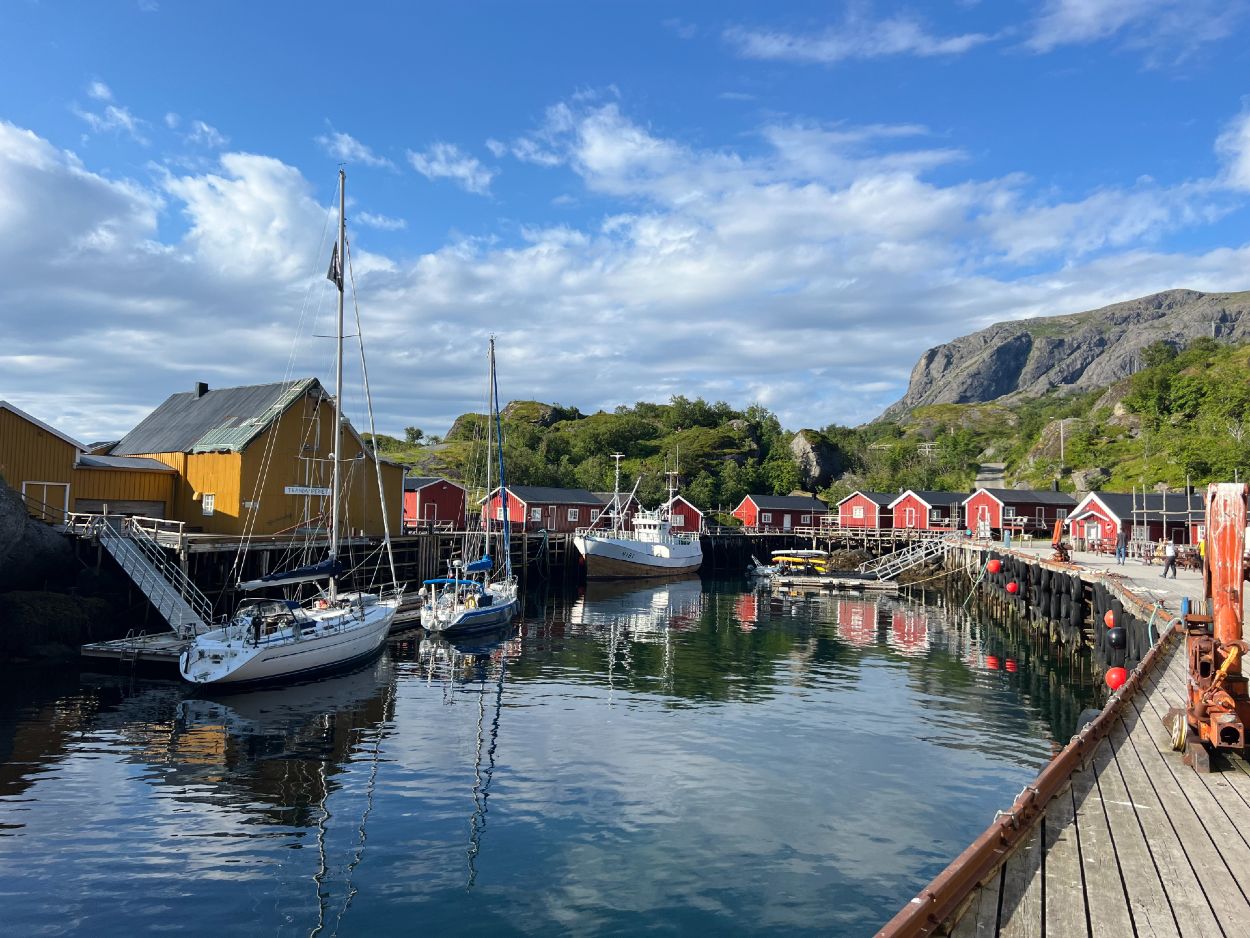
Nusfjord Village & Resort, Lofoten Islands, Norway
The Lofoten Islands, located just inside the Arctic Circle, are an archipelago of seven main islands bisected by glacial fjords. Travelers are rushing to this previously little-known Arctic destination because of its dramatic mountainscape, towering cliff walls, and deep, rocky fjords. Nusfjord Village & Resort sits at the end of a remote valley on one of these remote islands in the remote Arctic Circle. It doesn’t get more off the beaten path than Nusfjord.
Nusfjord was once a traditional fishing village, where fishermen spent the winter tackling the world’s toughest profession. (No, it isn’t travel writing.) That the soul of the village remains, along with nesting (endangered and protected) kittiwakes, the smithy, the General Store, the cod liver refinery, art gallery, and rorbus (traditional fishing cabins), is Nusfjord’s charm. And while tourists are free to roam this restored village by day, guests have it all to themselves come 5 pm. It’s then that I don my fluffy robe and slippers and slip into the sauna.
Their website states,“The earliest settlements in Nusfjord date from 425 BC. Our unique cultural heritage makes this fishing village one of Norway’s oldest and best-preserved. In Nusfjord’s golden age, over 1,500 fishermen lived in the rorbu cabins. Today, there are only 16 people who can call Nusfjord their permanent home.”
Why Go to Nusfjord Village?
Adventure, adventure, adventure. Views to knock the socks off even the most intrepid traveler. Hike, bike, kayak, RIB, SUP, surf, repeat. Nusjord Resort has it all (with Northern Lights streaking the winter skies). A spa and sauna with a window overlooking Arctic Circle views means never sacrificing a view for the sake of self-care.
What About The Rooms?
Ranging from one-bedroom rorbus to ones with several rooms, a living room, a kitchenette, and a roaring fireplace, Nusfjord has added all the creature comforts those frozen fishermen had to live without. Original timber-clad walls, soft woolen blankets, Nespresso makers, tea kettles, and high-end amenities abound.
For those who want to splurge, reserve Dahlgården, the home of the original landowner, Hans Dahl, and the most exclusive accommodation at Nusfjord. The House of Dahl is a private retreat in the village, offering views of the mountains and the sea and beautiful historic furnishings befitting a wealthy landowner.
And The Food?
Nusfjord Village & Resort has three dining options. Restaurant Karoline is the signature spot, with dark wooden walls, windows overlooking the harbor, and an ambience that has guests relaxed and cozy before they’re even seated. Karoline serves traditional Arctic fare like cod with smoked beurre blanc,Jerusalem artichoke with bleak roe, and pickled green apple, and crisp pork belly with beets, orange, and a touch of aquavit.
Oriana Taverna is a firelit pizza and wine bar located in what was once a whisky cellar. Serving everything from Margherita and Parma pies to more decadent options topped with champignons, chanterelles, and truffle oil, it’s a nice contrast to the more refined dishes at Karoline.
Lastly, find Landhandleriet Café tucked away in the whimsical old General Store, dating back to 1907. Grab a table with a view and choose from a limited menu featuring simmering fish soup, homemade waffles, and various baked goods—a great option for lunch or breakfast.
Nusfjord’s Best Photo Op
There are no bad shots of Nusfjord Village & Resort, just one picture-postcard after another. But for the best overview of the property, head to the upper parking lot. An unlikely and easily overlooked spot, it’s here where Nusfjord Village visually reigns.
The Lofoten Islands Are Waiting
Until not long ago, the Lofoten Islands were virtually unknown to the average traveler. But with the help of Instagram and TikTok, tourism is growing at a fast and furious pace. Lodgings here are finite. Book a year out if you want your first-choice accommodation.
Nusfjord’s prime and central location in the Lofoten Islands makes it a fantastic base for exploring the entire archipelago. It’s an authentic, historic gem reimagined for the modern-day traveler. For those seeking a bit of hygge (Scandi-comfort realized through candlelight, coziness, and sheer ambience) on their adventure, there’s no place better positioned to deliver it.
Intimate fishing cabins with plush down comforters, topped with piles of oversized pillows, make Nusfjord so much more than a place to rest your head.
Don’t forget to ask for a late check-out. You’ve earned it.
Starting a travel blog turned out to be a bigger challenge than I thought. From learning the language of SEO and OptinMonster to overcoming fear of failure and embracing vulnerability. My travel website, I am Lost and Foundwas a true labor of love.
If you ever wondered how I started a travel blog, I mean, website, you are in the right place.
Thank you, Brené
Thank you, Brené Brown, part-time TED-Talker, full-time mother, and all-time story collector, for introducing me to my vulnerabilities. Nice to meet you, imposter syndrome. Good morning, fear of failure. Please come out from under the rug; we have some things to discuss.
For anyone who hasn’t listened to her 2010 TED Talk, The Power of Vulnerability, please stop reading and download it immediately. I’ll wait.
The Power of Vulnerability is one of the most viewed TED Talks ever, and when you listen, you will understand why. Brené’s messages are clear and told with huge doses of dry humor and self-deprecation. She describes the link between courage and vulnerability in an immensely relatable way: “Having the courage to show up when you can’t control the outcome.”
In the podcast, Brené spoke to me directly, with her masterful storytelling style, darling Texas drawl, and utterly humble manner. She was irresistibly vulnerable. If she could put herself out there like that, I could, too.
I had been looking to reinvent myself—to be productive in a way that didn’t involve my kids, my husband, or my dogs. I wanted to create something.
Villa Laura, Cortona, Italy
Just don’t call it a blog
A few years ago, a friend suggested I start a travel blog. She reminded me of the joy I get from sharing my travel experiences—like recommending a villa under the Tuscan sun, or a family-friendly resort in St Lucia. An off-the-beaten-path restaurant in Buenos Aires, or a hidden beach bar on the Caribbean island of Anegada.
She went on to explain how my combined loves of photography, books, and wine could live on my blog. Start a travel blog? That sounded interesting.
The Vines, Mendoza, Argentina
My brain caught fire—I opened my journal and began writing.
On a roll, I brainstormed names, content ideas, and imaginative, yet useful, menu links. I dreamed of media trips and bylines in Travel + Leisure magazine.
I refused to call it a travel ‘blog’, which rhymes with ‘blob’, and is totally unappealing, unrefined, and dull. “It’s a travel website!”, I declared, (and will continue to call it that, even though we all know it’s a blob, ummm, blog).
Then, like every project I had ever started, I stalled, got intimidated, and overwhelmed. What seemed like a great idea a few days ago now feels daunting and unattainable. I was deflated and put my journal away. I did laundry.
Everything you need to start your travel blog today, 28 full-color pages that walk you through the entire process from idea to published posts, without jargon, shortcuts, or guesswork. It’s designed for absolute beginners who want clarity, structure, and a calm, confident way to start.
WordPress, Bluehost, and other learning curves
I can’t recall exactly when or why I reopened my journal. Or, what reignited the creative spark? But it was back, faintly, and I seized it. So, I googled, ‘starting blogswebsites blogs’.
I overcame three gigantic hurdles: WordPress, GoDaddy, and BlueHost. I spent countless hours writing and sifting through thousands of photos on my desktop. Next, I learned a new language that included words like search engine optimization, backlinks, plug-ins, and Yoast.
When my WordPress theme glitched, I cried to tech support. I labored over the content, revising and editing, all the while wondering if my parents would be my only readers.
March 16, 2015, I am Lost and Found went ‘live.’ I had officially put myself out there.
Yikes.
Born to Create
I have always created things. Clues of the traveler I would become appeared in the form of handmade passports, baggage tags, and boarding-pass-filled scrapbooks. My infatuation with all things British developed early on. In high school, I made more scrapbooks—devoted to boyfriends which I would obsess over like, well, a teenage girl.
Destined to travel, circa 1980
In my early 20s, I started earning a living from my creativity. Cue my parents’ collective sigh of relief. Initially, I worked as a graphic designer for a strong-minded, bad-ass boss in her all-female firm. She was the first in a long line of smart and powerful women who would shape me and my 20-year career in New York City.
Eventually, I went from creating corporate identities, direct mail packaging, print advertising, and TV commercials to overseeing creative teams. I was always in awe of creative talent, and to this day still get giddy over a well-designed logo or matchbook.
Creative Parenting
In my mid-30s, I became a parent and channeled my creativity in other ways. I baked elaborate cakes for my kids’ birthdays, scouring Pinterest for ideas (aka copying) and matching the icing to my favorite Pantone® color.
At 15 and 17, my kids are probably aging out of my homemade cakes. Yet, I’ll keep baking until they demand I put down my spatula or get married—whichever comes first.
In my late 40s, I discovered coloring—jumping into the adult coloring book craze with wild abandon. (Not to be confused with any other adult craze, mind you). Coloring allows my brain to be in use and checked out at the same time.
My kaleidoscopic spectrum of fine-tipped markers fills the gaps between fine black lines and satisfies my need to organize. It’s something I can control on days when I feel completely untethered. In short, it keeps me sane.
If, at first, you don’t succeed
I can’t count how many ideas I have had over the years that have fizzled out. Some dissipated within a week, while others died a slow death. My initial excitement was inevitably replaced by fear and inertia.
For example, I used to craft personalized shadow boxes from vintage printer’s type drawers, as gifts to nieces, nephews, or friends. The theme varied depending on the child’s interests, from a love of baseball or ballet to an obsession with dogs or dinosaurs.
I would painstakingly cut little squares of handmade and vintage papers to fit each little cubby. I miss seeing it come together like a puzzle, with colors and patterns forming something much larger. It was back-breaking work, sitting for hours on the floor with my Exact-O knife and straightedge.
I don’t know why I stopped. One day, I put my tools and pretty papers away. I was done. Yet another hobby that no longer piqued my interest.
Semi-Empty Nest Syndrome
Years ago, when we moved from Tokyo to DC, my kids were still young enough to need me. Cooking well-balanced dinners and making sure we had enough fruit in the house to counteract the size of our junk food drawer was a priority. Laundry was constant, as the kids were messy, and participated in sports that stained clothes in ways I never could eliminate.
Washington DC
There wasn’t much time for creativity. I was too busy with the day-to-day: soccer car pools, school parents’ nights, and dentist appointments. I was happy. Ish. As happy as any once productive-outside-the-home woman could be. I was content. Until I wasn’t.
As I neared 50, my kids’ needs didn’t take up as much daily bandwidth. Sure, I needed to go food shopping, get dinner on the table, and do laundry. But I had more time. The school day tacked on sports and games, and they often didn’t arrive home until well past 6pm. Suddenly, my days felt long.
The semi-empty nest syndrome I was feeling was not new; it was just new to me. I gave serious thought to what would fulfill me. A new search for meaning. What next? I felt lost.
Everything you need to start your travel blog today, 28 full-color pages that walk you through the entire process from idea to published posts, without jargon, shortcuts, or guesswork. It’s designed for absolute beginners who want clarity, structure, and a calm, confident way to start.
Sparking, starting a website
So I did what any newly-found rudderless person would do. Absolutely nothing. I pretended that it didn’t matter to me, that I was perfectly ok with it. I was fine.
It was just around then that we booked a last-minute trip to the Caribbean for the New Year. We are not last-minute people, yet somehow always get caught off guard when it comes to the festive season. You’d think it didn’t happen each year at exactly the same time. I’m as baffled as you are.
Turks and Caicos
We scored what may have been the last villa in Turks and Caicos. With a pool and beachfront location, we were grateful we found it. There was more cloud coverage than one would want, and Daniel caught a parasite. But it was the year of the East Coast polar vortex, and we were on the beach. No complaints.
On New Year’s Day, I sat on the beach and rediscovered my desire to start a travel website.
Starting a Blog. What’s in a name?
I spent hours thinking of a name, filling pages in my journal with hundreds of clichéd ideas. I googled any viable contenders. Taken.
Lost and Found popped up like a cartoon thought bubble. It felt good—ethereal, not too specific, open-minded, aspirational. I got excited for the first time—until I googled it. Taken.
GoDaddy suggested I buy the domain name lostandfound.com for $5,000. Thank you, but no, GoDaddy, I’ll pass. As per usual, when I’m annoyed or discouraged, I complain to my husband. Daniel’s immediate response was, “Call it, I am Lost and Found”.
I was thrilled, then annoyed again. Why hadn’t I thought of that? I’m the creative one. But I loved it. It was even better than Lost and Found. It is a statement about me, my travels, mand y travel stories. It’s who I am, or more accurately, who I wanted to be.
I googled it. Then, I bought it.
In case I forgot to say it, Daniel, thank you.
If you build it
I dug into my library of travel experiences, zeroed in on trips, selected photos, and started building a website. I wanted I am Lost and Found to be a cross-section of luxury and adventure travel. Anecdotal, first-person, and more than anything else, inspirational. As long as I can, I will stay on that path.
My family has had the opportunity to live abroad and to expose our kids to different cultures. I’ve visited 48 countries on six continents. For all of that, I am grateful. It is from these adventures and travels that I create content.
I know that circumstances can change. To paraphrase the ancient adage, that is the only constant thing. Should that happen, I plan to find other ways to stay relevant. I can evolve, and my writing can, too.
At a villa in Mexico a few years back, a friend suggested I might need to rename my site ‘I am Lost and Broke’ as many of my adventures lean towards the splurge side of travel. Perhaps one day, James, but not quite yet.
Travel Goals
I am often asked what my goal is for I am Lost and Found. For a while, I had no answer. I touted platitudes: ‘It’s a passion project!’, and ‘I’m just doing it for fun!’. While there is truth in both statements, I knew deep down that I wanted it to succeed and that I had to define what that success would look like.
I realize my goal is exactly where I started—to inspire others to travel. Would I like to make money by inspiring travel? Yes. Would I like more exposure, more followers, and more subscribers? Yes, yes, yes. Do I want to be sent on media trips to fabulous hotels and get a byline in Travel+Leisure magazine? Yes!
Overcoming vulnerability
Starting a travel website has given me a different sense of purpose, as well as an outlet for creativity. Some of my favorite posts are the ones with a more personal narrative. Like ‘Traveling Around The Room’, written on the cusp of the pandemic. Or, ‘The Best Of Stowe: 10 of Life’s Littlest Luxuries’, my home away from home.
Botswana
‘Botswana is the Magic Kingdom’ was my very first post. Since then, my style and voice have changed (hopefully for the better), yet it might be the post that I am most proud of—the one that put my vulnerabilities out there for anyone to see.
Brené Brown once said, “Vulnerability is the birthplace of innovation, creativity, and change.” Keep talking, Brené, I’m listening.
60, and counting
This is my 60th post—sixty posts in six years. I still get anxious when I press ‘Publish’ on WordPress, and never more so than when I pressed it today. But it doesn’t rule me. I started this website with the support of friends, family, and my always-available tech guru, Grant. It was, and is, a constant labor of love.
Everything you need to start your travel blog today, 28 full-color pages that walk you through the entire process from idea to published posts, without jargon, shortcuts, or guesswork. It’s designed for absolute beginners who want clarity, structure, and a calm, confident way to start.
I wrestle with my iPhone, trying to connect it to CarPlay as we race out of the Enterprise parking garage. Speed bumps ignored, the Jeep lurches and bounces like a bronco at a Texas rodeo. Was a 4×4 really necessary? The answer will be clear soon enough, but suffice it to say—hell, yeah!
Finally, I pair successfully and set up the Shaka Guide—an app designed to expertly navigate the Road to Hana—a drive on eastern Maui known for its crazy switchbacks, towering waterfalls, and dramatic landscapes.
‘It’s about the journey, not the destination,’ I tell my husband and daughter for the umpteenth time. They scowl. This is new territory for Daniel, who thinks the destination is the destination. I close my eyes and practice square breathing.
Shep Who?
When we exited Kahului Airport after twelve hours on two planes, an overnight in Waikiki, and an ungodly early morning hop to Maui, we were understandably tired (aka grumpy, under-caffeinated, and hangry). But we were on Maui. Who can complain?
I thought of my dad. As he’s mentioned more than once, one of his fraternity brothers lives on Maui. “Would you be able to meet up with Shep? You know, my fraternity brother, Shep? You’d love Shep. He’s a great guy.”
My dad has a weekly Zoom with his college buddies. And although I don’t think anyone aside from my dad gets a chance to speak, Shep is a name I hear often. My dad has great friends, all of whom are impressive and unique. My dad is a great friend. He’s also impressive and unique. Unfortunately, we don’t have time to see Shep on this trip, I tell my dad. We are driving the Road to Hana. Plus, I’m sure Shep has things to do.
So when we stumble wearily from the plane, our carry-ons and neck pillows trailing behind us, I jump when Ella shouts, “Oh my god, Mom, look!” I follow her gaze. The wall ahead has a banner that reads ‘Maui Nui Hall of Fame’ above a grid of portraits. Sandwiched between Woody Harrelson and Paul Simon is Shep. Shep Gordon. Hollywood talent manager, film agent, and producer.
Oh, and loyal fraternity brother to one Barry Lyman.
But First, (Kona) Coffee
Our hotel in Hana can take up to eight hours to reach, depending on how many fun stops one makes along the way. That’s the point of the Shaka App, I tell Daniel, ‘fun stops.’ Places to watch waterfalls, swim, hike, walk a black sand beach, climb through lava caves, and explore. It’s the journey, the journey, the journey…
This is how I knew we wouldn’t be able to meet Shep. I’d be happy if Daniel stopped for breakfast.
A perky male voice pipes up in surround sound, “Aloha! Welcome to the Shaka Guide’s Road to Hana driving tour!” Whoa, it’s too early in the morning for that kind of tone. I lower the volume. “It’s going to be a great day on our drive and tour together!” the voice continues. Ella and Daniel look nervous. I’m as thrilled as Victoria Ratliff clutching her first G+T of the day. This is going to be fantastic.
“Our trusty, albeit overeager, guide needs a name,” I say. “We’ll be listening to him for hours. Any ideas?”
“Shep!” Ella and Daniel shout in unison.
So begins our adventure along the Road to Hana.
Maui’s Most Famous Road
In the 1500s, Maui’s King Piʻilani initiated the construction of what was essentially a long, dirt footpath across Eastern Maui. The path was about 5 feet wide and stretched over 138 miles, enabling travel and trade across the island. By the 1870s, the road was improved, yet still unpaved.
It would remain that way until 1926, the official opening of ‘The Road to Hana,’ when groundwork and bridge construction were implemented for a more passable route. (I guess crossing rivers and streams by rope swing got old quickly.) Fast forward to the 1960s—a fully paved, albeit harrowing, road was complete.
By the numbers, the Road to Hana is impressive. This 64.4-mile scenic tropical drive that connects Kahului to Hana town has 620 curves (some with switchbacks that double back on themselves), 59 bridges (46 of which are single lane), over 18 waterfalls, countless beaches (some with black sand), bamboo forests, marbled eucalyptus trees, and ocean views.
Divorce Highway
Hana Highway’s switchbacks, sweetly rebranded as curves, had been on my mind since I booked the trip. Daniel and I have braved many death-defying, hair-raising, and winding roads: Corsica,Mexico, and Mallorca are a few standouts. We survived them, but not without a few heated discussions. I think he drives too fast; he thinks I worry too much about his driving too fast. We’re both right. But being right hardly matters when I’m convinced we’re about to launch off a cliff every 45 seconds.
Having Shep alert us of upcoming sharp turns and single-lane bridges eases my mind. He even describes how to share the road with the locals, who careen around curves like Formula One hopefuls.
I’ll let Shep tell Daniel to slow down, tell us where the nearest bathrooms are, and where we should stop for a snack. And he does. Hence, the Road to Hana, sometimes dubbed ‘Divorce Highway,’ is a pretty pleasant ride. Shep, if I didn’t thank you earlier, hear me now. You saved my marriage.
Navigating the Road to Hana With The Shaka Guide
Over the next three days, the Shaka Guide becomes our lifeline—highlighting 33 tour stops and 125 Tour Audio Points over 10-12 hours. I know what you’re thinking. Did Shep talk for 10-12 hours? In the downtime between talking points, the Shaka Guide played traditional Hawaiian music. The ukulele and drums set the tone—soft, rhythmic, and pure aloha vibes.
Since the Shaka app is connected to Google Maps, Shep always knew exactly where we were. Even if we didn’t. Even when it bordered on creepy. “Ignore the row of illegally parked cars ahead on the right,” Shep instructed. Then, reading my mind. “Don’t worry; better examples of marbled eucalyptus are ahead.” Sure enough, a few cars were stopped on the right, just like Shep said.
I have to give the Shaka Guide props; this kind of attention to detail is hard to pull off in real-time. To say we got more out of the drive than if we’d been reading a traditional guidebook is an understatement.
We would have missed critical turn-offs on a road where backtracking isn’t an option. We’d have missed magical views while arguing who has the right of way on 46 single-lane bridges. And we would have missed some stops altogether, clueless about what lay beyond the next bend.
It’s not called Divorce Highway for nothing.
The Road to Hana: Starting Out
The Road to Hana officially starts at mile marker 0. Shep tells us not to worry if the marker is missing, as travelers sometimes take it as a souvenir. We stop in Paʻia Town to grab a coffee and provision up. This is the first and only town we will see before we reach Hana Town in 6-7-8 hours. And although there are promises of huli-huli chicken and banana bread stands along the route, there’s no way I’m letting hanger ruin our journey.
Thanks to advanced planning, we had reserved The Hana-Maui Resort for three nights. Hana-Maui is the only traditional resort in Hana Town. With only 66 rooms and suites, it’s 620 hell-ish curves back to Paʻia Town if you don’t book one.
Our first stop is Hoʻokipa Beach, just off the highway past Paʻia Town. Roosters roam the gravelly parking lot, pecking with intention, while the Pacific Ocean surges below. Although called the ‘windsurfing capital of the world,’ we only see surfers sitting in the lineup and a few napping monk seals.
We return to the Jeep and drive towards the turn-off to the legendary surf break, Jaws. During the winter, we learn the waves here can reach as high as 70ft. Shep tells us to “Be aware; it’s a long and bumpy dirt road that leads to the beach.” We’re warned that the single-lane dirt track to see the break is sometimes impassable, with deep ruts and deep puddles. 4WD is a must. We skip it and vow to see it on our way back to the airport (cue foreshadowing).
Shep says we are approaching mile marker 0. If Daniel’s concerned that we’ve already stopped twice and haven’t officially started the road to Hana, it doesn’t show.
The Road to Hana: Bamboo Forests, Lava Caves, and Waterfalls
Our three days of driving are as exciting, adventurous, and scenic as I’d hoped. We see majestic waterfalls, including Twin Falls (mile marker 2) and 400-foot Waimoku Falls (mile marker 42). We trek the Pipiwai Trail, past ancient banyan trees and through tall bamboo groves, whose clacking sounds like a line of tumbling dominoes.
The sandwiches stave off hunger, as planned, but a stop at Aunty Sandy’s (mile marker 16) for a warm loaf of banana bread is the crowning culinary moment of the morning. The raging Pacific crashes against lava rocks. Palms cling to the beach and lean permanently sideways from the wind. Everything along the road feels green, mystical, and alive.
Shep tells us that if we haven’t bought tickets in advance for Waʻanapanapa State Park (mile marker 32), one of Maui’s most famous black sand beaches, we’re out of luck, as same-day passes can’t be purchased. “Ummmm, no, I hadn’t secured advance tickets,” I tell Daniel and Ella. They don’t seem to mind. Daniel probably views this as a win—an extra hour at our resort in Hana Town.
Ever the optimist, Shep reminds us there’s much more to see and do ahead. After a short ukulele melody, he has us pull off the road.
“Maybe Shep’s wrong?” Ella says as we look around. “Where’s the cave?”
But just then, we spot an opening, about three feet tall, on the edge of the highway. We peer in; it’s pitch black. ‘Trust Shep,’ I think as I scramble in. We crawl through the short, drippy, black lava cave and pop out into the forest (mile marker 23). Exhilarating and surprising, this is what the Road to Hana is about.
Hana Town: Hidden Beaches, Food Trucks, and the Hana-Maui Resort
We arrive at the Hana-Maui Resort around 4pm. It’s been a day. Miles of hairpin turns, stone bridges, gushing waterfalls, hiking, and eating. Our weathered green cottage is an oasis.—modest and clean, with 360-degree uninterrupted ocean views and an oversized veranda. We embrace stillness for the first time in days.
The only traditional restaurant in the area is at Hana-Maui, where we have two of our three dinners. But lunch steals the show in Hana Town, where groupings of food trucks keep locals and tourists well-fed. Choices abound, including homemade tacos filled with chicken, shrimp, or beef, poke bowls, huli-huli chicken, Thai food, acai bowls, and smoothies. Lunch is so good; I crave lunch for dinner. But unfortunately, the food trucks close at 630pm.
After visiting the coffee truck one morning, I sit on our deck with my book. On my left, just outside the property’s perimeter, I notice people heading down the steep hill towards the bay. ‘Where are they going?’ I wonder. Curiosity gets the best of me. Ella and Daniel are poolside, honing their Hawaiian tropic tans. I text them my general whereabouts and set off.
A ten-minute cliff-hugging hike takes me to a crescent cove with enormous red lava cinder cliffs and a red sand beach. A wall of black lava rocks absorbs the Pacific break, revealing a tranquil pool. There’s no feeling quite like discovering a hidden beach. Although not exactly hidden. As the Shaka Guide later revealed, this is Red Sand Beach (mile marker 35).
I bask in the sun and enjoy the solitude on our last full day in Hana.
Our flight to Kona is at 12:30pm and the last thing I want is to get stuck on the Hana Highway. I package our early morning wake-up with the promise of one last stop at our favorite coffee truck and the chance to see anything we missed on the way up. Daniel has his heart set on Jaws.
The all-knowing Maui gods say the drive from Hana Town to Paʻia Town is roughly 2 ½ hours without stops. Daniel clocks in at 1 hour 48 minutes. He’d make a great local. So when we get to the turn-off for this mythical surf break, I’m unconcerned; we have time to spare.
Our Jeep creeps down the single-track dirt path, which gets steeper, narrower, muddier, and more deeply rutted the further we go. We cross puddles of indeterminate depth. Mud attacks the windows and obscures our view. The silence in the car is deafening. Even Shep is speechless. What have we gotten ourselves into? There’s no going back—turning around is physically impossible.
Finally, we reach Jaws, locally known as Peʻahi—one of the world’s most famous big wave surf spots. It earned its nickname from the sudden, monstrous swells that can appear seemingly out of nowhere.
Legendary Surf Break, Jaws
We hop out of the Jeep and anxiously gaze out over the cliff. Jaws’ waves are tragically underwhelming. But none of us would have appreciated them, even if they had towered at 70ft with Kai Lenny deep in the barrel. We were too worried about the mile-long trek back to the highway. I ask Daniel what he thinks, assuming he will assuage my fears like always. “50/50,” he says with little confidence.
I start square breathing. Ella checks her phone for a signal, and Daniel puts the Jeep into gear. Off we go.
Some journeys lead to great destinations, others to great stories. On the Road to Hana, we got both.
Did You Notice?
You don’t have to be a cartographer to recognize my list of sights is geographically out of order, but they are the moments that made our journey. Use the Shaka Guide to map out your adventure. Click here to get yours!
“Where’s Mérida?” you wonder, and “Why should I go there?” I’m happy you asked. Mérida, Mexico, is the capital city of the Yucatán State. It’s simple luxuries fly under the radar in terms of typical Mexican tourist destinations—more rustic, fewer bells, fewer whistles, and friendlier on the wallet. Long may that last. Recently, I spent three days uncovering the best of Mérida, Mexico, old school style with a pen and paper. Three days exploring boutiques, boutique hotels, hidden watering holes, and airy rooftop bars.
Was it enough? Not by a hot Mexican mile.
My iPhone lights up. ‘Mérida is 🔥’ It’s Amy, one of my oldest and closest friends. Is she reporting the weather or preparing me for the fabulousness of Mérida? As of two weeks ago, I couldn’t have found Mérida, or the Yucatán, on a map if you gave me a million pesos.
Yet here I am, booking flights on one computer tab and mapping it out on another. This isn’t me; I don’t fly by the seat of my pants. I get to the airport at least two hours before my scheduled departure time and book restaurantsa month out. I prepare for Christmas in August. Planning is my thing.
Until it isn’t.
Why Mérida, Mexico?
Amy and her husband decide to live in Mérida, Mexico, for a month, testing a work-from-anywhere model they hope to repeat if successful. Mérida is the capital of the Yucatán State and is quickly becoming one of the most sought-after destinations in Mexico.
They offer their extra bedroom and plunge pool as an incentive to visit. Amy says she’s already scouted out the best of Mérida, Mexico—no need to research. I’m sold on the plunge pool.
The Best of Mérida, Yucatán, Mexico
Despite the gaping holes in my knowledge about the location, the language, and nearly everything about Mérida, I can’t wait to get there. My daughter, Ella, seems happy, too. But it’s hard to tell, as her happy face, annoyed face, and indifferent face look so much alike. As ever, I’m optimistic.
Mérida, here we come!
My ‘Best of Mérida’ shortlist follows, fueled by Amy’s insider knowledge and advanced planning. You’d be surprised by what you can experience in three days unless you know Amy. Then you wouldn’t be surprised at all. If I’m a travel planner, Amy’s the Marie Kondo of travel planning. She had our life-changing, magical Mérida itinerary tidied up before I could say muchas gracias.
When our plane touches down, I know one thing for sure. Amy’s right, Mérida is hot.
Mi casa es su casa, in Mérida
We grab a taxi and head out. Crumbling concrete casas begging to be brought back to life reside next to those lovingly restored. Some with fresh coats of pastel-colored paint, flickering colonial-era lanterns, and glossy wooden doors. They’ve been returned to their original glory. This juxtaposition of old and new is what makes Mérida especially captivating.
Time has taken its toll on the buildings’ bones, not their souls. I imagine the conquistadors of centuries past roaming these very streets. Its history is palpable. Each turned corner reveals a new palette of watery rainbow-washed colors, glimpses of hidden courtyards, taquerias, and colorful plazas.
The city streets are laid out in a series of perfect right angles. A topographical chessboard of sorts. This layout makes the city accessible to even the most geographically stunted (myself included).
Their Airbnb is on the edge of the historic old town and has a seafoam green facade with bright white trim and a cerulean blue door. A light breeze takes the edge off the midday heat, and I hear a woman’s voice singing scales from above. Her undulating notes escape a top-floor window like liberated butterflies.
I quickly discover that music, in one form or another, is woven into the city’s DNA. I’ve only been here 18 minutes, but I know I will love it. 72 hours. The clock is ticking.
Best of Mérida, Mexico: Hotels
I research hotels anyway, for fun. Yes, I think that’s fun. One day, when I bring my husband here, I’ll know exactly where to stay. The planner in me makes a fleeting appearance. A Google search combined with a chance to wander the city in real-time provides a shortlist of possibilities for my next trip to Mérida. Or possibly yours.
Coqui Coqui Residences
The five Yucatán-based residences of eternally boutique-chic Coqui Coqui Residences & Spa balance old-world charm with modern amenities. I fantasize about hopping from one swoon-worthy locale to the next.
Each residence is part chic hotel and part perfumery, with a spritz of tropical glamour. The Mérida location, built in 1903, is an ivory townhouse on a quiet street. It has only one room! I’m dying to see it!
The saleswoman says it’s occupied. That it’s always occupied, she notes my disappointment yet says the room has not one but two freestanding bathtubs. The epitome of Belle Epoque style, it also has a private rooftop pool and is accessed via a staircase, so elegant that Architectural Digest could devote an entire spread to it.
I drown my sorrows by devouring several of Coqui Coqui’s decadent chocolates and testing their perfumes. It’s tough to choose a favorite among the Yucatán-inspired fragrances. Should my new signature scent lean towards earthy tobacco or Hawaiian Tropic circa 1985? I choose coconut. This should be the toughest decision I make all day.
Coqui Coqui’s richly textured ochre-colored walls and black and white marble floors are devastatingly photogenic. Crystal chandeliers drip from double-height ceilings. Velvet poofs, curtains, and gilded, golden-framed mirrors convey an ultra-chic opulence. I slowly meander around this aromatic sanctuary, taking it all in.
Rosas y Xocolate
Rosas y Xocolate is a duo of the pinkest pink French mansions transformed into a boutique hotel that receives accolades for its style and service, not to mention an award-winning restaurant.
I step inside to oooh, ahhhh, and recalibrate my body temperature. Did I mention Merida is hot? The tranquil entry is a respite from the buzzy, pedestrian-filled Paseo de Montejo. I continue to meander, which is starting to wear on Ella. She is not a meanderer. Is that her annoyed face or hangry face? I look the other way.
The interior is dark and moody, a break from the dizzying bright blue skies outside. It’s like walking into a warm chocolate cookie. Or, maybe I’m hungry, too. I notice a wall of wine, oversized modern art displayed on a nearby easel, and a sunny outdoor patio for drinks. Rosas y Xocolate has my essentials covered.
Each of the 17 rooms is unique, featuring handmade chocolate soaps. Now that’s a hotel product I’d love to steal, I mean buy. Splashes of the hotel’s signature shade of rose abound, whether as an accent wall, a throw pillow, or actual blossoms. Bravo, Rosas y Xocolate.
Hotel Sevilla
Located in the oldest part of historic Mérida, just one block from the main square, sits Hotel Sevilla. A restored 19th-century hotel, old and new come together in this magical, spacious, hidden jewel with gardens, sun-drenched patios, and beautiful rooms. This compact boutique hotel oozes Colonial charm, adding a touch of industrial drama to its coveted city location.
A 19th-century mansion turned boutique hotel, this seven-room property on the outskirts of town has a delicate combination of traditional glamour and modern flourishes. Its azul-painted facade is as welcoming as the cenotes themselves. Hotel Cigno offers excursions and dining experiences to make any gringo feel at home in Mérida. The rooms are reasonably priced, with a splash of old and new Mexican design and some with private plunge pools to escape the heat.
Amy and John have been in Mérida, Mexico, for three weeks when Ella and I arrive. This allows them to narrow down the shops and boutiques worth visiting during our limited time.
The following day, we enjoyed a leisurely breakfast at home. Amy presents an array of flaky croissants, including tiramisu, almond-topped, and knotted babkas from Soco, a local artisanal bakery. Soco’s plumped-up pastries could easily compete with boulangeries in Paris.
Its derelict hole-in-the-wall style belies the doughy gems inside. I visit three times in as many days, pretending that Mexican calories don’t count. Or rather, French-inspired, Mexican-made calories don’t count. You get the idea.
PC: Ella Edwards
Caracol Púrapura, Mérida
Mexican folk art, handmade jewelry, and ceramics are just a few of the treasures to be unearthed at the intersection of Calles 60 and 53. Caracol Púrapura feels more like a museum than a series of local boutiques. Larger-than-life sculptures fill the cavernous space.
Vessels turned from Oaxacan black clay and Huichol beaded bracelets made by Wixárica artisans are displayed alongside paintings, handbags, and intricately designed pottery. These handicrafts preserve the traditions of Mexico while simultaneously supporting the local artists.
Taller Maya, Mérida
After more meandering, I pronounce Taller Maya as my favorite boutique. Taller Maya could live as comfortably on Spring Street in Soho as in Mérida. The clean, spare, brightly lit space has unusually high ceilings and an overall breezy feel. I stroll around the store several times, seeing something new and beautiful with each lap.
Solid marble pedestal bowls, modern wooden furniture, luminous lamps, and hand-woven hammocks only begin to describe the highly curated wares at Taller Maya. I covet it all, down to the handwoven tortilla warmers. A study in neutrals and as welcoming as a Tribeca loft. I would have moved in immediately had they offered.
Best of Mérida, Mexico: Sights
Mérida feels real. Perhaps this is the most luxurious thing about it. When so many places in Mexico are tourist-focused to the point of being inauthentic, Mérida nails it without effort. Oh, and it’s incredibly affordable, at least for now.
We explore the city from the main square, Plaza Grande. Its prismatic energy echoes the vibrant buildings and lush grassy knolls. It’s also the home to the magnificent Cathédral of Mérida.
Constructed from Mayan ruins, the Cathédral of Mérida, aka San Ildefonso Cathédral, sits on the east side of Plaza Grande. It’s an imposing 16th-century backdrop to the lively promenades, street vendors, and historical buildings.
But, as far as I’m concerned, the multicolored city sign at Plaza Grande is the end-all-be-all tourist attraction. It is the best tourist trap/photo op in Mérida, without question. Even Ella liked it.
‘Welcome to Mérida!’, it shouts, in all colors of the rainbow, ‘We’re so happy you’re here!’. I stopped to take a photograph just as a real-life rainbow appeared behind it. I kid you not. Photo evidence above.
Paseo Montejo, Mérida
On Sundays, the Paseo Montejo, Mérida’s wide, tree-lined street, is closed to pedestrians and cyclists only. Locals and tourists stroll the pavement, listen to music, dance, walk dogs, and brunch on verandas. Inspired by the Champs-Élysées and dotted with palatial Beaux-Arts homes, it’s a way to harness the city’s energy while burning off babka-sized calories.
Best of Mérida, Mexico: Cuisine
Local Mayan, Caribbean, Spanish, North African, and Middle Eastern cultures influence Yucatán cuisine. No wonder food is the center of Mérida’s universe.
That we drink and eat our way through the city is an understatement. Ella sums it up well: ‘We didn’t just go for drinks before dinner, we went for drinks at four different places, and then tacos, before dinner.’ Amy and John know how to live. My people.
Panuchos Yucatecan became my favorite Mexican food despite having never heard of it before. Panuchos are two lightly fried corn tortillas with a thin layer of refried black beans between them. They are topped with chicken, pickled onion, and sliced avocado. Indescribably amazing.
I vow only to eat them in Mexico, fearing they can’t be re-created elsewhere. I grab my pen and add it to my list: ‘Best of Mérida: panuchos.’
With humble beginnings as a food truck in Merida’s industrial zone, El Marlin Azul is now considered one of the best places to eat in the city. I can speak with culinary confidence about the shrimp ceviche. Amy and John had bought some from the store the morning we arrived—our first foray into Yucatán cuisine. I make another vow, and add another entry: ‘Best of Merida: ceviche at El Marlín Azul’.
Restaurant Micaela, Mérida
Restaurant Micaela’s website claims its food is a tribute to Nana’s cooking, but the vibe is anything but grandmotherly. Micaela’s is a hidden gem in the old town, featuring vivid mural-painted walls, terra cotta tiles, and soft amber lighting. The hustle of its open kitchen further enhances the buzziness. Micaela’s is the kind of place to eat, drink, and linger, which is easy to do when the food is this good.
We order various appetizers for the table, including Crudo de atún (fresh tuna) and Rellenos de queso Oaxaca, followed by steak, short ribs, and other carnivorous entrées. Micaela’s Nana also notes that cooking is her love language. I hear you, Nana—loud and clear.
Best of Mérida, Mexico: Cocktails and Tacos
Terraza Picheta is said to have the only terrace overlooking the old city of Mérida, Mexico. When we enter the expansive patio just before sunset, it’s clear they’ve won the Mérida lottery for location.
The views are panoramic and dominated by the cathedral in the east. Our rainbow remains a non-stop photo op until I turn around to re-focus my camera on the setting sun.
One round of drinks and a few appetizers are consumed until the sun is gone. Time for dinner—I think.
Not quite. First, we stop for another cocktail and pre-dinner taco at El Lucero, where I fall in love with the never-before-heard-of panucho. Lanterns hang at varying heights from an enormous vaulted and thatched roof. Palm trees line the stone walls. Marc Anthony’s smoky tenor fills the room.
Best of Mérida, Mexico: Cocktails, Tacos, and Jenga
Patio Petanca is the complete opposite of Terraza Picheta. Low-key and hidden to Picheta’s upscale and wide-open. But it still makes the list. Petanca’s graffiti-covered metal door opens up to a game lover’s dream—an outdoor space with two boules courts and piles of games to keep one’s mind sharp throughout happy hour.
In Merida, boules is known as petanque, and the sandy game area takes up nearly all of Patio Petanca’s modest space. Amy and John order mezcal. I have a beer. No, Mom, no one has taken over my blog, I mean, website. I drink beer. But only in Mexico.
A fierce game of Mexican Jenga begins, and Ella eventually topples the tower. Before she can complain, a sudden rainstorm has us fleeing for cover under the thatched bar. There we find, really and truly, the world’s best taco.
If you don’t believe me, Amy, John, and Ella agree. This is the world’s best taco. Petanca has brought in a guest chef from nearby Pico de Gallo, much like Miami’s LIV would bring in DJ Steve Aoki. Well, not exactly the same way.
We want more tacos, but are dangerously late for dinner, which shouldn’t matter as none of us are hungry anymore. I open my notebook: ‘Best of Merida: tacos at Patio Petanca with guest chef from Pico de Gallo.’ My list is growing longer by the minute.
Best of Mérida, Mexico: Live Music
Live music abounds in Mérida. You only need to walk down the street and follow your ears. Jazz and Blues lovers won’t want to miss a night at Dzalbay Cantina. Pick a night, any night. Because at Dzalbay, there’s never a night without live music. And with its well-tended bar of 30 beers and delectable cocktails, one night won’t be enough.
Best of Mérida, Mexico: Daytrippin’
You don’t have to be super adventurous, a good swimmer, or even like water to enjoy the cenotes of the Yucatán. Trust me. Cenotes result from centuries-old, collapsing limestone bedrock that forms underground pools. The Yucatán peninsula has over 7,000 cenotes, some of which are thought to have been created by asteroids.
Swimming (or, in my case, wading) in freshwater cenotes is an otherworldly experience. Ancient Mayans believed that cenotes were sacred passages to the underworld. I believe they are a refreshing, ethereal escape from the Mexican sun. Undeniably, they are natural stunners and worth the trip out of town.
Santa Barbara Cenotes, Mérida
We visit the Santa Barbara cenotes on a quiet Monday morning, leaving the house at 9am to beat the crowds. Our driver knows exactly where to go, which is reassuring as the directions on the pamphlet have some cenotes-sized holes. ‘Located entrance of Homún. Take the first turning to the right and following road next to police station’. (sic) Hmmm.
The inexpensive entrance fee covers the bikes and life jackets. Despite my poor aquatic skills, I refuse to wear the life jacket. I get reprimanded three times, one in each of the cenotes. Cascabel, Chacsikín, and Xooch are within a mile of one another—each is more beautiful than the next.
At Cascabel, we descend a precarious set of wooden steps toward a secret pool of water. Drippy cave sounds plink and plonk, and well-placed underwater lighting makes the setting even more surreal. There are a few other visitors, but not many. Amy and Ella swim the loop in the cave. I don’t. We hop back on our bikes and head to the other cenotes.
The entrance to the Xooch’ cenote is through a moss-covered arch at the bottom of a steep stone stairway. It theatrically opens to a freshwater pool with a wide-open Simpson-blue sky lighting it from above.
Trees hover precipitously on the crater’s edge, their long roots dangling toward the water’s surface. It feels very Jurassic Park circa 1993, and I half expect to see a pterodactyl swoop overhead. Instead, we see equally prehistoric-looking iguanas.
We float and enjoy the sounds of nature. For a full fifteen minutes, we have Xooch completely to ourselves. Well, almost. One particularly angry iguana gives me the side-eye from his perch on the cave wall. Gringos, he must be thinking in his pea-sized brain, vámanos!
Mayapan Ruins, Mérida
Chichen Itza Ruins are one of Mexico’s most famous Mayan sites, and for good reason. However, some lesser-known sites are equally enticing for those who want ruins for themselves. Mayapan is one of those places, and with a $2.40 entrance fee, there is very little reason not to go. Intrepid guests are free to climb the ancient ruins at their own risk, naturally.
Mayapan is 25 miles from Mérida, in a pueblo called Tecoh. It’s said that Mayapan may have been the last Mayan city to be built and inhabited. The central pyramid is named the Castle of Kukulcan, and I climb its crumbling steps easily, proud of my speed and fearlessness.
Upon reaching the top, panic replaces pride, and my knees buckle. My husband’s voice echoes in my head, ‘Going up is optional. Coming down is mandatory.’ I hate it when he says that. It takes me three times as long to return to Earth. It isn’t pretty, speedy, or fearless. Humbled and sweaty, we head back to Mérida.
Celestún Beach
The sleepy fishing village of Celestún is about an hour or so west of Mérida. With its pristine white sandy beaches lined with coconut trees, you might think that’s plenty of motivation to attract visitors. But this sprawling natural wetland has much more to offer. In addition to being home to over 400 migratory birds, the most famous of which are the stunning pink flamingos, it also has a hidden gem—Baldiosera spring.
Baldiosera Spring is a hidden gem in the Yucatan, reminiscent of a cenote nestled amidst the mangroves. Visitors can access this idyllic spot via boat along the river’s estuaries—a magical addition to any Mérida itinerary.
The unassuming luxuries of the Yucatán and Mérida are found behind crumbling facades, upon makeshift stages, and within subterranean pools of water. At first glance, it appears to be an uncomplicated life. After three days of compiling my ‘Best of Mérida’ shortlist, I realize just how much Yucatán history there is here, below the surface, as deep as the cenotes themselves.
To add a little fuel to the fire, consider this. Three days in Mérida, Mexico, will cost less than one at a swanky hotel in Punta Mita. Is budget luxury a thing? It all depends on our definitions of luxury. I have room for both in my travels.
‘Why visit Mérida?’ Because it’s hot. It is in temperature for sure, but even more so as a destination to visit before the rest of the world finds it. Hopefully, this snapshot of one of Mexico’s most understated, richly colored cities sparks Marie Kondo-esque joy.
Where exactly is Mérida? Tucked into Mexico’s Yucatán Peninsula, Mérida is about 35 km from the Gulf and has its own international airport, Manuel Crescencio Rejón International. You can also fly into Cancún International Airport and drive three to four hours west, watching the jungle quietly take over the landscape.
When’s the best time to visit? November through March is Mérida’s sweet spot: balmy days, low humidity, and breezy nights that make you want to linger in a courtyard with a mezcal cocktail in hand. Summer brings the heat and humidity, and June through October is the rainy season—though storms here are more cameo appearances than all-day affairs.
Why does everyone love Mérida? Because it’s a city with soul. Colorful facades, Mayan roots, colonial charm, world-class food, and a pace that encourages you to slow down. Stroll Paseo de Montejo, dip into nearby cenotes, listen to live music in the plazas after dark, and you’ll get it.
Is Mérida expensive? Mérida is refreshingly gentle on the wallet. Boutique hotels and chic Airbnbs abound without requiring a trust fund. Tacos are divine and cheap, taxis are easy, and splurges, like tasting menus and rooftop cocktails, won’t leave you wincing when the bill comes.
What can’t I miss? A sunset walk down Paseo de Montejo • A dip in the cool turquoise waters of Cenote X’batun or Cenote San Ignacio • Sunday markets on the Plaza Grande (with churros that could change lives) • A history fix at the Gran Museo del Mundo Maya • A day trip to Uxmal or Chichén Itzá because standing beneath a 1,000-year-old pyramid never gets old.
Does working as a digital nomad based in Mexico (or anywhere else) appeal? Look no further than JOOBLE and start packing.
(Please note a few affiliate links above for which I may receive a small referral fee. But rest assured, I only highlight products I fully stand behind.)
Think Stowe is only for leaf peepers and ski bums? Let me introduce you to summer—my favorite season in Stowe. Sure, it’s not even spring yet, but it’s never too early to plan for summer. Read on for inspiration—what to do, where to hike, eat, drink, and stay. Discover some off-the-beaten-path places only locals know about, like eerie covered bridges and how to sniff out the best coffee in town. Ready to take on Vermont’s not-so-best-kept secret?
I round the bend, obeying the speed limit like the rule follower I am. Mac’s Market appears on my left, marking the spot where, for a mile or so, Route 100 becomes Main Street. I stop at the intersection of Main and Mountain. A full stop. A deep breath. A smile.
Stowe’s Main Street is an apple pie-shaped slice of Americana. It transports me from my fast-paced city existence to a slow-paced country one. No matter the season, it feels like coming home. But in the summer, it feels like something else.
It feels green.
A Stowe for (almost) All Seasons
In the Fall, Stowe is an intense kaleidoscope of color. Reds, oranges, and yellows transform the landscape little by little each day. By winter, those harvest colors are replaced by blankets of white—a muted landscape marked by the woooosssh of a skier or the crunch of snow underfoot. Spring brings the mud, keeping tourists at bay. The village quietly regroups.
But in the summer, Stowe is a love letter to green—hunter, honeydew, laurel, lichen, moss, grass, forest, sage, and mint. In the summer, Stowe owns green. These greens have a distinct look, feel, and smell—layered mountains, freshly mown meadows, and forests thick with birch, elm, poplar, and hickory.
In Stowe, green is a vibe.
40 Summers of Stowe
Summer in Stowe isn’t the secret it was when I was a kid. Even today, it’s overshadowed by its bossy older siblings, Winter and Fall. I’ve been visiting Stowe for more than 40 years. Over the decades, the village has grown and changed, adding stores selling non-GMO granola, organic wines, and overpriced avocados. But at its core, it remains the same—a place to get reacquainted with Mother Nature, to embrace the simple life—and to recharge.
In Stowe, nature and adventure unfold in many ways. No two days are the same. Tackle winding, wildflower-filled trails and bike through overgrown forests. Lose yourself in the town’s galleries or seek out Scottish Highland cows to photograph. For those who believe the best adventures are savored, Stowe’s food scene will satisfy your cravings.
Are the Green Mountains of Stowe on your summer radar? Or, do you wonder if they hold enough to captivate you and your family? Read on for inspiration on how to spend three sensational days in Vermont’s prettiest village.
9am-ish: My brain doesn’t boot up until my first sip of coffee. For a small town, Stowe has multiple places I like to caffeinate (none of which ends in ‘bucks). Black Cap Coffee is powered by women pouring badass brews. Don’t be intimidated by the lines. These women move fast. And their coffee will kick start your first day in Stowe like a green flag at NASCAR.
I recently added a teaspoon of Chagaccino to my coffee order. Chaga is a medicinal mushroom rich in antioxidants and claims, among other health benefits, to lower blood pressure and stimulate immune systems. I’m all in for Black Cap’s Chagaccino cappuccino. But boosting immune systems comes at a price. Be warned!
10am: Sufficiently revved, I stroll Stowe’s picturesque Main Street. I stop at long-time faves like Shaw’s General Store and Bear Pond Books. Many of these independent businesses have been here since I was a kid.
I cross the street and dip into Farm Home Co, a home decor shop that, with its highly-curated wares, could just as happily live on Main Street, Sag Harbor. A few doors down is The Country Store, a home goods shop where I inevitably buy kitchen gadgets I don’t need. A Hasselback potato slicer catches my eye. I head to the register. Yes, we make Hasselback potatoes at least twice a year. Money well spent, indeed.
And this one time, at Ranch Camp
I take a hard turn at Mountain Road and walk through Stowe’s 150ft pedestrian-covered bridge. Dewey’s Bridge has been a village icon since 1973. I grab my phone. From here, the views of Stowe’s Community Church, the town’s crowned jewel, are postcard-worthy.
12pm: After a few (hundred) snaps, I beeline to Ranch Camp, a five-minute walk up the road. Part bike shop, part sandwich shop, part tap room, Ranch Camp has an entire menu worth devouring. For RC virgins, I strongly recommend The Rock. I’m a Ranch Camp expert, and I still can never not order The Rock.
The Rock is a protein bowl of perfect proportions—arugula and brown basmati rice with black beans and corn salsa, topped with an avocado sliced with surgeon-like precision (no doubt with a gadget they bought at The Country Store).
2pm: At this point in the day, I need one of three things: coffee, chocolate, or a nap. If chocolate is your pick-me-up, Lake Champlain Chocolates is nearby. Travel + Leisure named their hot chocolate ‘America’s Best.’ And no, hot chocolate isn’t just for winter.
5pm: If the sun is shining, grab an Adirondack chair and a microbrew and watch the world go by from the front lawn of Stowe Public House. This al fresco pitstop sometimes blends into dinner, so I book an early table at Plate just a few doors down. This California-inspired restaurant is always packed. But even if I forget to make a res, I grab a stool and enjoy my Hearts of Palm Vegan ‘Crab Cakes’ at the bar.
8pm: At summer’s peak, the sun remains high in the sky well past my bedtime. But I can’t pass up an after-dinner stroll along Stowe’s Rec Path. I catch it just behind the church for a last few breaths of green mountain air before I fall into a deep summer slumber.
Day 2: What to do in Stowe
9am-ish: Hidden in the far back corner of Baggy Knees Shopping Center, Woodland Bakery is the coffee and pastry shop no local wants you to know about. When I become a local, I will curse you for going there, but for now, be my guest!
The air inside Woodland is pure butter. I salivate like my black lab at dinnertime. The coffee quietly screams artisanal, and though Woodland isn’t only for coffee snobs, they’ll feel right at home. At Woodland, brews, brioche, and butter rule.
10am: It’s time to hike the Green Mountains Stowe is so well known for. Try Sterling Pond, which is accessed from the top of Smugglers’ Notch via a trailhead on Route 108—a moderate hike to an alpine pond. Or follow the same pass once used by outlaws and smugglers—Smugglers’ Notch Trail is near the Barnes Camp Visitor Center. This steep uphill hike winds through dramatic cliffs, enormous boulders, and forests.
If you have kids in tow, take them to Percy Farm’s yearly corn maze and enjoy the views while they get lost in the tall cornfields for a while.
For those who love waterfalls (who doesn’t love waterfalls?), Glen Moss Falls, located right off Route 100, is a picturesque stop. It’s more walk than hike, so don’t expect to burn off that brioche here. Bingham Falls, accessed from a marked trailhead along Route 108, rewards hikers with a dramatic cascade and inviting, albeit cold, layers of swimming holes.
An afternoon of brews, boutiques, and burgers
12:30pm: One of Stowe’s prettiest places to have lunch is the Ideltyme Brewery and Restaurant’s backyard garden. With its central, convivial, al fresco bar and simple bites like warm pretzel bread with pub mustard and fried pickles, it’s easy to whittle away a few hours in the sun with a flight of beer.
1:30pm: If you’re in Stowe on a summer Sunday, and I highly recommend that you are, walk from Idletyme to the farmer’s market. Weave in and around the tented vendors: popsicles, potstickers, and artisan popcorn. Herbs, herbal roots, and herbal-infused teas—it’s everything a village farmer’s market should be.
3:30pm: The Mountain Road is lined with standalone shops and boutiques. Archery Close is one of the best, with brands that elevate Vermont flannel like Amundsen, Marine Layer, and Faherty, as well as curated accessories and shoes.
There are two Coco Goose boutiques. I’m not sure why, but they’re both worth visiting. With brands I covet, like Nili Lotan, Ulla Johnson, Veronica Beard, and Herno, those Coco Geese certainly know their audience.
7pm: Warm summer nights in Stowe are made for Doc Ponds. Casual and lively, kick back with a cold craft beer, some cheddar fritters, and a burger with hand-cut fries. The vibe is effortlessly cool—with vinyl records spinning, picnic tables on the patio, and a steady hum of conversation. Whether you roll in from a day of hard-core hiking or hard-core shopping, Doc Ponds is a great place to end the day.
9am: I’m not a yogi, yet I love the morning Yin Yoga class at The Swimming Hole. In Yin Yoga, you hold stretching poses until you almost fall asleep. I love to sleep. Yin Yoga is the yoga for me. The Swimming Hole also has a gym and a pool, where day passes are sold. This is an especially good option should your summer day start with some rain. Those Green Mountains don’t get green by themselves, remember!
10am: Walk or bike the 5.3-mile scenic trail that loops around town. The Rec Path path follows the West Branch of the Little River, crossing 11 low-arching bridges and ducking behind the Stowe Community Church. Each turn has a beautiful view of the landscape. Wildflowers line the trail and mountain views around every bend. Wear a bathing suit and take a picnic lunch with you. You’ll find plenty of spots to hang out beside the river.
1pm: Take a scenic drive to some of Stowe’s iconic and historic covered bridges and barns—snapshots of Vermont’s past. Gold Brook Bridge, aka Emily’s Bridge, comes with a ghost story. After being abandoned by her lover, legend has it that Emily met a tragic fate here. Red Covered Bridge, just outside town, is classic Vermont—bold, bright, and reflected in the slow-moving brook below.
Take a selfie with Parker’s Barn on Weeks Hill Road. Although the town gives funds to keep it standing, this iconic and dilapidated red barn’s days are numbered. The dozens of pigeons who live there should start looking for new lodgings.
Time to Splurge
2pm: A vacation isn’t a vacation without some decadent splurges. The Spa at Topnotch Resort is just what I need to soothe my weary body and soul after a few adrenaline-filled days. Topnotch’s Spa has been a favorite of mine for decades and offers classic treatments, from 25-minute spot massages to 80-minute deep tissue massages. But it has also changed with the times and has R&R CBD and Thai massages.
Don’t forget to book in advance—I’m not the only one who thinks the Spa at Topnotch is the best.
7pm: Edson Hill is just far enough from the bustle of town for those looking for a quiet place for drinks and dinner. The Tavern has brown leather couches and low post-and-beam ceilings that define coziness. The restaurant has modernized classic New England fare with a seasonally changing menu. Views are photo-worthy in every direction—a culinary standout in Stowe.
Finding the right place to stay in Stowe in summer depends on your vibe—are you here to unwind at the spa, explore every mountain trail, or just soak in the small-town ambiance with a cocktail?
For the Romantics:
Edson Hill is as elegant as it gets in Stowe. Set on 38 rolling acres, this beautiful and romantic spot has eight Manor House rooms and 15 guest houses, each oozing sophistication and antique charm. Four poster beds with crisp white linens, fireplaces, velvet couches, and standalone soaking tubs may mean you never leave the room. But, those who do will be rewarded, as the property has wildflower-filled walking trails, horse stables, and a bucolic pond.
For the Spa-Goers:
Topnotch Resort & Spa is for those who want luxury without the pretense. Tucked into the mountains, Topnotch has topnotch views, an award-winning spa, and an outdoor pool that begs for lazy afternoons. Whether you’re booking a tennis lesson, indulging in a deep tissue massage, or sipping wine by the fire pit—lean into relaxation at Topnotch.
For the Best Village Location:
The Green Mountain Inn is a quintessentially Stowe inn located on Main Street in the heart of Stowe village. It’s quaint, cozy, and packed with old-world charm—only steps away from shops, restaurants, and the Rec Path. With its creaky floors, afternoon tea, and kind hospitality, you’ll feel like a regular, even on your first visit.
The Green Mountains are Calling
‘Stowe’s such a small town—do you ever get bored?’ I sometimes get asked. No, never. Not in 40 years. But feel free to ask me again in ten.
It’s hard to get bored in a place where the morning fog continuously reshapes the scenery, where the Green Mountains often take on layers of blue, and where I’ll never exhaust the hiking trails and summit views. Where I feel green.
I might get bored of my go-to grain bowl at Ranch Camp. But I doubt it.
Anyone can Google a destination, but finding the right sources, the hidden gems, the places worth your time—well, that’s an art that takes time. I’ll cut through the noise, saving you from hours of searching in the wrong places. Each of my recommendations is researched with your specific trip in mind.
After visiting 70 countries on 7 continents, I know how overwhelming travel planning can be.
But I also know how to make it easy. And exciting. And stress-free.
When my kids were little, the 100th day of school was a very big deal. In the days leading up to the 100th day, the excitement was exponential. There were 100th-day projects, 100th-day activities, and 100th-day surprises—all culminating in a 100th-day celebration with a guest appearance by Zero the Hero (a masked superhero played by their teacher’s fiancé).
I never questioned why the 100th day of school was such a big deal. I was knee-deep in 100 Honey Nut Cheerios, 100 LifeSavers, and 100 cotton balls—all glued to neon construction paper courtesy of Elmer. Elementary school was a blur of sticky little fingers wreaking havoc on our black labs and white sofas.
The 100th day of school. For teachers—a way to nurture a love of math. For parents—a categorical mess.
This is my 100th post. I’m as excited by this number as any 1st-grader about to meet their first superhero. To mark the occasion, I won’t abuse processed oats or hard candy. I won’t use glue. Instead, I’ll list 100 places I want to go.
As a point of clarification, these are not 100 places to visit before you die, not the top 100 places to visit in 2025, and definitely not 100 places to see after you die (wow, sometimes Google suggestions are entirely off the mark).
Just 100 (amazing) places.
Lists of lists
My travel wish list has lived in my phone’s Notes App for years, quietly snowballing with conversations overheard in coffee shops, inspiring Instagram posts, friend recommendations, and sidebars in Travel + Leisure magazines. I’ve grouped them into a few broad categories to add structure. But that’s about it. A random, cobbled assortment of (amazing) places to go. 100 places to inspire your next trip. 100 places to add to your travel wish list.
Do you have a travel wish list?
It’s time to create one.
Mustique
Counting to 100
Listing these 100 places was an interesting exercise—sort of like time travel. I thought back to how, years ago, my list was filled with fancy beach hotels in Mexico—places with kids’ clubs so I could have lunch with my husband without cutting quesadillas into poquito pieces. Back then, Caribbean resorts mesmerized me with miles of pristine coastline where my kids would argue over one square foot of sand.
Later, my list included glamorous city hotels so Daniel and I could dine at Michelin-starred restaurants and sit for hours at sidewalk cafés. The kids were the ideal ages to stay with grandparents. Grandparents who thought sno-cones for lunch was perfectly acceptable.
Montenegro(even from behind, Ella looks completely unimpressed)
As the kids got older, we found places with activities we could do as a family—adventurous spots that didn’t solely revolve around the beach or pool. Our kids will deny it, but they hated hiking from the ages of 8-18. Daniel and I selfishly marched them up mountains, forcing them to admire views in places like Montenegro, Mallorca, and Montana. The only times our kids got along was when they were lagging fifty feet behind, complaining about these (their words) god-awful, miserable hikes. They cried child abuse. We hiked faster.
Now, they act like they invented hiking. Jimmy Chin is Ella’s idol. Chase races us to the summit. Parenting is a thankless job.
100 (Amazing) Places To Go
It’s worth mentioning this list is aspirational. If you hope to find budget-friendly and easy-to-get-to destinations, you’re reading the wrong blog. But—if you’re hoping to get inspired and find a few splurge-worthy vacation spots, read on—100 very expensive ideas await!
And lastly, those marked ( * ) are currently at the tippy top of my list.
I started this blog, (I mean, website), in 2018 with a handful of subscribers and even fewer Instagram followers. Today, I’ve reached my 100th post, have several thousand subscribers, and over 10K Instagram followers. No one is more surprised by these stats than me—and probably my daughter.
I love this blogwebsite blog. It’s given me a creative outlet beyond helping my kids find 100-round things to glue to construction paper. It’s taken my travels to new levels, as I’m constantly thinking about how to best describe what I’m seeing and experiencing, which, in turn, helps me see and experience things differently. 100 posts (often with suspect grammar and incorrect punctuation) about travel.
What’s the point?
I think about this list. What’s the point? I won’t get through 10% of it in my lifetime. But that’s precisely the point. The list will change as I change. Some places will fall off my radar as others replace them. Some will make no sense—did I really want to go to Easter Island??? Others will attempt to recapture those years when my kids waddled along the beach in saggy, swimmy diapers.
I’ll never finish my list. I’ll never win. The hard-core list makers of the world might have trouble with this concept. I know I do. Or, I did. Until I realized that’s the best part: adding, subtracting, and multiplying (the math metaphors are neverending!) destinations. It’s ok to lose.
My kids are adults now. They stopped believing in Zero the Hero around the same time they found out about the tooth fairy. But I thank the teachers, especially Mrs. Haese and her long-suffering husband Derek (aka Zero the Hero), for doing their job. My kids can count. And because they can count, they have lists of their own. Lists that will expand and change as their lives expand and change.
Those elementary school years are a sticky, messy blur. My clearest memories are from our family vacations. So, I’ll keep adding.
Will my list look completely different in ten years? Or even five?
A tiny square on Instagram stops me mid-scroll—a photo of a glass cabin perched above a stone jetty cantilevered over the sea. Through plate glass windows, a seated woman with a book on her lap gazes towards the horizon. The caption reads, “Can you see yourself in this chair?”
That was six years ago. If I’d seen it today, I would’ve been convinced the image was computer-generated. But in 2018, Instagram still depicted reality. Well, sort of.
“Yes!” I think to myself as that familiar swell of travel lust washes over me. “Yes, I can see myself there!” I look at the geo-tag, eager to learn the location of this enchanting chair.
Manshausen Island: 67°50.163’N, 14°46.462’E
I click on the map. Then zoom out. And out. And out. Finally, I recognize the shape of the country—Norway. I sigh. Not just Norway but a remote island off of a mainland village called Nordskot. Nordskot, population 56. The Arctic Circle. Manshausen Island is about as accessible as the moon. I swipe out of Instagram and put my phone away. I sigh again, this time in defeat.
Six years later, when planning our summer vacation, I remember that tiny square. Then, I build an itinerary around it.
Instagram vs. Reality
Who doesn’t love Instagram? Instagram is a portal to an alternate reality. Its mesmerizing photos pull us into a world of swoon-worthy vistas, avant-garde fashion, and food as art.
In 2018, the same year I covet that tiny square, Merriam-Webster declared ‘Instagram’ a verb. Hotels start dedicating Instagrammable spots to encourage social media posts, like Moet Chandon vending machines or waterfall swings. On Instagram, all the world’s a show, and everyone wants to be in it—or at least photograph it.
How would real-life Manshausen compare to its Instagram feed? I recognized the geographic hurdles and inherent risks. Getting there will take three planes, a ferry, and a speedboat. The weather could be hot and sunny or cold and rainy. The food could be inedible. The activities underwhelming. What if the island doesn’t even exist? I was acting on a gut feeling—hoping my family would trust it.
“Ummmm, I found this cool place on Instagram,” I tell them. “Ok, boomer,” my son shoots back, even though I’m not. My daughter raises an eyebrow. My husband says, “What could possibly go wrong?” Exactly.
So begins our journey to the Arctic Circle. We fly to Oslo, where we spend two nights at the architectural beauty, The Sommerro Hotel. From Norway’s capital city, we fly to the port town of Bodø to await the 7pm ferry. With hours to spare, we find an outdoor restaurant. I order a Pimms Cup in honor of Wimbledon just as Djokovic and Alcaraz amble onto the court. The sun is shining. We settle in for the match.
The ferry is the first of many surprises in Norway—a glorious introduction to the Arctic landscape and the power of the midnight sun. Passengers disembark at ports called Moskenes and Helnessund. Their spouses, dogs, and kids welcome them eagerly at the dock. I wonder what their stories are. What happens here in Helnessund? Do they know their village is all the rage on Instagram?
When we glide into Nordskot at 9pm, the sun is still high in the sky and casts a golden glow over the towering mountainscape. I imagine few places on Earth evoke a sense of utter breathlessness. The Norwegian islands in the Arctic Circle are some of them.
Angus Staples, one of Manshausen’s two hosts, meets us at the dock and lowers our bags into the boat. He looks like a mountain climber—rugged, compact, and deeply tanned. He whisks us to the island, the final leg of the journey that began with a tiny square on Instagram.
Instagram vs. Reality—the Moment of Truth
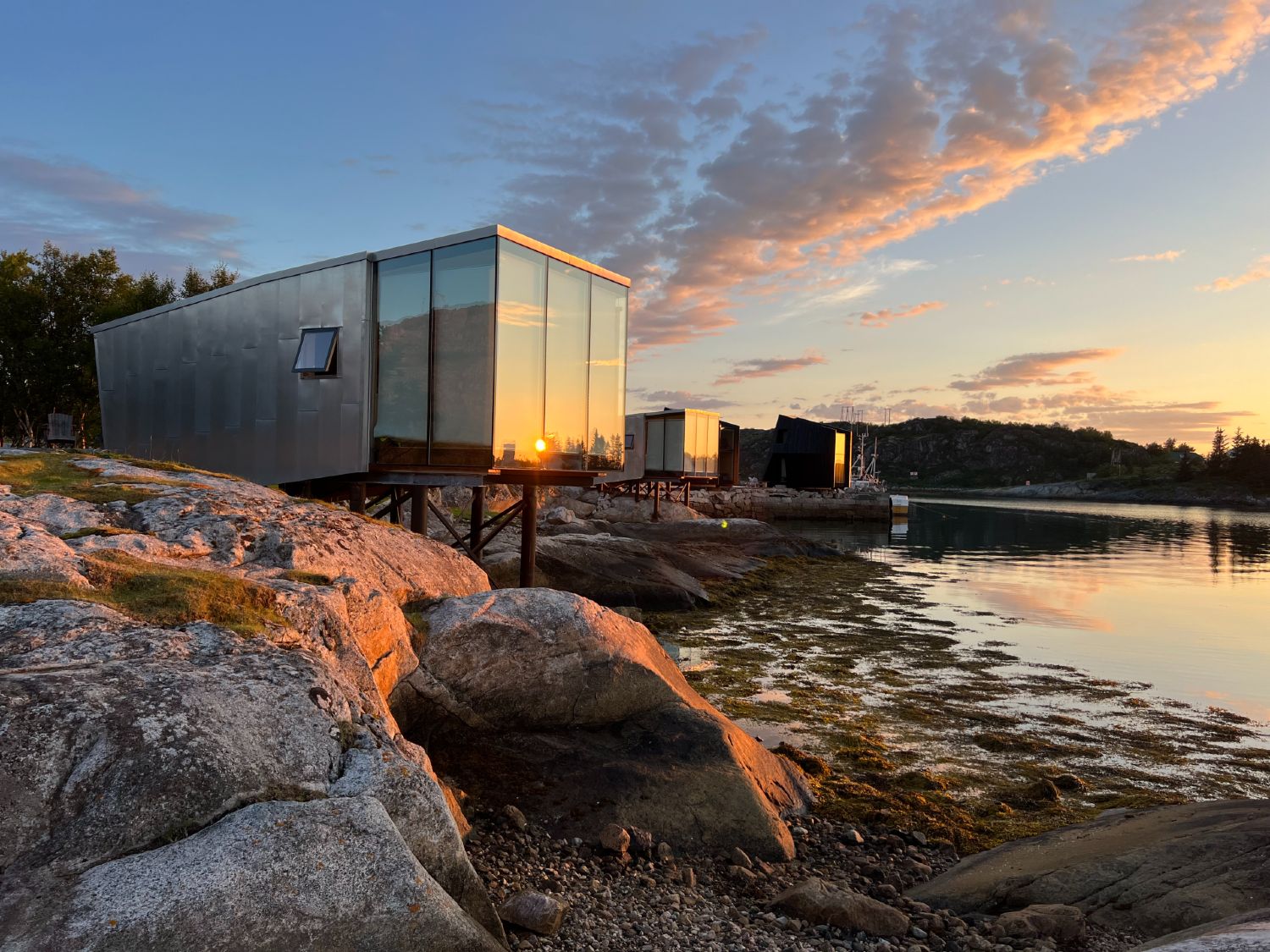
Any anxieties I have dissipate once Manshausen comes into view. I breathe a sigh of relief—thankful it exists. The glass cabins act like beacons, welcoming us to the island. The sun radiates off their metal exteriors, and the floor-to-ceiling windows mirror the placid, tranquil water. I see a wide dock stacked with yellow and red kayaks. A wooden sauna and a dozen bleating sheep are not far beyond it. We hear the low-piercingcalls of seagulls above.
I hop off the boat to find my chair.
The Manshausen Story Started in 1698
Manshausen is a small, flat, rocky island. A mere 14 acres in all, its roots date back to 1698 when it was a part of the Grøtøya trading post. Its sheltered location made it ideal for the area’s thriving fishing industry. Until the 1800s, Manshausen was used as a fish export storage location. But by the 1900s, ships were just too large to reach the island, and the trading post went bankrupt. After that, the island went through several iterations (none Insta-worthy) until a man named Børge came along.
Børge Ousland bought Manshausen in 2010. And, along with award-winning architect Snorre Stinessen, built a destination for intrepid travelers. Børge is a real-life polar explorer, having spent over 30 years traversing the Arctic and Antarctic regions, often in the bleakest and darkest months.
I imagine when he visits Manshausen between treks, it’s a true respite, with its intimate sauna, simple and flavorful food, and majestic sea eagles soaring overhead.
Norwegian-born Ousland was the first to complete an unsupported solo crossing of Antarctica. He was a deep-sea diver in the North Sea, a Navy Special Forces Officer, and was married at the North Pole. Børge Ousland is an all-around badass. I want to meet him. Sadly, he isn’t at Manshausen when we visit. He’s probably taming orcas, wrestling polar bears, or swimming the Drake Passage.
I overcome my disappointment and focus on more important matters—the sea cabins.
Manshausen’s Award-Winning Cabins
The nine sea cabins and two towers at Manshausen have won over 40 design and architectural awards, hence their inherent stopping power on Instagram. To me, the cabins artfully honor the traditional rorbu (fishing cabins) of the early 1900s. Communities of brightly painted rorbus were positioned in protected harbors with the harbor-facing side of the cabin on poles. This design meant fisherman could easily access their boats each morning.
Today, most rorbus have been retrofitted as picturesque accommodations for travelers. Their fiery red exteriors pop against the green and blue landscape—the kind of imagery that, if you catch the light right, can go viral. Although not mine, unfortunately.
Set on stilts above rocks and the ebbing tide, Manshausen’s nine modern cabins are made of wood, glass, and metal. Their angles and stark edges contrast the natural elements yet meld harmoniously within the scenery. The warm wooden interiors are simple and highly functional, with cubbies, hooks, and storage nooks in all the right places—except for the bathroom. Angus, a few more towel hooks would be helpful, please.
Each sea cabin on the island is named for one of Børge’s expeditions. The towers, Nansen and Amundsen, pay homage to his idols in polar exploration. It won’t surprise anyone who knows me that I heavily researched the ‘best cabin on Manshausen’ before booking. Phone calls were made. Aerial maps were navigated. Leaving this very important decision to fate was not an option.
Franz Josef sits just above the water and has uninterrupted mountain views. Its location at the far edge of the island means no one walks past our cabin, which is fairly important since they’re made almost entirely of glass.
The sea cabins advertise to sleep four people. In hindsight, we should have booked two cabins. During our stay, Norway experienced warmer-than-usual temperatures, and the second bedroom became an unwanted in-room sauna. I’m guessing this isn’t typical—unless you believe in global warming—otherwise, Manshausen should consider central air. Next time, we’ll book Patagonia, too.
Beach Mustard, Bread Ice Cream, and Other Culinary Surprises
Our three days on Manshausen are filled with round-the-clock sunshine, blue skies, and temperatures in the mid-70s. The weather is a gift in this part of the world known for highly changeable microclimates. I sit in my chair, but not as much as I thought I would. There’s too much to see and do.
Mornings on Manshausen are leisurely. Angus visits each guest at breakfast in the main house to confirm plans for the day. Ondrej, Manshausen’s chef and island co-host, creates magic in the open kitchen with a friendly and seasoned staff.
Ondrej tells us nearly all the ingredients he uses are foraged and sourced from the island and local area. On our first night, we have halibut topped with a plant I’d never seen. “It’s beach mustard,” Ondrej says, then mentions he’d found it earlier while walking. I later learn beach mustard is an aquatic herb with a salty, juicy flavor. It’s a spicy contrast to his light, flaky fish and poached tomatoes.
Overall, the food quality, presentation, and variety is another surprise. I’d been anticipating small, oily fishy fish like sardines and anchovies. Instead, we dine on freshly caught halibut and cod. Ondrej pairs unusual ingredients with familiar ones. We enjoy root vegetables like beets, cabbage, and parsnips in multiple ways. Truffle seaweed, pine shoots, and pine cones adorn our plates. Ondrej makes ice cream from leftover bread that he roasts and infuses with milk. Bread ice cream. Brilliant.
A Typical Day on Manshausen is Never Typical
One of the perks of never-ending sunlight is that activities are pretty much available 24/7. One night, our kids take the rowboat to Nordskot at 10pm in search of gummy bears. My husband and I watch from the cabin. Though we can’t hear them, it’s pretty clear from how the boat is rocking that they’re arguing. We look the other way.
Layers of mountains provide endless viewing entertainment. Norway’s mountainous mainland changes from green to blue to deep purple, and far beyond it, the Lofoten Island archipelago’s jagged peaks look like they were cut with a razor’s edge.
Manshausen offers adventures for every type of traveler. One morning we kayak, spotting our first sea eagles of the trip. Another day we fish, and my son catches four large halibut Ondrej will likely serve for dinner.
There’s hardcore mountain climbing along the Nordskot Traverse and more moderate hikes like the one we take to Resshola Cave. Otherwise known as ‘Troll’s Cave,’ it’s 140 meters deep and blankets us in complete darkness for the first time since arriving in Norway. Those trolls really know how to hide. I didn’t see a single one.
Each day, I walk the island, searching for treasures and following the sheep. All they do is eat and bleat. Bessie is my favorite, as she’s the hungriest and always lets me feed her.
Another woolly ewe wears a bell around her neck. I ask Ondrej if it’s so the staff knows where the sheep are at all times. “Actually, no.” He says, “It’s for the sheep. They get distressed when they can’t find each other, so the bell keeps them from getting lost.” At 2am, that very bell tells me the flock is grazing outside Franz Josef’s cabin. Such is life on Manshausen Island.
Sauna Culture
Sauna has been an integral part of Scandinavian culture since, well, forever. Many consider the sauna a sacred space, ‘Nature’s Church,’ a place to cleanse the mind, body, and spirit. It’s easy to see the allure. The mystical and traditional characteristics of the island permeate everything.
The wooden sauna sits beside a natural pool of water. Although the air temperature is warm, the water is anything but. Yet, it’s the best way to prepare, so we jump in and brave the chill. I cleanse my mind, body, and spirit multiple times a day. It’s so restorative my husband now wants one at home. Sauna—the ultimate Scandinavian souvenir.
Manshausen is Unreal/Real
After three days on Manshausen, we gather our things and get ready to meet the ferry. From Nordskot, we will head north to tackle the luminous Lofoten Islands, whose peaks we’ve been admiring in the far distance.
When the ferry floats in, it unloads a few new travelers destined for Manshausen. I wonder how they found it. Did they see it on Instagram? Which cabin did they get? I want to tell them to feed Bessie because she’s always hungry. And I want to prepare them for the ethereal colors of the sky at one o’clock in the morning. I want to hear what they think about bread ice cream.
I want to stay.
Manshausen blurs the lines between illusion and reality. Its location at the edge of the world furthers its dreamlike qualities. Once it’s entirely out of view, I turn around and face north. The Lofoten Islands are waiting. ‘But where will we go next?’ I can’t help but wonder.
Author’s Note: For those who wonder how we packed for this trip, it was carry-on only all the way to the Arctic. My go-to brand is Eagle Creek. Their Gear Warrior Backpack was ideal for my 18-year-old son, pictured below.
Our Corsica travels take us canyoning through mountains and hiking to mountaintop lakes. Our Corsica travels take us from party beaches to remote ones. Traveling in Corsica is an adventure a day, sprinkled with riverside retreats, clifftop restaurants, and the occasional wild pig.
Where’s Corsica, exactly? And does it belong on your travel wish list? Read on.
“If you don’t project yourself outwards,” our canyoning instructor says calmly, “it will end—how do you say in English—badly.”
I peer over the granite ledge. A gushing waterfall lies to my left, and a rock face extends 30 feet below. I feel, rather than see, my husband and kids doubting me from the water below. ‘Terrified’ vastly understates my singular emotion.
“Project outwards”, our guide repeats. Ever the rule follower, I close my eyes and—
Don’t panic, Mom; it ends well.
Where’s Corsica, exactly?
“Corsica is Italian.”, one friend says. Another assures me it’s Greek. The island of Corsica is closer to mainland Italy than any other country. Yet, surprise!—it’s a territory of France.
Who knew? I sure didn’t. Corsica is as elusive as Keyser Söze in The Usual Suspects. We meet only three other Americans on our trip. A testament to how relatively unknown Corsica is in the United States.
Why visit Corsica? I’ll pretend you asked. Follow along on our island adventures to discover what makes Corsica worth finding on a map.
As an aside, if The Usual Suspects reference escaped you, head over to your sofa and watch it. I’ll wait.
Corsica: What I wish I knew
Corsica is the fourth-largest island in the Mediterranean. There is no public transportation, so renting a car is a must. But be warned: Narrow roads and lanes run serpentine around colossal boulders and cliffs. Hairpin turns are frequent and hair-raising.
There are few, if any, barriers between cars and sudden death. Corsican drivers take to the roads like Lewis Hamilton wannabes. They drive like angry wasps. They laugh at lanes. According to my kids, I gasp 3,000 times. And that number doesn’t include the times I disguise my gasp as a cough.
I’m not making a case for Corsica. Bear with me. It gets better.
Corsica: by the numbers
Corsica is 112 miles long at its longest and 52 miles wide at its widest. It has 620 miles of coastline with 200 beaches. It’s home to the world-famous GR 20 Trail and has over 120 summits. Simmer down Corsica, my flights are booked.
We have 12 days. I want to cover ground but not feel rushed. Visit areas with different terrain and activities. Dine on authentic Corsican food and drink local wine. It’s a tall order, but Corsica delivers.
In Corsica, there are no bad regions (only bad drivers). Note the map of our route above. Those art school fees are really paying off, Dad.
Instead of a linear path (hahaha, there are no linear paths in Corsica!) I’ve outlined the highlights from our three destinations in Corsica. Will any of our adventures inspire you to visit? Let’s find out.
I jump—plunging into the cold canyon water with semi-wild abandon. I emerge, still holding my nose, to looks of disbelief (my kids, our guide) and pride (my husband). See, Mom? No need to panic.
“What is canyoning?” you ask. A friend aptly describes canyoning as ‘white water rafting without a raft.’ Hmmm, I don’t even enjoy white water rafting with a raft. The gorges and valleys of the Restonica River are widely known for the sport. If I’m going to try it, I’m in the right place.
After a sweaty 45-minute bathing-suit-clad hike, we put on our wetsuits, helmets, and water shoes. This isn’t pretty. Note the lack of photographic evidence. You’ll have to take me at my word.
We wade into a crystal clear pool of water. It’s crazy fun—to use a technical canyoning term. We scale boulders, swim under waterfalls, jump off cliffs, slide over rocks, and zip line above the river with child-like joy.
White water rafting without a raft turns out to be my new favorite sport.
Corsica Travels: Hiking, Haut-Corse
Our holiday wouldn’t be complete without a treacheroushike organized by my husband. The fact that Daniel and I fight when we hike would lead one to think it’s an activity to be avoided. But, no.
The ride to the trailhead is short yet harrowing. Blind corners with unyielding boulders on one side and unnerving precipices on the other. My kids will say I’m being hyperbolic. Wait. They don’t know what hyperbolic means. They’ll say I’m being emo.
Our goal is a 4-mile in-and-out hike to Lac de Melu in Haut-Corse. The lake sits at an elevation of 5,610 ft. Why we never visit sea-level lakes as regular people do baffles me. The views, (it pains me to admit), are worth the struggle. Don’t tell Daniel.
The landscape is prehistoric. I feel small—like ‘on the set of Jurassic Park’ small. Instead of ferocious dinosaurs, though, we encounter docile cows. Tall pines and fragrant alders look tiny against the towering, jagged mountains that loom in the distance.
Rangy rock faces glisten in the colors of Olympic medals. A gold medal is exactly what I’ll deserve after a day dodging cow dung with two moody teenagers. That, and a vodka tonic.
Choosing which towns to visit on an island with 650 miles of coastline is challenging. But I rise to it. Three exceptional examples follow.
PORTO-VECCHIO
Porto-Vecchio is a harbor town in southeast Corsica. Its focal point is Eglise St. Jean-Baptiste, a 19th-century church tower. Beside the church, an old-fashioned merry-go-round slowly rotates, delighting children.
Boutiques, wine shops, and restaurants are abuzz on the piazza. The heartbeat of Porto-Vecchio is palpable. A lovely introduction to Corsican life.
BONIFACIO
Bonifacio towers over the southernmost tip of Corsica. Its sculpted chalk-white limestone cliffs plunge dramatically into the Mediterranean Sea. These imposing sea walls make Bonifacio one of the most popular places to visit in Corsica.
Bonifacio is as picturesque as it is historical. The Staircase of King Aragon sits 200 feet above the sea. It was built in 1420 to access a freshwater well. Each of the 189 irregular stone steps is an accident waiting to happen, yet they are the highlight of my day.
After I reach the bottom, I walk along and under caves of eroding limestone. The Mediterranean views are interrupted only by paper-white sails of passing schooners. The water is luminous.
The downside of King Aragon’s arduous steps is as clear as the sea. What goes down must come up. I curse you, King Aragon. My quads still hurt.
PATRIMONIO
Patrimonio is considered Corsica’s best-known wine region. Our drive through Patrimonio reveals patterns of terraced vineyards in the foreground and Saint Florent Bay in the background. It’s a spectacular setting to sample the wines of the region. As an added bonus, it requires no death-defying roads.
We visit Domaine Leccia and Orenga de Gaffory wineries. Since I’m the only one in my family who enjoys wine tasting, I’m forced to drink at record speed. Corsicans do nothing at record speed except drive. Needless to say, I do nothing to alter American stereotypes. I hope the other three Americans in Corsica are better behaved.
While visiting Corsica’s numerous hilltop villages, we hear pealing church bells celebrating a local wedding. We sit on lively piazzas with glasses of cloudy Pastis—a centuries-old pastime. Visiting these villages is another highlight of our Corsica travels.
Nonza is located along another sea cliff wall. This time on the west coast of Cap Corse. Nonza is so tiny that by the time we realize we’ve reached it, we’ve passed it. My husband does an 18-point K-turn and finds a place to park. I make a mental note that arguing while driving has surpassed arguing while hiking.
The village centers around the 16th-century church of Saint-Julie. Its bright orange facade stands out against the village’s otherwise white-washed, ancient buildings. Wild oleander is in bloom, in colors to inspire Nars’ next lip gloss shades.
We have lunch at La Sassa, an outdoor-only restaurant with a low-key party vibe and Michelin-worthy food. It is 160 meters above the beach and overhangs the sea.
White-capped waves swirl below, and the Genoese Tower of Nonza soars above—an unparalleled lunch setting, indeed.
Reservations are a must at La Sassa. I’m not proud to admit it, but I felt smug watching hungry onlookers envy my tuna tartare.
CORTE
Corte lies deep in the mountainous interior of the island. The air smells of pine, the humidity is low, and rivers and waterfalls rumble gently in the distance.
Although crowded, the town of Corte feels untouched by mainstream tourism. The piazza overflows with locals. A musician croons. I notice people sitting on windowsills above—catching notes as they rise into the sky. I capture a snapshot of Corsican life in my mind rather than with my camera.
Corte steals my heart in the subtlest ways, with its hidden pottery studios, produce markets, and a spectacular citadel piercing the sky. When I return home, I’ll remember these moments—the simplicity and authenticity—and I’ll miss them.
Oletta is the opposite of the lively and musical Corte. It’s eerily quiet, with jagged stone steps and paths that weave intricately around the village. Flowers and vines climb crumbling stone walls and overflow from ceramic pots. How they grow is a mystery, as Oletta’s narrow, sleepy streets hardly allow for sunlight to reach them.
One evening, we dine in the village, and the residents magically appear—playing cards, laughing, and drinking. Where have they been hiding?
We sit outdoors at A Forge, a restaurant overlooking the valley. By the time we head back to our hotel, everyone has disappeared, and the town is silent again.
Corsica Travels: Beaches
The beaches surrounding Corsica range from nearly deserted, boat-access only to restaurant-lined with a party vibe. For the sake of keeping my audience engaged (are you still with me?), two of many standouts follow.
THE LAVEZZI ISLANDS ARCHIPELAGO
The Lavezzi Islands Archipelago, in southern Corsica, is just a few miles from Bonifacio’s formidable limestone walls. Accessible only by boat, it’s an aquatic playground for divers and snorkelers alike.
Some islands are quiet, with gigantic granite boulders that break the water’s glassy surface. Coral reefs are chock full of colorful schools of fish.
Other islands are a party on the sea with tranquil, waist-deep water. This creates a pop-up pool party atmosphere that is impossible not to enjoy. Think bikini-clad (and yikes, Speed-O-clad) people dancing on boats, in-water volleyball games, and colorful inflatable rafts floating on the placid Mediterranean Sea.
The Agriates Desert, in Northern Corsica, is a barren and dry coastline mainly accessible by boat. Any day in Corsica that doesn’t require driving is my kind of day.
But calling this 40km stretch of protected land a desert is misleading. The Agriates Desert is home to Corsica’s most remote beaches: Windswept, scrub-covered, wild, and sun-scorched.
Windex-colored waters, pale limestone boulders, and wide stretches of golden sand make this part of the Corsican coast so appealing. The air is heavy with history and the scent of the island’s ubiquitous maquis.
Maquis is a scrubby, untamed shrub that covers much of Corsica’s hills. Its scent combines at least nine herbs, including eucalyptus, juniper, rosemary, and heather. The scent is so popular that the famous French perfumery Diptique makes a maquis-scented candle. For $72, I can relive my Corsica memories from home.
Each of our three accommodations in Corsica is equally enchanting—from riverside retreats to hilltop and beachside boutique hotels. When I ask the kids which place is their favorite, they can’t decide. Well done, me.
LES BERGERIES DE PALOMBAGGIA
Les Bergeries de Palombaggia, in Porto-Vecchio, is a Relais & Chateaux property seven miles from Sardinia. This Italian island’s silhouette provides a never-ending and beautiful backdrop to our stay. Grazie, Italia.
Life at Les Bergeries centers around its inviting infinity-edged pool. The views at sunset, when the sky mirrors the sea, are especially spectacular. Palombaggia Beach is a short, convenient, and pretty walk from the hotel.
The sea air is filled with the aromatic herbs of the maquis. Les Bergeries’ old terra cotta roof tiles have faded to rich hues of sienna and mocha. I spot olive trees with silvery sage leaves and vibrant green umbrella pines. Les Bergeries’ color palette is as French as it gets. The overall vibe is ‘low-key fancy’—my favorite kind.
HIGHLIGHTS Breakfast with locally made jams, crêpes, brioches, and traditional Fiodone (Corsican cheesecake) / La Table de Mina’s poolside dining patio at sunset / Suites with hydrangea-filled balconies overlooking the pool and sea
Dominique Colonna, in Corte, is a riverside boutique hotel. Inspired by nature, its charm lies in sheer simplicity. Intentionally spartan in design, the rooms are divine, with small balconies facing the river.
The hotel’s low-impact exterior respectfully sits within the dramatic mountainous scenery. Dominique Colonna is a sublime spot from which we launch our Haut-Corse adventures. But the grounds are so welcoming and intimate that I’m hard-pressed to leave it each day.
HIGHLIGHTSImpeccably-maintained Mediterranean gardens that showcase dwarf olive trees, climbing white jasmine, and Florentine cypresses / The tiered riverside terrace for a breakfast of housemade granolas and local honey / A private massage cube made of wood and glass, nestled in the woods by the pool
U Palazzu Serenu, in Oletta, was once a 17th-century palace. After a complete restoration, this nine-room hotel is now basking in its original glory. This classic, austere, contemporary boutique hotel has rooms and common spaces designed in layers of white.
Our suite’s white-louvered windows have all-encompassing views of vineyards and Saint Florent Bay. Recycled wood, museum-worthy art, and artfully chosen coffee table books make the rooms feel personal and homey.
U Palazzu Serenu’s unique selling point is its secret access to Oletta. A creaky back gate hidden behind the pool’s tiered lounging area allows me to explore Oletta whenever I want. I go each day, searching for signs of life. Mainly, I see feral cats.
HIGHLIGHTSThe small, sheltered dining space by the pool is by reservation only. It serves ‘Italian classics with a Corsican twist.’ The artwork and sculptures are by renowned artists such as Paul de Pignol, Wendy Wischer, and Udo Nöger. The pool. Views from the pool. Drinks at the pool.
In Corsica, All’s Well That Ends Well
It’s pretty hard not to fall for Corsica. Even if that means intentionally falling from a 30-foot granite ledge into a gurgling river. I placed my trust in this rugged, craggy, and far-flung island. I was ever-rewarded.
The beauty of Corsica is in the adventures, but it’s also in the details—the colorful facade of a hilltop church against emerald green mountains. Wild oleander poking through an ancient stone wall beside an abandoned Genoese tower. A pottery studio found only by following wooden signs through a maze-like village. Wild pigs grazing on the side of the road.
As I said, it’s hard not to fall for Corsica. Just don’t forget to project outwards. You won’t regret it.
Anyone can Google a destination, but finding the right sources, the hidden gems, the places worth your time—well, that’s an art that takes time. I’ll cut through the noise, saving you from hours of searching in the wrong places. Each of my recommendations is researched with your specific trip in mind.
After visiting 70 countries on 7 continents, I know how overwhelming travel planning can be.
But I also know how to make it easy. And exciting. And stress-free.
(Please note a few affiliate links above for which I may receive a small referral fee. But rest assured, I only highlight products I fully stand behind.)
We were well on our way to Amangani when I saw ‘WOAH’ on a red octagonal sign that would normally read ‘STOP.’ We’d been in Jackson Hole for a total of 30 minutes. Little did we know that ‘Woah!’ would become the buzzword of this trip among the Teton mountains. Amangani, here we come.
Nerves of Steel, in Jackson Hole
There have been precious few trips where wildlife has played a central role in our experience. Safari in Botswana was certainly one of them, and gorilla tracking in Uganda was another. Closer to home, but no less adventurous, was Jackson Hole, Wyoming. The impetus of the trip was three days of hiking in Jackson Hole’s Teton Mountain Range, planned by my husband, Daniel. I was nervous, I’ll admit now. Not only nervous the hiking would get the best of me physically, but the bears. I was nervous about the bears.
Those who have grown up in the West might find my fears amusing. As a former New Yorker, I was never afraid of being mugged or subway rats—but bears were another story. Being born and raised in the metropolitan northeast, where my most grizzly encounters were with the squeegee guys at the Lincoln Tunnel, the West meant ‘wild’. Frankly, I wasn’t sure I was cut out for it.
Softening the blow, my husband cushioned the trip by booking Amangani. Having spent time at Amangiri in Utah a few years ago, we knew we were in for a decadent experience.
Bear Spray Rentals, in Jackson Hole
After touching down at Jackson Hole Airport, we headed to baggage claim. At the carousel, I spotted a kiosk called ‘Bear Spray Rentals.’ What a clever name for a car rental service, I thought. It took another beat to register that the kiosk was actually renting bear spray. Did I mention that I spent all my adult life in big cities?
According to the attendant, bear spray is rarely used in Jackson Hole, as the bears want to hang out with us about as much as we do with them. That said, I rented a can of bear insurance and went on my merry way.
As a barometer for the kind of scenery we were in for, I needed only to look out the car window. If it’s this scenic at the airport in Jackson Hole, we were in for something pretty spectacular. The airport was named a national monument in 1943 and merged with Grand Teton National Park a few years later. I also discovered that the airport is ‘a popular mating ground for the sage grouse.’ Good local knowledge. I was fitting in already.
Amangani is low-profile and high-impact, an architectural style we have noticed at many Aman properties. Perched upon a hilltop, with illustrative snow-capped mountain views in the distance (even in July) and green pastures of cows below, Amangani’s vibe is modern rustic lodge-chic. The exterior is a lovely combination of redwood and stone and sits ever-so-comfortably in its surroundings.
A small pond on the grounds, which later became a never-ending photo op, was a flourish on the bucolic scene. It acted as a backdrop to Jackson Hole’s glorious Grand Teton mountain range photos that changed with the light and mirrored the cloud formations that rolled past throughout the day. I was obsessively drawn to this spot, as is clearly evident from the absurd number of photos I took there.
Settling into Amangani
Upon entering Amangani, which means ‘peaceful home’, a grand, sweeping staircase welcomed us. The staircase led to a multi-level windowed wall that formally introduced us to the landscape. Hello, Tetons!
There were plenty of spaces to find quiet at Amangani. Comfy chairs were placed to maximize the panorama of the Snake River Valley, whether in the lounge, the airy central sitting area, or on our private room balcony. Native American touches, oversized sepia-tinted wildlife photography, painted cowhides, and textiles were displayed. Everything was placed with a designer’s touch.
A room for all seasons at Amangani
As tempting as it was to spend all of our time outside in Jackson Hole, the rooms at Amangani encouraged us to stay in. Being an all-season destination, the rooms at Amangani had as much to offer comfort-wise as we could wish for.
A raw-cut stone fireplace sat in the corner. The room’s centerpiece was a low platform bed, donned with crisp, white linens and a wooden headboard that went from floor to ceiling and continued its design onto the ceiling itself. Natural materials in shades of gray, ecru, and soft faux fur accents completed the ambient scene.
Were it not for the showstopper of a pool and the hiking ahead, I would have been hard-pressed to leave the walls of the lodge and head out into Jackson Hole at all.
To infinity and beyond, at Amangani
One of the hotel’s unique selling points was its nearly 400-square-foot heated outdoor infinity pool. The rectangular, blue-toned, mosaic-tiled pool spanned the entire length of the main lodge. It offered uninterrupted mountain views. The icing on the cake was the square, sunken hot tub that sat center stage along the pool’s top edge. Its idyllic location begged us to enjoy a bottle of champagne there.
The row of poolside loungers was a magical spot from which to watch the layers of blue sky evolve throughout the afternoon. Jackson’s jagged Teton mountains cut into the sky in the distance, and puffy cloud formations floated effortlessly in the foreground.
In Jackson Hole, it’s all about the views
A rickety wooden fence edged the perimeter. Beyond that, a steep slope led towards green fields and cow pastures. From our aquatic perch, the cows looked no bigger than ants in the Snake River Valley, and we dreamily watched them migrate across the pasture each day post-hike. My legs were rendered useless by then, and I was very happy to not have to use them for the remainder of the day.
The air was cool and dry. I watched red-tailed hawks crisscross the sky over our heads. An idyllic scene.
At 6am, our alarm sounded. This was not my idea of a vacation. Although I knew that once I got going and had some caffeine, I’d be happy to start the morning. Daniel is obsessed with avoiding crowds. He hates parades, auctions, big parties, and just about any situation where he might have to converse with strangers. Hence, the early start time. I, on the other hand, am obsessed with avoiding bears and moose, and I’m told they like to get a jump start on their day around the same time.
According to our guidebook, Jackson Hole’s Cascade Canyon hike is majestic, adorned with a canopy of Douglas firs, sheer canyon walls, and Teton mountain views. However, it warned of the huckleberry bushes along the way that attract grizzlies. In this case, being first on the trail meant being first to greet the hungry huckleberry eaters. I took a long, deep breath, and we set off.
Grand Teton and Jenny Lake
Crossing Jenny Lake to get to the trailhead made the early wake-up worthwhile. The lake was flat and serene, mirroring the mountains and clouds, undulating ripples for as far as I could see. I quickly noticed that the few other passengers on the boat had bells, music, and whistles, to detract wildlife. We had nothing, so were told to keep up a steady, and loud conversation. Who has six hours of steady conversation after 17 years of marriage?
Noisy, gushing waterfalls, wooden footbridges, and enormous pines met us as we started our ascent. It couldn’t have been more beautiful and peaceful, especially since no one else was on the trail. We made it up the first steep pass to Inspiration Point, which offered uninterrupted views of Jenny Lake.
Finding our stride in Jackson Hole
We saw signs of bears, like tree trunks that had been used for sharpening claws, but thankfully, no actual bears. Daniel walked ahead carrying the bear spray, which was a clever ploy to get me to keep up with his faster pace. The 13.6-mile round-trip journey took us through spots called Paintbrush Divide and Hidden Falls, which looked as illustrative as their names implied. Birds of prey glided in the breeze overhead.
Wyoming’s snow-capped Grand Teton welcomed us in the distance like a beacon. I might have smirked more than once on our hike back towards the lake as we passed hikers starting their climb as we finished ours. Thank you, Daniel.
Once again, my weary legs earned the right to sit at the pool’s edge and revel in the morning’s accomplishment, book in one hand, a refreshing drink in the other. With rewards like this, I could certainly get used to hiking.
Eat and drink, Amangani and beyond
While the town of Jackson Hole and Teton Village was only a fifteen-minute drive from the resort, we ended up going out for dinner only twice in five nights. It was too hard to leave the nest after a day of hiking and sun-soaking.
The dining room at the Amangani Lodge was ambient and moody, with a menu with enough variety to satisfy us for three dinners. As you might imagine, the windows played a large role in the setting, and it was hard to concentrate on anything when the views were as captivating as the Teton mountain range.
Jackson Hole’s Snake River Grill
One of our two dinners out in Jackson Hole was at the highly recommended Snake River Grill. We wondered if it could live up to the hype, as everyone I had spoken to about Jackson had waxed lyrical about it. The simple log cabin decor somewhat belies the elegance of the food. We were impressed from the first bite.
The menu at Snake River Grill was bold, with hearty meats like elk, beef cheeks, and pork shank. It also catered to the pescatarian and vegetarian, with options like a roasted cauliflower steak and sea bass. As has become a habit, when I am fully enthralled with a meal, I forget to take photos. I have since become a master at ‘mostly-eaten’ food photography. Take my word for it: the food looked appetizing when it arrived.
The next morning came a little too soon, especially after a stomach full of elk, but I rallied, remembering the views and the scenery, forgetting, for a moment, about the bears. Daniel told me that we were going to hike to Delta Lake, a glacial lake at the base of Grand Teton.
What he didn’t tell me was that to access this hidden gem, we needed to take unofficial, unmaintained trails, navigate several steep boulder fields, and bypass fallen trees along a rocky precipice.
It’s tempting to say it wasn’t worth it—but I can’t lie. It was as if we were discovering another world deep inside the natural wonderland of the Tetons. After about three hours of hiking, we finally caught sight of the lake—Woah!
The lake was a luminous milky turquoise, the kind of color that is impossible to truly describe. I read later that Delta Lake gets its otherworldly hue from the glacial silt of the Teton Glacier. Wherever it gets it, I was sold. Hiking was my new favorite pastime, bears or not.
With day two of hiking (and surviving) behind us, we later celebrated with drinks outside on Amangani’s veranda. The fully stocked bar looked especially beautiful as the setting sun started to descend behind the glass bottles. Another pair of red-tailed hawks soared and circled above as if delicately sewn into the fabric of the scene.
In the distance, dark storms gathered. The air smelled heavy. As it came closer, it became a game of chicken—in which guests would abandon their seats first to take cover. The raindrops didn’t slowly trickle as much as they decided to whole-heartedly dump down on us at once. We dashed indoors.
The storm didn’t disappoint. Jagged lightning bolts took turns bolting, and thunder cracks intermittently cracked. Then, as dramatically as it had started—it stopped. The rainclouds were beyond us, heading towards and eventually obscuring Grand Teton before making their way swiftly across the range. What the storm left behind was a sky of violent color, dramatic clouds, and crisp mountain silhouettes. Woah.
Amangani-led safari
With a hiking reprieve the next day, we headed out with a guide on a land safari in Grand Teton National Park. Our guide was so full of information—about wildlife, mating calls, obscure species, flora, and fauna that I didn’t have the bandwidth in my brain to keep up. I tried to impress him with my mating knowledge of the sage grouse, but it seemed he was already up to speed. Show off.
I was excited for a break and a day of photographic soul food. Searching for wildlife from the safety of a car? Now, I was in my happy place.
Again, an early morning beckoned, as that is when the wildlife is easiest to spot. We immediately came upon a herd of lovely chocolate brown elk silently grazing in a barely sun-touched field. Soon after, we spotted a pair of bison on the road’s edge.
Bisons have an awkward body shape, with a massive hairy head and front quarters compared to their somewhat skinny, spindly hindquarters. I was taken by surprise when we witnessed these large mammals elegantly jump a fence to get more food. They are shockingly limber creatures!
The crowning moment of the morning, without question, was when we drove directly past an enormous grizzly bear grazing just off the side of the road. With wildflowers in the foreground and fields and mountains in the background, it felt like he had been planted there for camera-armed tourists like me.
We watched this lovely old grizzly slowly saunter around, munching plants, minding his own bucolic existence. Woah. It was one of the best wildlife moments of all time. When you have Jackson Hole, who needs Africa?
Tackling the Teton Mountains
It was inevitable that something would go wrong; we were in the wilderness, after all. Our third day of hiking started typically enough. We rode up the aerial tram to Rendezvous Mountain, where we were due to take a scenic 12-mile hike down to the base. Many had told us about the heavenly waffles that were sold at Corbet’s Cabin, just at the summit, and I bee-lined there as soon as we hopped off—energy for the hike ahead.
Again, a victim of half-eaten food photography, I had already inhaled their famous traditional brown sugar-buttered waffle before I remembered to snap it.
Although it was July, there was still snow on the ground in places, and some signage might or might have not been obscured. Or, we might have just missed the signs altogether. We got lost, found ourselves off the trail, my biggest nightmare, and to top it off, we had just descended a harrowing scree field that took all of my technical and physical energy.
As if that weren’t enough, I caught sight of a lumbering silhouette alongside the stream in the distance. Yes, I panicked. Yes, we argued loudly. The upside was that our shouting definitely kept the bear at bay.
After deciding to cut our losses and head back to the tram via the dreaded scree field we had just navigated (exponentially worse going up than down), we had still hiked about 10 miles, had an adventure, and gone nowhere. At least we had those famous buttery waffles.
Until next time, Jackson Hole
Sometimes, it is best to have not seen and done it all. To leave something behind for another day —a reason to return. The iconic male moose had eluded us those five days, even though our eyes were peeled for him at every turn. We had seen our fair share of wildlife in Jackson Hole, snow-capped Teton mountain views, and epic hiking adventures.
Until next time, Jackson Hole.
Author’s Update: Amangani will close in April of 2025 for extensive refurbishment and reopen in the summer of 2026.
My Antarctic travels reveal more than the differences between Weddell and Leopard seals. Or how Gentoo penguins care for their young. My Antarctic travels reveal the power of the wind. And how much of an iceberg we really see floating above the water’s surface. Antarctica evokes awe. I discovered anything can happen in Antarctica—which is exactly the way it should be. Wondering how I got to Antarctica? Bundle up—you’re in the right place.
A humpback whale breaks the water’s inky surface. Remains of barnacles, those ubiquitous ocean hitchhikers, appear on its bulbous body. Thirty feet from my sea kayak, I see its dorsal fin and tail disappear into the sea as if caught in slow motion. An iceberg provides a striking background to its dripping fluke. It takes a deep dive, and I nervously wonder where and when it will resurface.
I’m in Antarctica, the most extreme place on Earth. A humpback whale is swimming directly beneath me. Justifiably, I’m a little nervous, but mainly, I feel at peace.
The idea of Antarctica
I can’t recall what inspired my Antarctic travels. But it will surely have to do with a combination of three things I crave: adventure, wildlife, and a desire to go places before everyone else.
I asked Rick, my 78-year-old stepfather, if he’d like to join me. The conversation goes something like this: “Rick, do you want to go to Ant—”
“YES!”
I could well have been asking Rick to go to Antwerp. Rick is up for anything, which is one of the reasons I ask him. He doesn’t bat an eye. Antarctica, Antwerp, Antigua. He’s in.
Click here to get my free wish list destinations hot sheet!
Antarctic Travels: Quark’s Ultramarine
There are two ways to get to Antarctica—by airplane or by ship. Ships typically depart from the southernmost tip of Argentina, from a city named Ushuaia. I choose Quark Expeditions’ ultra-modern Ultramarine. Quark has decades of experience in polar travel. Their two-year-old Ultramarine has a maximum capacity of 199 guests. It’s purpose-built for polar travel and is purely expedition-based. These two factors weigh heavily in my decision.
Purpose-built means the ship was designed from scratch to handle polar conditions. Expedition-based means the trip is all about wildlife, excursions, and the environment: no cringe-y nightly shows or formal dinners.
Base Camp
The Ultramarine is the equivalent of a mountain climber’s base camp. It has everything we need to stay safe, keep warm, and be well-fed on our daily adventures. For instance, Deck 2 has two ready rooms where each guest has a personal cubby for outdoor gear, life-saving equipment, and muck boots. Deck 2 is designed to fast-launch twenty Zodiac boats that shuttle intrepid explorers around the sea with the speed and precision of a military operation.
Deck 5 is where the main restaurant, Balena, is located. Balena’s ever-changing menu has options from fresh tuna to filet mignon. It also has a daily ice cream station where the chef recreates my childhood fave—the Chipwich. There is no all-day buffet, but I can promise that no one on the Ultramarine goes hungry.
Deck 8 has two twin-engine helicopters for flight-seeing, heli-trekking, and heli-landings. Deck 7 has features designed for self-care—a sauna with floor-to-ceiling windows and the aptly named Tundra spa. Bistro 487 and the Panorama Lounge are also on Deck 7—with spaces designed for maximum relaxation between excursions.
Antarctic Eco-Matters
Quark Expeditions has a strong sustainability and eco-conscious mindset. They care about the planet and show it. A few examples include the lack of single-use plastic on board the Ultramarine. Instead, guests are given two soft water bladders that can be refilled at stations throughout the ship. The boat is practically paperless. Computer displays on each deck outline the day’s events, and an onboard phone app provides instant access to information.
Our muck boots are disinfected after each polar landing so as not to spread avian flu. For the same reason, we aren’t allowed to kneel or place equipment on the continent during excursions. The crazy (I mean, adventurous) explorers who sign up to sleep one night on the continent are only allowed to take a sleeping bag. No food. No drinks. And no tents. They are told not to pee on the continent, either. How this played out is anyone’s guess.
Quark has its eco-mindset firmly set. It also has a team of expedition guides I want to be when I grow up.
Explorers Wanted
Our Expedition Leader is named Abbey. Along with the Captain, she’s in charge of, well—everything. Abbey wakes us from our polar slumber each morning via the PA system. Each evening, she (and the team) presents a recap of the day’s events and a briefing for the following day’s Antarctic travels.
Abbey’s sentences often begin with ‘If conditions allow…’ or ‘We are hoping to…’. This isn’t because Abbey is ill-informed. It’s because, from day to day, no one but Mother Nature knows quite what the Antarctic has in store. If this doesn’t pique your interest, perhaps Antarctica is best visited from your couch with David Attenborough and the BBC.
For example, the day we are due to explore Hidden Bay, Mother Nature decides to deny us entry by creating winds the Ultramarine can’t battle. A humbling moment like this makes each day a true adventure in Antarctica. It also makes it difficult to be Abbey.
Antarctic Travels: The Ultramarine Dream Team
The Expedition Team is a multifaceted group of explorers. Fabrice is Ultramarine’s ornithology presenter. He is also a biologist, a children’s picture book author, and a skillful Zodiac driver. Michelle is the onboard photography guide. She is also a trained field guide and fluent in Spanish, French, Catalan, and the Queen’s English—a bonus for many European and South American passengers.
Ross is a 26-year-old British historian. He treats polar history with the gusto of a Broadway performer on opening night. History was my least favorite subject in school (sorry, Ross), yet I’m riveted by every talk he gives. I go to the lounge early for a front-row seat to his Shackleton presentation. I’m not the only one. Ross has a talent for storytelling that goes well beyond his years.
The expertise and unity of the crew, expedition team, expedition leader, and captain (140 people strong) are critical to the journey’s success. When I spend ten hours in my cabin on lockdown due to a category of wind just shy of hurricane strength, I want to know that my fate is in the hands of experts. That way I can best enjoy my pan-seared Dover sole with lemon and couscous while watching The Secret Life of Walter Mitty on my flat-screen TV without a trace of anxiety.
Cabin Fever
My room is big—only marginally smaller than my first studio apartment in NYC, and with more closet space. The modern bathroom has an oversized mirrored vanity, a walk-in shower, and heated floors that are perfect for drying wet gloves or hats overnight. While built-in bottles of shampoo, conditioner, and body wash containers align with the no single-use plastic model, it also means nothing is falling off the shower ledge as we cruise through Antarctic waters.
Cabin 325 has a large picture window facing the sea nearly at sea level. I’m on Deck 3, the lowest deck for cabins, and I like the view more than I anticipated. I sit in the deep window frame with a pillow each night to watch the sea for whales and the sky for birds. I count wandering albatrosses, storm petrels, and Antarctic prions as the sun sets. January is summer in Antarctica, so it stays light well after I’ve gone to bed.
This window is a backstage pass to Antarctica’s glory. I don’t even need to leave my room to experience it.
The Drake Passage, Part One
The Drake Passage is infamous. These words conjure up age-old explorers, choppy, turbulent waters, epic winds, and crashing waves. In the factual sense, the Drake Passage is the shortest route from civilization to Antarctica. It’s 620 miles wide and over 11,000 feet deep, with water passing through it at up to 200 million cubic yards per second. I’m not one for numbers, but that sounds pretty intense. In the abstract sense, the Drake Passage is one of the planet’s most thrilling and exclusive adventures.
I lift my gaze towards the open sea as we leave the safety of the Beagle Channel. Who knows what awaits—which is another part of the adventure of Antarctic travel. Waves gently roll for hundreds of miles with nothing to break their undulating stride. Our two-day passage proves to be eerily calm—an extreme often called the Drake Lake. Guests toast the sea gods with another cocktail. And another.
None of us think about the fact that we will have to come back. It’s just as well.
Click here to get my free wish list destinations hot sheet!
Outside, it’s Antarctica
It’s 630am. I race to my cabin window. A world of polar white greets me. I stumble as I get dressed. I grab my binoculars, camera, and heated vest. It may be early, but the rattle and hum of the ship are palpable. The combined energy of 136 toddlers waking up on Christmas morning. I’m afraid if I waste even one moment, Antarctica might disappear.
We have arrived at Hughes Bay, which lies along the west coast of the Antarctic Peninsula. It’s 26 miles long and may or may not have been the site of Antarctica’s first mainland landing in 1821. None of this means anything to me right now. I’m taking my first polar breaths and catching the first polar breezes on my cheeks. I’m awe-struck by the first windswept, snow-covered landscapes of Antarctica.
Sixty seconds elapse before I see a glossy humpback whale leisurely swimming off the ship’s bow. I’m stunned into silence. I’m not alone.
Antarctica is otherworldly
How can one render the vastness and otherworldliness of Antarctica? A photographer can capture it on film, but depth of field limitations are a hindrance. An artist can draw it but is bound by the edges of the canvas. I’m visual by nature, tied permanently to my camera. But try as I might; the only way I can describe it is through sound.
I hear the rhythm of waves propelling and releasing icebergs, whales trumpeting, and wind whistling. I hear the ice cracking, the deafening echo of ice shelves calving, and distant avalanches roaring: the ship keels and creaks.
I close my eyes—humbled and ever-so-slightly afraid. It dawns on me just how far I am from home, my kids, and my husband. At 7am, Abbey’s voice rings across the ship. It’s time to get breakfast and suit up for the Zodiacs.
Antarctica, we have arrived.
Antarctic Travels: A typical day is never typical
“Tern!” shouts Fabrice, with the enthusiasm other guides use when spotting whales. Fabrice is all about the birds. Our Zodiac group looks up in unison to see a snow-white Antarctic Tern glide overhead. It looks like it’s wearing a black cap and red lipstick. Anyone who ignores birds in Antarctica is missing out.
A typical day in Antarctica is never typical. The two daily excursions that await us may be by Zodiac, sea kayak, stand-up paddle, or helicopter. The excursions take anywhere from 2-4 hours, depending upon how sidetracked the guides get chasing spy-hopping whales or a raft of penguins. This leaves little room for downtime. We eat, have coffee, suit up, and get back out on the water. This is not a leisure cruise, mind you.
Above and below the surface of Antarctica
Each of the 136 passengers on the Ultramarine is invited to take a 15-minute heli-flight. Having two helicopters on board is a perk exclusive to the ship. The opportunity to see Antarctica from above is a total thrill. By the end of the expedition, I’ll have racked up multiple vantage points from which I experience it. Above sea level, at sea level, and below sea level. (The below-sea-level experience is fleeting, not to mention numbing.)
One evening, Abbey alerts us to a trio of orcas off the ship’s starboard side. Their dorsal fins and tell-tale black and white torpedo-shaped bodies bring a hush over the crowd. At 10pm, the sun is still high in the sky. A rose-tinted light is cast over the snowy mountain range and is mirrored on the rippling water.
One day, we spot a Weddell Seal dozing on a teetering tabular iceberg. He yawns and scratches his long, dove-gray whiskered face. He raises a fin in acknowledgment. We respond with a hundred continuous SLR clicks. Photoshoot complete, he returns to his nap. Anything can happen in Antarctica, and everyone wants to capture it.
Sea Kayaking, For The Win
Rick and I are two of only sixteen passengers in the sea kayaking program. We sign up for it the day we put down our deposit and count ourselves lucky for having secured a coveted spot. I’m not exaggerating when I say 120 passengers are jealous of us each day we put on our dry suits.
“How different can it be from the Zodiacs?” you may wonder. In a word, very. Kayaks are stealthy, quiet, provide legitimate exercise, and are solo (or tandem) endeavors. In a kayak, we are even closer to the sea, the ice, and the wildlife.
We kayak through small, bergy bits (a technical term I learned from our fearless guides, DT and Sarah) and larger growlers. DT tells us we only see about 10% of an iceberg above the water’s surface. I have an a-ha moment about the idiom, ‘That’s just the tip of the iceberg…’ I’m guessing most people don’t have to go to Antarctica to learn.
Taking our time on our Antarctic Travels
I watch the sun eke its way through dense, gray cloud cover—savoring the landscape while Rick paddles. In case you’re concerned about Rick’s welfare, this arrangement has been pre-organized. Rick paddles and I take pictures. That’s the deal. Plus, he’s an excellent kayaker. He went to sleepaway camp for 30 years.
Despite Camp Chickawah’s tutelage, DT has to adjust Rick’s foot pedals in the middle of the sea. Twice. I channel inner peace and exhale. DT is surprisingly patient—a big Aussie that none of us wants to disappoint. So if DT isn’t in a rush, neither am I. Pedals locked in place, we catch up to the rest of the kayakers.
A sharp breath escapes from a humpback’s blowhole. Before I can blink, the whale is before us, nearly upon us, and then underneath us. One hundred Ultramarine guests on land with binoculars are oozing with jealousy. Anything can happen in Antarctica, as every day continues to prove.
A collection of penguins
I geek out on collective nouns for animals. Don’t judge. For instance, a group of puffins is called a circus, and a group of jaguars is called a shadow. Imagine my delight in learning the collective nouns of penguins! Bear with me, you’ll love this.
The collective nouns of penguins are determined by where they are and what they are doing! Colonies of penguins are the most commonly known term for a group of penguins, but huddles and rookeries are others. Walking penguins are called a ‘waddle’ and swimming penguins are called a ‘raft’. Am I the only one who loves this stuff? Fabrice?
We see three of the four penguins living in Antarctica: Gentoo, Adélie, and Chinstrap. In January, the Emperor Penguins are further inland. I push away my disappointment and enjoy the 100,000 penguins at hand. Or, should I say, at my feet.
The Penguin Highways of Antarctica
Our Zodiac landings allow us to walk alongside and observe these fascinating creatures. Penguins are the only animals on Earth that look cuter as adults than as babies. Our two hours on Danco Island are an introduction to penguin life I’ll never forget. And that’s not only because it smells so bad.
On Danco’s rocky shoreline, Gentoo penguins waddle as far as the eye can see. They build nests by brazenly stealing their neighbor’s rocks. Then, they squawk at the same neighbor who steals the rocks back. They create convenient paths along the steep mountains to waddle up and belly-slide down—penguin highways. Our guides tell us that penguins always have the right of way. No one argues.
Gentoos have orange bills, a white triangular patch on their otherwise black heads, and are inherently curious. We are asked to stay 15 feet from them, but every time I turn around, I find one staring up at me quizzically.
On another penguin landing, we observe (and by observe, I mean take 4000 photos of) the slightly smaller Chinstraps. Chinstraps are defined by a black stripe that runs across their throat. Four million breeding pairs of these feisty little penguins exist throughout the Antarctic. We see most of them.
The Adélie Penguins are the smallest (and cutest!) of the Antarctic penguin species. Adélies have a white ring around their eyes and a mostly feather-covered bill. Nothing sums up cuteness like a waddle of Adélies balancing on a rocking iceberg before they take the polar plunge. There you go—a fine intro to Antarctic penguins. You’re welcome.
Antarctic Travels are about one thing
In Antarctica, it’s all about the wildlife, but it’s also all about the ice and the landscape. Let’s agree that it’s all intertwined. I allow for transcendental moments every day. I’m spoiled by them.
Today, we see a raft of penguins! Today, we watch an enormous ice shelf topple dramatically into the sea! Today, we pass through the narrow Lemaire Passage! Today, we see orcas hunt a humpback! Today I purposely throw myself into the ocean! Antarctica is a world of hyperbole! I can’t use enough exclamation points to make my point!
Click here to get my free wish list destinations hot sheet!
The Drake Passage, Part Two
It’s immediately clear our return crossing will not be another Drake Lake. For a start, Abbey announces we’re heading back a ‘touch’ earlier than planned. At dinner, plates rattle, and waiters weave around unstable guests. There are far fewer diners in the restaurant than usual—a telling sign.
Despite deteriorating conditions, those who can party on. We have drinks at the bar and eventually head off to count Gentoo penguins in our sleep. Throughout the night, the waves and wind increase in severity.
By 9am, it’s obvious we’re in for a wild ride. I’m struggling a little to get to the Panorama Lounge for a much-needed shot of caffeine when Abbey pipes up over the PA system. “For everyone’s safety, we will be on cabin lockdown for the next ten hours. But fear not, all is well!”, she says energetically. “Room service will be coming around shortly.”
Satisfied with my marching orders, I get into my cushy robe and enjoy a movie marathon that involves a Sir Edmund Hillary documentary (but I hate history, Ross!) and The Life Of Pi. I look out the window at what I later learn are 30-foot waves. The wind strength moves the needle to 11 on the Beaufort Wind Scale. A scale that maxes out at (what I also later learned) is 12. We are one notch shy of hurricane-strength winds. In Antarctica, anything can happen. I remind myself that this is what I signed up for. I hope Rick did, too.
Surviving The Drake Shake
Do some passengers despise the passage? Definitely. Do some get sick? Ummmm yes. But do we all agree it’s a right of (Drake) passage? Well, I haven’t taken a formal poll, but yes, let’s agree!
Eventually, we round Cape Horn and the waters still. We’re allowed to leave the cabins. Feeling like released hostages, we toast the sea gods (yet again) and behave like we’ve weathered something big.
Indeed, we have.
Processing Antarctica
I visit my sister a few days after my Antarctic travels. When I wake up at 630am, it’s still dark outside. The sun slowly rises as I head north. Puffy clouds in the distance take me back to the whipped cream peaks of Antarctica. The currents beneath the Delaware Memorial Bridge remind me of kayaking with Rick.
I see a bird swoop overhead and think, “Tern!” channeling my inner Fabrice. But alas, it’s a turkey vulture circling roadkill over the NJ Turnpike.
Over the next two hours, my mind processes the vast, otherwordly continent I left behind. I recall the passengers I befriended and the crew from whom I learned so much. I think of the sky, mountains, and sea. The seals and penguins.
And, of course, the whales.
I’m home. Far from the most extreme place on Earth, but brimming with endless reminders of an awe-inspiring journey. In Antarctica, anything can happen. And that’s fine with me.