Tag: Views

  • These Remote Norwegian Islands Have An Unusual Smell. It’s Money.

    These Remote Norwegian Islands Have An Unusual Smell. It’s Money.

    Our RIB slices through Trollfjorden towards Svolvær, the scenic capital of the Lofoten Islands. Twelve of us instinctively lean left—as if we have some control over the heeling boat. The narrow fjord’s steep-sided, jagged mountains rise dramatically from the sea. The water swirling beneath me is a shade of blue I’ve never seen. Overhead, the sea eagles we met earlier turn back towards Raftsundet strait, realizing their midday snack is officially over. The trolls remain hidden.

    As we get closer to the harbor, a stench hits me like a rogue wave. I look around. My face isn’t the only one scrunching in disgust. Our guide is watching. Is he smirking? The Brit behind me is the first to bite. “What’s that awful smell?” he asks. “Ahhhh,” Emil smiles and exhales slowly, deliberately. “That, my friend, is the smell… of money.”

    Twelve heads turn in unison, baffled.

    Reine

    Where Are The Lofoten Islands?

    I found the Lofoten Islands through my usual source of inspiration—Instagram. Those algorithms are eerily spot on, drawing me into little tiles of mesmerizing mountainscapes and fjords. I needed to know exactly where this magical place was and how soon I could get there. 

    The Lofoten Islands are in Northern Norway, I discovered, just inside the Arctic Circle. 

    Of course they are.

    Factually speaking, the Lofoten Islands are an archipelago of seven main islands bisected by glacial fjords. By the numbers, they are about 100 miles long, over 3 billion years old, and have roughly 25,000 residents. The Midnight Sun reigns from late May to mid-July. Intriguing facts, Wikipedia, but I don’t need them to inspire my trip—Instagram beat you to it.

    Illustration map of Lofoten

    The Scandinavia Travel Boom

    Scandinavia is on the cusp of a travel boom, partially as a reaction to the wildfires and raging heat from which the rest of Europe suffers. Some travelers are looking for more temperate climes. Others are seeking roads, or in this case, fjords less traveled—a response to overtourism plaguing countries like Italy, Spain, and Greece. 

    Nordic countries saw a surge in tourism last year, with Finland, Denmark, Sweden, and Norway reporting a record-breaking number of visitors. In Norway alone, nearly 17 million hotel nights were booked—a 3% increase from the previous year. Those numbers are expected to rise as more intrepid travelers view Scandinavia as the antidote to mainland Europe’s woes. But, the Lofoten Islands are remote even by Scandinavian standards. 

    It’s worth noting the emphasis on destinations yet to grace the covers of Travel+Leisure and Condé Nast Traveler. Travelers want bragging rights, to get to destinations first. If Scandinavia is the next travel hot spot, I want to get there first, too. I book my flights and ferries. Thank you, Meta. I’m on my way. 

    The Fish That Put Lofoten On The Map

    “That smell is stockfish,” Emil continues. “Stockfish is Norway’s most important export—and has been for centuries. To us, the smell of drying cod is considered the smell of money.”

    The Tørrfisk industry dates back to the Viking era. Tørrfisk (aka stockfish, or dried cod) was so lucrative that it lured over 30,000 fishermen to northern Norway each winter. Fishermen who endured the Arctic’s extreme and harrowing conditions to provide for their families back home. 

    Stockfish
    PC: Ruramos

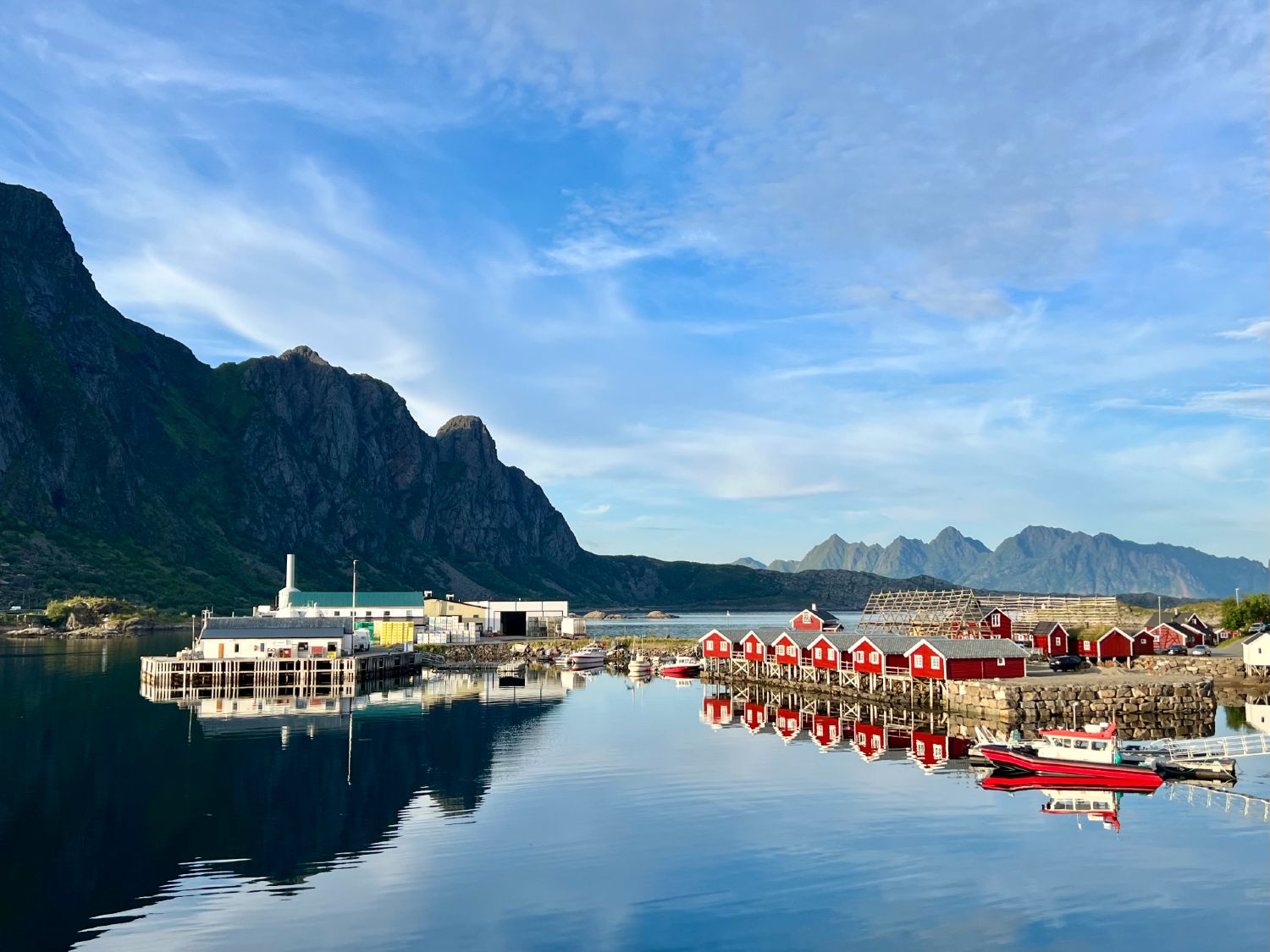
    Once caught, the codfish, with their wiry whiskers and mouths agape, are placed on large pyramid-shaped wooden racks called fiskjehell. Norwegian winters are windy and well below freezing, thus creating a natural preservation system for the fish to dry without rotting.

    Fiskjehells are still used in the Lofoten Islands and can be seen (and detected sight unseen) in many seaside villages—a monument to the dedicated fishermen who endured Lofoten’s long, dark winters. 

    Stockfish’s Place on the Global Table

    The smell of stockfish also reminds us of Lofoten’s importance in commercial fishing. Of all the European nations that import dried cod from Norway, Italy is the largest. Stockfish is the central ingredient in their famous dish, Stoccafisso Accomodato (stockfish stew). It’s also a staple of Nigerian cuisine, often used for stews and soups. 

    Stockfish adorns the menus of Lofoten restaurants, from fine dining at the Kitchen at the End of the World to Svinøya Rorbuer’s humble restaurant, Børsen. Travelers can experience the fish that built Lofoten with dishes like Tørrfisk Royal, cod stew with carrots, egg, butter, and bacon, and stockfish filleted with baked leeks, wild mushrooms, and kale.

    The curious Brit quips, “I don’t see any fish, only empty racks.” Emil is ready. “The fish hang for three to four months,” he explains. “By May, about six million tons of cod hang in hjells, ready to be shipped. But, even when the racks are empty, the smell lingers.” Satisfied, the Brit settles.

    View of Reine with clouds

    The Fisherman’s Wife

    Emil cuts the motor, and the silence is welcome. We’ve been careening around the fjord, feeding sea eagles and troll-hunting for hours. That’s when I see her. Standing poised and strong against the wind on a rocky promontory, she clutches a shawl around her neck with one hand and waves longingly with the other. 

    “That’s Fiskerkona,” Emil says, reading my mind. “The Fisherman’s Wife. She represents the resilience of the women left behind to raise families during their husband’s long absences. Many would never see their spouses again.” This poignant statue quiets the group—even the inquisitive Brit.

    Nusfjord interior

    Turning Tradition into Luxury

    Thousands of fishermen traveled north each winter to hunt for Norway’s prized fish. They lived in rorbuer, traditional stilted, wooden huts. In Norwegian, ‘ror’ means row, and ‘bu’ means small house. Up to 12 fishermen shared each rorbu. Rorbuer were sheltered from the elements and divided into two parts, one for sleeping and one for gear. The ceilings were low, and the windows were small and inefficient. They had basic kitchenettes and uncomfortable beds. But, they provided what mattered most—direct and immediate access to their fishing boats.

    Rorbuer

    These seaside cabins, many restored to their original red and yellow colors, have been retrofitted as tourist accommodations. Some, however, are retrofitted better than others. Rorbuer are an integral part of Lofoten’s history, giving visitors a chance to imagine life within the same four walls as Nordic fishermen, albeit in some cases, on 600-thread-count sheets, with rain showers and Nespresso machines.

    Nusfjord bedroom

    Turning tradition into luxury is hard work. Not as hard as fishing for cod in the Arctic, but hard nonetheless. Although updated with modern conveniences and creature comforts, some rorbuer lack the sophisticated amenities often associated with high-end luxury. Others have found an idyllic balance,  elevating the rorbu by adding soft, plush duvets, Bluetooth speakers, and bespoke toiletries while keeping the cabins’ historical integrity intact.

    That said, rorbuer accommodations are in such high demand that some were fully booked as early as February for this coming summer. These rorbuer create a source of income beyond stockfish—attracting the kind of money that looks, feels, and smells like actual money.

    View of Nusfjord village

    The End Of The Road in the Lofoten Islands

    The Nusfjord Arctic Resort is tucked away at the end of a road in a secluded valley that hovers over the sea. A Small Luxury Hotel of the World, Nusfjord has managed to preserve the look and feel of a typical fishing village so vividly that I could swear I traveled through time.

    Many of Nusfjord’s rorbuer are several hundred years old. During the day, tourists come from near and far to explore the grounds, the general store, the bakery, the smithy, the boatshed, and the cod liver refinery. 

    Black-Legged Kittiwakes

    They dine at the property’s on-site restaurant, Karoline, and gaze at the mountain views. They order pizza from a small wooden shack, grab a cold beer, and sit among the protected Black-Legged Kittiwakes (Krykka) that nest on the cliffs and windowsills. From 9am-5pm, Nusfjord swells with tourism.

    Dock at Nusfjord Hotel

    But come 5:01pm, the property is reserved for guests only. Cue a mass exodus akin to heading west on Montauk Highway after Labor Day Weekend. It’s then that lucky Nusfjord guests peek out from their rorbu windows, making sure the coast is clear. They shuffle out in fuzzy slippers and fluffy robes one by one en route to the sauna.

    Lofoten Island’s Endless Days

    We’re getting closer to Svolvær’s docks. Our sea eagle safari will soon end. This high-speed RIB excursion has been a highlight of my trip. Not only because I saw so many of the promised eagles but also because of Emil’s insights into Lofoten’s history. 

    I look back at the scenery Instagram inspired me to come so far to admire. Hiking peaks like Reinebringen and Djevelporten provide an eagle-eye view of the islands that change with the sun, mist, and fog—each stunning in its own way. The mountains appear hand-painted and are set against layered clouds in a sky that never gets dark. Summer in Lofoten is an ongoing study in beauty. I could spend a lifetime of summers here and never tire of it.

    Svolvaer overview

    The Set-Jetting Travel Trend

    The Lofoten Islands aren’t the only Norwegian destination benefiting from a boost in tourism. Anyone who followed the black comedy Succession will recall the episode in which Shiv and Roman Roy visit Mattson’s homeland. The Roys stay at Juvet Landscape Hotel, a property entirely immersed in nature.

    Juvet is located on the west coast of mainland Norway. It’s a great example of ‘set-jetting,’ the travel trend best described as wealthy Americans spending gobs of money in places like Thailand and Dubrovnik courtesy of TV shows like The White Lotus and Game of Thrones. These days, Juvet is as hard to get into as the Vatican on Easter Sunday. Damn you, Roman.

    Achingly cinematic and designed with the environment as the star, Juvet’s seven minimalistic rooms include airy Birdhouses, glass-walled Landscape rooms, and the writer’s aerie, Scrivener’s Room. At Juvet, luxury is at its most understated, and the only tension lies in the ever-changing scenery.

    Boats at Svinoyer

    Past, Meet Present

    “Come back to Lofoten,” Emil calls out as we disembark. My heart sinks. The possibility of coming back seems unlikely. Who goes to the Arctic Circle twice? Hmmm. Maybe I do.

    The sun is high in the sky. Since it won’t fully set, we have endless hours ahead of us to explore and relax. I peel off my dry suit and take off my goggles and hat. It’s 36 degrees, and I’m freezing. I think of the fishermen. I wouldn’t have made it past Fiskerkona. 

    Nusfjord

    Although Lofoten’s fishing industry remains deeply rooted in history, some things have changed. The boats have been modernized with GPS and sonar radar for tracking schools of fish. Safety has improved with the addition of anti-slip surfaces and hydraulic winches. The fishermen sleep in heated cabins and have cell phones to call their wives (whether they consider that an improvement is unclear.)

    I turn towards Trollfjorden—contemplating those elusive trolls. I no longer detect the intrusive fishy smell. How quickly humans adapt—even to an unpleasant odor like dehydrated fish. Though surely not unpleasant to the residents of the Lofoten Islands—where the scent of dried cod symbolizes history, prosperity, and a tourist industry’s moment in the sun.

    Click here to learn more about what to do, what to see, and where to stay in the Lofoten Islands


  • 3 Sensational Summer Days in Stowe: A Vermont Secret No Longer

    3 Sensational Summer Days in Stowe: A Vermont Secret No Longer

    Think Stowe is only for leaf peepers and ski bums? Let me introduce you to summer—my favorite season in Stowe. Sure, it’s not even spring yet, but it’s never too early to plan for summer. Read on for inspiration—what to do, where to hike, eat, drink, and stay. Discover some off-the-beaten-path places only locals know about, like eerie covered bridges and how to sniff out the best coffee in town. Ready to take on Vermont’s not-so-best-kept secret?


    I round the bend, obeying the speed limit like the rule follower I am. Mac’s Market appears on my left, marking the spot where, for a mile or so, Route 100 becomes Main Street. I stop at the intersection of Main and Mountain. A full stop. A deep breath. A smile.

    Stowe’s Main Street is an apple pie-shaped slice of Americana. It transports me from my fast-paced city existence to a slow-paced country one. No matter the season, it feels like coming home. But in the summer, it feels like something else. 

    It feels green.

    farm in field

    A Stowe for (almost) All Seasons

    In the Fall, Stowe is an intense kaleidoscope of color. Reds, oranges, and yellows transform the landscape little by little each day. By winter, those harvest colors are replaced by blankets of white—a muted landscape marked by the woooosssh of a skier or the crunch of snow underfoot. Spring brings the mud, keeping tourists at bay. The village quietly regroups. 

    But in the summer, Stowe is a love letter to green—hunter, honeydew, laurel, lichen, moss, grass, forest, sage, and mint. In the summer, Stowe owns green. These greens have a distinct look, feel, and smell—layered mountains, freshly mown meadows, and forests thick with birch, elm, poplar, and hickory.

    In Stowe, green is a vibe.

    Pond swimming with dogs

    40 Summers of Stowe

    Summer in Stowe isn’t the secret it was when I was a kid. Even today, it’s overshadowed by its bossy older siblings, Winter and Fall. I’ve been visiting Stowe for more than 40 years. Over the decades, the village has grown and changed, adding stores selling non-GMO granola, organic wines, and overpriced avocados. But at its core, it remains the same—a place to get reacquainted with Mother Nature, to embrace the simple life—and to recharge.

    In Stowe, nature and adventure unfold in many ways. No two days are the same. Tackle winding, wildflower-filled trails and bike through overgrown forests. Lose yourself in the town’s galleries or seek out Scottish Highland cows to photograph. For those who believe the best adventures are savored, Stowe’s food scene will satisfy your cravings.

    Are the Green Mountains of Stowe on your summer radar? Or, do you wonder if they hold enough to captivate you and your family? Read on for inspiration on how to spend three sensational days in Vermont’s prettiest village.

    Scottish Highland Cows


    Stowe Sweets

    Day 1: What to do in Stowe

    9am-ish: My brain doesn’t boot up until my first sip of coffee. For a small town, Stowe has multiple places I like to caffeinate (none of which ends in ‘bucks). Black Cap Coffee is powered by women pouring badass brews. Don’t be intimidated by the lines. These women move fast. And their coffee will kick start your first day in Stowe like a green flag at NASCAR.

    I recently added a teaspoon of Chagaccino to my coffee order. Chaga is a medicinal mushroom rich in antioxidants and claims, among other health benefits, to lower blood pressure and stimulate immune systems. I’m all in for Black Cap’s Chagaccino cappuccino. But boosting immune systems comes at a price. Be warned!

    Village main street

    10am: Sufficiently revved, I stroll Stowe’s picturesque Main Street. I stop at long-time faves like Shaw’s General Store and Bear Pond Books. Many of these independent businesses have been here since I was a kid.

    I cross the street and dip into Farm Home Co, a home decor shop that, with its highly-curated wares, could just as happily live on Main Street, Sag Harbor. A few doors down is The Country Store, a home goods shop where I inevitably buy kitchen gadgets I don’t need. A Hasselback potato slicer catches my eye. I head to the register. Yes, we make Hasselback potatoes at least twice a year. Money well spent, indeed.

    Dewey Bridge in Stowe

    And this one time, at Ranch Camp

    I take a hard turn at Mountain Road and walk through Stowe’s 150ft pedestrian-covered bridge. Dewey’s Bridge has been a village icon since 1973. I grab my phone. From here, the views of Stowe’s Community Church, the town’s crowned jewel, are postcard-worthy. 

    12pm: After a few (hundred) snaps, I beeline to Ranch Camp, a five-minute walk up the road. Part bike shop, part sandwich shop, part tap room, Ranch Camp has an entire menu worth devouring. For RC virgins, I strongly recommend The Rock. I’m a Ranch Camp expert, and I still can never not order The Rock. 

    The Rock is a protein bowl of perfect proportions—arugula and brown basmati rice with black beans and corn salsa, topped with an avocado sliced with surgeon-like precision (no doubt with a gadget they bought at The Country Store).


    My Stowe E-Guide is filled with even more things to do. Click Here!

    Stowe E-guide

    The Stowe Summer Trifecta: Nap, Dinner, Stroll

    2pm: At this point in the day, I need one of three things: coffee, chocolate, or a nap. If chocolate is your pick-me-up, Lake Champlain Chocolates is nearby. Travel + Leisure named their hot chocolate ‘America’s Best.’ And no, hot chocolate isn’t just for winter.

    5pm: If the sun is shining, grab an Adirondack chair and a microbrew and watch the world go by from the front lawn of Stowe Public House. This al fresco pitstop sometimes blends into dinner, so I book an early table at Plate just a few doors down. This California-inspired restaurant is always packed. But even if I forget to make a res, I grab a stool and enjoy my Hearts of Palm Vegan ‘Crab Cakes’ at the bar. 

    8pm: At summer’s peak, the sun remains high in the sky well past my bedtime. But I can’t pass up an after-dinner stroll along Stowe’s Rec Path. I catch it just behind the church for a last few breaths of green mountain air before I fall into a deep summer slumber.

    Corn Maze in Stowe

    Day 2: What to do in Stowe

    9am-ish: Hidden in the far back corner of Baggy Knees Shopping Center, Woodland Bakery is the coffee and pastry shop no local wants you to know about. When I become a local, I will curse you for going there, but for now, be my guest! 

    The air inside Woodland is pure butter. I salivate like my black lab at dinnertime. The coffee quietly screams artisanal, and though Woodland isn’t only for coffee snobs, they’ll feel right at home. At Woodland, brews, brioche, and butter rule.

    Green Mountains of Stowe

    10am: It’s time to hike the Green Mountains Stowe is so well known for. Try Sterling Pond, which is accessed from the top of Smugglers’ Notch via a trailhead on Route 108—a moderate hike to an alpine pond. Or follow the same pass once used by outlaws and smugglers—Smugglers’ Notch Trail is near the Barnes Camp Visitor Center. This steep uphill hike winds through dramatic cliffs, enormous boulders, and forests.

    If you have kids in tow, take them to Percy Farm’s yearly corn maze and enjoy the views while they get lost in the tall cornfields for a while.

    Stowe waterfall

    For those who love waterfalls (who doesn’t love waterfalls?), Glen Moss Falls, located right off Route 100, is a picturesque stop. It’s more walk than hike, so don’t expect to burn off that brioche here. Bingham Falls, accessed from a marked trailhead along Route 108, rewards hikers with a dramatic cascade and inviting, albeit cold, layers of swimming holes. 

    Wildflowers

    An afternoon of brews, boutiques, and burgers

    12:30pm: One of Stowe’s prettiest places to have lunch is the Ideltyme Brewery and Restaurant’s backyard garden. With its central, convivial, al fresco bar and simple bites like warm pretzel bread with pub mustard and fried pickles, it’s easy to whittle away a few hours in the sun with a flight of beer.

    1:30pm: If you’re in Stowe on a summer Sunday, and I highly recommend that you are, walk from Idletyme to the farmer’s market. Weave in and around the tented vendors: popsicles, potstickers, and artisan popcorn. Herbs, herbal roots, and herbal-infused teas—it’s everything a village farmer’s market should be.

    3:30pm: The Mountain Road is lined with standalone shops and boutiques. Archery Close is one of the best, with brands that elevate Vermont flannel like Amundsen, Marine Layer, and Faherty, as well as curated accessories and shoes.

    There are two Coco Goose boutiques. I’m not sure why, but they’re both worth visiting. With brands I covet, like Nili Lotan, Ulla Johnson, Veronica Beard, and Herno, those Coco Geese certainly know their audience.

    7pm: Warm summer nights in Stowe are made for Doc Ponds. Casual and lively, kick back with a cold craft beer, some cheddar fritters, and a burger with hand-cut fries. The vibe is effortlessly cool—with vinyl records spinning, picnic tables on the patio, and a steady hum of conversation. Whether you roll in from a day of hard-core hiking or hard-core shopping, Doc Ponds is a great place to end the day.


    More hikes, more restaurants, more shopping. Click Here for my Stowe E-Guide!


    Church steeple view

    Day 3: What to do in Stowe

    9am: I’m not a yogi, yet I love the morning Yin Yoga class at The Swimming Hole. In Yin Yoga, you hold stretching poses until you almost fall asleep. I love to sleep. Yin Yoga is the yoga for me. The Swimming Hole also has a gym and a pool, where day passes are sold. This is an especially good option should your summer day start with some rain. Those Green Mountains don’t get green by themselves, remember!

    10am: Walk or bike the 5.3-mile scenic trail that loops around town. The Rec Path path follows the West Branch of the Little River, crossing 11 low-arching bridges and ducking behind the Stowe Community Church. Each turn has a beautiful view of the landscape. Wildflowers line the trail and mountain views around every bend. Wear a bathing suit and take a picnic lunch with you. You’ll find plenty of spots to hang out beside the river. 

    Parkers Barn

    1pm: Take a scenic drive to some of Stowe’s iconic and historic covered bridges and barns—snapshots of Vermont’s past. Gold Brook Bridge, aka Emily’s Bridge, comes with a ghost story. After being abandoned by her lover, legend has it that Emily met a tragic fate here. Red Covered Bridge, just outside town, is classic Vermont—bold, bright, and reflected in the slow-moving brook below.

    Take a selfie with Parker’s Barn on Weeks Hill Road. Although the town gives funds to keep it standing, this iconic and dilapidated red barn’s days are numbered. The dozens of pigeons who live there should start looking for new lodgings.

    Time to Splurge

    2pm: A vacation isn’t a vacation without some decadent splurges. The Spa at Topnotch Resort is just what I need to soothe my weary body and soul after a few adrenaline-filled days. Topnotch’s Spa has been a favorite of mine for decades and offers classic treatments, from 25-minute spot massages to 80-minute deep tissue massages. But it has also changed with the times and has R&R CBD and Thai massages.

    Don’t forget to book in advance—I’m not the only one who thinks the Spa at Topnotch is the best.

    7pm: Edson Hill is just far enough from the bustle of town for those looking for a quiet place for drinks and dinner. The Tavern has brown leather couches and low post-and-beam ceilings that define coziness. The restaurant has modernized classic New England fare with a seasonally changing menu. Views are photo-worthy in every direction—a culinary standout in Stowe.


    This Stowe day trip comes with a scoop of Cherry Garcia. Click here to learn more.


    Green Mountains of Stowe from Edson Hill

    A Stowe Hotel for Everyone

    Finding the right place to stay in Stowe in summer depends on your vibe—are you here to unwind at the spa, explore every mountain trail, or just soak in the small-town ambiance with a cocktail? 

    For the Romantics:

    Edson Hill is as elegant as it gets in Stowe. Set on 38 rolling acres, this beautiful and romantic spot has eight Manor House rooms and 15 guest houses, each oozing sophistication and antique charm. Four poster beds with crisp white linens, fireplaces, velvet couches, and standalone soaking tubs may mean you never leave the room. But, those who do will be rewarded, as the property has wildflower-filled walking trails, horse stables, and a bucolic pond.

    For the Spa-Goers:

    Topnotch Resort & Spa is for those who want luxury without the pretense. Tucked into the mountains, Topnotch has topnotch views, an award-winning spa, and an outdoor pool that begs for lazy afternoons. Whether you’re booking a tennis lesson, indulging in a deep tissue massage, or sipping wine by the fire pit—lean into relaxation at Topnotch.

    For the Best Village Location:

    The Green Mountain Inn is a quintessentially Stowe inn located on Main Street in the heart of Stowe village. It’s quaint, cozy, and packed with old-world charm—only steps away from shops, restaurants, and the Rec Path. With its creaky floors, afternoon tea, and kind hospitality, you’ll feel like a regular, even on your first visit.

    Green Mountains of Stowe

    The Green Mountains are Calling

    ‘Stowe’s such a small town—do you ever get bored?’ I sometimes get asked. No, never. Not in 40 years. But feel free to ask me again in ten.

    It’s hard to get bored in a place where the morning fog continuously reshapes the scenery, where the Green Mountains often take on layers of blue, and where I’ll never exhaust the hiking trails and summit views. Where I feel green.

    I might get bored of my go-to grain bowl at Ranch Camp. But I doubt it.


    My $10 Stowe E-Guide has even more fabulous places to stay. Click Here!

    Stowe E-guide

    My Interactive Stowe Map

    This map was created with Wanderlog, an itinerary planner on iOS and Android


    Travel Coaching Logo

    Ready to travel—but can’t find the time to plan?

    Anyone can Google a destination, but finding the right sources, the hidden gems, the places worth your time—well, that’s an art that takes time. I’ll cut through the noise, saving you from hours of searching in the wrong places. Each of my recommendations is researched with your specific trip in mind.

    After visiting 70 countries on 7 continents, I know how overwhelming travel planning can be.

    But I also know how to make it easy. And exciting. And stress-free.

    Click here to learn more about Jamie Edwards Travel Coaching

    My research. Your adventure.


  • Where in the World is Manshausen Island?

    Where in the World is Manshausen Island?

    A tiny square on Instagram stops me mid-scroll—a photo of a glass cabin perched above a stone jetty cantilevered over the sea. Through plate glass windows, a seated woman with a book on her lap gazes towards the horizon. The caption reads, “Can you see yourself in this chair?”

    That was six years ago. If I’d seen it today, I would’ve been convinced the image was computer-generated. But in 2018, Instagram still depicted reality. Well, sort of.

    “Yes!” I think to myself as that familiar swell of travel lust washes over me. “Yes, I can see myself there!” I look at the geo-tag, eager to learn the location of this enchanting chair.

    Manshausen Island: 67°50.163’N, 14°46.462’E

    I click on the map. Then zoom out. And out. And out. Finally, I recognize the shape of the country—Norway. I sigh. Not just Norway but a remote island off of a mainland village called Nordskot. Nordskot, population 56. The Arctic Circle. Manshausen Island is about as accessible as the moon. I swipe out of Instagram and put my phone away. I sigh again, this time in defeat. 

    Six years later, when planning our summer vacation, I remember that tiny square. Then, I build an itinerary around it.

    Cabins at Manshausen

    Instagram vs. Reality

    Who doesn’t love Instagram? Instagram is a portal to an alternate reality. Its mesmerizing photos pull us into a world of swoon-worthy vistas, avant-garde fashion, and food as art. 

    In 2018, the same year I covet that tiny square, Merriam-Webster declared ‘Instagram’ a verb. Hotels start dedicating Instagrammable spots to encourage social media posts, like Moet Chandon vending machines or waterfall swings. On Instagram, all the world’s a show, and everyone wants to be in it—or at least photograph it.

    Jetty

    How would real-life Manshausen compare to its Instagram feed? I recognized the geographic hurdles and inherent risks. Getting there will take three planes, a ferry, and a speedboat. The weather could be hot and sunny or cold and rainy. The food could be inedible. The activities underwhelming. What if the island doesn’t even exist? I was acting on a gut feeling—hoping my family would trust it.

    “Ummmm, I found this cool place on Instagram,” I tell them. “Ok, boomer,” my son shoots back, even though I’m not. My daughter raises an eyebrow. My husband says, “What could possibly go wrong?” Exactly.


    Click Here for a Free List of all my Wish List Destinations


    Backpack on ferry

    It’s the Journey and the Destination

    So begins our journey to the Arctic Circle. We fly to Oslo, where we spend two nights at the architectural beauty, The Sommerro Hotel. From Norway’s capital city, we fly to the port town of Bodø to await the 7pm ferry. With hours to spare, we find an outdoor restaurant. I order a Pimms Cup in honor of Wimbledon just as Djokovic and Alcaraz amble onto the court. The sun is shining. We settle in for the match.

    The ferry is the first of many surprises in Norway—a glorious introduction to the Arctic landscape and the power of the midnight sun. Passengers disembark at ports called Moskenes and Helnessund. Their spouses, dogs, and kids welcome them eagerly at the dock. I wonder what their stories are. What happens here in Helnessund? Do they know their village is all the rage on Instagram?

    When we glide into Nordskot at 9pm, the sun is still high in the sky and casts a golden glow over the towering mountainscape. I imagine few places on Earth evoke a sense of utter breathlessness. The Norwegian islands in the Arctic Circle are some of them.

    Angus Staples, one of Manshausen’s two hosts, meets us at the dock and lowers our bags into the boat. He looks like a mountain climber—rugged, compact, and deeply tanned. He whisks us to the island, the final leg of the journey that began with a tiny square on Instagram. 

    Chair

    Instagram vs. Reality—the Moment of Truth

    Any anxieties I have dissipate once Manshausen comes into view. I breathe a sigh of relief—thankful it exists. The glass cabins act like beacons, welcoming us to the island. The sun radiates off their metal exteriors, and the floor-to-ceiling windows mirror the placid, tranquil water. I see a wide dock stacked with yellow and red kayaks. A wooden sauna and a dozen bleating sheep are not far beyond it. We hear the low-piercing calls of seagulls above.

    I hop off the boat to find my chair.

    View from dock

    The Manshausen Story Started in 1698

    Manshausen is a small, flat, rocky island. A mere 14 acres in all, its roots date back to 1698 when it was a part of the Grøtøya trading post. Its sheltered location made it ideal for the area’s thriving fishing industry. Until the 1800s, Manshausen was used as a fish export storage location. But by the 1900s, ships were just too large to reach the island, and the trading post went bankrupt. After that, the island went through several iterations (none Insta-worthy) until a man named Børge came along.

    Views from the sea

    Børge Ousland bought Manshausen in 2010. And, along with award-winning architect Snorre Stinessen, built a destination for intrepid travelers. Børge is a real-life polar explorer, having spent over 30 years traversing the Arctic and Antarctic regions, often in the bleakest and darkest months.

    I imagine when he visits Manshausen between treks, it’s a true respite, with its intimate sauna, simple and flavorful food, and majestic sea eagles soaring overhead.

    Sea Eagle

    Norwegian-born Ousland was the first to complete an unsupported solo crossing of Antarctica. He was a deep-sea diver in the North Sea, a Navy Special Forces Officer, and was married at the North Pole. Børge Ousland is an all-around badass. I want to meet him. Sadly, he isn’t at Manshausen when we visit. He’s probably taming orcas, wrestling polar bears, or swimming the Drake Passage.

    I overcome my disappointment and focus on more important matters—the sea cabins.

    Views over Manshausen

    Manshausen’s Award-Winning Cabins

    The nine sea cabins and two towers at Manshausen have won over 40 design and architectural awards, hence their inherent stopping power on Instagram. To me, the cabins artfully honor the traditional rorbu (fishing cabins) of the early 1900s. Communities of brightly painted rorbus were positioned in protected harbors with the harbor-facing side of the cabin on poles. This design meant fisherman could easily access their boats each morning. 

    Today, most rorbus have been retrofitted as picturesque accommodations for travelers. Their fiery red exteriors pop against the green and blue landscape—the kind of imagery that, if you catch the light right, can go viral. Although not mine, unfortunately.

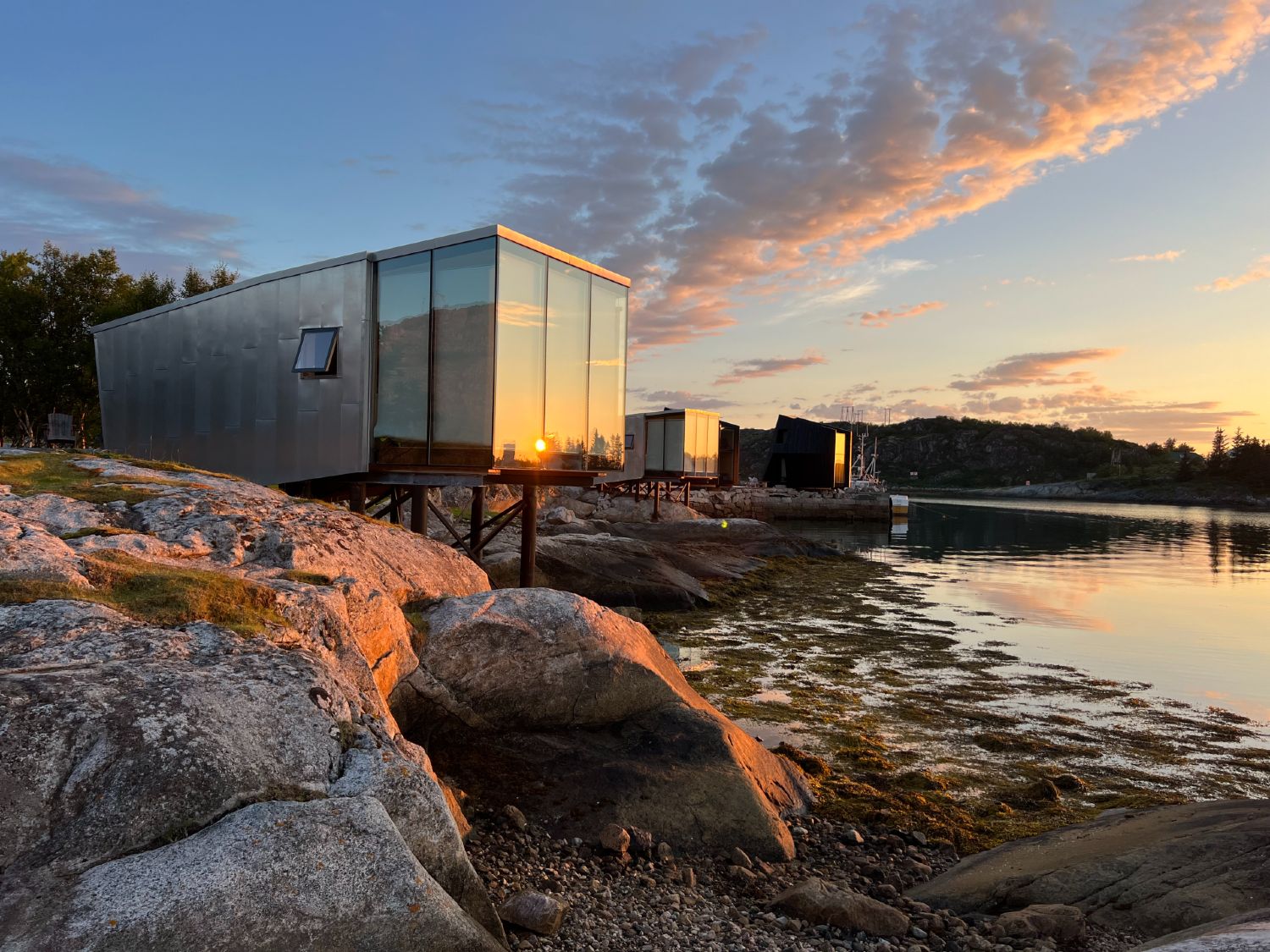
    Set on stilts above rocks and the ebbing tide, Manshausen’s nine modern cabins are made of wood, glass, and metal. Their angles and stark edges contrast the natural elements yet meld harmoniously within the scenery. The warm wooden interiors are simple and highly functional, with cubbies, hooks, and storage nooks in all the right places—except for the bathroom. Angus, a few more towel hooks would be helpful, please.


    Click Here for a Free List of all my Wish List Destinations


    Franz Josef, Grønland, or Patagonia?

    Each sea cabin on the island is named for one of Børge’s expeditions. The towers, Nansen and Amundsen, pay homage to his idols in polar exploration. It won’t surprise anyone who knows me that I heavily researched the ‘best cabin on Manshausen’ before booking. Phone calls were made. Aerial maps were navigated. Leaving this very important decision to fate was not an option.

    Franz Josef sits just above the water and has uninterrupted mountain views. Its location at the far edge of the island means no one walks past our cabin, which is fairly important since they’re made almost entirely of glass. 

    The sea cabins advertise to sleep four people. In hindsight, we should have booked two cabins. During our stay, Norway experienced warmer-than-usual temperatures, and the second bedroom became an unwanted in-room sauna. I’m guessing this isn’t typical—unless you believe in global warming—otherwise, Manshausen should consider central air. Next time, we’ll book Patagonia, too.

    Crab tartlet

    Beach Mustard, Bread Ice Cream, and Other Culinary Surprises

    Our three days on Manshausen are filled with round-the-clock sunshine, blue skies, and temperatures in the mid-70s. The weather is a gift in this part of the world known for highly changeable microclimates. I sit in my chair, but not as much as I thought I would. There’s too much to see and do.

    Mornings on Manshausen are leisurely. Angus visits each guest at breakfast in the main house to confirm plans for the day. Ondrej, Manshausen’s chef and island co-host, creates magic in the open kitchen with a friendly and seasoned staff. 

    Haibut and beach mustard

    Ondrej tells us nearly all the ingredients he uses are foraged and sourced from the island and local area. On our first night, we have halibut topped with a plant I’d never seen. “It’s beach mustard,” Ondrej says, then mentions he’d found it earlier while walking. I later learn beach mustard is an aquatic herb with a salty, juicy flavor. It’s a spicy contrast to his light, flaky fish and poached tomatoes.

    Dining Room Manshausen

    Overall, the food quality, presentation, and variety is another surprise. I’d been anticipating small, oily fishy fish like sardines and anchovies. Instead, we dine on freshly caught halibut and cod. Ondrej pairs unusual ingredients with familiar ones. We enjoy root vegetables like beets, cabbage, and parsnips in multiple ways. Truffle seaweed, pine shoots, and pine cones adorn our plates. Ondrej makes ice cream from leftover bread that he roasts and infuses with milk. Bread ice cream. Brilliant.

    Row boat

    A Typical Day on Manshausen is Never Typical

    One of the perks of never-ending sunlight is that activities are pretty much available 24/7. One night, our kids take the rowboat to Nordskot at 10pm in search of gummy bears. My husband and I watch from the cabin. Though we can’t hear them, it’s pretty clear from how the boat is rocking that they’re arguing. We look the other way.

    Layers of mountains provide endless viewing entertainment. Norway’s mountainous mainland changes from green to blue to deep purple, and far beyond it, the Lofoten Island archipelago’s jagged peaks look like they were cut with a razor’s edge.

    Manshausen offers adventures for every type of traveler. One morning we kayak, spotting our first sea eagles of the trip. Another day we fish, and my son catches four large halibut Ondrej will likely serve for dinner. 

    Resshola Cave

    There’s hardcore mountain climbing along the Nordskot Traverse and more moderate hikes like the one we take to Resshola Cave. Otherwise known as ‘Troll’s Cave,’ it’s 140 meters deep and blankets us in complete darkness for the first time since arriving in Norway. Those trolls really know how to hide. I didn’t see a single one.

    Each day, I walk the island, searching for treasures and following the sheep. All they do is eat and bleat. Bessie is my favorite, as she’s the hungriest and always lets me feed her. 

    Sheep

    Another woolly ewe wears a bell around her neck. I ask Ondrej if it’s so the staff knows where the sheep are at all times. “Actually, no.” He says, “It’s for the sheep. They get distressed when they can’t find each other, so the bell keeps them from getting lost.” At 2am, that very bell tells me the flock is grazing outside Franz Josef’s cabin. Such is life on Manshausen Island. 

    Sauna

    Sauna Culture

    Sauna has been an integral part of Scandinavian culture since, well, forever. Many consider the sauna a sacred space, ‘Nature’s Church,’ a place to cleanse the mind, body, and spirit. It’s easy to see the allure. The mystical and traditional characteristics of the island permeate everything.

    The wooden sauna sits beside a natural pool of water. Although the air temperature is warm, the water is anything but. Yet, it’s the best way to prepare, so we jump in and brave the chill. I cleanse my mind, body, and spirit multiple times a day. It’s so restorative my husband now wants one at home. Sauna—the ultimate Scandinavian souvenir. 

    Manshausen is Unreal/Real

    After three days on Manshausen, we gather our things and get ready to meet the ferry. From Nordskot, we will head north to tackle the luminous Lofoten Islands, whose peaks we’ve been admiring in the far distance. 

    When the ferry floats in, it unloads a few new travelers destined for Manshausen. I wonder how they found it. Did they see it on Instagram? Which cabin did they get? I want to tell them to feed Bessie because she’s always hungry. And I want to prepare them for the ethereal colors of the sky at one o’clock in the morning. I want to hear what they think about bread ice cream. 

    I want to stay.

    Author on the jetty

    Manshausen blurs the lines between illusion and reality. Its location at the edge of the world furthers its dreamlike qualities. Once it’s entirely out of view, I turn around and face north. The Lofoten Islands are waiting. ‘But where will we go next?’ I can’t help but wonder.

    I open Instagram and start scrolling.


    Click Here for a Free List of all my Wish List Destinations


    Author’s Note: For those who wonder how we packed for this trip, it was carry-on only all the way to the Arctic. My go-to brand is Eagle Creek. Their Gear Warrior Backpack was ideal for my 18-year-old son, pictured below.

    Backpack on ferry
  • Stowe in Summer: 10 of the Best Ways to get Local

    Stowe in Summer: 10 of the Best Ways to get Local

    A few summers ago, my husband and I decided to head north. To live village life, country life, and a less rushed life in the mountains of Stowe. My parents’ house was empty, and it seemed an ideal way to escape the oppressive DC heat—a way to break the monotony that had gradually manifested over the past few months.

    Swimming with dogs

    We packed up only the most essential items: our kids, our dogs, a few hundred Nespresso capsules, and cornhole. As it turned out, our essentials don’t fit in one car, so we took two and began our 10-hour caravan to New England. We’ve been living in Stowe for over a month now, and while our kids may do feel slightly differently, it was the decision of the year for me and Daniel. I’ve learned a lot about living a simple life. For one, I’ve discovered that while big luxuries are great, little luxuries are even greater.

    Dogs in pond

    I’ve compiled a list of the things that Stowe and village life have given me—a mix of the tangible and intangible. A list of things I hadn’t thought much about but now seem overwhelmingly luxurious. My list is by no means complete and is seen through my tiny, rose-colored lens. I am excited for this list to grow as we spend more time in New England. But for now, and in no particular order, are the 10 things I have learned to appreciate, love, and (dare I say?) consider true luxuries about Stowe living.


    Click here for my free Stowe Summer Hot Sheet


    Church steeple

    THE BEST OF STOWE #1: THE RECREATION PATH

    Looping gently around the town of Stowe and covering 5.3 scenic miles is the much-loved Rec Path. The path is beautifully maintained and easily accessible. One natural starting point is directly behind the Stowe Community Church, the soaring centerpiece of the village. However, there are countless places to enter and exit the serpentine route.

    Sixteen meticulously kept wooden bridges appear intermittently, crying out for photo ops as they arch over clear, stone-filled streams. The low rumble of bikes that pass over the wooden slats would alert me to their oncoming presence. Tots on tricycles would whiz past me, their parents racing to catch up. Bikers, walkers, and runners share the meandering path, which bends and curves around and behind the town’s main streets.

    Wooden arched bridges

    Lovely, hidden picnic spots dot the water’s edge, and I often hear kids splashing and squealing by the banks. A picturesque way to burn calories, the Rec Path has just the right balance of shade and sun, streams and fields, and cows and gardens to keep me entertained for a few hours.

    Often, we bike to the back garden of Idletyme Brewing Co., a local restaurant, and enjoy a well-earned drink to cool off. It has an idyllic location on Mountain Road and the Rec Path. Fried pickles tempt me, which is no surprise if you read ahead to little luxury #3. Oversized, soft pretzels come hanging on a stand with various dipping sauces. Daniel always orders a flight of local IPAs from the tap.

    THE BEST OF STOWE #2: THE QUIET PATH

    If the Rec Path doesn’t conjure up a Norman Rockwell portrait, the Quiet Path certainly does. Built as a low-impact extension of the Rec Path, the mown grass pathways keep the Quiet Path true to its name.

    The 1.8-mile panoramic route hugs the perimeter of tall, rapidly-growing cornfields and a burbling stream filled with beaver dams that my dogs always seem to destroy inadvertently. Alpine views are within sight, as is the steeple of the community church in the distance at specific points along the way.

    Foot traffic only, whether four-legged or two, is allowed, and I found it amusing to read that dogs need to be under voice or leash control. Voice control is certainly not guaranteed with my two willful dogs, but luckily, I have yet to be reprimanded.

    radishes

    THE BEST OF STOWE #3: THE FARMERS’ MARKET

    Sunday mornings quickly became something to look forward to when every day was beginning to feel like a Sunday. What was once a small smattering of vendors has since blossomed into a destination unto itself—the Stowe Farmers’ Market. A gathering of local vegetable producers, cheese vendors, ice cream makers, handmade crafts, and a variety of ethnic food stalls, the market offers different tastes and treats for the widely differing taste buds in my family.

    My favorite food stall is Green Mountain Potstickers. Homemade dough that is just the right consistency, and balanced with the optimal amount of fillings—like edamame, scallions, chives, and tofu, for starters. Their scallion pancakes easily compete with those I’d had long ago in Beijing, as do the cold sesame noodle salads topped with julienne-sliced veggies.

    Dumplings

    The list of vendors and artisans at the Stowe Farmer’s Market has grown since the summer of COVID. Some of my favorites include Two Sons Bakehouse, Sage Farm Goat Dairy, and Stephanie Grace Ceramics. I don’t know how someone could pass by her stall without wanting to buy one of her magnificent porcelain creations. I certainly couldn’t.

    Stephanie Grace ceramics

    The market is open from 10am-2pm from May through October. Go for lunch and be sure to grab a picnic table in the shade.


    Click Here For My Free Stowe Summer Hot Sheet


    Sage Goat Farm

    THE BEST OF STOWE #4: SAGE FARM

    I discovered that one of the Farmers’ Market vendors is just up the road from our house. Sage Farm Goat Dairy is a picture-perfect, Insta-ready, and family-run goat farm located on Upper West Hill Road. The weathered gray barn/farm store sits neatly next to a field of wildflowers and a tattered wooden fence. A small sign invites customers to walk in. The store is unattended and provides an honesty box alongside the refrigerated case of small-batch artisanal goat cheeses and fresh eggs.

    Chickens peck noisily at the ground; some days, we spotted the goats roaming the fields. They have a bucolic spot, those lucky alpine goats. By the smug look on their long faces, I’m guessing that they know it.

    Maria's Garden

    THE BEST OF STOWE #5: FROM MARIA’S GARDEN

    A pretty, gray, clapboard house sits at the top of Cape Cod Road; the charming roadside flower stand called From Maria’s Garden. Mason jar-filled wildflowers are presented daily, as are hand-cut bouquets and potted plants. A price list and honesty jar sit nearby, and she recently let me know that she has had the honor system in place since 1987—honesty—a popular Stowe theme.

    As her website notes, Maria escaped the corporate life in NYC to live a simpler one in Vermont. She is a certified floral designer. Aside from her daily roadside flowers, she designs for weddings and events. 

    Every time I drive past, I am tempted to buy, and during our first few weeks in Stowe, I did just that. The homespun feeling that radiates from the colorful property is magnetic, and I have often seen Maria’s husband, shears in hand, cutting for the day’s arrangements.

    Lately, noticing the variety of wildflowers that are blooming in our own backyard, I’ve started to create my own masterpieces. Although I think I need a little help. I wonder if Maria is available for lessons?

    Village main street

    THE BEST OF STOWE #6: STOWE VILLAGE

    The village of Stowe has a storybook setting, just the right amount of charm, quaint shops, ice cream parlors, and lively (modern definition: ‘socially distant’ lively) restaurants to wander and explore. Stowe village is slow-paced, an inherent part of its charm.

    My son and I bike to breakfast some mornings, passing acres of cornfields and barns, and sit outside at his favorite, Café on Main. We eavesdrop on the locals gossiping over their coffees and Stowe Reporters. Little shops hide behind big shops. Stowe has many lovely historic homes to gawk over; photographing them became another daily pastime.

    The Historic Old Depot houses one of my favorite Stowe treasures, Bear Pond Books. Perhaps because it was ‘born’ the same year I was, 1970. Or that it’s a 2nd generation, family-owned, independent bookstore that’s still going strong despite the rise of Amazon. In 35 years, I’ve never visited Stowe without getting lost in the aisles of Bear Pond.

    Jennifer Hale, the owner, and her staff handpick the books. Her sweet pup, Tucker, curls up on a bed behind the register. I wonder if he, too, has a say in the book choices, as there are a lot of canine-related tomes. It feels highly curated, warm, and inviting, even on the coldest winter days. I rarely leave empty-handed. 

    A notable Stowe fact is that neon signs are strictly forbidden. Yet another way that Stowe can maintain its charm. Until I found myself in a non-neon environment, I realized how much of my life is neon-filled. Its absence has been refreshing.

    hikers on cliff

    THE BEST OF STOWE #7: STOWE TRAILS

    The countless hiking and mountain biking trails could take up a post of their own. Suffice it to say that hiking has become one of my go-to activities over the years, and Stowe has more mountains, gorges, notches, summits, and waterfalls than I have time to tackle.

    One morning, Daniel and I hiked to Sterling Pond. A steep, natural rock staircase welcomed us to the 2-mile climb and got my legs fired up faster than I was prepared for. Dense foliage, streams, and wet rocks gave way to tall pines, signaling that the summit was close. Moss-covered stones, fallen tree trunks, wild mushrooms, and a plush carpet of ferns covered the mountain floor. The reward for our efforts was a glorious, serene pond, which, to me, should be called a lake. Whatever it is called, it was a beautiful sight after an arduous climb.

    Man hiking long trail

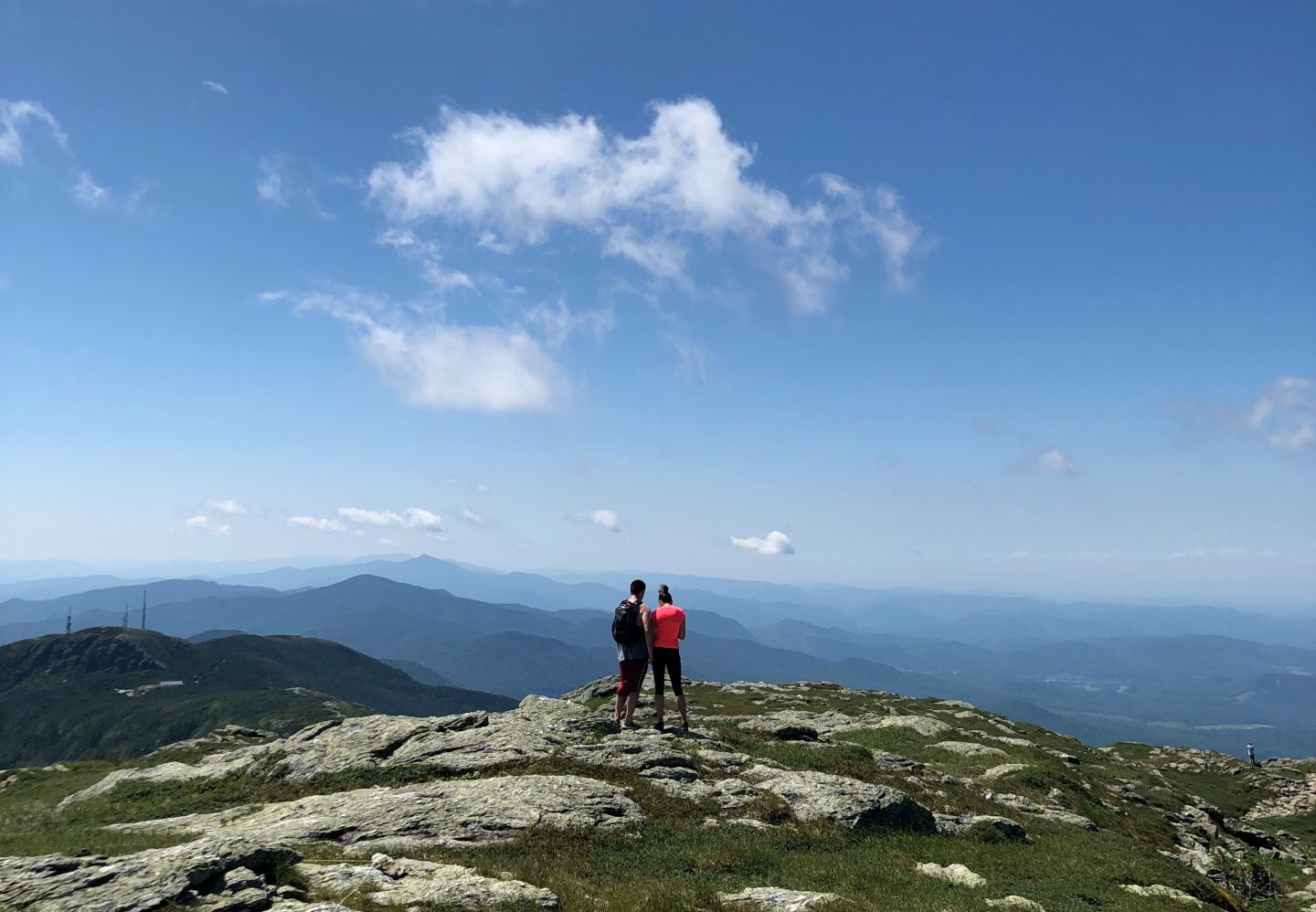
    Our next morning of hiking started with a steep, 4.5-mile switchback drive to the top of the Toll Road, followed by an hour-long open vista hike (The Long Trail) to the ‘chin’ of Mt Mansfield. There, we were rewarded with blue skies and 360-degree views of the area. We looked down over the grass-covered winter ski runs and gazed out towards the distant layers of overlapping mountains. My favorite kind of hike—one that both starts and ends at the top. Views rule.

    While hiking back towards the car, we passed a man with a butterfly net, who we learned was actually searching for dragonflies. Although not just any dragonfly—he was on a mission to spot a  particularly elusive species. Since then, I’ve taken note of the dragonflies I see every day at the pond after not having given them any thought before.


    Click Here for My Free Stowe Summer Hot Sheet


    butterfly monarch

    THE BEST OF STOWE #8: WILDLIFE, VERMONT-STYLE

    Who needs Africa to experience wildlife? In Stowe, I’ve seen beavers, frogs, hummingbirds, dragonflies, chipmunks, cows, gophers, snakes, horses, and even a pair of berry-eating bears. While not the traditional ‘big five,’ wildlife is fascinating regardless of size.

    One early morning in July, my walk revealed a world of beaver dams, vivid clusters of fiery tiger lilies, dilapidated barns, and grazing cows. Even if I chose the same route to walk each day, I would inevitably spot something I hadn’t seen the day before, which was due, in part, to the ever-changing light, weather conditions, and bovine behavior.

    I stopped mid-run one day to take a photo of a cornfield and found myself at a stand-off with a suspicious gopher. While stretching, later on, I caught a Monarch butterfly feasting on a flower. I never stop in my DC life. In Stowe, I stop and, in doing so, am rewarded with the littlest, most beautiful sights.

    Pond reflection at night

    THE BEST OF STOWE #9: AL FRESCO DINING

    Being such a popular, all-season travel destination, it isn’t surprising that Stowe has restaurants and cafés to suit just about everyone. Having had years of local eating under my belt (literally and figuratively), I came to town armed with a few faves.

    The Bistro at Ten Acres has been perched at the junction of Luce Hill Road and Barrows Road for as long as I can remember and has always been my parents’ favorite. We sat outside for dinner, watching a particularly remarkable sunset one night, and wondered what it would be like to cash it all in and make the simple life of Stowe a permanent one.

    Even outdoors, the Bistro at Ten Acres feels intimate. A musician played guitar, just far enough from the patio so that we could still have a conversation. The dry summer air made the night memorable, as did my lovely spring pesto over homemade linguini.

    At 91 Main Street, California-inspired Plate became a new favorite. The owners, originally from LA, have been in Stowe for years. Their menu is described as being able to satisfy meat lovers and hard-core vegans. I’m not vegan, but I gravitated toward the vegan dishes when we visited. I thought the vegan crab cake starter was a menu highlight, as was the Tofu Ramen and Plate’s interpretation of a veggie burger. The wine list was incredibly well-thought-out, and I’d be lying if I said that didn’t somehow factor into our return throughout the month.

    Sweeping views of corn

    THE BEST OF STOWE #10: MOUNTAIN SCENERY

    Bucolic pastoral scenes that appear to be lifted from the canvas of a Wyeth abound. Wispy streaks of yellow grasses and lavender wildflowers lay against green pastures and distant blue skies. This led to an epiphanic moment.

    After having spent days wondering why the sunsets seem to be more colorful in Vermont or the clouds more defined, I finally realized that it had nothing to do with the sun or the clouds at all. It’s the scenery against which the sunsets set and the cloud formations sit above that make it more spectacular. The sky can be gorgeous anywhere, like over the NJ Turnpike, for instance, but it wouldn’t look quite as pretty. (No offense, NJ). It’s the surrounding scene that makes it extraordinary.

    The late afternoon thunderstorms that pass through mountainous Stowe instantly turn on all of the primary colors of the landscape. At times, we’ve been able to see both the incoming storm and the blue sky at exactly the same time. The dark clouds would inevitably swallow up the sky, and then bright blue would once again emerge.

    After one particularly fast and furious morning storm, I witnessed a full rainbow that was so bright that it glowed.

    kids in pond

    SUMMER ISN’T OVER, YET

    Tomorrow, I head back to DC. Our house in Vermont has felt like another world, and the change of scenery has been healthy on many levels. I’ve realized that I can define luxury in more ways than I had thought. Luxury is personal. It’s spotting a photo-worthy pond, buying pickles at a farmers’ market, or goat cheese from a barn with an honesty box.

    How do you define luxury? It’s worth finding out.


    Click here for my free Stowe summer hot sheet


    Interactive Map of My Favorite Stowe Places

    Trip map created using Wanderlog, for making itineraries on iOS and Android

  • From Jamaica, With Love: The Goldeneye Resort Review

    From Jamaica, With Love: The Goldeneye Resort Review

    Our van takes a sharp left from the busy road through a small gap in an unassuming stone wall. Twisted tree limbs dangle over it and I have the urge to hold my breath as we squeeze through. I peer out the rear window, half expecting the gap to close up and disappear into the overgrowth. I’ve arrived at Goldeneye in Jamaica, the very place where James Bond was brought to life by author Ian Fleming. Although I’ve been on the grounds all of seven seconds, its magnetic pull is undeniable.

    It’s another world in here.

    Goldeneye views

    Why Jamaica?

    We choose Jamaica for utilitarian and unromantic reasons. It’s less than two weeks until the avalanche otherwise known as Christmas arrives and Jamaica is a non-stop three-hour flight from DC. Perfect. I need a quick getaway to find my holiday spirit. I hope it fits in my carry-on. I’ve overpacked as usual.

    Our driver is easy to spot, holding up a small sign that reads ‘Goldeneye’. I smile, imagining myself beachside within the hour. ‘How far to the resort?’, I ask, ready to get out of my bulky plane clothes. ‘Two hours’, he replies with a wide grin. I throw my head back and laugh, having heard this joke before. ‘No, really.’ I say, ‘How far?’ Still smiling, but not joking, he repeats, ‘Two hours.’ Ugh.

    Goldeneye views

    But, once we pass the mega, all-inclusive resorts of Montego Bay, the ride is a snap. I take mental notes as we traverse the northern coast of the island: uninterrupted views of the Caribbean Sea, colorful rowboats in shallow salt marshes, hot pink oleander hovering over narrow medians, and banded palm trees lining crescent coves. 

    Before I know it, two hours have elapsed. As a bonus, I’m completely relaxed. 

    Our van takes a sharp left… oh wait, you know that part. Moving on.

    Map of Jamaica

    Goldeneye, Jamaica: A Brief History

    Super fans of 007 will likely know that Jamaica is where Ian Fleming wrote his famous British spy series. In 1946, Mr. Fleming, a former British soldier himself, built Goldeneye, a villa perched majestically on a sea cliff with expansive Caribbean views. At one time, Goldeneye was the social epicenter of the island, with guests like Truman Capote, Princess Margaret, and Errol Flynn coming and going throughout the year.

    Twelve years after Mr. Fleming died, reggae pioneer Bob Marley bought the estate. Shortly thereafter, he sold it to Island Records founder, Chris Blackwell who added 25 acres to the original 15 and converted the property into a small hotel.

    Goldeneye views

    James Bond is the most charming secret agent in history. And while I’m a big fan, I’ll admit now that I was a tad nervous about the Bond theme being too, well, theme-y. It’s not. There are subtle nods, like the License to Chill cocktail I enjoyed at Button Beach every day. But, that’s about it. So, if you’re a 007 enthusiast hoping for a Bond-themed lazy river or paragliding excursion, manage your expectations.

    Goldeneye hasn’t lost its original allure. Celebrities, models, and rock stars alike visit today—just not the week we are there, unfortunately.


    Click here for my wish list destination hot sheet. It’s free.


    One bedroom beach villa

    Rooms With A View, At Goldeneye

    Goldeneye has three types of rooms; beach villa, lagoon cottage, or beach hut. Despite being within such close proximity to one another, they are very different. As the name implies, beach villas are on the beach. Unlike other resorts where a beach villa might mean you have to walk (gasp!) five minutes to said beach, Goldeneye’s beach villas are located in the sand, just steps from the water. 

    Let me flog my point. I pack four pairs of shoes, including the sneakers (or trainers, this is a former English colony!) I wore on the plane. Once at the resort, I don’t wear shoes. Not to dinner, not to the spa. Not at all. I’m pretty much walking on sand the entire time I’m there. If Goldeneye doesn’t define ‘barefoot luxury’ I’ll eat my shoe (I mean, trainer).

    Our villa has a wide-covered veranda and two beach loungers on either side of a large umbrella facing Low Cay. The decor is beach shack fancy, Jamaica-style. Aka rustic. Our villa has dark wood accents, bright batik-dyed colored fabrics, a claw-footed tub, and a refreshing outdoor shower.

    A full kitchen we never use has a Smeg refrigerator that keeps our Red Stripe and bottled water cold. The gauzy netting above our king bed isn’t decorative, which worries me. That I wake up bite-free each morning is a mosquito miracle.

    Lagoon cottage
    Lagoon cottages

    The Blue Lagoon (Cottages)

    The lagoon cottages would be my second choice of accommodation at Goldeneye. Perched directly on the calm, warm lagoon, they’re unlike anything I’ve seen in the Caribbean. The lagoon people can swim from their private docks to search for giant sea turtles lurking below the surface. They can tie their kayaks up to the dock after a late afternoon paddle.

    It all feels very Blue Lagoon circa 1980—sans Brooke Shields and Christopher Atkins. I’ll bet they’ve been past guests. I make a note to check the guest book.

    Bed at beach villa

    Hut Life

    Goldeneye’s beach huts are a world unto themselves, clustered between Button Beach and Snorkeler’s Cove. Contrary to the name, beach huts are not on the beach. They are huts near the beach. It’s an important nuance. Some huts are raised ten feet from the ground and overlook flower-filled gardens and paths. Others have private verandas and outdoor showers.

    According to Goldeneye’s website, hut life is about casualness and simplicity. It states that the freestanding huts are special because of the louvered windows that control the light and breeze. To me, this is code for no air conditioning. But, if you’d like a basic, primal, louvered window wooden cabana near the beach, consider hut life.

    Pretty windows notwithstanding, if we ever wondered if we were hut people, the huts at Goldeneye assure us we aren’t. 

    Pool at Goldeneye

    Simple Luxury, at Goldeneye

    Our waiter does a little jig between the tables, singing along with the music, a wide smile on his face. The Field Spa hut dangles over the lagoon’s edge and I enjoy a warm foot bath on the veranda while awaiting my massage. Johnny cakes for breakfast and homemade plantain chips with snapper ceviche for lunch. The simple luxury of Goldeneye is in the details.

    Johnny cakes breakfast

    Sea turtle nests are found around the beach villas. Wooden signs acknowledge their locations and lighting is kept intentionally low to accommodate them. The benefit of tiki torches being our sole source of light means we can see constellations overhead with such clarity I walk into more than one palm tree while stargazing.

    This could be 1964, 1974, or 2004. I doubt much has changed at Goldeneye in Jamaica over the decades. It’s no-frills, simple luxuries like these that have guests returning again and again.

    Goldeneye views of lagoon

    To Do, Or Not To Do

    At Goldeneye, I do practically nothing. If there was ever a place to do nothing, this is it. I don’t leave the property. Aside from eating, drinking, and sleeping, here’s a list of what I did:

    I read The Heaven and Earth Grocery Store, by James McBride. If you haven’t read it you are missing out on some seriously fine writing. No offense, Mr. Fleming.

    I kayaked around the lagoon. It was so serene and peaceful that I did it twice.

    I had a sports massage. This wasn’t serene or peaceful. My mistake—I should have chosen better.

    In four days, my step counter totals under 5,000 steps. It probably thought I was dead.

    Who Goes to Goldeneye?

    Aside from all the celebrities we don’t see at Goldeneye, the resort caters to normal people who want complete seclusion in a lush, tropical setting. There’s plenty for kids to do, snorkeling, swimming, and an array of other water sports like sailing and SUP. But once the sun goes down, it’s pin-drop quiet. While that’s appealing to me, who believes a good night’s sleep is a gift from the gods, kids might disagree.

    We come to Goldeneye seeking escape, not adventure. Goldeneye delivers. Natural beauty is everywhere. The Caribbean Sea, turquoise lagoons, fiery sunsets, and thousands of trees. We see trees in every stage of life, from newly planted plum, almond, and mango trees to mature orange, coconut, and apple trees. 

    Many of these trees have signs displaying who donated them. Goldeneye’s innovative plant-a-tree program means guests can tell friends at home that their mango tree grows beside Kate Moss’s coconut one. Your bragging rights are helping to sustain the planet. One thousand dollars well spent.

    Goldeneye views

    Goldeneye: The Antidote to the Mega-Resort

    Ian Fleming may be long gone, but his creativity lives on in this picturesque and remote coastal part of Jamaica. It’s all too easy to see how one can be inspired here. The gentle, lapping waves, mesmerizing sea turtles, starry nights, and whistling birds are just a few of the reasons Goldeneye Resort is so captivating. 

    Forget what you think you know about Jamaica. It’s not only mega-resorts with water slides, pirate-themed water parks, and ‘frozé all day’. Not that there’s anything wrong with frozé. Actually, everything is wrong with frozé, but that’s an opinion for a future post.

    Ian Fleming book cover

    It’s another world behind the stone walls of Goldeneye. Channel your inner secret agent. The one who needs to relax after saving the world from total destruction (or trying to get your son into college, etc). Find a reason to go barefoot and fancy-free for a few days. Bring a book. Consider Casino Royale—the very one that kickstarted Fleming’s famous series.

    Or do nothing at all.


    See what all the fuss is about at Goldeneye. Click here!


    Click here for my wish list destination hot sheet. It’s free.


    Note: This post contains an affiliate link. But don’t worry, I only partner with brands I use myself!

  • How to get to Antarctica—the most extreme place on Earth

    How to get to Antarctica—the most extreme place on Earth

    My Antarctic travels reveal more than the differences between Weddell and Leopard seals. Or how Gentoo penguins care for their young. My Antarctic travels reveal the power of the wind. And how much of an iceberg we really see floating above the water’s surface. Antarctica evokes awe. I discovered anything can happen in Antarctica—which is exactly the way it should be. Wondering how I got to Antarctica? Bundle up—you’re in the right place.


    Whale under kayak

    A humpback whale breaks the water’s inky surface. Remains of barnacles, those ubiquitous ocean hitchhikers, appear on its bulbous body. Thirty feet from my sea kayak, I see its dorsal fin and tail disappear into the sea as if caught in slow motion. An iceberg provides a striking background to its dripping fluke. It takes a deep dive, and I nervously wonder where and when it will resurface. 

    I’m in Antarctica, the most extreme place on Earth. A humpback whale is swimming directly beneath me. Justifiably, I’m a little nervous, but mainly, I feel at peace. 

    Mountain scenery

    The idea of Antarctica 

    I can’t recall what inspired my Antarctic travels. But it will surely have to do with a combination of three things I crave: adventure, wildlife, and a desire to go places before everyone else.

    I asked Rick, my 78-year-old stepfather, if he’d like to join me. The conversation goes something like this: “Rick, do you want to go to Ant—” 

    “YES!”

    I could well have been asking Rick to go to Antwerp. Rick is up for anything, which is one of the reasons I ask him. He doesn’t bat an eye. Antarctica, Antwerp, Antigua. He’s in.


    Click here to get my free wish list destinations hot sheet!


    Ultramarine with zodiac

    Antarctic Travels: Quark’s Ultramarine

    There are two ways to get to Antarctica—by airplane or by ship. Ships typically depart from the southernmost tip of Argentina, from a city named Ushuaia. I choose Quark Expeditions’ ultra-modern Ultramarine. Quark has decades of experience in polar travel. Their two-year-old Ultramarine has a maximum capacity of 199 guests. It’s purpose-built for polar travel and is purely expedition-based. These two factors weigh heavily in my decision.

    Purpose-built means the ship was designed from scratch to handle polar conditions. Expedition-based means the trip is all about wildlife, excursions, and the environment: no cringe-y nightly shows or formal dinners. 

    Penguin with boat

    Base Camp

    The Ultramarine is the equivalent of a mountain climber’s base camp. It has everything we need to stay safe, keep warm, and be well-fed on our daily adventures. For instance, Deck 2 has two ready rooms where each guest has a personal cubby for outdoor gear, life-saving equipment, and muck boots. Deck 2 is designed to fast-launch twenty Zodiac boats that shuttle intrepid explorers around the sea with the speed and precision of a military operation.

    Gentoo penguin

    Deck 5 is where the main restaurant, Balena, is located. Balena’s ever-changing menu has options from fresh tuna to filet mignon. It also has a daily ice cream station where the chef recreates my childhood fave—the Chipwich. There is no all-day buffet, but I can promise that no one on the Ultramarine goes hungry.

    Sauna

    Deck 8 has two twin-engine helicopters for flight-seeing, heli-trekking, and heli-landings. Deck 7 has features designed for self-care—a sauna with floor-to-ceiling windows and the aptly named Tundra spa. Bistro 487 and the Panorama Lounge are also on Deck 7—with spaces designed for maximum relaxation between excursions.

    Leopard Seals

    Antarctic Eco-Matters

    Quark Expeditions has a strong sustainability and eco-conscious mindset. They care about the planet and show it. A few examples include the lack of single-use plastic on board the Ultramarine. Instead, guests are given two soft water bladders that can be refilled at stations throughout the ship. The boat is practically paperless. Computer displays on each deck outline the day’s events, and an onboard phone app provides instant access to information. 

    Our muck boots are disinfected after each polar landing so as not to spread avian flu. For the same reason, we aren’t allowed to kneel or place equipment on the continent during excursions. The crazy (I mean, adventurous) explorers who sign up to sleep one night on the continent are only allowed to take a sleeping bag. No food. No drinks. And no tents. They are told not to pee on the continent, either. How this played out is anyone’s guess.

    Quark has its eco-mindset firmly set. It also has a team of expedition guides I want to be when I grow up.

    Iceberg with zodiac

    Explorers Wanted

    Our Expedition Leader is named Abbey. Along with the Captain, she’s in charge of, well—everything. Abbey wakes us from our polar slumber each morning via the PA system. Each evening, she (and the team) presents a recap of the day’s events and a briefing for the following day’s Antarctic travels. 

    Abbey’s sentences often begin with ‘If conditions allow…’ or ‘We are hoping to…’. This isn’t because Abbey is ill-informed. It’s because, from day to day, no one but Mother Nature knows quite what the Antarctic has in store. If this doesn’t pique your interest, perhaps Antarctica is best visited from your couch with David Attenborough and the BBC.

    For example, the day we are due to explore Hidden Bay, Mother Nature decides to deny us entry by creating winds the Ultramarine can’t battle. A humbling moment like this makes each day a true adventure in Antarctica. It also makes it difficult to be Abbey.

    Visitors on the continent

    Antarctic Travels: The Ultramarine Dream Team

    The Expedition Team is a multifaceted group of explorers. Fabrice is Ultramarine’s ornithology presenter. He is also a biologist, a children’s picture book author, and a skillful Zodiac driver. Michelle is the onboard photography guide. She is also a trained field guide and fluent in Spanish, French, Catalan, and the Queen’s English—a bonus for many European and South American passengers.

    Ross is a 26-year-old British historian. He treats polar history with the gusto of a Broadway performer on opening night. History was my least favorite subject in school (sorry, Ross), yet I’m riveted by every talk he gives. I go to the lounge early for a front-row seat to his Shackleton presentation. I’m not the only one. Ross has a talent for storytelling that goes well beyond his years.

    The expertise and unity of the crew, expedition team, expedition leader, and captain (140 people strong) are critical to the journey’s success. When I spend ten hours in my cabin on lockdown due to a category of wind just shy of hurricane strength, I want to know that my fate is in the hands of experts. That way I can best enjoy my pan-seared Dover sole with lemon and couscous while watching The Secret Life of Walter Mitty on my flat-screen TV without a trace of anxiety.

    Room/Cabin

    Cabin Fever

    My room is big—only marginally smaller than my first studio apartment in NYC, and with more closet space. The modern bathroom has an oversized mirrored vanity, a walk-in shower, and heated floors that are perfect for drying wet gloves or hats overnight. While built-in bottles of shampoo, conditioner, and body wash containers align with the no single-use plastic model, it also means nothing is falling off the shower ledge as we cruise through Antarctic waters.

    Cabin 325 has a large picture window facing the sea nearly at sea level. I’m on Deck 3, the lowest deck for cabins, and I like the view more than I anticipated. I sit in the deep window frame with a pillow each night to watch the sea for whales and the sky for birds. I count wandering albatrosses, storm petrels, and Antarctic prions as the sun sets. January is summer in Antarctica, so it stays light well after I’ve gone to bed.

    This window is a backstage pass to Antarctica’s glory. I don’t even need to leave my room to experience it.

    Ultramarine boat

    The Drake Passage, Part One

    The Drake Passage is infamous. These words conjure up age-old explorers, choppy, turbulent waters, epic winds, and crashing waves. In the factual sense, the Drake Passage is the shortest route from civilization to Antarctica. It’s 620 miles wide and over 11,000 feet deep, with water passing through it at up to 200 million cubic yards per second. I’m not one for numbers, but that sounds pretty intense. In the abstract sense, the Drake Passage is one of the planet’s most thrilling and exclusive adventures.

    I lift my gaze towards the open sea as we leave the safety of the Beagle Channel. Who knows what awaits—which is another part of the adventure of Antarctic travel. Waves gently roll for hundreds of miles with nothing to break their undulating stride. Our two-day passage proves to be eerily calm—an extreme often called the Drake Lake. Guests toast the sea gods with another cocktail. And another.

    None of us think about the fact that we will have to come back. It’s just as well.


    Click here to get my free wish list destinations hot sheet!


    View from boat

    Outside, it’s Antarctica

    It’s 630am. I race to my cabin window. A world of polar white greets me. I stumble as I get dressed. I grab my binoculars, camera, and heated vest. It may be early, but the rattle and hum of the ship are palpable. The combined energy of 136 toddlers waking up on Christmas morning. I’m afraid if I waste even one moment, Antarctica might disappear.

    Solo penguin

    We have arrived at Hughes Bay, which lies along the west coast of the Antarctic Peninsula. It’s 26 miles long and may or may not have been the site of Antarctica’s first mainland landing in 1821. None of this means anything to me right now. I’m taking my first polar breaths and catching the first polar breezes on my cheeks. I’m awe-struck by the first windswept, snow-covered landscapes of Antarctica.

    Sixty seconds elapse before I see a glossy humpback whale leisurely swimming off the ship’s bow. I’m stunned into silence. I’m not alone.

    Mountain scenery

    Antarctica is otherworldly

    How can one render the vastness and otherworldliness of Antarctica? A photographer can capture it on film, but depth of field limitations are a hindrance. An artist can draw it but is bound by the edges of the canvas. I’m visual by nature, tied permanently to my camera. But try as I might; the only way I can describe it is through sound.

    I hear the rhythm of waves propelling and releasing icebergs, whales trumpeting, and wind whistling. I hear the ice cracking, the deafening echo of ice shelves calving, and distant avalanches roaring: the ship keels and creaks. 

    I close my eyes—humbled and ever-so-slightly afraid. It dawns on me just how far I am from home, my kids, and my husband. At 7am, Abbey’s voice rings across the ship. It’s time to get breakfast and suit up for the Zodiacs. 

    Antarctica, we have arrived.

    Milky blue icebergs

    Antarctic Travels: A typical day is never typical

    “Tern!” shouts Fabrice, with the enthusiasm other guides use when spotting whales. Fabrice is all about the birds. Our Zodiac group looks up in unison to see a snow-white Antarctic Tern glide overhead. It looks like it’s wearing a black cap and red lipstick. Anyone who ignores birds in Antarctica is missing out. 

    Helicopter

    A typical day in Antarctica is never typical. The two daily excursions that await us may be by Zodiac, sea kayak, stand-up paddle, or helicopter. The excursions take anywhere from 2-4 hours, depending upon how sidetracked the guides get chasing spy-hopping whales or a raft of penguins. This leaves little room for downtime. We eat, have coffee, suit up, and get back out on the water. This is not a leisure cruise, mind you.

    Ice from above

    Above and below the surface of Antarctica

    Each of the 136 passengers on the Ultramarine is invited to take a 15-minute heli-flight. Having two helicopters on board is a perk exclusive to the ship. The opportunity to see Antarctica from above is a total thrill. By the end of the expedition, I’ll have racked up multiple vantage points from which I experience it. Above sea level, at sea level, and below sea level. (The below-sea-level experience is fleeting, not to mention numbing.)

    Orca

    One evening, Abbey alerts us to a trio of orcas off the ship’s starboard side. Their dorsal fins and tell-tale black and white torpedo-shaped bodies bring a hush over the crowd. At 10pm, the sun is still high in the sky. A rose-tinted light is cast over the snowy mountain range and is mirrored on the rippling water. 

    One day, we spot a Weddell Seal dozing on a teetering tabular iceberg. He yawns and scratches his long, dove-gray whiskered face. He raises a fin in acknowledgment. We respond with a hundred continuous SLR clicks. Photoshoot complete, he returns to his nap. Anything can happen in Antarctica, and everyone wants to capture it.

    Sea Kayaking group

    Sea Kayaking, For The Win

    Rick and I are two of only sixteen passengers in the sea kayaking program. We sign up for it the day we put down our deposit and count ourselves lucky for having secured a coveted spot. I’m not exaggerating when I say 120 passengers are jealous of us each day we put on our dry suits.

    “How different can it be from the Zodiacs?” you may wonder. In a word, very. Kayaks are stealthy, quiet, provide legitimate exercise, and are solo (or tandem) endeavors. In a kayak, we are even closer to the sea, the ice, and the wildlife.

    Sea Kayaking tandem

    We kayak through small, bergy bits (a technical term I learned from our fearless guides, DT and Sarah) and larger growlers. DT tells us we only see about 10% of an iceberg above the water’s surface. I have an a-ha moment about the idiom, ‘That’s just the tip of the iceberg…’ I’m guessing most people don’t have to go to Antarctica to learn.

    Rick with camera

    Taking our time on our Antarctic Travels

    I watch the sun eke its way through dense, gray cloud cover—savoring the landscape while Rick paddles. In case you’re concerned about Rick’s welfare, this arrangement has been pre-organized. Rick paddles and I take pictures. That’s the deal. Plus, he’s an excellent kayaker. He went to sleepaway camp for 30 years.

    Despite Camp Chickawah’s tutelage, DT has to adjust Rick’s foot pedals in the middle of the sea. Twice. I channel inner peace and exhale. DT is surprisingly patient—a big Aussie that none of us wants to disappoint. So if DT isn’t in a rush, neither am I. Pedals locked in place, we catch up to the rest of the kayakers.

    Whale tail

    A sharp breath escapes from a humpback’s blowhole. Before I can blink, the whale is before us, nearly upon us, and then underneath us. One hundred Ultramarine guests on land with binoculars are oozing with jealousy. Anything can happen in Antarctica, as every day continues to prove.

    Penguins on rock

    A collection of penguins

    I geek out on collective nouns for animals. Don’t judge. For instance, a group of puffins is called a circus, and a group of jaguars is called a shadow. Imagine my delight in learning the collective nouns of penguins! Bear with me, you’ll love this. 

    The collective nouns of penguins are determined by where they are and what they are doing! Colonies of penguins are the most commonly known term for a group of penguins, but huddles and rookeries are others. Walking penguins are called a ‘waddle’ and swimming penguins are called a ‘raft’. Am I the only one who loves this stuff? Fabrice?

    Baby penguin

    We see three of the four penguins living in Antarctica: Gentoo, Adélie, and Chinstrap. In January, the Emperor Penguins are further inland. I push away my disappointment and enjoy the 100,000 penguins at hand. Or, should I say, at my feet.

    Penguin Highway

    The Penguin Highways of Antarctica

    Our Zodiac landings allow us to walk alongside and observe these fascinating creatures. Penguins are the only animals on Earth that look cuter as adults than as babies. Our two hours on Danco Island are an introduction to penguin life I’ll never forget. And that’s not only because it smells so bad.

    Gentoo penguin

    On Danco’s rocky shoreline, Gentoo penguins waddle as far as the eye can see. They build nests by brazenly stealing their neighbor’s rocks. Then, they squawk at the same neighbor who steals the rocks back. They create convenient paths along the steep mountains to waddle up and belly-slide down—penguin highways. Our guides tell us that penguins always have the right of way. No one argues.

    Gentoos have orange bills, a white triangular patch on their otherwise black heads, and are inherently curious. We are asked to stay 15 feet from them, but every time I turn around, I find one staring up at me quizzically.

    Chinstrap

    On another penguin landing, we observe (and by observe, I mean take 4000 photos of) the slightly smaller Chinstraps. Chinstraps are defined by a black stripe that runs across their throat. Four million breeding pairs of these feisty little penguins exist throughout the Antarctic. We see most of them.

    Two penguins

    The Adélie Penguins are the smallest (and cutest!) of the Antarctic penguin species. Adélies have a white ring around their eyes and a mostly feather-covered bill. Nothing sums up cuteness like a waddle of Adélies balancing on a rocking iceberg before they take the polar plunge. There you go—a fine intro to Antarctic penguins. You’re welcome.

    Raft of penguins

    Antarctic Travels are about one thing

    In Antarctica, it’s all about the wildlife, but it’s also all about the ice and the landscape. Let’s agree that it’s all intertwined. I allow for transcendental moments every day. I’m spoiled by them.

    Today, we see a raft of penguins! Today, we watch an enormous ice shelf topple dramatically into the sea! Today, we pass through the narrow Lemaire Passage! Today, we see orcas hunt a humpback! Today I purposely throw myself into the ocean! Antarctica is a world of hyperbole! I can’t use enough exclamation points to make my point!

    Adelies on ice

    Click here to get my free wish list destinations hot sheet!


    Icebergs

    The Drake Passage, Part Two

    It’s immediately clear our return crossing will not be another Drake Lake. For a start, Abbey announces we’re heading back a ‘touch’ earlier than planned. At dinner, plates rattle, and waiters weave around unstable guests. There are far fewer diners in the restaurant than usual—a telling sign.

    Despite deteriorating conditions, those who can party on. We have drinks at the bar and eventually head off to count Gentoo penguins in our sleep. Throughout the night, the waves and wind increase in severity.

    By 9am, it’s obvious we’re in for a wild ride. I’m struggling a little to get to the Panorama Lounge for a much-needed shot of caffeine when Abbey pipes up over the PA system. “For everyone’s safety, we will be on cabin lockdown for the next ten hours. But fear not, all is well!”, she says energetically. “Room service will be coming around shortly.”

    Satisfied with my marching orders, I get into my cushy robe and enjoy a movie marathon that involves a Sir Edmund Hillary documentary (but I hate history, Ross!) and The Life Of Pi. I look out the window at what I later learn are 30-foot waves. The wind strength moves the needle to 11 on the Beaufort Wind Scale. A scale that maxes out at (what I also later learned) is 12. We are one notch shy of hurricane-strength winds. In Antarctica, anything can happen. I remind myself that this is what I signed up for. I hope Rick did, too.

    Lemaire Channel

    Surviving The Drake Shake

    Do some passengers despise the passage? Definitely. Do some get sick? Ummmm yes. But do we all agree it’s a right of (Drake) passage? Well, I haven’t taken a formal poll, but yes, let’s agree!

    Eventually, we round Cape Horn and the waters still. We’re allowed to leave the cabins. Feeling like released hostages, we toast the sea gods (yet again) and behave like we’ve weathered something big.

    Indeed, we have.

    Sunset in Antarctica

    Processing Antarctica

    I visit my sister a few days after my Antarctic travels. When I wake up at 630am, it’s still dark outside. The sun slowly rises as I head north. Puffy clouds in the distance take me back to the whipped cream peaks of Antarctica. The currents beneath the Delaware Memorial Bridge remind me of kayaking with Rick.

    I see a bird swoop overhead and think, “Tern!” channeling my inner Fabrice. But alas, it’s a turkey vulture circling roadkill over the NJ Turnpike.

    Over the next two hours, my mind processes the vast, otherwordly continent I left behind. I recall the passengers I befriended and the crew from whom I learned so much. I think of the sky, mountains, and sea. The seals and penguins.

    And, of course, the whales.

    I’m home. Far from the most extreme place on Earth, but brimming with endless reminders of an awe-inspiring journey. In Antarctica, anything can happen. And that’s fine with me.

    Humpback whale tail

    Check out more reviews of Quark Expeditions here!


    Note: I may receive a small fee for any affiliate links above. But rest assured, I only recommend expeditions I have personally experienced.

  • 5 Travel Wish List Destinations That Will Inspire

    5 Travel Wish List Destinations That Will Inspire

    I am Lost and Found’s original tagline was ‘Luxury Travel.’ Over the years my travel tastes evolved and ‘luxury travel’ felt limiting. Plus, I wasn’t only traveling to luxury hotels anymore. So I changed it to ‘Adventure and Luxury Travel.’ Eventually, even that felt limiting. I thought about the goals of my site. I am Lost and Found inspires travel—so ‘Inspiring Travel’ it is. Ready for inspiration? Follow along for five travel wish list destinations I’m dreaming about right now. 


    It’s another sticky, steamy day in DC. I should be doing something productive. Instead, I’m at my local coffee shop sipping an iced latte and daydreaming about future travels. I spin the globe in my mind. Green continents and blue oceans swirl together like a Van Gogh immersion experience. It takes my attention away from today’s news where most of the world is covered in a sheath of orange and red.

    I pause over Norway—an appealing place right now for obvious reasons. Breathing crisp, cool, Arctic air sounds blissful. I take another sip of coffee and add it to my travel wish list, suddenly energized to write.

    I keep spinning the globe. The next few hours unfold easily.

    Join me as I waste time. Time that could be spent figuring out the dinner my kids will complain about least or watching the next intestine-twisting episode of The Bear. Read along for the next installment of my top five travel wish list destinations. Lord knows my husband will regret he didn’t join me this morning. This post is going to cost him.

    Norway drone shot

    Travel Wish List:  5 / Manshausen Island, Norway

    A telling indicator a place belongs on my travel wish list is when I can’t contain my emotions after discovering it. Those times I frantically fire off picturesque screen grabs to my husband, Daniel, and impatiently wait for a thumbs-up emoji—eager to book it before he can blink. This is exactly how I feel when I look at Manshausen Island’s website. Obsessed. 

    Manshausen’s seven modern sea cabins and two sea towers hover over the water. Glass windows take full advantage of the spectacular views. It’s easy to see why the sea cabins have won so many design awards. They’ve adopted a ‘compact living’ mentality, focusing on comfort and ‘calm minimalism’. I’ve never heard of calm minimalism but I’d love to book a one-way ticket there and never look back.

    Sea cabins

    Where is Manshausen Island?

    Manshausen is a 55-acre island off the coast of northern Norway, across the fjord of the Lofoten Islands. In the late 1600s, Manhausen was a trading post. Today, it’s owned by famous polar explorer, writer, and photographer, Børge Ousland who turned Manshausen into one of the world’s best-kept secret adventure destinations. 

    I deep dive into Børge Ousland’s Wikipedia page. Ousland began his career as a Norwegian Special Forces Officer. In 1994, he made the first unsupported trek to the North Pole from Russia’s Arctic Cape. Then, as if that wasn’t bad-ass enough, in 1996 Børge Ousland was the first person to cross Antarctica solo. That he did it unsupported, on skis, and over 58 days makes my head spin like the globe I was daydreaming about earlier. Oh, and then he got married at the North Pole in 2012. Ok, Børge, simmer.

    Hiking in Norway

    What to do on Manshausen Island?

    Some activities on Manshausen Island abide by the seasons while others are enjoyed year-round. Sea kayaking, fishing, trekking, mountain climbing, traversing, cave touring, and eagle spotting are just a few of the Nordic adventures on hand. Add on wellness and culinary programs that touch upon all of the senses and it’s pretty clear why this island north of the Arctic Circle is so captivating.

    Børge Ousland notwithstanding, visitors don’t need to be polar explorers or Special Ops to fall for Manshausen. Coastal museums, fortresses, fishing villages, and the original 1690 trading post are travel-worthy attractions nearby. Personally, I’d be content sitting at my panoramic sea cabin window with a cozy blanket, the latest Ann Patchett novel, and a glass of wine. 

    USP (Unique Selling Point) #1: The Northern Lights in the winter or the midnight sun in the summer? How to choose when to visit this Arctic escape from reality? Manshausen Island will just have to count as two travel wish list destinations. Do I see another thumbs-up, Daniel?

    USP #2: Børge Ousland.


    Click Here. Get My Wish List Destination Hot Sheet Free.


    Katmai bear in water

    Travel Wish List:  4 / Katmai National Park, Alaska 

    I count eight brown bears wading in the current. I see two bear cubs lumbering over slick boulders, pawing one another like feisty toddlers. A gull swoops overhead catching the attention of mama bear, who is competing with another bear for a fishing spot. The gulls’ caws, the gurgling river, and the steady gush of waterfalls are the only discernable sounds.

    I’m not at Katmai National Park, but oh how I wish I was. Instead, I’m one of 2393 wildlife geeks enthusiasts simultaneously viewing Alaskan brown bears on the Brooks Falls bear cam. I’ve been watching them for longer than you’d imagine possible and have even started giving names to my faves. 

    Where is Katmai National Park?

    Located on the Alaskan peninsula across from Kodiak Island, Katmai National Park and Preserve is 300 miles south of Anchorage. Katmai was designated a national monument in 1918 in order to protect it after a volcanic eruption in 1912. The area, 18 volcanoes strong (seven active), is also known as the Valley of Ten Thousand Smokes. Whoever’s in charge of Katmai’s branding deserves a raise. I’d visit based on the name of that valley alone.

    Katmai bear cam

    What to do at Katmai National Park?

    The bears are the main attraction in this incredibly remote and untamed part of the American wilderness. That’s why I want to go. I want a front-row seat to see Yogi, Baloo, and Teddy catch sockeye salmon in real-time. The grainy webcam footage, while highly addictive, just isn’t cutting it. 

    Katmai is one of the top ten least visited national parks in the United States with just under 25,000 tourists last year. Compare that to Yellowstone’s 3 million and I’ve easily uncovered another great reason to visit.

    The park is home to more than 2000 Alaskan brown bears. Grizzlies are the smaller species of brown bears and live further inland. If bears aren’t your thing, feel free to move on to my next travel wish list entry. But, if bears aren’t your thing, we should reconsider our friendship. Just kidding, I have lots of friends who don’t like bears.

    Bears at Katmai

    Flightseeing, boating, catch-and-release fishing, backcountry hiking, and camping make Katmai National Park a haven for adventure seekers. There aren’t enough luxury hotel products on Earth to get me to camp in the backcountry though. That’s where the grizzlies are! My adventure mindset has limits.

    USP: Grizzly bears, Alaskan brown bears, bear cubs, bears catching sockeye salmon, bears swimming, bears frolicking beneath waterfalls, Yogi, Baloo, and Teddy…

    Wildflower Farms

    Travel Wish List:  3 / Wildflower Farms, New York

    Built in 2022, Wildflower Farms is a modern ode to the Hudson Valley. Its tranquil and serene landscape seems to have sprouted up like the wildflowers for which it is named. An all-season boutique property, Wildflower Farms has an epicurean program that celebrates the region and a wellness program that celebrates healthy living. It’s clear there is much to celebrate at Wildflower Farms.

    Wildflower Farms

    Where is Wildflower Farms?

    Those who hail from the East Coast will have likely heard of the Hudson Valley. Just 90 miles north of New York City, the Hudson Valley is so renowned for natural beauty, it inspired an artistic movement. In the 19th century, the Hudson River School was founded by Thomas Cole and other landscape artists who were influenced by Romanticism.

    The Hudson River School’s realistic paintings depict a pastoral world where humans and nature coexist in harmony. A romantic notion indeed! With 65 free-standing cabins and cottages set on 140 secluded acres, Wildflower Farms, an Auberge property, artfully continues the movement’s philosophy of awe and wonder.

    yoga studio

    What to do at Wildflower Farms?

    The valley’s Hudson School may have been heavily influenced by romance but Wildflower Farms appeals to both couples and families alike. There are so many activities I want to take part in I’m considering asking if I can be a summer intern. Fall intern? Carrot peeler?

    I can tell that a weekend at Wildflower Farms won’t be enough time for me to express my inner artist. Do I take a class in Botanical Mixology or Botanical Baking?  Should I make pressed flower pottery or bake floral focaccia? 

    How do I choose the best ways to activate my sporty side (yes, Daniel, I have a sporty side)? Do I fly fish or forage, e-bike, or wine taste? Wine tasting is a sport, right? I scan the wellness menu. What if I can’t fit in Mountain Mat Pilates or a Sound Bath? Champagne problems at Wildflower Farms abound.

    USP: Ridge Suites have views of the Shawangunk Mountain Range interrupted only by fields of wildflowers. We can either climb the rugged Shawangunks, admire them from the suite’s floor-to-ceiling windows, or grab a brush and start painting. Given enough time, I would happily do all three.


    Click Here. Get My Wish List Destination Hot Sheet Free.


    ULUM Moab tent

    Travel Wish List:  2 / ULUM Moab, Utah

    Some of our favorite vacations have been to national parks located in desert locations: Joshua Tree, Canyonlands, and Arches, among them. We’ve stayed at AirBNBs, rustic lodges, and super swanky hotels. But glamping at ULUM Moab is a class of accommodation all its own. 

    For anyone not familiar with glamping, it means ‘glamourous camping’, a term open to wide interpretation. I’ve glamped in places that were a far cry from the ‘glamour’ advertised. ULUM Moab appears to have found the sweet spot for adventure and luxury to coexist. 

    Its 50 safari-styled tent suites have private viewing decks. There are three dipping pools, a yoga deck, and modern common spaces that embrace indoor/outdoor life. Add in Parachute Linens, Aesop products, and bespoke Pendleton wool blankets, and this glamping destination offers better amenities than most traditional hotels.

    ULUM Moab arch

    Where is ULUM Moab?

    Located 25 miles south of Moab and within reach of multiple national and state parks, ULUM Moab is a secluded desert paradise. The camp is set on 200 acres of red rock formations and mesas and is just steps from Looking Glass Arch. ULUM Moab is the ultimate introduction to the beauty of the American Southwest.

    ULUM moab lobby

    What to do at ULUM Moab?

    On-site activities at ULUM Moab range from relaxing guided nature walks, sound bath meditations, yoga, and stargazing. Your Adventure Concierge (yes, that’s a thing) will help curate off-site excursions like white-water river rafting, kayaking, paddleboarding, National Park tours, and canyoneering. If you haven’t canyoneered, you haven’t lived. It’s one of the funnest activities of all time (and yes, I’m aware funnest isn’t a real word).

    At night, as you prepare to stargaze, sit by the bonfire and make polite chit-chat with other like-minded adventurers. Swap stories about the slot canyons you discovered while canyoneering or how you snored through the sound bath. Then grab your Pendleton blanket, a bottle of wine, and settle into the dark skies and constellations above.

    USP: With 360 mountain views by day and starry skies by night, ULUM Moab has perfected glamping—the ultimate way to get comfortable in nature.

    Forestis dolomites

    Travel Wish List:  1 / Dolomites, Italy

    The last time my insides physically ached from witnessing natural beauty was a few summers ago in Jackson, Wyoming. The Tetons were so striking, so unbelievably scenic in their razor-cut jaggedness, that I was compelled to photograph them for hours each day. By day three, my husband wanted to feed me to the bears. If the Italian Dolomites are making my insides ache just from my Instagram feed, I can’t imagine what would happen if I saw them in real life. 

    Where are the Dolomites?

    The Dolomites are a mountain range in northeastern Italy. They are sometimes referred to as the ‘Pale Mountains’ due to the carbonate minerals in the rocks. In 2009, they were officially named a UNESCO World Heritage Site. The Dolomites have been around for millennia. Why it took so long for UNESCO to recognize them is a mystery.

    The Dolomites boast some of the most unique and beautiful hotels in the world. Many of them have won awards for design and architecture. The hotels are so swoon-worthy, I wouldn’t know how to choose one without having FOMO about the others.

    Hubertus hotel

    What to do in the Dolomites?

    While renowned for winter skiing, there is much to do in the Dolomites in the summer months, too. This mesmerizing mountain range is the center of the region’s universe. It’s where the luckiest hotels face and the point from which many adventure activities revolve. 

    Some of the hotels in the Dolomites defy gravity, like the ultra-modern Alpin Panorama Hotel Hubertus. Others, like Forestis, have mountain-facing private pools that make it impossible to leave the room. Aman’s Rosa Alpina (soon to reopen) embraces traditional alpine architecture and has a restaurant with three Michelin stars. 

    Climbing, hiking, waterfall chasing, rafting, and mountain biking will appease those with an adventurous spirit. Wellness retreats, spas, and woodland walks will satisfy those looking to reset and recharge.

    USP: With over 20 Michelin-starred restaurants in the region, the Dolomites are a wish list destination for foodies, too.

    Wasting Time

    It’s hot in DC, and just about everywhere else in the world right now. I’m sure the oppressive heat has much to do with how these travel wish list destinations came about. Fresh, crisp, mountain air, fields of wildflowers, calm desert-scapes, and bear-filled streams are all pretty enticing right now. 

    I imagine myself sitting here next January—cupping my latte, complaining about the cold, and daydreaming about warmer climes. I’ll once again spin the globe in my mind, excited to see where I land, and ready to write another batch of travel wish list destinations.


    Click Here. Get My Wish List Destination Hot Sheet Free.


    Author’s Note: I am grateful to the hotels who kindly gave me high-res photos for use in this post. I’m also using Unsplash for the first time, and praise the photographers who are giving away their gorgeous photos for free. Typically, I only feature my own photos. But alas, if I had my own pictures of these wish list destinations, they wouldn’t be on my wish list.

  • Escape to New York, Inness takes on the Catskills

    Escape to New York, Inness takes on the Catskills

    Inness is the latest property to take on the Catskills, in New York State. With its low-key escapist vibe and majestic mountain scenery, Inness delivers a weekend getaway for those lucky enough to live within driving distance. Think a cabin-laden, nature-centric resort in the Catskills can’t deliver? Inness will prove you wrong.


    Barn views with clouds

    “Give me a 5-hour radius, Daniel?” I plead. My husband hates to drive. The last time we took a road trip, a four-hour drive turned into eight, due to an overturned tractor trailer and an ill-timed oil spill. Let’s just say that closed the books on road trips for good.

    With airplanes being public enemy #1 of travel these days, I thought I could re-open the case. Newspaper headlines cry, “Unfriendly Skies”, “Airmageddon”, and “The Summer of Lost Luggage”. Every day I’d email Daniel an article reinforcing my point. I’m nothing if not persistent. Although Daniel would likely use a different adjective.

    I send more self-serving sound bytes, but he’s unresponsive. If I’m making any headway, it’s impossible to tell. 

    As a last resort, I offer this: “We can listen to 80s on 8 the whole way.” A statement, while brilliant, I regret the moment it’s leaving my mouth. I detect a glint of possibility in his eyes. 

    Inness, here we come.

    Barn at storm

    You’re going to the Catskills?

    Friends ask, ‘Ummm, are the Catskills still a thing? Were they ever?’. Yes, we are going to the Catskills. The Catskills of Dirty Dancing lore. That place your grandparents used to go. ‘The Catskills are cool again.’, I reply. I hope I’m right. If they aren’t, I’ve given up road trip rights forever.

    I’m sensing you don’t believe me. I can see your mouse hovering over that red dot to close this tab. Give a travel blogger, I mean, a travel writer a chance.

    We fly past local farm stands and ramshackle barns that look one gust of wind away from absolute destruction. No traffic, no detours, or oil spills. Waze rules—we arrive at Inness at four hours and fifty-eight minutes.

    Dramatic sky

    We park. In the distance, enormous willows weep in pairs and in clusters. Queen Anne’s Lace delicately weaves around tall grasses. Cattails emerge with telltale cigar-shaped tips, adding texture to the overgrown landscape. Their pollen has already disintegrated into wispy pieces of cottony fluff that float dreamily through the air. 

    Thank you, Inness. This is just the welcome I’m hoping for. First, I dutifully thank the traffic gods. Next, I unsuccessfully try to get the refrain from ‘Karma Chameleon’ out of my head. We head towards check-in. 


    Click here for my FREE Wish List Destination Hot Sheet


    Cabin row

    Inness, the namesake

    American painter George Inness came of age during the Hudson River School era. He is referred to as ‘The father of American landscape painting.’ It took me all of 60 seconds to see why the farmhouse and cabin-laden property of Inness is named for him.

    A master of light and tone, George Inness couldn’t have chosen a better place to paint than this pastoral part of New York State. The landscape is the main event at Inness. Its location between the Catskill and Shawangunk mountain ranges provides both wide-angle vistas and macroscopic wildlife. I’m smitten. I think George would be, too.

    Three cabins

    Inness, the property

    Inness is comprised of 28 cabins and 12 farmhouse rooms set over 220 bucolic acres. Each cabin is created to maximize the view. I had a hard time deciding where to spend my viewing time. On our private deck? On the hill by the fire pit overlooking the valley? Or, from the adults-only circle pool. In the end, I rotate between all three. I’m an equal opportunity view seeker.

    Inness is all about the outdoors. Yet, the indoors have been curated and designed with ‘modern-farmhouse-chic’ in mind. A combination of sparse Scandinavian living with layers of luxury like Frette sheets and robes. Aesop toiletries and locally-sourced snacks are within arm’s reach. The cabins feel effortlessly designed, with vintage furniture and found objects, tea kettles, and minimalistic earth-toned pottery.

    Honor bar

    The Farmhouse has lovely common and outdoor spaces. A pool table, ping pong table, and corn hole are ready and waiting for a match. An honor bar opens in the afternoon, and we take full advantage of its proximity to the pool.

    Cabin interior

    Fit For a King

    Our King Cabin interior is a lesson in geometry. Two pentagons are divided by a square archway. A lone bulb encased by hand-blown glass dangles above a minimal wooden table in the center of the room. 

    Sheaths of linen are draped against the windows and match the warm dove-gray color of the walls. The Frette bed linens also match the walls, so the entire room feels bathed in shades of gray.

    Bed

    The bed is so underdone it appears naked. No decorative pillows, no patterns, or embellishments. It’s a perfect metaphor for Inness. Underdone, but luxurious.

    Two cabins

    Our cabin’s exterior is a lesson in simplicity. Rich, graphite-colored siding, iron-framed windows, and doors pop up between the wild green grasses. The cabins pay homage to the Catskill resorts of old, but with a casual and modern twist. They run serpentine along a dirt road that leads from the Farmhouse at one end to the restaurant barn at the other.


    Click here to get my free wish list destinations hot sheet


    Dining room exterior

    Peas in a pod, and other delights at Inness

    One of the reasons I choose Inness is its closeness to the mountains. I love hiking with Daniel. Nothing makes him happier than tackling a mountain with a view. Nothing makes me happier than eating a great meal after tackling a mountain with a view. We are two peas in the same pod. 

    In addition to DJ’ing five hours’ worth of Tear For Fears, A-Ha, and other dreadful 80s bands, it’s Daniel’s job to choose our hikes. It’s my job to choose our restaurants. Two peas.

    Inness’ restaurant encompasses the same simplicity found elsewhere on the property. The large open dining barn has a convivial bar and two outdoor dining areas. Why anyone would choose to sit anywhere but the balcony overlooking the fields and mountains is a mystery I will never solve. 

    Dining room interior

    Creatures of Habit

    In fact, we eat every meal at the same balcony table and never get bored—either of the menu or the views. Each night the balcony serves us much more than lovely meals.

    sunset from balcony

    Storms with dramatic purple clouds roll through while we share a plateful of thinly-sliced tuna carpaccio. Bolts of lightning strike during our shared course of homemade pasta. By the time our mains are served, the sky has cleared and golden light touches the fields below. 

    Tuna carpaccio

    On Mondays and Tuesdays, Inness serves wood-fired pizzas and pasta dishes only. For the remainder of the week, the menu is more extensive. It includes local finds like steelhead trout with butter beans and salsa verde and an oven-roasted pork chop with charred rapini and hot honey mustard.

    sunset from balcony

    We did attempt to have a dinner off-property. Perhaps find a local farm with a restaurant? But we are creatures of habit, as my friends and family can attest. Leaving the ever-changing skies and sunset from the balcony never materialized. Shocker.

    The Catskills Overdeliver

    Daniel expects to be underwhelmed by the hiking trails in the Catskills. He’s what you’d call a hiking snob. To be fair, we’ve done some challenging hikes in the past few years. The Tetons, Chamonix, and Helvellyn, as examples. How can the Catskills compare? 

    I love when Daniel’s expectations are exceeded.

    The downside of having no say in our hikes is that I never know what I’m getting into. Traditionally, Daniel and I fight while we hike. We fight because he gets us lost. He won’t admit that, of course. But it’s written right here on the internet so it’s 100% true.

    The upside of our fighting is that it scares the bears. 

    boulder view

    Lakes and Loops

    Daniel tells me we are hiking Millbrook Mountain to Gertrude’s Nose. It’s a 7-mile loop hike, rather than an in-and-out one. I’m thrilled. I don’t like in-and-out hikes. I spend the whole ‘in’ wondering when we are getting to the ‘out’. It spoils the experience. 

    The hike, which begins at the base of Lake Minnewaska, starts out friendly enough. Aside from the sign at the trailhead warning us that we are entering a rattlesnake habitat and to take heed. At least that takes my mind off the bears.

    The hike has a soft-padded start, with fallen pine needles paving our way. Inevitably, the work begins, and the terrain gets steep. But thankfully the trail rewards us with views that are worth the struggle. And Daniel’s constant amazement at the hike’s beauty makes me feel like saying ‘I told you so.’ 

    For the sake of marriage preservation, I refrain. Plus, he hasn’t gotten us lost yet.

    Gertrudes Nose

    On Gertrude’s Nose

    Who is this Gertrude and why is her nose so climb-worthy? In a nutshell, Dutch settler Gertrude Bruyn set up her house on the range opposite this geological marvel—a cliff escarpment that projects out over the Palmaghatt Ravine ‘like a nose’. I wonder if she’s disappointed by the body part chosen for this honor.

    The cliffs, crevices, and joint cracks that lead to the nose offer spectacular eastern and southern views of the Hudson Valley. It also offers a sheer drop to imminent death. If selfies are your thing, think twice. Your Instagram feed isn’t worth it. As silver linings go, maybe you’ll meet Gertrude in your next life.


    Click here for my FREE wish list destinations hot sheet


    Ladder

    Where’s the Lemon Squeeze?

    Daniel tells me our next hike is called Lemon Squeeze. Cute, I think. How hard can that be? He mentions it’s another 7-mile loop, but not to worry because it’s mostly downhill. Why I don’t calculate what that says about the uphill part still boggles my mind.

    One mile straight up a mountain is what I fail to compute. It’s a doozy of a climb, and I never use the word doozy. We crawl under, over, and around rocks that weigh several tons and balance precariously upon one another. A maze of boulders and tight squeezes dot the route.

    Every time I think we have come upon Lemon Squeeze, an even squeezier spot appears. Finally, the real squeeze is obvious, as only children aged ten and younger or supermodels can get through without losing layers of skin. 

    Lemon Squeeze
    The Real Lemon Squeeze

    After climbing a slippery ladder within an ultra-narrow crevice, I pop out onto a rock ledge overlooking a cerulean blue lake and matching skies. I kiss the rocks under my hands and feet and thank the Almighty this is not an in-and-out trail. The views of Mohonk Lake, creepy Mohonk Mountain House, and the Catskill range are worth every layer of skin I lose that day.

    Later, a friend texts me she hiked Lemon Squeeze too—when she was ten. I’m ever-humbled.

    The best reward for a morning of hiking is threefold: food, wine, and a pool. Inness has all three waiting for us each day. We dive deep into relaxation like the seasoned professionals we are.


    Click here for my Free Wish List Destinations Hot Sheet


    fire pit

    Inness is for the dogs, and other well-behaved guests

    If you live in NYC, Boston, or Philly, I envy your proximity to Inness. As is noted by the license plates which fill the parking lot, the property clearly pulls from the northeast. A mini-escape from the summer heat and city life, Inness is a quick 90-minute drive from Brooklyn. I would have definitely had control of Sirius XM if our drive was that short.

    As an added bonus, Inness welcomes dogs (for a fee). The website states it accepts up to two, crated, well-socialized, and well-trained dogs per reservation. This rules out our labs for one reason for sure. That Frette duvet cover would never have survived Indy and Shaka.

    However, we meet many adorable canines while at Inness. Most are better behaved than the guests.

    Adult pool

    Pool, Golf, and other obstacles at Inness

    We aren’t golfers. At least not yet. I’ll go out on a limb and say I’ll never golf. But then my dad will inevitably comment, ‘Never say never! You now eat fish!’ and I’ll never hear the end of it.

    I overhear a woman at the pool describing the course as having a good aura. That sounds a bit woo-woo, but what do I know about the past lives of golf courses? Built by King Collins Golf, the course has nine holes designed for ‘repeat play to fully appreciate the countless shot-making possibilities.” Their words, not mine.

    Two pools book-end the property. The rectangular, kid-friendly pool and the circular adults-only one. I imagine the architects discussing how to keep shrieking children as far away from the grown-ups as possible. The ones who have just dumped, I mean, dropped off their kids at summer camp. Well-played, team Inness.

    Inness takes advantage of that fantastic, new middle-aged activity—the obstacle course. Part Tough Mudder, part elementary school playground, the course is a nice alternative to the classic hotel gym, of which there is one on-site, as well.

    Check in and boutique

    Checking Out at Inness

    Three nights at Inness is the right amount of time to escape the city heat and enjoy the beautiful surroundings. A leisurely balcony breakfast allows us to savor the valley and mountain views one last time before we pile into the car.

    The check-in/check-out greenhouse of Inness doubles as a museum-like boutique and overpriced farm stand. We have our boxed leftovers from last night’s dinner for a road trip picnic. ‘This couldn’t happen on an airplane, Daniel.’ I don’t say.

    We jump in the car and I quickly change the station to ’90s on 9’. I glance back at Inness. I miss the balcony.

    George Inness died in 1894. According to his son, he was viewing the sunset, when he threw up his hands into the air and exclaimed, “My God! Oh, how beautiful!” Then he fell to the ground and died.

    That’s the way to go.


    Click here for my FREE wish list destination hot sheet


  • The Claremont Hotel is Acadia National Park’s  Hidden Gem

    The Claremont Hotel is Acadia National Park’s Hidden Gem

    The Claremont Hotel and Acadia National Park are a Maine tour de force. The recently redesigned Claremont Hotel has upped the ante on guest experiences in an unparalleled setting. So, if a glass of wine on a wraparound porch facing sunset-tinged mountains excites you, look no further than The Claremont Hotel. And, if hiking mountains to 360-degree panoramic vistas excites you, look no further than Acadia National Park. Read on to discover why The Claremont Hotel, just outside Acadia National Park, is a waterside gem.


    Acadia National Park is a national treasure. After decades of overlooking beauty in my own backyard, I discover our national parks. Is it weird that my discovery overlaps Obama’s Netflix series, Our Great National Parks? Or can we all agree that he and I are kindred spirits? “Yes, we can!”

    In the summer of 2020, when our overseas travel plans were so rudely interrupted, we decided to visit Utah’s Canyonlands and Arches National Parks. These desert parks were so deserted that I had no one to ask, ‘Where are you from?’. Or, ‘What brings you here?’. Questions all but guaranteed to embarrass my kids and husband. 

    Arches and Canyonlands encouraged us to fall back in love—with the USA.

    So when a friend asked if I could join her on a girl’s trip, complete with a stay at The Claremont Hotel, including daily adventures to Bar Harbor, Mount Desert Island, and Acadia National Park, I didn’t hesitate to say, “Yes! Yes, I can!”

    Sunset over Claremont

    The Claremont Hotel + Acadia = Adventure + Luxury

    Finding the optimal balance between adventure and luxury on a holiday is personal math. Some seek a 75/25 or 60/40 balance between the two. I strive for 50/50. Hmmm, does that sound like I’m satisfied with 50% of each? I’d like 100% each. So, I’m striving for a 100/100 balance. Is that even a thing? I hate math. You get the point.

    Claremont estate

    The Claremont Hotel on Mount Desert Island is the consummate compliment to an adventure in Maine’s Acadia National Park. My sought-after 100/100. Unfortunately, I can’t take credit for finding this waterside escape on the edge of Somes Sound. What I can do is pass it along with reasons why it makes a heavenly home base for an Acadia National Park trip.

    For me, passing on nuggets of inspiration so that others may enjoy it is what travel is all about. That’s certainly why this website exists. It’s no fun being the only one to know about a sensational travel destination like Acadia National Park or a hot place like the Claremont Hotel. Well, sometimes it’s fun. As long as I get there first.

    Claremont porch

    The Claremont Hotel, first impressions

    Our car weaves up and around rolling hills and through scenic towns like Bar Harbor. I see Mount Desert Island in the distance. I see handcrafted signs that cheer, ‘Welcome To Maine! The Way Life Should Be!’ I’ll be the judge of that, I think cynically.

    When we pull into The Claremont Hotel’s long driveway I can’t help but take a moment’s pause. A soft landing for my eyes and ears. In front of me stands a grand, lily-white, three-story home set against a cornflower blue sky. I hear the lulling melody of seagulls overhead.

    Claremont porch

    Fuchsia geraniums and forest green ivy cascade over window boxes. A carpet of short, manicured grass lead my gaze toward the mirror-calm sound. Mountains rise majestically in the distance. I pause a little longer, resisting the urge to snap, tag, and post.

    I feel like I’m home. I’ve yet to step onto the full wraparound porch or into the Claremont Hotel itself. I’ve been here less than five minutes and I’m already disappointed I’ll eventually have to leave. I know a treasure when I see one.

    The Claremont Hotel, The Captain’s Choice

    The Claremont Hotel is a historic and impeccably maintained six-acre property on Southwest Harbor, near Acadia National Park. It was built as a summer destination for wealthy families to escape the oppressive summer heat of the northeast. Its location near Bar Harbor was hand-picked by a retired sea captain named Jesse Pease. Capt. Jesse knew a treasure when he saw one, too. 

    Claremont porch

    Built in 1883, the Claremont Hotel was family-run until 1908 when it was sold to a local doctor. In 2020, it was bought by hospitality guru and real estate developer, Tim Harrington. Mr. Harrington is also the man behind other magnificent Maine properties like Hidden Pond and Tides Beach Club.


    Click here. Get My FREE Wish List Hot Sheet.


    The Claremont Hotel: Sights and Scents

    Upon entering the hotel, I first notice a tall, white ceramic dog sitting regally on a window ledge. Instead of facing inwards toward the room, this stoic Doberman is facing out, admiring the lavish grounds, just like me. 

    The next thing I notice isn’t visible. It’s sandalwood—the Claremont Hotel’s signature scent. Signature scents are all the rage these days. I saunter past the Doberman, knowing full well I’m being lured into the gift shop against my will. Now, every time I enter my living room in DC I’m reminded that I’m no longer at the beautiful Claremont Hotel. Pavlov’s theory was no joke. 

    The Claremont Hotel’s main house has common spaces that ignite my love of interior design and all things pretty. To say I swoon is an understatement. Patterns I’d expect to clash, instead harmonize. Palettes that I’ve always disliked, I suddenly love. Sister Parish paper wraps the walls. It’s textile nirvana—as if the DC Design Center exploded and thousands of colorful fabric samples were forced to find new soul mates.

    living room at claremeont

    Each piece of furniture feels collected rather than bought. Every coffee table book appears well-read and well-loved. The room has an ever-burning fireplace and a games table where I spy guests actually gaming. And I don’t mean Xbox. It’s so accommodating and peaceful, that I’m tempted to sink into a chair and stay there indefinitely.

    But I don’t. There’s so much to explore both indoors and out at The Claremont Hotel. I only have three days. Time is of the essence. 

    bedroom

    The Claremont Hotel: A room, cottage, or house, with a view

    I’d normally gravitate towards a cottage or house when at a property like the Claremont Hotel. But I wouldn’t have traded my intimate and bright guest room in the main house of this gorgeous Acadia hotel for any other that week. This being a girls’ trip, I have a room to myself—a rare event, indeed. I don’t take it for granted.

    The main house has three and a half floors and 24 guest rooms. The rooms facing the front of the Claremont Hotel have the before-mentioned window boxes. The rooms facing Somes sound receive the morning sun. Beds have piles of cushy pillows propped up against William Morris fabric-covered headboards. Fabric-covered headboards are propped up against patterned-covered walls. Patterns rule at The Claremont. I’m tempted to stay in my room all day to admire them.

    But I don’t. Acadia National Park is calling. And my friend is antsy to get going. She’s a very fast walker. The last time we hiked together was in Uganda tracking the Silverback Gorillas. I’m hoping she slows her pace this time. These views don’t weigh 600 lbs and move.

    ocean views

    Acadia calls

    Lest I forget the reason for our trip—three days of taxing trails, peaks, and panoramas in Acadia National Park. At nearly 50,000 acres, the park includes natural coastlines with rocky headlands, exposed granite rock faces, and U-shaped valleys. It has biodiverse wetlands, stone beaches, and pine forests. Pretty impressive stats, Acadia. I’m putting on my hiking boots now. Be patient!

    Acadia National Park is home to Cadillac Mountain, the tallest mountain on America’s eastern seaboard. Tack on 158 miles of hiking trails, 27 miles of motorized roads, and 45 miles of pedestrian-only carriage roads, and I easily calculate, (even with my miserable math skills), that I don’t have enough time here.

    Built between 1913 and 1940, the historic carriage road network was a gift from philanthropist and oil tycoon John D. Rockefeller. Sixteen low-arched granite bridges connect the pebble-lined paths. Mr. Rockefeller, an avid horseman, was adamant the park be non-motorized. I hope his horses appreciated the gesture. 

    vistas of sound

    Off-Season Rules

    We visit Maine in mid-May, which is considered off-season. My friend warns us that Mother Nature isn’t always kind to Maine in May and tells us to prepare for cold and rain. Ever the rule follower, I do just that, despite the weather forecast that continues to predict sunnier and warmer climes than the destination I’m coming from.

    Over the next three days, I’m ridiculed for my over-preparedness. Go ahead and laugh. Had we gotten lost, I would have been the only one with a baggie of trail mix and a Stroopwafel. 


    Click Here. Get My Personal Wish List Guide, Free.


    staircase of rocks

    The Ladders and Loops of Acadia National Park

    This brings me to our Acadia park hikes. As advertised, the 3.3-mile Ladder Trail Loop that leads to the summit of Dorr Mountain includes a series of ladders to help scale the rock faces. I liken the Ladder Trail to an open-air StairMaster.

    Any part of the trail that is not a ladder is a steep granite step. I curse the person who made these steps. I curse the person who invented ladders. My quads curse me. But then we get to the summit and all is forgiven. 

    The following morning, we tackle St. Saveur and Acadia Mountains. A 3.9-mile loop with two glorious mountain peaks. The trail meanders around lichen and moss-covered boulders. Gnarled, ancient tree trunks appear rooted in the rocks themselves.

    flowers

    The pines have clusters of lavender buds against green needles. Wild purple Rhodora emerges en masse and frames the distant views. Little kelly green ferns unfurl. Later, I recognize these very colors sewn into the fabrics at The Claremont. Mother Nature’s palette never disappoints.

    The trail takes us above the conifer tree line for a rewarding water-filled view. More than once we get turned around and retrace our steps to find the trail markers. No one mentions my stash of Stroopwafels, but I know they are jealous.

    vistas of sound

    Stop and smell the blueberries

    Maine may be known for blueberries, but in mid-May, we are out of luck. I’m willing to sacrifice the plump blueberries to the bears in order to have the trails to ourselves. 

    Acadia National Park, however, thrives in ways well beyond flowering and fruiting shrubs. Evergreen pitch pines and colorful native woodland flora abound. At the water’s edge, I peer into mini eco-systems living within the tidal pools. While we don’t see much wildlife, I’m told there are otters, deer, red foxes, and of course, bears, if you look hard enough. 

    Claremont pool view

    The Claremont Hotel: Porchin’

    We survive the hike, the ladders, the granite StairMaster, and the bears. Time to bask in our accomplishments. Back at the Claremont Hotel, a hot shower beckons, followed by a front-row seat on an evergreen rattan porch rocker with a glass of wine. The rest of my day will be rosé-tinted and food-centric.

    The porch. It’s undoubtedly the best outdoor spot at The Claremont Hotel. In the foreground, there is a welcoming heated pool, with pink and white striped umbrellas that summon up scenes from Dirty Dancing. (Ugh. I forgot to avoid all cultural references that reveal my age.)

    The pool is surrounded by an intricate pattern of lattice-cut grass. At the Claremont Hotel, even the lawn has patterns. In the distance, there are mountains to daydream about climbing. On the porch, there are green blankets in a basket to take the edge off the crisp air. I savor the soothing built-in beauty of the hotel while reflecting on our day. I reflect on Patrick Swayze. My 100/100 balance of luxury and adventure is realized.

    Harry's bar

    Meet Harry and Fern

    I’d be remiss if I didn’t introduce Harry and Fern. Two ways to enjoy dining and drinking at the Claremont Hotel. What a coincidence that these happen to be my two favorite post-hike activities.

    The Claremont Hotel’s main restaurant, Little Fern, isn’t little, but somehow still feels cozy. Kudos to the interior design team for the homey touches. Built-in bookcases, a fireplace, soft banquettes, an entire wall of windows, and a large bar that has us making friends at first sip.

    cocktail

    I order a cocktail that matches the ever-present hot pink geraniums. I’m nothing if not matchy-matchy. Ask anyone. Even my dogs match.

    The food is good, although the portions are too large, even for hungry post-hikers like us. My risotto entrée could have fed the city of Milan. By the next night, we decide to share, which is more fun anyway. Perfetto!

    Harry's bar

    The Claremont Hotels’ clubby, chummy Harry’s Bar is the kind of place to snuggle into with a tumbler of bourbon at an antique chessboard. I don’t drink bourbon or play chess, but Harry’s Bar makes me feel like I should. I imagine Harry’s is best visited on nights when the porch is too cold, but that said, I’d be hard-pressed to pass up having a drink there despite the weather.

    Swarthy sea captains peer down on us from oil paintings above. I hope Cpt. Jesse doesn’t mind the bar is named after some yahoo named Harry.

    lake views

    A fine balance 

    I do the math again and get the same outcome. The combo of The Claremont Hotel and a visit to Acadia National Park strikes an ideal balance between luxury and adventure. You need not be an artist, designer, or photographer to appreciate the natural beauty of both. The colors rooted in Acadia and Mount Desert Island are mirrored at the Claremont—gem tones like emeralds, sapphires, and pink tourmaline abound. 

    A national treasure is defined as ‘something that is greatly valued by the people of a country.’ With its all-encompassing natural beauty, Acadia National Park certainly fits the definition. Combine Acadia National Park with a stay at the Claremont Hotel and they become a treasured pair. “Maine! The way life should be!” Can we agree on that, Barack? 

    “Yes, we can!”


    Click here to read more reviews of the Claremont Hotel!


  • How To Spend An Unforgettable Weekend In Joshua Tree

    How To Spend An Unforgettable Weekend In Joshua Tree

    There are countless ways to spend a weekend in and around Joshua Tree National Park. Bike, hike, climb, stargaze. Take a sound bath, watch the sunrise, and spot a shooting star. Rent a vintage Airstream or a modern Airbnb. How you spend a weekend in Joshua Tree is personal, and sometimes spiritual. Need some inspiration to plan a weekend in Joshua Tree? You’re in the right place.


    Desert sky
    Dream beneath the desert sky
    The rivers run, but soon run dry
    We need new dreams tonight

    —In God’s Country, U2

    The Joshua Tree, circa 1987

    I storm out of the house. A flimsy metal headband secures foam-covered earbuds to my head. Tangled cords attach my head to a fiery yellow Sony Walkman Sport. The color is appropriate, as it matches my blazing teenage angst. 

    It’s March of 1987 and U2 has just released The Joshua Tree. Without exaggeration, it’s a defining moment in my ego-centric, music-driven teenage life. The album, their 5th, may have catapulted U2 to superstardom, but I’m already in deep. I know every song lyric from War, Boy, Under a Blood Red Sky, and The Unforgettable Fire, by heart.

    I’m 17 years old. Ecstatic and furious at the same time. Two sides of the same record.

    I haven’t a clue what a Joshua tree is, or where it’s found. Only now, decades later, do I find myself in God’s Country, the very part of the world that inspired these eleven unforgettable songs. 

    Sunset tree

    Joshua Tree, A brief history

    Joshua Tree National Park is in southeast California, about 50 minutes from Palm Springs, but easily accessed by car from Los Angeles, Las Vegas, or San Diego. It outsizes the state of Rhode Island ever-so-slightly at 795,156 acres.

    It’s named after the signature Joshua trees (Yucca brevifolia) that are native to the Mojave Desert. Joshua trees are succulents closely related to the agave plant. If your mind shoots straight to tequila then you and my husband are kindred spirits. 

    I learn from Wikipedia, that the Joshua tree is a symbol of faith and hope in the midst of aridity. Early Mormon settlers named them after the prophet Joshua, as the branches reminded them of him raising his arms in prayer.

    Tree view

    To me, the shape of the Joshua tree looks like my son when I accuse him of devouring the last two pints of Ben and Jerry’s ice cream. His arms rise up defensively in disbelief while I point out empty cartons of Americone Dream and The Tonight Dough in the garbage bin.

    boulders

    A pile of rocks and a sea of stars

    Among the two best reasons to spend a weekend in Joshua Tree are the rocks and the stars. Some of the park’s oldest rocks are 1.7 billion years old and owe their shape to groundwater that has eroded their hard edges. 1.7 billion years is hard to comprehend, and I imagine this ancient timeline contributes to the spirituality of the area.

    Golden boulders look like overlapping mounds of soft, drippy sand kids create on the beach. I climb a pile of these massive rocks. In every direction, I see specks of human life. Some are sitting, eyes wide open, absorbing the vortices of the desert. Others are meditating, eyes closed in contemplation. The serenity of the park is palpable. No wonder it attracts 3 million visitors a year. 


    Click here to be the first to know when I find a new place to get lost.


    outside at night

    A Weekend in Joshua Tree: Stargazing

    Joshua Tree National Park is a stargazing utopia. It’s certified by International Dark Sky Parks as one of the best natural ‘dark sky’ places in the world. The IDSP has been ‘protecting the night from light pollution since 1988’. That’s just one year after The Joshua Tree was released. I wonder if Bono knows about this?

    With astrotourism (yes, astrological tourism is a thing) on the rise, the eastern side of the park provides some of the darkest skies in the area. If you want to get closer to the universe, this is the place to do it. 

    cacti

    Our Airbnb is located about 15 minutes from the park’s west entrance. The sky at night looks infinite in its lunar starkness. We spend hours flat on our backs to take it in.

    I try not to blink. The sky is awash in stars brighter than I’ve ever seen. The Milky Way is showing off. More than once a meteor silently screams across the sky, with a long tail of energy trailing behind. Those who see it shout in delight while the ones who don’t pout and say we’ve made it up. This nightly activity is a highlight of my weekend in Joshua Tree. I’d declare myself starry-eyed if it weren’t such an awful pun.

    A Weekend in Joshua Tree: The Park

    Joshua Tree is easy to tackle in one day, or in our case, just a few hours. Perhaps lounging around the Airbnb all morning with a cappuccino is not the optimal way to plan a national park day. By the time we finally head out we realize our lunch will be so ill-timed it threatens to spill into dinner. Some of us, me, are already hangry. 

    Since we blow through the park at breakneck speed, I’ll identify must-see places for future reference. I don’t recall which landmarks we visit that day as I’m so ravenous I can’t see straight. Thankfully the park itself is so tranquil and peaceful, that I’m able to put my hunger aside to enjoy it.

    A few highlights follow, in semi-logical order. Don’t blame me if you get lost, I’m not a travel advisor for good reason.

    map

    A few highlights

    The route starting from the south entrance towards the west entrance could look like this:

    Cholla Cactus Garden: A great place to begin, especially for sunrise junkies. The masses of soft and fluffy-looking cacti species are sweetly called Teddybear Cholla, but I wouldn’t attempt to cuddle one.

    Arch Rock: At 30 feet across, this natural arch at Joshua Tree doesn’t rival its counterparts at Arches National Park, but it’s still worth a look. Joshua Tree allows visitors to climb the boulders making the park feel like a prehistoric playground.

    girl on rocks

    Skull Rock: A rock shaped like, you guessed it, a skull. Kind of underwhelming. Possibly due to the throng of visitors or the straight-up fact that I’m still really hungry. Skull Rock is located just off the side of the road so it’s easy to do a fly-by if the crowds are overwhelming.

    Keys View: For sunset chasers, head to Keys View to catch the late afternoon sun that enhances the colors of the landscape. Rivers of the past are now a dusty mocha brown, and snake between the arid valleys. All in all, it’s nothing short of spectacular.

    Author’s Note: In case you’re curious about our lunch crisis (and something tells me you’ve quickly forgotten it) I’ll fill you in. We pull up to Pappy & Harriet’s jam-packed parking lot at 230pm and are told there’s a 45-minute wait. Ugh. Next time, I’m packing a picnic.

    A Weekend in Joshua Tree: Beyond the rocks

    Joshua Tree National Park’s surrounding areas have much to offer beyond the park itself. Three of the main nearby towns are Joshua Tree, Yucca Valley, and Twentynine Palms. Each lies within a short drive to one of the park’s three entrances (north, south, or west). Each has its own homestead desert vibe, quirky attractions, and accommodation options.

    gems

    Rock Shops and Crystals

    I don’t plan to visit Joshua Tree to get in touch with my spiritual side, but it’s hard to avoid. The area is oozing with opportunities to experience spirituality. Yoga retreats, sound baths, and ancient vortices are just a few ways to recharge and relax. 

    The Joshua Tree Rock Shop sells gems and crystals that each have their own characteristics and healing properties. Collect a piece of Amber so you can carry around your very own piece of the sun. Or, Angelite to communicate with Spirit Guides. I buy Amethyst for my daughter, to counter negative energy. And Rose Quartz for myself to cope with negative daughters.

    Our trip revolves around a friend’s birthday. We are a group of six, three couples, who have known each other for over 15 years. Between us, we fall into the wide array of types that are drawn to this far-flung part of the country—artists, musicians, writers, and yogis, among us. Joshua Tree is a retreat with wide appeal. It’s hard to imagine anyone not finding comfort and peace here.

    Wine and Rocks

    With organic wines, craft beers, gems, crystals, stones, and good vibes, the Wine and Rock Shop is as eclectic as they come. Walk in and stock up on Tutu’s Tortilla Chips and a bottle of Gearhead Crazy Sexy Cool wine for a post-hike snack. Leave with a Blue Agate Plate to improve concentration. Wait, what did I come in for again? Go ahead and get distracted. It’s all good here.


    Click here to be the first to know when I find a new place to get lost.


    Integraton

    A Weekend in Joshua Tree: Getting Spiritual

    The Integraton looks like a 50-year-old sci-fi movie set. Located in Landers, CA, about 20 miles north of the park, and built in 1954, this geodesic structure is a well-known sound bath and a historically recognized place for rejuvenation.

    While it’s said to be created according to the design direction of extraterrestrials, the Integraton is worth a visit whether you believe in life beyond our planet or not. I’m pretty open-minded, but can’t quite wrap my head around aliens as art director. If nothing else, its Instagram-ability is reason enough to go.

    The Integraton is built on a powerful intersection of geomagnetic forces which is thought to amplify the earth’s magnetic field. The 60-minute sound bath experience promotes sonic healing and total relaxation. As you might imagine, it’s highly popular and needs to be booked well in advance.

    Is it all bit woo-woo? Yes! But that’s part of why I’m here. I want to get out of my light-polluted city and into a different mental state. I’d like to explore the desert in all of its glory. If that happens to include lying down under a blanket with 40 strangers in a sci-fi movie-esque, alien-engineered, geo-dome that’s miles from civilization, sign me up.

    The experience is, umm, different. I wish I could say I felt the powerful forces of the earth’s magnetism beneath me. I wish I felt electrically charged and noticeably changed afterward. Perhaps I’m not evolved enough. Wearing a face mask didn’t help my breathing technique and someone next to me was snoring. I won’t name names. Enrico.

    Jokes aside, it’s an intriguing experience I’d like to do again (sans facemasks) someday. The dome is so ET-friendly that I’m afraid it might get sucked up into space before I get a chance to revisit it.

    exterior airbnb

    A Weekend in Joshua Tree: Where to stay

    Airbnbs are prevalent in Joshua Tree. So much so that the New York Times recently wrote an article begging the question “Is 1,818 Airbnbs Too Many in Joshua Tree?” Our Airbnb, Tierra Del Sol, is so remote we get lost driving the dirt roads back to it at night. To think there are 1,817 others nearby is mind-boggling.

    interior Aribnb

    Yet, there’s little doubt the modern desert aesthetic has been rebranded in Joshua Tree, partially due to Instagram and a boom of COVID-induced domestic travel. The ‘Joshua Tree look’ is pretty hard to dislike, especially for those of us on the east coast who don’t live near nude-shaded landscapes with dried botanical gardens and cowhide rugs.

    The ‘Joshua Tree look’ can be summed up as boho, high-desert swank sprinkled with bleached-out antlers, hand-woven baskets, rattan poofs, and cowboy hot tubs. That summation is a bit wordy but necessary for accuracy.

    Fireplace mantles are oh-so-perfectly staged with stone buddhas, cacti, crystals, and local pottery. Tack on Wolf ranges and Miele built-in coffee machines and you’d think Design Within Reach changed its creative model to Eat-Pray-Love-homestead chic.

    Some Airbnbs accessorize their properties with pétanque courts, stand-alone lounges, and windswept, curtain-lined, wedding chapels.

    Others boast low eco-footprint, energy-efficient, zero waste accommodations alongside giant gas-lit fire pits. 

    Others are practically invisible.

    Invisible house
    PC: The Invisible House

    The Invisible House

    I’d be remiss if I didn’t mention the overwhelming, overpublicized, and overpriced Invisible House. 

    Mirroring nature—and I mean literally mirroring nature, this $4050/night property is set on 90-desert acres. It has, among other amenities, its own 4,000 ft. mountain and 100 ft. indoor pool. It’s a visual feast for those who don’t mind the mountainous price tag.

    Invisible House
    PC: The Invisible House

    The 5500 sq. ft. 22-story horizontal structure sleeps only six, but if you have more guests, fear not. They can stay in the 720 sq. ft. pre-fab ‘escape pod’ somewhere else on the property. Just don’t expect them to still be your friends afterward.

    Don’t want to shell out $4050 a night for a weekend at Joshua Tree’s Invisible House? No worries, it can be all yours for the bargain price of $1,750 an hour. Instagram it and get out.

    Desert Vintage circa 1975

    Airstreams in Joshua Tree are all the rage, not to mention a way to get up close and personal with the desert. The features that accompany some of these vintage trailers are as unusual as the surroundings themselves.

    airstream
    PC: Airbnb

    Some Airstreams have swinging queen sized-beds for stargazing. Others have metal barrel hot tubs, outdoor living spaces, and raised wooden decks adorned with twinkling fairy lights. Really? Who needs the fairy lights when you have the starry skies above?

    A Weekend in Joshua Tree: Where to eat

    The beauty of an Airbnb stay is the ability to cook your own meals. It’s simultaneously a downfall for those who go on vacation to not cook. As always, balance wins. We decide to eat a few lunches out but have breakfasts and dinners in. This turns out to be a hidden blessing as there’s no way we’d be able to find the house at night anyway. This is an International Dark Sky Zone, mind you.

    reflection of sunset

    One night a local chef creates a feast for the birthday girl’s dinner, while other nights we grill, sit by the fire pit, and stargaze with a bottle of wine. 

    For those seeking ultra-fine dining, the desert is not the place for you. Most restaurants are casual and informal.

    Worth a mention

    La Copine: This 42-seat highway-side, uber-casual eatery attracts foodies for miles. And for good reason. Said to have the best fried chicken in the desert (am I the only one wondering where the chickens live in the desert?) the menu tackles items like artichoke toast, Spanish crispy rice, and duck confit among other culinary delights. Eclectic indeed, and highly sought after.

    Pappy and harriets

    Pappy & Harriett’s: Go early or don’t go, in my humble opinion. But if you’re as hungry as I am when you arrive, everything will taste as if it’s prepared by a Michelin-starred chef. 

    A convivial hangout if there ever was one, Pappy’s is the place to listen to live music, dance, and throw back a pint of beer along with some baby back ribs. If you have to wait for a table—AND YOU WILL—you can pass the time in Pioneertown, conveniently located a short walk behind the restaurant. 

    Pioneertown is as cheesy as it sounds. Built as an old western movie set in the 40s, it has all of the expected kitsch from the General Store, Red Dog Saloon, and fancy soap goats. Ok, maybe that part is not expected. What’s a soap goat? Maybe you can find out. You’ll have lots of time to kill.

    The Natural Sisters Cafe: The website reads “Food made with kindness, focus and love.” Who can argue with that philosophy? Known for vegetarian and plant-based wraps, sandwiches, and smoothies, this local eatery caters to the breakfast and lunch crowd. Located close to the Joshua Tree entrance, it’s an especially good spot to hit before you head into the park.


    Click here to be the first to know when I find a new place to get lost.


    desert sunset

    Outside it’s America

    On the last morning of our short weekend in Joshua Tree, I wake up before sunrise. On purpose. This is unusual for me. I value sleep more than just about anything, except perhaps wine and coffee. 

    I sneak outside just as the first rays are rising over the distant mountains, some of which are still snow-capped in March. The mountain range silhouette is razor-sharp on this unusually cold morning. I race back inside to grab a blanket (in shades of desert neutrals, naturally) wooly hat, and fuzzy birks. Desert cold is no joke.

    It’s worth the early hour and cold feet. The scene illustrates why an Irish band would pay homage to the open spaces of America. I summon up the theatrical and melodic notes of Where The Streets Have No Name—the first song on the album. I stand still.

    mountain with snow

    It’s written in the Stars

    As I write, the haunting harmony of The Joshua Tree envelops me—this time tangle-free on my wireless AirPods and iPhone 13. The music is as ethereal and transporting as it was then. But now I listen to it through the framework of Joshua Tree—the place.

    What connected me to the music back then is realized decades later on the deck of this gorgeous desert house. The soundtrack of my teenage life comes back with a roar. Milky blue desert skies and cracked riverbeds are lyrical elements of U2’s best-selling album. They define the music and this vast landscape, but also a state of mind. I vow to see the park again one day to spend more time absorbing it.

    When I do, I’ll make sure I eat first.


    Click here to be the first to know when I find a new place to get lost.